
Since the people were constantly murmuring, longing to return to the land of bondage for its leeks, its onions, its melons and so on… He wanted to reveal to them the kind of fruits of the new land He had promised them, so as to draw their hearts toward it, so that they would not turn back to the land of bondage.
1. The Choosing of the Men
KJV · Verses 1–16
1 And the Lord spake unto Moses, saying, 2 Send thou men, that they may search the land of Canaan, which I give unto the children of Israel: of every tribe of their fathers shall ye send a man, every one a ruler among them. 3 And Moses by the commandment of the Lord sent them from the wilderness of Paran: all those men were heads of the children of Israel. 4 And these were their names: of the tribe of Reuben, Shammua the son of Zaccur. 5 Of the tribe of Simeon, Shaphat the son of Hori. 6 Of the tribe of Judah, Caleb the son of Jephunneh. 7 Of the tribe of Issachar, Igal the son of Joseph. 8 Of the tribe of Ephraim, Oshea the son of Nun. 9 Of the tribe of Benjamin, Palti the son of Raphu. 10 Of the tribe of Zebulun, Gaddiel the son of Sodi. 11 Of the tribe of Joseph, namely, of the tribe of Manasseh, Gaddi the son of Susi. 12 Of the tribe of Dan, Ammiel the son of Gemalli. 13 Of the tribe of Asher, Sethur the son of Michael. 14 Of the tribe of Naphtali, Nahbi the son of Vophsi. 15 Of the tribe of Gad, Geuel the son of Machi. 16 These are the names of the men which Moses sent to spy out the land. And Moses called Oshea the son of Nun Jehoshua.
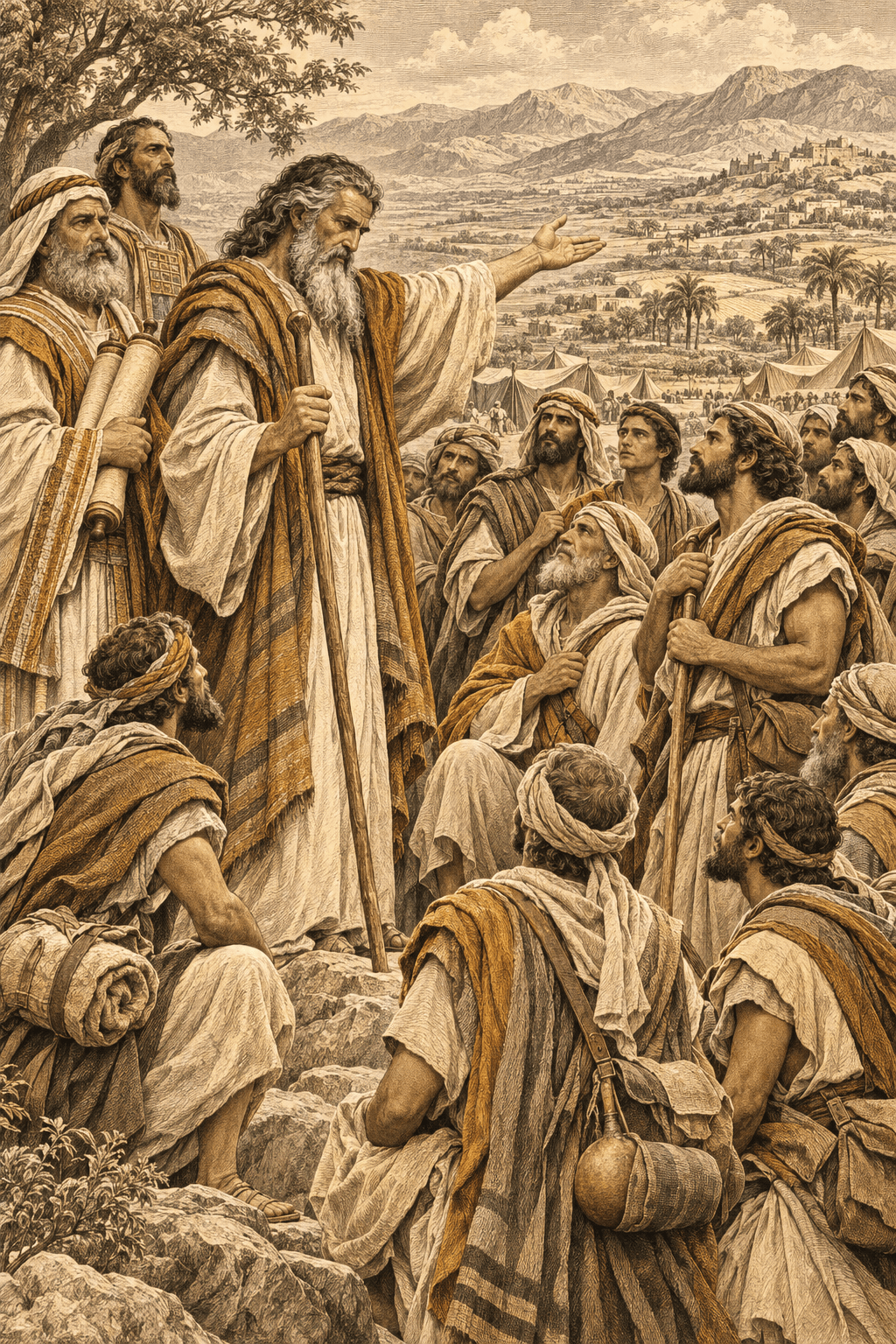
“And the LORD spake unto Moses, saying, Send thou men, that they may search the land of Canaan, which I give unto the children of Israel: of every tribe of their fathers shall ye send a man, every one a ruler among them” (1–2).
Though God commanded Moses to send men to explore the land for themselves, this command came at the request of the people themselves, for Moses the prophet says: “And ye came near unto me every one of you, and said, We will send men before us, and they shall search us out the land, and bring us word again by what way we must go up, and into what cities we shall come. And the saying pleased me well” (Deuteronomy 1:22–23). The people ought to have walked by faith, not by sight; but because of their weakness the Lord answered their request, and Moses carried out the matter as the Lord Himself asked. Saint Gregory of Nyssa noted that this happened after the people had fallen into the temptation of gluttony and the longing for the foods of bondage, flesh, leeks, onions and so on; so God wanted some of their leaders to taste the foods of God’s promises. The saint says:
Moses, with his soul raised above such a lust (for flesh), was wholly devoted to enjoying the inheritance which God promised to those who come out of Egypt (in the spiritual, not the literal sense, that is, those who leave the love of the world) and make their way toward the land flowing with milk and honey. Therefore he appointed some spies to become teachers about the beautiful things of this land. [76]
Moses chose twelve of the princes of the people to taste the fruit of the land, so that they could bear witness to their brethren, offering an earnest of the blessings granted them by God. For teachers ought not to offer philosophies, theoretical beliefs and words without experience, but to offer the people the inner good things of God which they have tasted in fact and in practice.
Among the men were two excellent ones: Oshea, who was called Joshua (8, 16), and Caleb the son of Jephunneh (6). Moses called Oshea Jehoshua, because Oshea means a prayer, “save,” while Jehoshua means “saviour.” It is as though Moses, in choosing Oshea, perceived that the prayer for the accomplishment of salvation had been fulfilled symbolically; so he called him Joshua, that is, “Jesus,” who is the true Saviour. As Saint Jerome says:
He is not called Oshea but Jesus, that is, Saviour. Truly he is a saviour, for he saves us and leads us from the wilderness to the promised land. [77]
And Tertullian says:
Here there is a figure of things to come. For it is Jesus Christ who brings the second people, which consists of us Gentiles, who were for a time wandering in the wilderness of the world, into the promised land flowing with milk and honey (Exodus 3:8), by our receiving eternal life, than which nothing is sweeter. This was not done through the Law, that is, through the legal dispensation, but through Jesus, that is, through the grace of the new law, after we have been circumcised with a knife of rock, that is, the commandments of Christ; for Christ is symbolized by the rock in many places (1 Corinthians 10:4). [78]
Saint Augustine comments on the change of Oshea’s name, saying:
Why did he give him this name when he sent him from the valley of Paran to the land into which he would lead the people? Because the true Jesus… [79]
The name “Caleb” means “heart,” that is, one who does the work with all his heart, in sincerity, without fear, trusting in God’s power offered to us for victory and triumph so that we may enjoy His promises. Origen comments on this, saying:
Jesus speaks of those who follow Him sincerely: “Behold, I give unto you power to tread on serpents and scorpions, and over all the power of the enemy” (Luke 10:19). He wants to work miracles! He wants to overcome the giants with grasshoppers, giving victory over the spiritual hosts of wickedness in high places through the inhabitants of the earth (Ephesians 6:12). [80]
Joshua was joined with Caleb in entering the promised land. If Jesus, the Lord of glory, is our leader in our entry into the promised land, we have no entry into it unless our heart (Caleb) is earnest and sincere in entering. The joining of Joshua with Caleb is the union of God’s free work with the free human will that accepts the work in the inner depths.
2. The Instructions Given to Them
KJV · Verses 17–20
17 And Moses sent them to spy out the land of Canaan, and said unto them, Get you up this way southward, and go up into the mountain: 18 And see the land, what it is, and the people that dwelleth therein, whether they be strong or weak, few or many; 19 And what the land is that they dwell in, whether it be good or bad; and what cities they be that they dwell in, whether in tents, or in strong holds; 20 And what the land is, whether it be fat or lean, whether there be wood therein, or not. And be ye of good courage, and bring of the fruit of the land. Now the time was the time of the firstripe grapes.
We can sum up the instructions given to these men in two words: “Get you up… be ye of good courage” (17, 20).
First: “Get you up this way southward, and go up into the mountain” (17), and from the mountain they would see the land and those who dwell in it. So it befits teachers, in order to bear witness to the truth, to taste it by going up from here in their hearts and rising on the mountain of the divine commandment, so that their souls soar in heavenly places and their inner sight is opened to the new land, its inhabitants and its glories. In this way they experience the earnest of the eternal inheritance and offer their flock of the good things they have seen and experienced themselves. Truly, if the shepherd remains immersed with his flock in earthly concerns and daily demands and does not go up the mountain, how can he draw the hearts of God’s people toward the high places and offer them eternal things?
Perhaps for this reason God did not allow the priests and Levites in the Old Testament to have a portion with their brethren in the land, so that He Himself would be their portion, and they would not be entangled in administration and material things but be occupied with God alone. I say with bitterness: how grievous it is to God when priests become entangled in material things, even those of the Church! They ought to imitate the apostles, who left the serving of tables to the deacons so as to give themselves to prayer and the ministry of the word (Acts 6:1–4).
Second: “And be ye of good courage, and bring of the fruit of the land” (20)… The matter does not stop at going up; the teacher’s heart must be strengthened with power, trusting with hope in the fulfilment of God’s promises, tasting for himself God’s gift to him, and believing in God, who is able to give mankind this gift. Nothing destroys the ministry like the spirit of despair entering the life of teachers, concerning themselves or their flock. We ought to see the strong hand of God, able to lift all mankind toward His holy promises. As Saint John Chrysostom says:
The shepherd must be noble: his resolve must not weaken, nor must he despair of the salvation of those who have strayed from the flock; but let him always reason with himself, saying: “if God peradventure will give them repentance to the acknowledging of the truth; And that they may recover themselves out of the snare of the devil” (2 Timothy 2:25–26). [81]
3. Their Movements
KJV · Verses 21–25
21 So they went up, and searched the land from the wilderness of Zin unto Rehob, as men come to Hamath. 22 And they ascended by the south, and came unto Hebron; where Ahiman, Sheshai, and Talmai, the children of Anak, were. (Now Hebron was built seven years before Zoan in Egypt.) 23 And they came unto the brook of Eshcol, and cut down from thence a branch with one cluster of grapes, and they bare it between two upon a staff; and they brought of the pomegranates, and of the figs. 24 The place was called the brook Eshcol, because of the cluster of grapes which the children of Israel cut down from thence. 25 And they returned from searching of the land after forty days.
The men went up “from the wilderness of Zin unto Rehob, as men come to Hamath” (21); then “they ascended by the south, and came unto Hebron; where Ahiman, Sheshai, and Talmai, the children of Anak, were… And they came unto the brook of Eshcol, and cut down from thence a branch with one cluster of grapes, and they bare it between two upon a staff; and they brought of the pomegranates, and of the figs” (22–23).
The men’s movements were as follows:
A) They went up from the wilderness of Zin, a desert region lying on the southern border of Canaan (Numbers 34:3–4) and of Judah (Joshua 15:1), containing Kadesh and Meribah [82] (Numbers 20:1; 27:14; 33:36; Deuteronomy 32:51), and on the border of Edom to the west. It is either part of the wilderness of Paran or on its border at Kadesh. [83]
We must not confuse the wilderness of Zin, which according to Origen means “bush” or “temptation,” with the wilderness of Sin, which he also takes to mean temptation. Some, however, hold that the latter took its name from the moon god Sin. It is now most likely Debbet er-Ramleh, a heap of sand at the foot of Jebel et-Tih in the south. In this wilderness God sent down the manna to the people for the first time, when they reached it after crossing the Red Sea, from Elim (Exodus 16:1) to Rephidim.
B) Rehob: a Hebrew name meaning “a broad or spacious place.” It is an Aramean city near the northern border of Canaan. There the war took place between David’s men and the Ammonites (2 Samuel 10:8), where it was called “Beth-rehob.” As for the words “as men come to Hamath,” Hamath is the very city now called Hama, about 130 miles north of Damascus and about 30 miles north of Homs. Some hold that “as men come to” means the road leading to Hamath, perhaps the long valley between the western and eastern ranges of Lebanon, through which the road to Hamath runs.
C) Hebron: a Hebrew name meaning “company” or “bond.” It was formerly called “Kirjath-arba” (Genesis 23:2) and belonged to Judah (Joshua 15:13, 54). It was built seven years before Zoan (Tanis) in Egypt, the city in which the negotiations between Moses and Pharaoh took place (Psalm 78:12, 43).
Hebron existed at least in the days of Abraham, for he dwelt near it under the oaks of Mamre for some time (Genesis 13:18; 35:27). There Sarah died, and Abraham bought the cave of Machpelah as a burial place, buying it from the sons of Heth (Genesis 23:2–20). There Isaac and Jacob also sojourned for a time (Genesis 35:27; 37:14). In the days of Joshua the son of Nun its king was Hoham, who allied himself with the kings of Jarmuth, Lachish and Eglon, together with Adoni-zedek king of Jerusalem, against Joshua, who defeated and killed them (Joshua 10). But some of the fugitives returned and rebuilt it, so that some of its inhabitants were found in it after the conquest of Canaan (Joshua 14:12). Caleb claimed it (Judges 1:10, 19–20), and it was given to the priests as one of the cities of refuge (Joshua 20:7; 21:10–13; 1 Chronicles 6:54–57). Hebron was David’s first seat at the beginning of his reign, where he reigned seven years and six months (2 Samuel 2:1–3, 11, 32; 5:1–5). There Abner was buried (2 Samuel 3:32), and there Absalom rebelled against his father (2 Samuel 15:7–10). Rehoboam fortified it (2 Chronicles 11:5, 10). During the exile it fell into the hands of the Edomites, and Judas Maccabeus recovered it (1 Maccabees 5:65). The Romans burned it in AD 68.
Today it is called the city of al-Khalil, after Abraham the Friend of God (James 2:23). It stands 3,040 feet above sea level, 19 miles south-west of Jerusalem and 13.5 miles south-west of Bethlehem. There are 25 springs of water and ten large wells near it, with vineyards and olive trees. [84] In the twelfth century Hebron was the see of a Catholic bishop. [85]
D) Eshcol: means “cluster.” It is not known whether this name is ancient, from before Moses the prophet, or whether it took the name in his time, when the men brought the cluster of grapes from it. It is a valley near Hebron, most likely to its north, and this region is still famous for its vineyards.
The men set out from the wilderness of Zin to Rehob at the entrance of Hamath, then to Hebron, where the three giants, the sons of Anak, were found, and then they went to Eshcol. This is the way of every soul that wants to pass into the kingdom to receive Christ the Lord Himself as a life-giving cluster of grapes. It begins its way from the wilderness of Zin, that is, where temptations and afflictions are, not to live in gloom and murmuring, but to enter Rehob, where temptation is turned into comfort, and the narrow way becomes for the believer broad and joyful. He finds himself at the entrance of Hamath, where he enjoys divine protection, hidden in his Christ, the Rock of Ages. Here he enters Hebron, that is, the life of “company” with God in His only Son, and with his brethren too in Christ Jesus our Lord; and the giant sons of Anak, that is, the evil spirits, cannot hinder him from passing over to Eshcol to carry the cluster of life in his heart!
So no one can pass over to the valley of Eshcol except through temptations mingled with the peace and joy of Christ. He meets the sons of Anak, who resist the kingdom of God, wrestling not against flesh and blood but against spiritual wickedness in high places (Ephesians 6:12).
In Eshcol the two men carried the one cluster on a staff to bring it in to the people, declaring the fulfilment of God’s promises. The two men are Joshua and Caleb; as though the life-giving cross is carried by “Jesus” Christ our Lord, and carried by the believer with a heart (Caleb) full of sincerity. It is the cross of Jesus Christ the Saviour, which the believer carries as fellowship in the sufferings of his Master, so as to enter with Him into the power of His resurrection.
Saint Gregory of Nyssa speaks of this cluster carried on the staff, saying:
Joshua was one of those who led the good mission, who gave a trustworthy report with assurances. Moses looked to him, and in him a firm hope arose toward the things to come, for he saw a proof of the good things of the land through the cluster of grapes which Joshua carried on the staff. Truly, when you hear Joshua telling you about the land and see the cluster hanging on the wood, you understand what he saw and how his hope was established. What is the cluster of grapes hanging on wood but that Cluster which was hung in the last days, who poured out His blood as a drink that gives salvation to believers! Moses spoke to us of Him elsewhere, saying in a figure: “thou didst drink the pure blood of the grape” (Deuteronomy 32:14), meaning by this the saving Passion. [86]
Many Fathers have spoken of this cluster as a symbol of Christ the Lord lifted up on the cross, such as Saints Justin Martyr, [87] Irenaeus, [88] Hippolytus, [89] Clement of Alexandria [90] and Origen. [91]
Saint Augustine says:
The Lord was called a cluster of grapes, He whom those who were sent, the people of Israel, crucified; and they brought Him from the land of promise hanging on a staff, as though crucified. [92]
And Saint Ambrose says:
God gave Himself the title of cluster of grapes by the voice of the prophet, when Moses sent the spies into the valley of grapes at God’s command. What is this valley but the lowliness of the flesh and the fruit of the Passion! I believe He was called a cluster because He came from the vine that was brought out of Egypt, that is, from the Jewish people, and grew as a fruit for the good of the world. [93]
Saint John Chrysostom sees in this cluster an earnest of the heavenly life, for he says:
Let us not despise heaven…! For He has brought us fruits from heaven, not a cluster of grapes carried on a staff, but “the earnest of the Spirit” (2 Corinthians 1:22) and the citizenship of heaven (Philippians 3:20), the things which Paul and the whole company of the apostles, those wonderful husbandmen, taught us. It is not Caleb the son of Jephunneh nor Joshua the son of Nun who brought these fruits, but Jesus, the Son of “the Father of mercies” (2 Corinthians 1:3), the Son of God, who brings every virtue, bringing from heaven all its fruits, that is, its hymns of praise! [94]
4. Their Report
KJV · Verses 26–33
26 And they went and came to Moses, and to Aaron, and to all the congregation of the children of Israel, unto the wilderness of Paran, to Kadesh; and brought back word unto them, and unto all the congregation, and shewed them the fruit of the land. 27 And they told him, and said, We came unto the land whither thou sentest us, and surely it floweth with milk and honey; and this is the fruit of it. 28 Nevertheless the people be strong that dwell in the land, and the cities are walled, and very great: and moreover we saw the children of Anak there. 29 The Amalekites dwell in the land of the south: and the Hittites, and the Jebusites, and the Amorites, dwell in the mountains: and the Canaanites dwell by the sea, and by the coast of Jordan. 30 And Caleb stilled the people before Moses, and said, Let us go up at once, and possess it; for we are well able to overcome it. 31 But the men that went up with him said, We be not able to go up against the people; for they are stronger than we. 32 And they brought up an evil report of the land which they had searched unto the children of Israel, saying, The land, through which we have gone to search it, is a land that eateth up the inhabitants thereof; and all the people that we saw in it are men of a great stature. 33 And there we saw the giants, the sons of Anak, which come of the giants: and we were in our own sight as grasshoppers, and so we were in their sight.
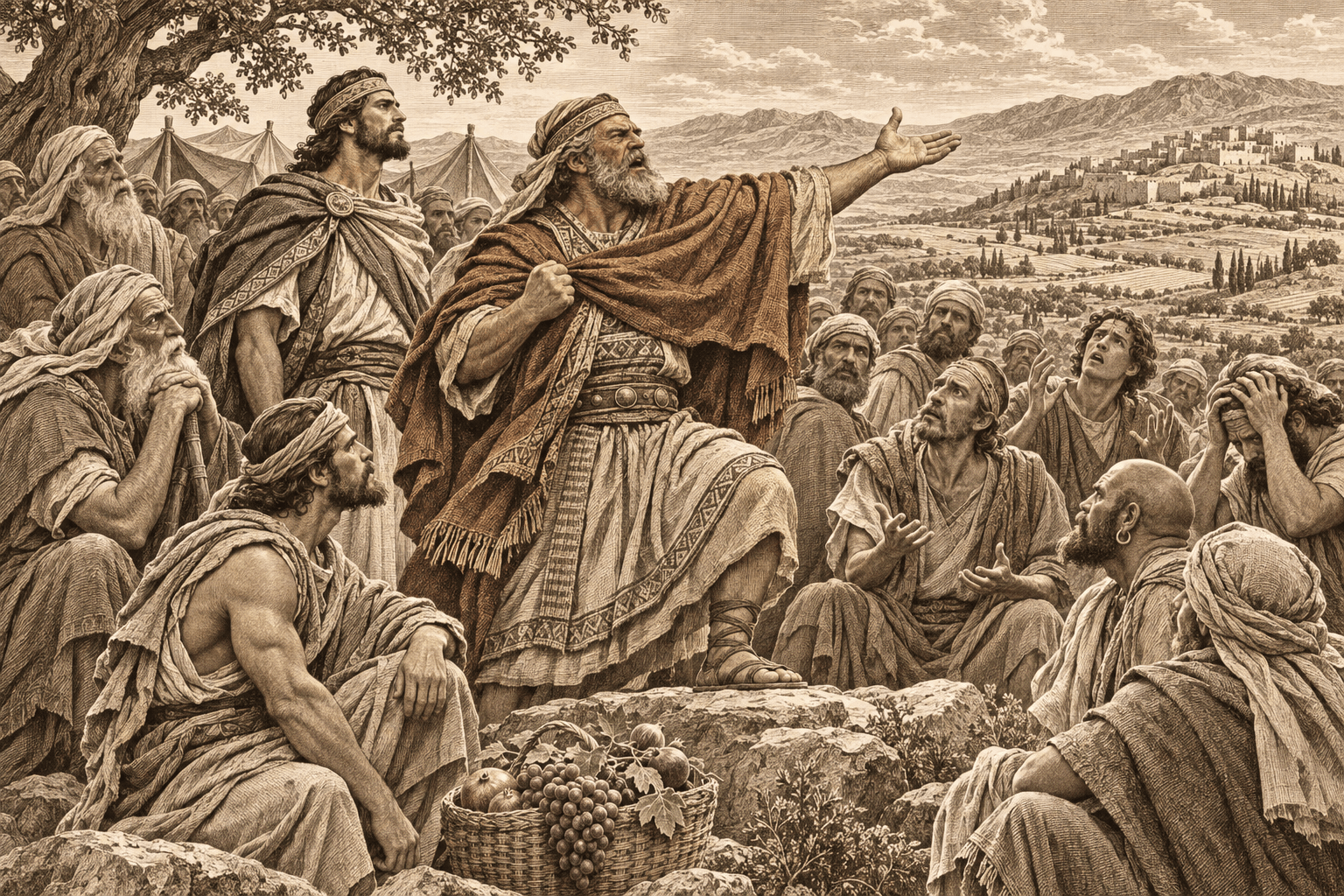
The report presented by the men was divided into two parts. The great majority could not deny the good things they had seen, but they were terrified of the sons of Anak and terrified the congregation with them, so that they lost hope and sank into despair. The report went thus: “We came unto the land whither thou sentest us, and surely it floweth with milk and honey; and this is the fruit of it. Nevertheless the people be strong that dwell in the land, and the cities are walled, and very great: and moreover we saw the children of Anak there… And there we saw the giants, the sons of Anak, which come of the giants: and we were in our own sight as grasshoppers, and so we were in their sight” (27–28, 33). The second part, which included Caleb with Joshua, said: “Let us go up at once, and possess it; for we are well able to overcome it” (30).
Saint Gregory of Nyssa speaks of these two parts, saying:
On the side of those who offer hope in good things are the reasons born of faith and of firm hope in the good things prepared for us. On the other side are the reasons of the adversary, which despise the good hope and oppose faith in what is established. But Moses did not trust the report of the opponents; he accepted the man who gave a report worthy of the (holy) land. [95]
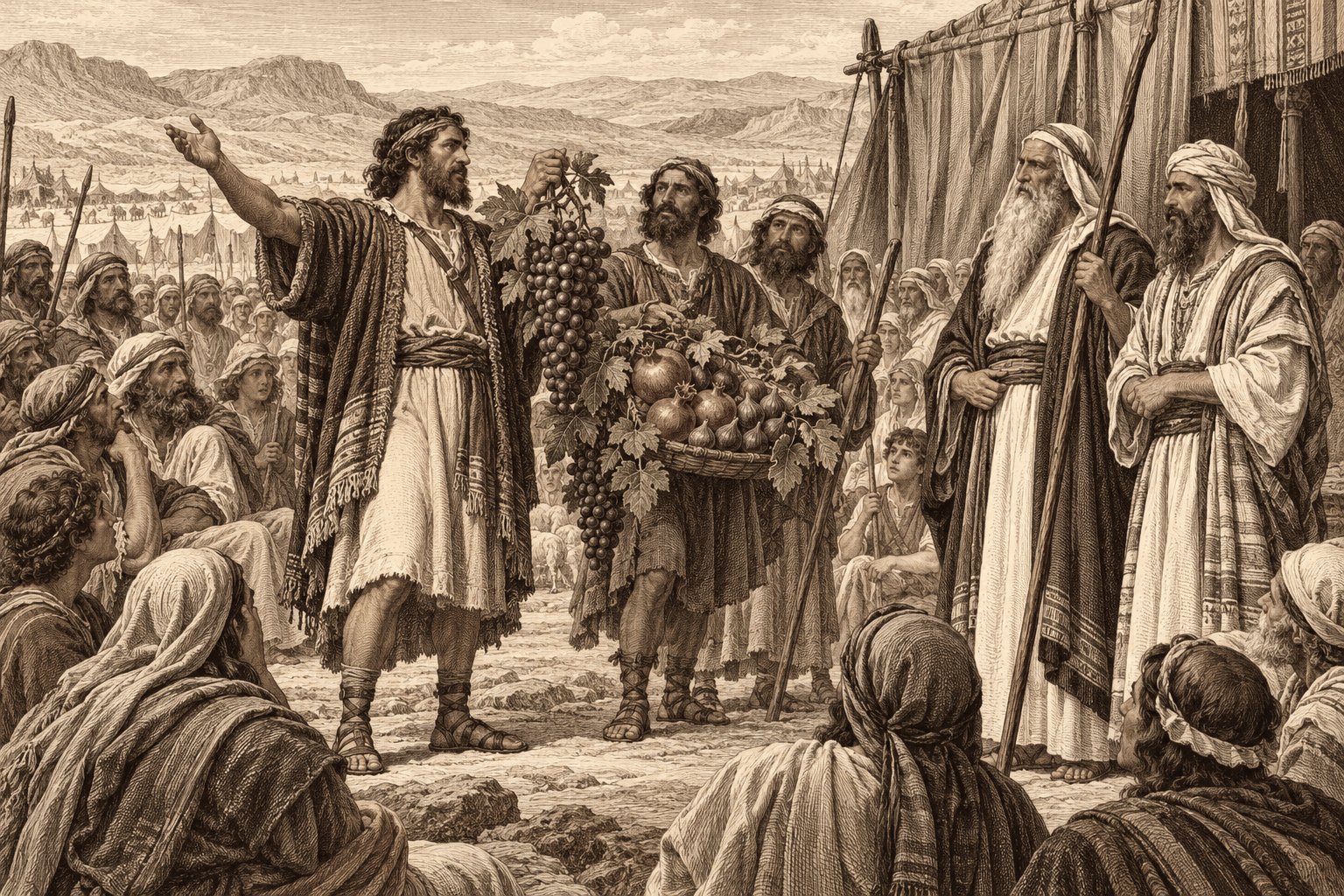
Truly the unbelievers saw themselves as grasshoppers before the giant sons of Anak; but the believers do not look at themselves and their natural human abilities, but at God, who goes before them, and His Spirit dwelling in them, who supports them, giving grasshoppers victory over the giants (the devil and his spiritual hosts). Origen says:
If we compare human nature with that of the devils, we find ourselves as grasshoppers and they as giants, especially if our faith is wavering or weak; then we draw back, and they become giants and we grasshoppers. But if we follow Jesus (Joshua), believe His words and are filled with faith in Him, they become as nothing before us. Truly let us hear what was said: “If the LORD delight in us, then he will bring us into this land” (Numbers 14:8), for it is very good and its fruits are wonderful. [96]
Notes and References
[76] St. Gregory of Nyssa, The Life of Moses 2.265.
[77] St. Jerome, Homilies on the Psalms 10.
[78] Tertullian, An Answer to the Jews 9.
[79] St. Augustine, Reply to Faustus 16.9.
[80] Origen, Homilies on Numbers 6.
[81] The author, Pastoral Love, p. 671.
[82] McKenzie, Dictionary of the Bible, p. 953.
[83] The New Westminster Dictionary of the Bible, p. 1024.
[84] The New Westminster Dictionary of the Bible, p. 375.
[85] Hastings, p. 375.
[86] St. Gregory of Nyssa, The Life of Moses 2.267–268.
[87] St. Justin Martyr, First Apology 32; Dialogue with Trypho 54.
[88] St. Irenaeus, Against Heresies 4.20.2.
[89] St. Hippolytus, On Christ and Antichrist 2.11.
[90] St. Clement of Alexandria, The Instructor 2.2.9.
[91] Origen, Commentary on Jeremiah 8.51.
[92] St. Augustine, On Psalm 7.
[93] St. Ambrose, On the Christian Faith 4.12 (168).
[94] St. John Chrysostom, Homilies on Ephesians 23.
[95] St. Gregory of Nyssa, The Life of Moses 2.266.
[96] Origen, Homilies on Numbers 7.