
When the men presented their reports about the land, its good things and its inhabitants, murmuring and weeping broke out among the people, longing to return once more to bondage under a new leadership other than Moses the prophet.
1. The People Murmur
KJV · Verses 1–4
1 And all the congregation lifted up their voice, and cried; and the people wept that night. 2 And all the children of Israel murmured against Moses and against Aaron: and the whole congregation said unto them, Would God that we had died in the land of Egypt! or would God we had died in this wilderness! 3 And wherefore hath the Lord brought us unto this land, to fall by the sword, that our wives and our children should be a prey? were it not better for us to return into Egypt? 4 And they said one to another, Let us make a captain, and let us return into Egypt.
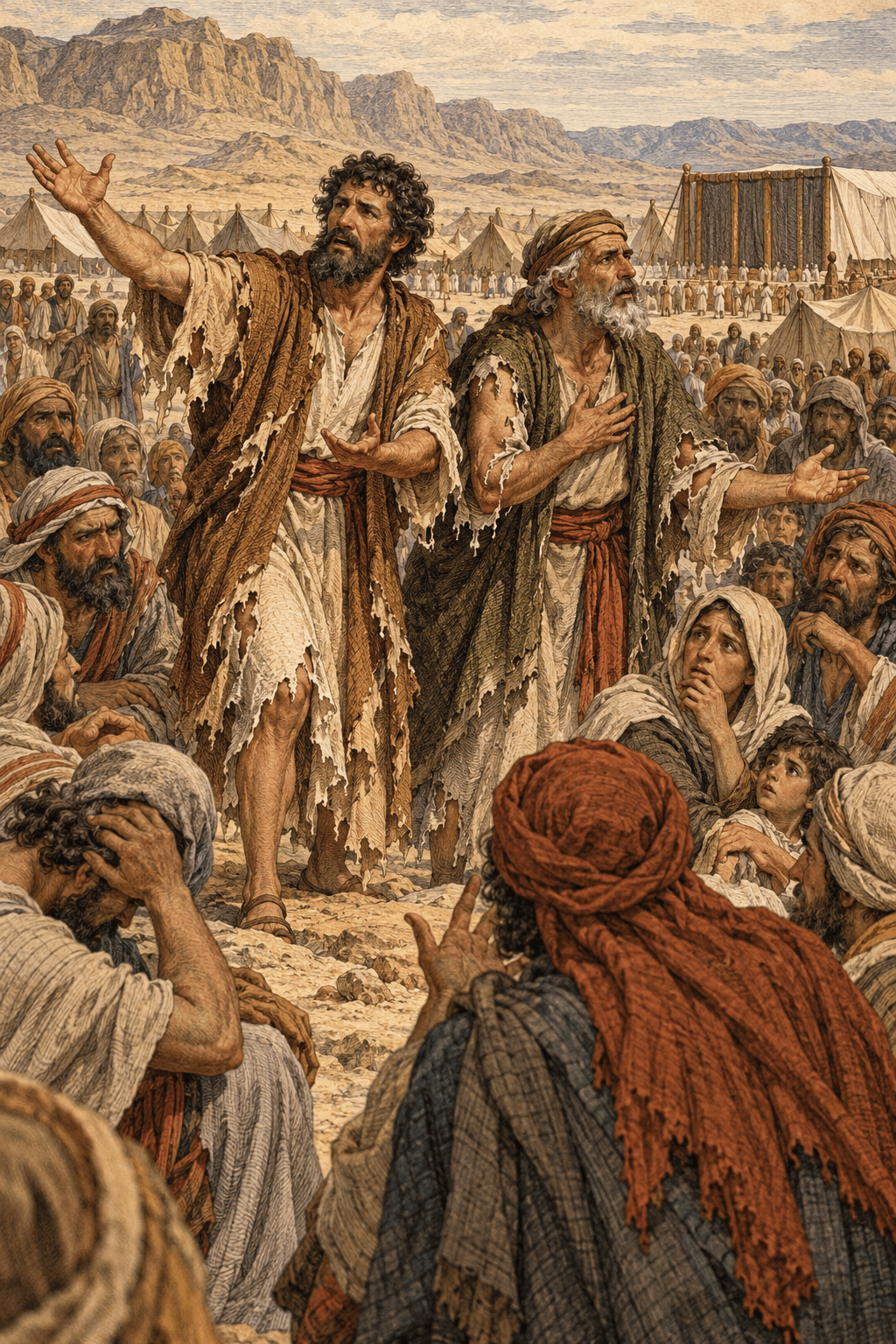
The people paid attention to the report of the evil men, who stirred up in them a spirit of fear, and they did not listen to God’s word and His promises. So their life was filled with anxiety, and they cried and wept all that night, not to ask God’s help and guidance, but murmuring against Moses and Aaron, longing to be rid of them and return once more to bondage. They explained the secret of their anxiety and turmoil by their coming out of the land of bondage, or by the leadership of Moses and Aaron, and did not perceive that what had befallen them came from their unbelief. Therefore Saint John Chrysostom affirms that no one can harm a man unless the man harms himself. [97] The secret of their bitterness lay neither in the circumstances around them nor in the leadership that cared for them, but in the inner sickness of the heart and the soul’s turning aside from the care of its Creator.
How hard is the heart of man! Instead of offering a sacrifice of thanksgiving to God, who freed him from bondage and cared for him in the wilderness of this world to bring him into the new Canaan, he murmurs, saying: “Would God that we had died in the land of Egypt! or would God we had died in this wilderness! And wherefore hath the LORD brought us unto this land, to fall by the sword, that our wives and our children should be a prey? were it not better for us to return into Egypt?” (2–3).
They saw that the remedy for the situation was to do away with the present leadership and set up a leadership according to their desires, for “they said one to another, Let us make a captain, and let us return into Egypt” (4). They wanted to be rid of Moses and Aaron, as also of Joshua and Caleb, by stoning (10), so as to find a leadership that would walk according to their desires.
Saint Ambrose praised the two spies because they preferred to speak the truth, even at the price of being stoned (10), rather than do as the rest of the spies, who pleased the people at the expense of the truth. The saint says:
They preferred to be stoned, as the people threatened them, rather than draw back from their steadfastness full of virtue. [98]
The two good men preferred (divine) glory to safety, while the wicked preferred safety to virtue. [99]
2. The Attempt to Calm Them
KJV · Verses 5–10
5 Then Moses and Aaron fell on their faces before all the assembly of the congregation of the children of Israel. 6 And Joshua the son of Nun, and Caleb the son of Jephunneh, which were of them that searched the land, rent their clothes: 7 And they spake unto all the company of the children of Israel, saying, The land, which we passed through to search it, is an exceeding good land. 8 If the Lord delight in us, then he will bring us into this land, and give it us; a land which floweth with milk and honey. 9 Only rebel not ye against the Lord, neither fear ye the people of the land; for they are bread for us: their defence is departed from them, and the Lord is with us: fear them not. 10 But all the congregation bade stone them with stones. And the glory of the Lord appeared in the tabernacle of the congregation before all the children of Israel.
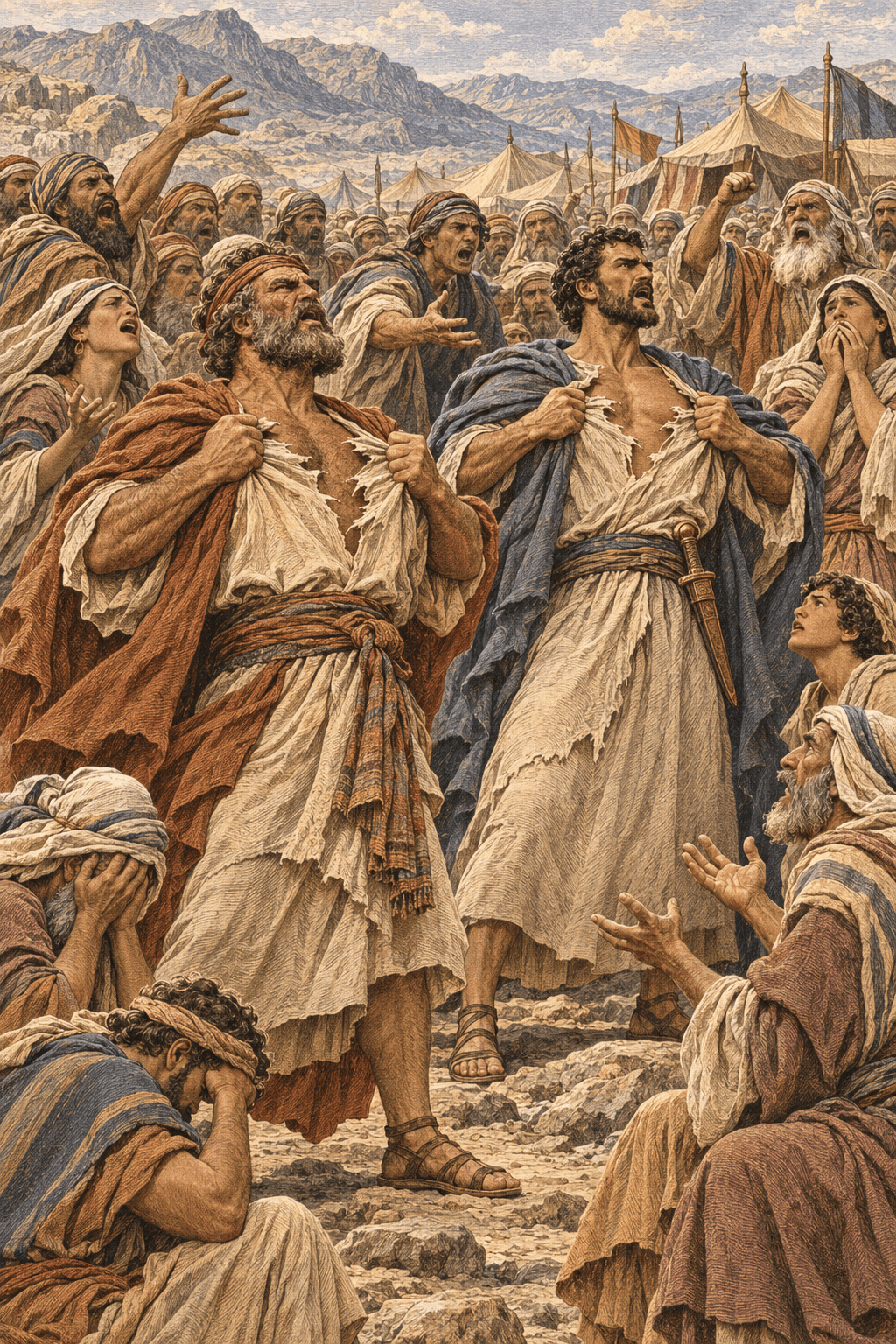
Moses and Aaron had nothing left but to fall on their faces before all the congregation, a sign of their complete inability to deal with them, and to turn away the spirit of anger, not only from the murmuring congregation but also from God, who would surely chastise them because of their continual murmuring. Truly, how beautiful is the spirit of humility! It is the adornment of the shepherd: through it he turns away every murmuring from the life of his people, and by it he intercedes before God for them.
Moses and Aaron mingled their humility with a spirit of wisdom and the power of persuasion, for they put forward Joshua and Caleb, who had tasted the earnest of the promise and seen the land, to bear witness before the congregation. They said: “The land, which we passed through to search it, is an exceeding good land. If the LORD delight in us, then he will bring us into this land, and give it us; a land which floweth with milk and honey. Only rebel not ye against the LORD, neither fear ye the people of the land; for they are bread for us: their defence is departed from them, and the LORD is with us: fear them not” (7–9).
They bore witness that God’s promises are rich and true, given to hearts full of faith, the object of God’s good pleasure; and the enemy of God cannot make us lose them as long as we hasten toward them with hope, without turmoil.
Before this humility and this witness, alas, the people murmured all the more and sought to stone the two faithful witnesses (10). But God declared His support for His faithful men, the prophet, the high priest and the two witnesses, for “the glory of the LORD appeared in the tabernacle of the congregation before all the children of Israel” (10). It was open divine support: when men rejected them, even unanimously, God was with them, supporting them and accompanying them.
3. God’s Threats to Destroy Them
KJV · Verses 11–12
11 And the Lord said unto Moses, How long will this people provoke me? and how long will it be ere they believe me, for all the signs which I have shewed among them? 12 I will smite them with the pestilence, and disinherit them, and will make of thee a greater nation and mightier than they.
As the people went on in their murmuring as usual, God was obliged to threaten, saying to Moses: “How long will this people provoke me? and how long will it be ere they believe me, for all the signs which I have shewed among them? I will smite them with the pestilence, and disinherit them, and will make of thee a greater nation and mightier than they” (11–12).
As was His custom, He did not carry out the chastisement at once, but laid the matter before His prophet Moses. In this He reveals His dealings with man: He wants to befriend him, reveal His secrets to him and speak with him about His actions, especially toward mankind. This is what God did with Abraham when He wanted to punish Sodom and Gomorrah, for He said: “Shall I hide from Abraham that thing which I do?” (Genesis 18:17). In this way God gives us a living understanding of pastoral care. If God, who is all-wise and alone the Good Shepherd, does not hide His plans from His servants, how can any man, however high his priestly rank or spiritual stature, act with an individual mind without sharing with his brethren and partners in the service?
Perhaps God, by laying this matter before Moses, wanted to give him the opportunity to warn the people, so that they might repent and He would forgive them; or perhaps He wanted to give Moses the prophet a new opportunity to intercede for the people who resisted him, so that he would be approved all the more, asking for them more than for himself. He had stood before God before, when God’s anger was kindled against His people, and interceded for them, saying: “Yet now, if thou wilt forgive their sin—; and if not, blot me, I pray thee, out of thy book which thou hast written” (Exodus 32:32). By this love he surpassed, in God’s eyes, all the signs and wonders he had done, and was approved in the eyes of heaven and earth. This was repeated often, so that Moses’ life became like holy incense or a continual prayer for his people. This is what gave him his standing with God, so that God listened to him, saying to him: “I will do this thing also that thou hast spoken: for thou hast found grace in my sight, and I know thee by name” (Exodus 33:17). Moses entreated God, and God changed His judgments. As Origen says:
If God has reasons for displeasure against man, by man’s supplications and entreaties this wrath is calmed, so that man obtains from God a change of the judgments He had already pronounced; for God’s kindness that follows the wrath shows Moses’ standing with God. [100]
Origen sees in God’s threats to the people a prophecy fulfilled by the coming of Christ the Lord and His acceptance of another people from the Gentiles, other than the Jews. He says:
This chastisement did not come from God’s anger; it is a prophecy. For another nation had to be chosen from among the peoples of the Gentiles; but this is not done through Moses… because the (new) people does not bear the name of Moses but the name of Christ. [101]
4. Moses Intercedes for Them
KJV · Verses 13–19
13 And Moses said unto the Lord, Then the Egyptians shall hear it, (for thou broughtest up this people in thy might from among them;) 14 And they will tell it to the inhabitants of this land: for they have heard that thou Lord art among this people, that thou Lord art seen face to face, and that thy cloud standeth over them, and that thou goest before them, by day time in a pillar of a cloud, and in a pillar of fire by night. 15 Now if thou shalt kill all this people as one man, then the nations which have heard the fame of thee will speak, saying, 16 Because the Lord was not able to bring this people into the land which he sware unto them, therefore he hath slain them in the wilderness. 17 And now, I beseech thee, let the power of my lord be great, according as thou hast spoken, saying, 18 The Lord is longsuffering, and of great mercy, forgiving iniquity and transgression, and by no means clearing the guilty, visiting the iniquity of the fathers upon the children unto the third and fourth generation. 19 Pardon, I beseech thee, the iniquity of this people according unto the greatness of thy mercy, and as thou hast forgiven this people, from Egypt even until now.
In this book, as in the Book of Exodus, the figure of Moses stands out as an intercessor for his people before God, for he says: “Pardon, I beseech thee, the iniquity of this people according unto the greatness of thy mercy” (19). It is a symbolic picture of the atoning intercession of Christ the Lord for the sins of mankind before the Father through His precious blood, as He cries on the cross: “Father, forgive them; for they know not what they do” (Luke 23:34).
In his intercession Moses first reminds the Lord of the gloating nations, who would stumble, saying: “Because the LORD was not able to bring this people into the land which he sware unto them, therefore he hath slain them in the wilderness” (16). He also reminds Him of His mercy and long-suffering: “And now, I beseech thee, let the power of my LORD be great, according as thou hast spoken, saying, The LORD is longsuffering, and of great mercy, forgiving iniquity and transgression, and by no means clearing the guilty, visiting the iniquity of the fathers upon the children unto the third and fourth generation. Pardon, I beseech thee, the iniquity of this people according unto the greatness of thy mercy” (17–19).
He reminds Him of His words: that God pardons the fathers, waiting for their repentance; and if they do not repent, He pardons their children too because of His long-suffering; but if the following generations persist in not repenting and walk in the evil way of their fathers, then He chastises. [102] In this way God’s long-suffering toward mankind appears. Saint Jerome has a beautiful comment on this, concerning God’s long-suffering toward man. He sees that God does not punish man at once for a passing thought, nor in the first generation, when the thought is received for a while; but He chastises in the third and fourth generations, when thoughts turn into deeds and into habits. He says:
This means that God does not punish us at once for our thoughts and intentions, but sends chastisement upon their children, that is, upon the evil deeds and habits of sin that spring from them. [103]
5. They Are Denied the Promised Land
KJV · Verses 20–35
20 And the Lord said, I have pardoned according to thy word: 21 But as truly as I live, all the earth shall be filled with the glory of the Lord. 22 Because all those men which have seen my glory, and my miracles, which I did in Egypt and in the wilderness, and have tempted me now these ten times, and have not hearkened to my voice; 23 Surely they shall not see the land which I sware unto their fathers, neither shall any of them that provoked me see it: 24 But my servant Caleb, because he had another spirit with him, and hath followed me fully, him will I bring into the land whereinto he went; and his seed shall possess it. 25 (Now the Amalekites and the Canaanites dwelt in the valley.) Tomorrow turn you, and get you into the wilderness by the way of the Red sea. 26 And the Lord spake unto Moses and unto Aaron, saying, 27 How long shall I bear with this evil congregation, which murmur against me? I have heard the murmurings of the children of Israel, which they murmur against me. 28 Say unto them, As truly as I live, saith the Lord, as ye have spoken in mine ears, so will I do to you: 29 Your carcases shall fall in this wilderness; and all that were numbered of you, according to your whole number, from twenty years old and upward which have murmured against me. 30 Doubtless ye shall not come into the land, concerning which I sware to make you dwell therein, save Caleb the son of Jephunneh, and Joshua the son of Nun. 31 But your little ones, which ye said should be a prey, them will I bring in, and they shall know the land which ye have despised. 32 But as for you, your carcases, they shall fall in this wilderness. 33 And your children shall wander in the wilderness forty years, and bear your whoredoms, until your carcases be wasted in the wilderness. 34 After the number of the days in which ye searched the land, even forty days, each day for a year, shall ye bear your iniquities, even forty years, and ye shall know my breach of promise. 35 I the Lord have said, I will surely do it unto all this evil congregation, that are gathered together against me: in this wilderness they shall be consumed, and there they shall die.
The Lord accepted the intercession of Moses the prophet and did not destroy the people, but He did not allow them to enter the promised land; He gave the promise to their children, saying: “I have pardoned according to thy word: But as truly as I live, all the earth shall be filled with the glory of the LORD. Because all those men which have seen my glory, and my miracles, which I did in Egypt and in the wilderness, and have tempted me now these ten times, and have not hearkened to my voice; Surely they shall not see the land which I sware unto their fathers, neither shall any of them that provoked me see it” (20–23), excepting Joshua and Caleb because of their faith in His promise.
God pardons our sins when we repent, but He chastises, not as wages for sin, for He paid the price in full on the cross, but so that we may taste its bitter fruits and not return to it. None of us could bear the fruit of his sins as it is, for it is eternal death; but because of the abundance of His mercies He leaves some traces to work to trouble us for a while and as far as we can bear, so that we may hate sin and realize that it is exceedingly sinful.
God pardoned, but He chastised: in place of the forty days in which they searched the land, they remained forty years wandering in the wilderness (34), chastised a whole year for each day! One of us may ask: Is there not a kind of harshness in chastising a man a year for a single day? Origen answers this question, saying:
If a man is wounded by a sword in less than an hour, he is exposed to many pains affecting his body and bones and needs a long period of treatment; perhaps complications arise and the wounds leave scars or disabilities. Is not this what happens also with the soul when the sword of sin wounds it, or, as the Apostle says, “the fiery darts of the wicked” (Ephesians 6:16)!
Oh, if only we could see in every sin we commit how a man is wounded, and what pains evil words cause! Have we not read that the wound of the sword is said to be lighter than that of the tongue? So the soul is wounded by the tongue, and by evil thoughts and defiled lusts the soul is broken and crushed by the works of sin. If we could see things as they are and feel the wounds of the soul, we would resist sin unto death. [104]
Origen also comments on this chastisement, saying:
Every sinner must suffer a year of misery for each day of sin. How many years, then, corresponding to the days we live in sin, must we pass through in punishment, we who sin every day, and not a day passes for us without sin? [105]
In any case, since the people accepted “unbelief,” they tasted its bitter fruits: a state of terror, for they said, “We be not able to go up against the people; for they are stronger than we” (Numbers 13:31); a state of loss and deprivation, for they were denied the promised land (30); they fell under chastisement forty years in place of the forty days (34); and they even came under sentence of death, for the Lord said: “in this wilderness they shall be consumed, and there they shall die” (35). The secret of all this is that by sin the Lord departs from them: “because ye are turned away from the LORD, therefore the LORD will not be with you” (43). They lost the Lord, the secret of their strength, their peace, their joy, their reward and even their life.
6. The Death of the Evil Men
KJV · Verses 36–39
36 And the men, which Moses sent to search the land, who returned, and made all the congregation to murmur against him, by bringing up a slander upon the land, 37 Even those men that did bring up the evil report upon the land, died by the plague before the Lord. 38 But Joshua the son of Nun, and Caleb the son of Jephunneh, which were of the men that went to search the land, lived still. 39 And Moses told these sayings unto all the children of Israel: and the people mourned greatly.
Since the people were at the stage of spiritual childhood, believing only what they saw and touched, the Lord allowed the ten men to be struck by the plague, and they died (37), so that all might realize what unbelief does to them.
7. The Chastisement of the People
KJV · Verses 40–45
40 And they rose up early in the morning, and gat them up into the top of the mountain, saying, Lo, we be here, and will go up unto the place which the Lordhath promised: for we have sinned. 41 And Moses said, Wherefore now do ye transgress the commandment of the Lord? but it shall not prosper. 42 Go not up, for the Lord is not among you; that ye be not smitten before your enemies. 43 For the Amalekites and the Canaanites are there before you, and ye shall fall by the sword: because ye are turned away from the Lord, therefore the Lord will not be with you. 44 But they presumed to go up unto the hill top: nevertheless the ark of the covenant of the Lord, and Moses, departed not out of the camp. 45 Then the Amalekites came down, and the Canaanites which dwelt in that hill, and smote them, and discomfited them, even unto Hormah.
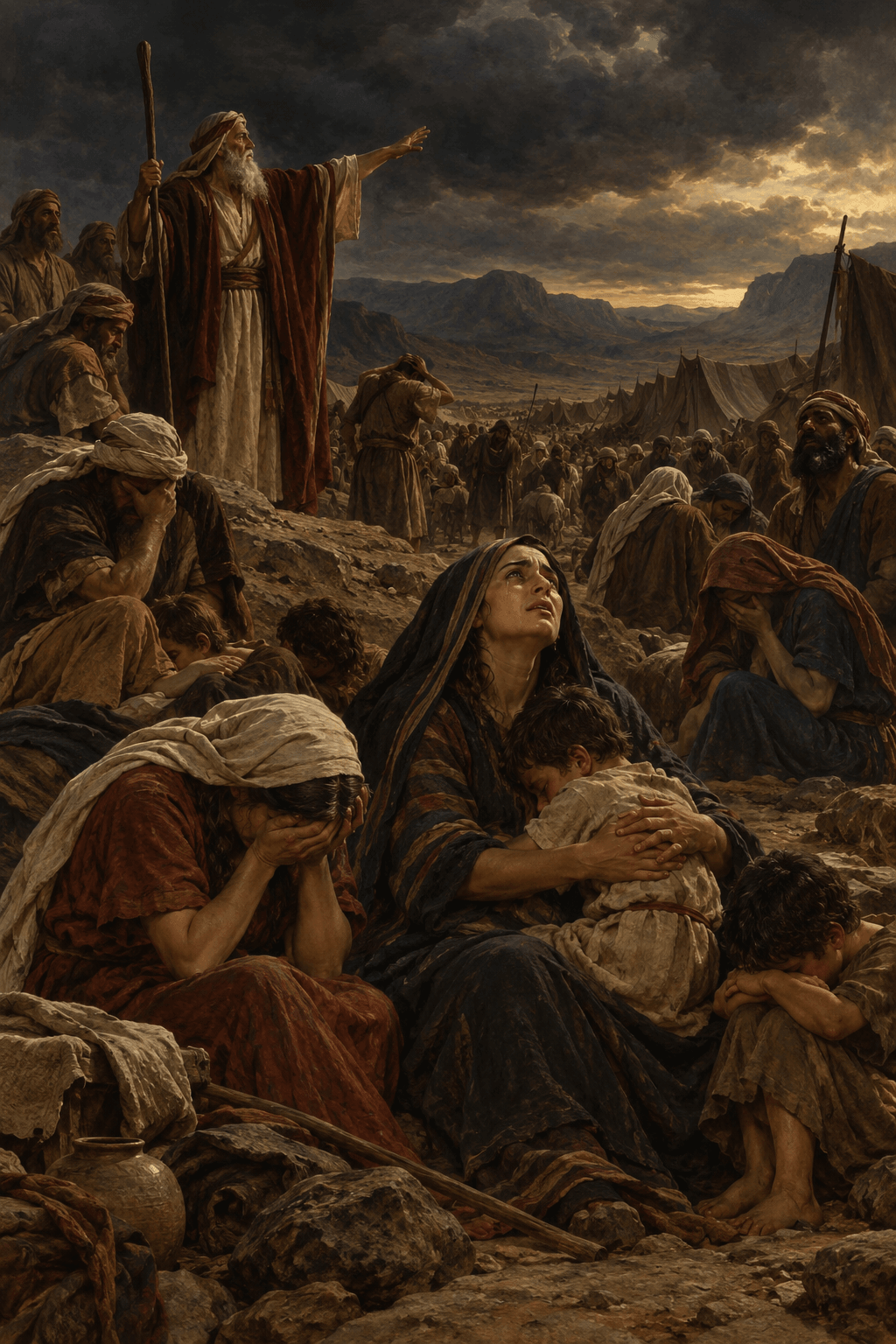
The people regretted their murmuring and wept greatly; but instead of obeying, they insisted on going up to the promised land. Moses the prophet warned them, but they insisted, and the Amalekites and the Canaanites destroyed them.
Truly, how strange man is! When the Lord asks him to go up, he is afraid and trembles in unbelief; and when He warns him not to go up, he goes out of his own accord and perishes!
The Canaanites with the Amalekites smote them even unto Hormah, which means “a holy place” or “a devoted (forbidden) place.” It is a city not far from Kadesh. The Hebrews later took it (Numbers 21:3); it fell to the lot of Judah, but was later transferred to Simeon (Joshua 15:30; 19:4; Judges 1:17). It was dear to David the prophet when he was a fugitive, for he sent to his friends there part of the spoil of Ziklag (1 Samuel 30:26, 30).
Notes and References
[97] I have previously translated this treatise under the title “Who Can Harm You?”
[98] St. Ambrose, On the Duties of the Clergy 3.8 (54).
[99] Ibid. 3.8 (56).
[100] Origen, Homilies on Numbers 8.1.
[101] Ibid.
[102] See the commentary on the Book of Exodus, 1981.
[103] St. Jerome, Epistle 130.9.
[104] Origen, Homilies on Numbers 8.
[105] Ibid.