
Having spoken of the holy feasts and the joyful convocations, He wanted to declare the secret of true inner joy through care for the golden lampstand, to enjoy the light, and the weekly bread, to enjoy fullness. The secret of losing joy is insulting God by blaspheming His name and offending others.
1. The Lampstand and the Pure Oil
KJV · Verses 1–4
1 And the Lord spake unto Moses, saying, 2 Command the children of Israel, that they bring unto thee pure oil olive beaten for the light, to cause the lamps to burn continually. 3 Without the vail of the testimony, in the tabernacle of the congregation, shall Aaron order it from the evening unto the morning before the Lord continually: it shall be a statute for ever in your generations. 4 He shall order the lamps upon the pure candlestick before the Lord continually.
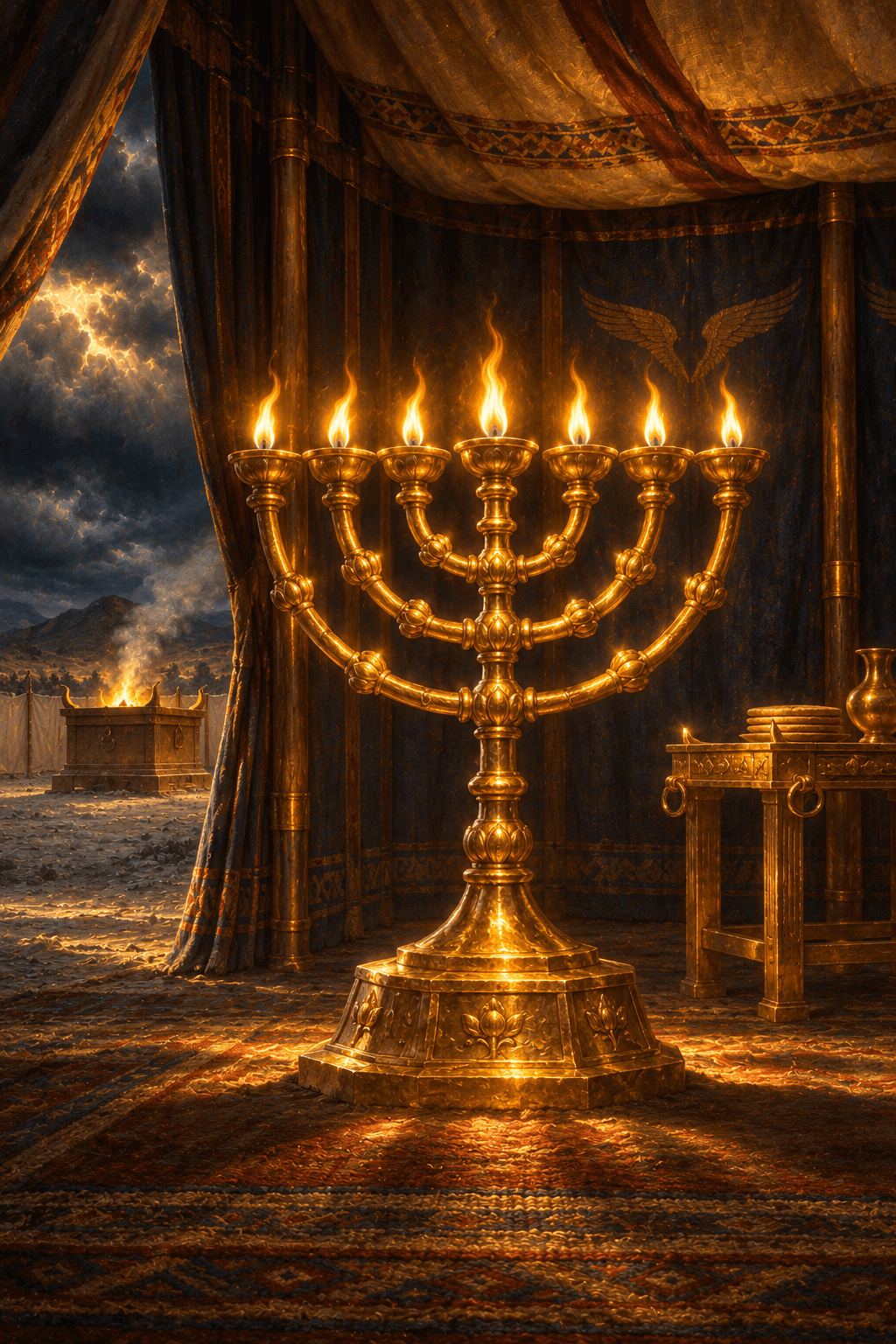
It is not strange that He speaks of the lampstand and the pure oil directly after speaking of the feasts and seasons. If God wants to grant His people unbroken, continual joy, the secret of this joy is His unbroken enlightenment by the oil of the Holy Spirit in it, who prepares the soul like a virgin to receive the Bridegroom (Matthew 25:1–10).
“Command the children of Israel, that they bring unto thee pure oil olive beaten for the light, to cause the lamps to burn continually. Without the vail of the testimony, in the tabernacle of the congregation, shall Aaron order it from the evening unto the morning before the LORD continually: it shall be a statute for ever in your generations. He shall order the lamps upon the pure candlestick before the LORD continually” (2–4).
The Lord commanded the people to offer beaten olive oil, that is, extracted by bruising or pounding in a mortar and straining, and that it be pure. Aaron and his sons were to order the seven lamps of the golden lampstand from evening until morning before the Lord, watching over them so that they would not go out. Historians mention that all the lamps were lit all night, while in the daytime only three of them were lit.
We saw before in our study of the Book of Exodus that the lampstand was not merely for lighting but carried theological and spiritual meanings touching our relationship with the Holy Trinity, the true Light; that the early Church cared for lighting even in the daytime inside the church as a spiritual rite touching the life of the believers; and that the priest blesses the people with the cross joined to lit candles as a sign of God’s work in their inner life. [295]
Saint Methodius comments on the rite of lighting from evening until morning in the holy place:
They were commanded to have a faint light from evening until morning, for their light seems to represent the prophetic word… It had to burn until the day came, for He says “from the evening unto the morning,” that is, until the coming of Christ. For when the Sun of purity and righteousness rises, there is no need of another light. [296]
And Origen says:
Before the coming of our Lord Jesus Christ, the Sun that had not risen on the children of Israel, they used the light of lamps, for they had the words of the Law and the prophetic sayings as a lamp shut in within a narrow wall, whose lights did not shine on the whole earth. For divine knowledge was confined to Judah alone, as the prophet says: “In Judah is God known” (Psalm 76:1). But when the Sun of righteousness rose (Malachi 4:2), our Lord and Saviour, when He was born of whom it is written that “the East is His name” (Zechariah 6:12, Septuagint), the light of divine knowledge spread throughout the whole world. In short, the words of the Law and the prophetic sayings were a shining lamp burning within the holy place, which could not go forth outside to radiate its beauty and splendor.
The words of the Law and the prophets are the lamps; this the Lord Himself taught us concerning John the Baptist (as the representative of the Old Testament with its Law and prophets): “He was a burning and a shining light: and ye were willing for a season to rejoice in his light” (John 5:35)… This lamp was burning, for he is John, in whom the Law and the prophets were fulfilled. As long as the people had oil to offer for the light, the lamp did not go out; but when they sinned and had no oil of mercy, good works, or purity, the lamp went out for lack of pure oil for the light.
But what shall we say of ourselves…? The Christian should care all the more to have oil, for without it, as the Lord says, the virgins are called foolish, because they did not carry oil in their vessels; so their lamps did not shine, and consequently they were deprived of the bridal chamber. And when they knocked at the door, having no oil, the Bridegroom commanded that the door not be opened (Matthew 25). I remember what I said before concerning Psalm 118 (Psalm 119 in the KJV): “Thy word is a lamp unto my feet, and a light unto my path” (Psalm 119:105), explaining as far as possible the difference between the lamp and the light. The lamp is assigned to the foot, being a lower member of the body, while the light is assigned to the paths, which are called elsewhere “the heavenly ways.” According to the mystical interpretation… the lamp of the Law shines for those who are in the world, as the foot of all creation (the men of the Old Testament), while the eternal light is reserved for the paths of the age to come. [297]
Saint Augustine [298] holds that the oil points to “love,” without which the virgins will not enter the wedding nor meet the Bridegroom in His heavenly chamber. And Origen says:
Does it not appear to you that whoever puts out the light of love puts out the lamp?! Whoever loves his brother (1 John 4:21) abides in the light of love and can say with all confidence: “But I am like a green olive tree in the house of God” (Psalm 52:8); “thy children like olive plants round about thy table” (Psalm 128:3). [299]
2. The Table and the Shewbread
KJV · Verses 5–9
5 And thou shalt take fine flour, and bake twelve cakes thereof: two tenth deals shall be in one cake. 6 And thou shalt set them in two rows, six on a row, upon the pure table before the Lord. 7 And thou shalt put pure frankincense upon each row, that it may be on the bread for a memorial, even an offering made by fire unto the Lord. 8 Every sabbath he shall set it in order before the Lord continually, being taken from the children of Israel by an everlasting covenant. 9 And it shall be Aaron's and his sons'; and they shall eat it in the holy place: for it is most holy unto him of the offerings of the Lord made by fire by a perpetual statute.
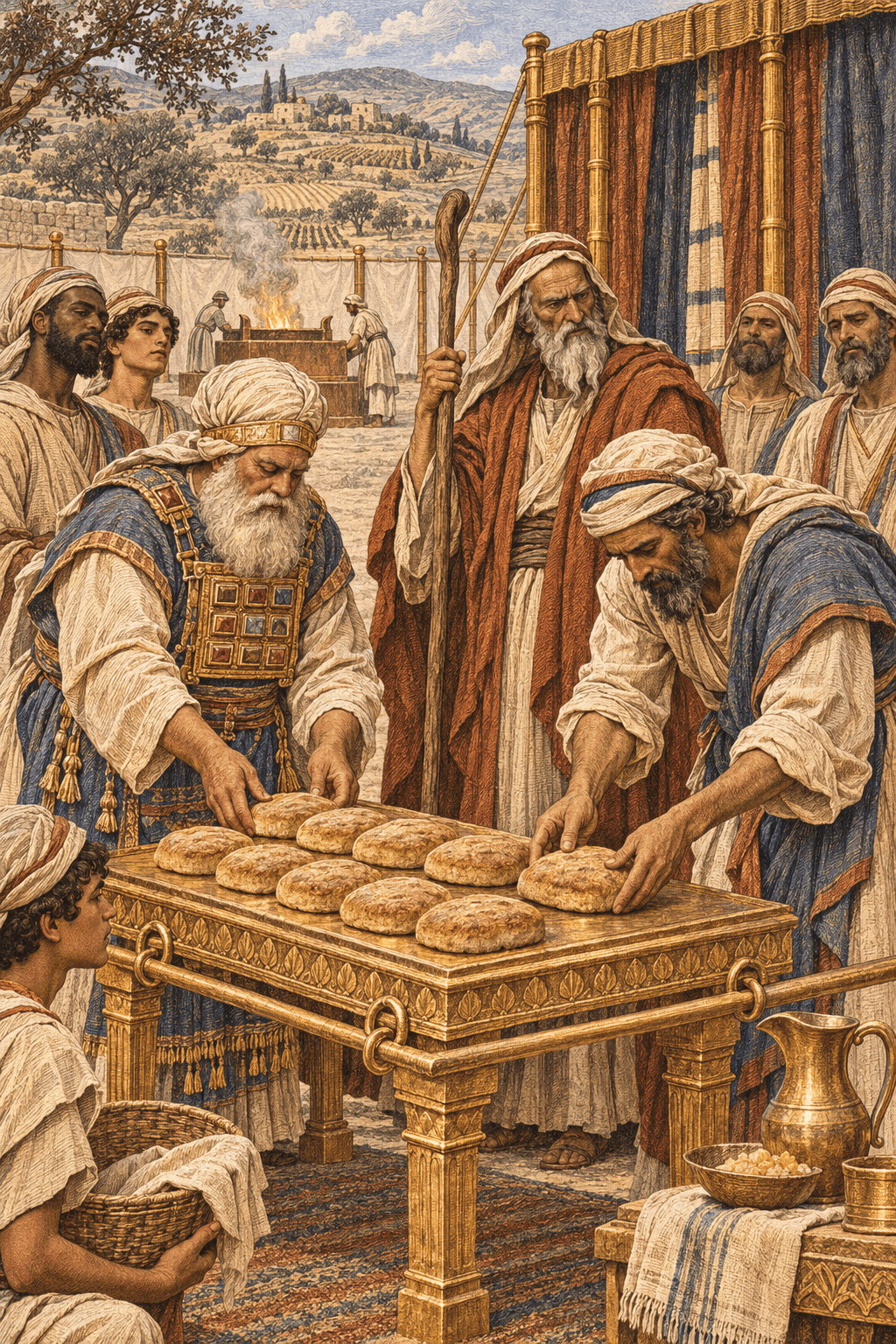
We have already spoken of the table and the rite of the shewbread in our study of the Book of Exodus (chapter 25). [300] Here He affirms: “And thou shalt put pure frankincense upon each row, that it may be on the bread for a memorial, even an offering made by fire unto the LORD” (7). The bread was set in two rows, each row holding six loaves on top of one another, with curved golden plates between the loaves allowing air to pass so that the bread would not spoil; a golden vessel of frankincense was put on each row and burned, so that the Lord would remember their offerings and accept them as a sweet savour.
If the bread points to the holy Church joined to her Head, Christ, the frankincense points to her continual work, which is unceasing prayer and praise.
Origen sees in the holy table a picture of the table which the Lord of glory gives us, the table of the Eucharist:
Let us return to the bread that came down from heaven, which gives life (John 6:33), the bread of propitiation, whom God set forth to be a propitiation through faith in His blood, to declare His righteousness (Romans 3:25). Let us look at this memorial of which the Lord spoke: “this do… in remembrance of me” (1 Corinthians 11:25); for in this memorial the Lord serves people. Let us remember with all exactness the mysteries of the Church, and realize how the laws of the Law bore a prior image of the truth to come (Hebrews 10:1). [301]
This bread is the food of the holy ones, who eat it “in the holy place” (9). It is the food of those who have become a chosen generation and a royal priesthood (1 Peter 2:9); they eat it prepared by the holy life. As Origen says: [302] “The ‘holy place’ here is not a spatial place, but means ‘the pure soul.’”
3. The Blasphemy of the Son of Shelomith
KJV · Verses 10–16
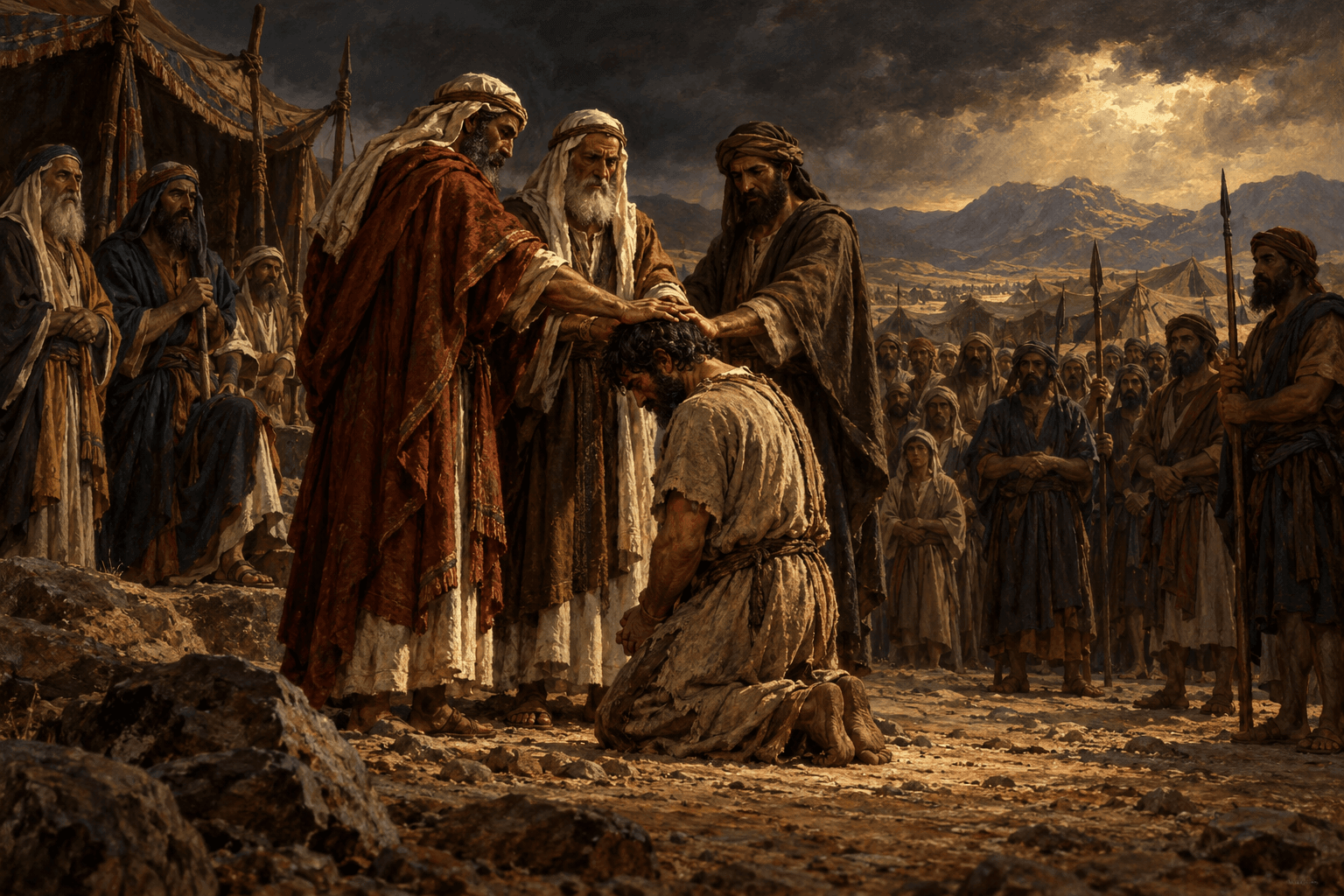
10 And the son of an Israelitish woman, whose father was an Egyptian, went out among the children of Israel: and this son of the Israelitish woman and a man of Israel strove together in the camp; 11 And the Israelitish woman's son blasphemed the name of the Lord, and cursed. And they brought him unto Moses: (and his mother's name was Shelomith, the daughter of Dibri, of the tribe of Dan:) 12 And they put him in ward, that the mind of the Lord might be shewed them. 13 And the Lord spake unto Moses, saying, 14 Bring forth him that hath cursed without the camp; and let all that heard him lay their hands upon his head, and let all the congregation stone him. 15 And thou shalt speak unto the children of Israel, saying, Whosoever curseth his God shall bear his sin. 16 And he that blasphemeth the name of the Lord, he shall surely be put to death, and all the congregation shall certainly stone him: as well the stranger, as he that is born in the land, when he blasphemeth the name of the Lord, shall be put to death.
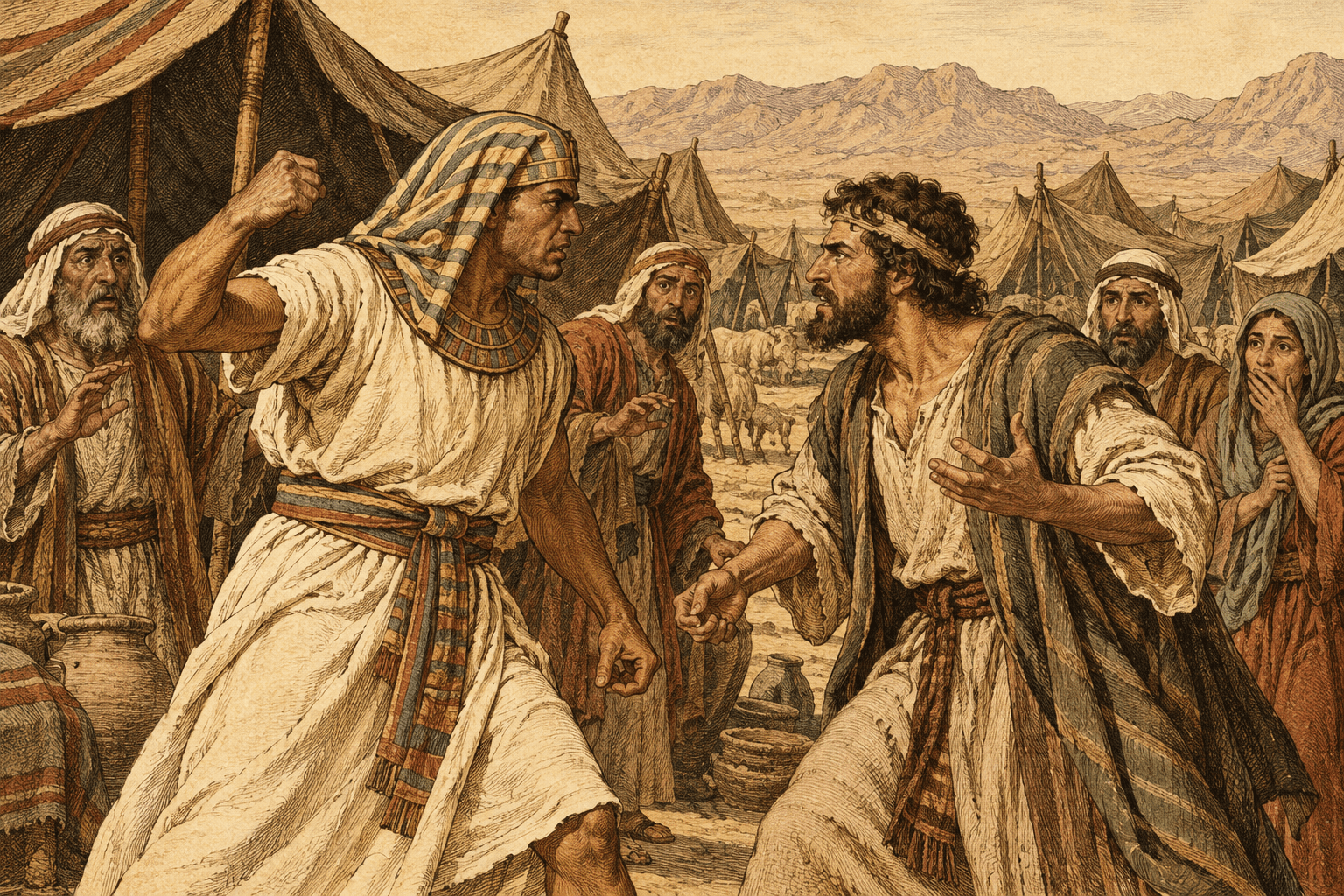
Having revealed the secret of the soul’s joy, by the shining oil of the lampstand, and its fullness, by the holy bread of the table, He tells us of the secret of the soul’s bitterness and its loss of peace, and even of life, through the story of the strife of the son of Shelomith with a man of Israel, in which the former blasphemed God. Moses the prophet did not hasten to judge by himself but took him and sought God’s counsel. The law came declaring that whoever blasphemes God, whether a native Jew or a proselyte, is put to death by stoning outside the camp; and so they did to the son of Shelomith.
Origen [303] gave a symbolic meaning to this story. He saw in the son of Shelomith, of an Egyptian father and a Jewish mother, a reference to the heretics, who attach themselves to the Church as their mother, but through their heresy accept Pharaoh as their father. By their deviation they lose the fatherhood of God while attributing themselves to the Church, to enter into conflict with her children, and they blaspheme God by the corruption of their faith. According to the letter or the appearance they belong to the Church, but they are outside her, and God is not their Father; so the son of Shelomith was taken outside the camp.
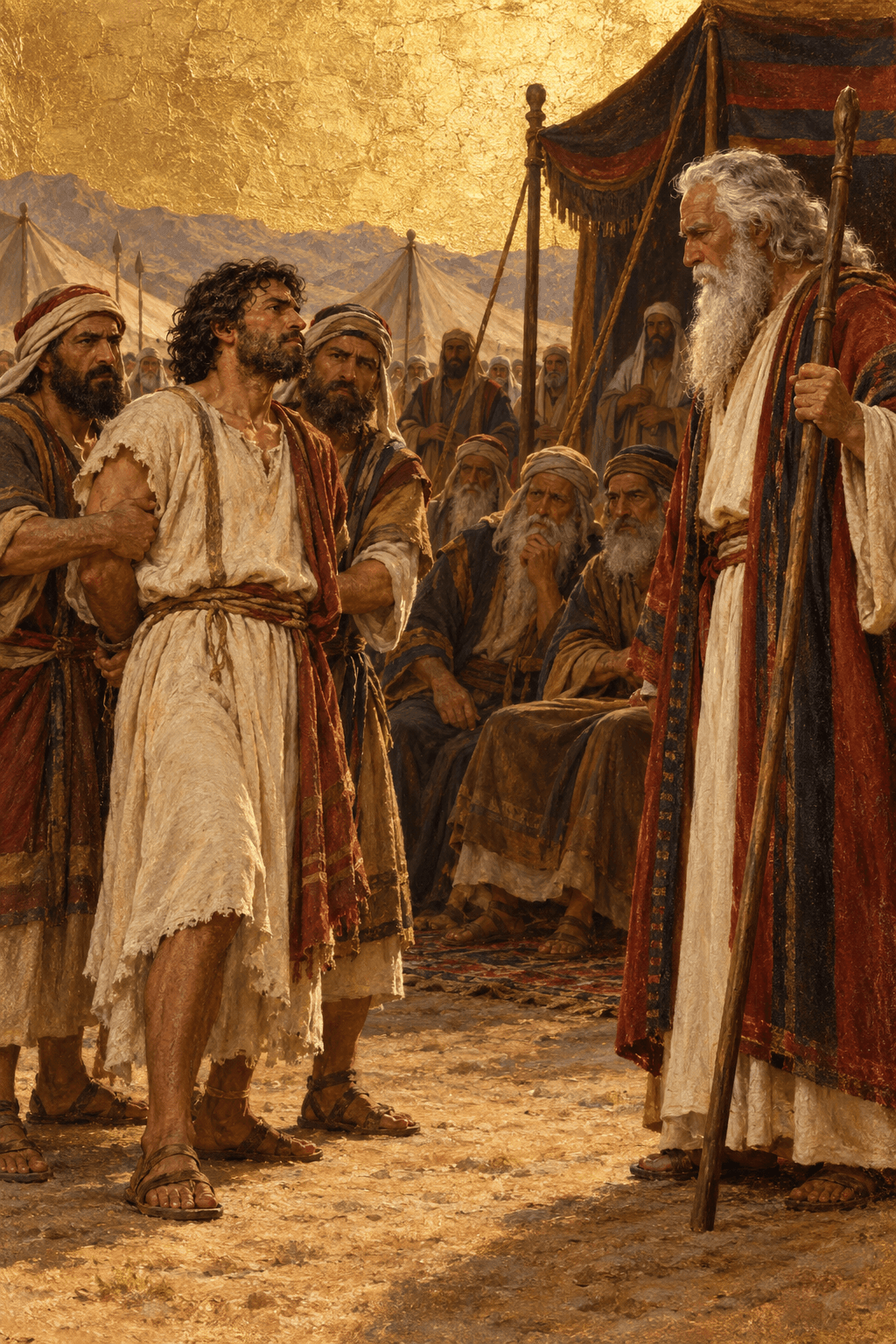
Whoever blasphemes God by his conduct also deprives himself of true membership in the Church: “Whoever goes out of the way of righteousness and of the law of the Lord… goes out of the company of the saints and their ranks.” [304] “Whoever goes out of the truth goes out of the fear of the Lord, faith, and love; in this way he goes out of the camp of the Church, even if no sentence has been issued by the bishop to cast him out… He may be inside her (in body), but in truth he is outside her.” [305]
4. Various Laws
KJV · Verses 17–23
17 And he that killeth any man shall surely be put to death. 18 And he that killeth a beast shall make it good; beast for beast. 19 And if a man cause a blemish in his neighbour; as he hath done, so shall it be done to him; 20 Breach for breach, eye for eye, tooth for tooth: as he hath caused a blemish in a man, so shall it be done to him again. 21 And he that killeth a beast, he shall restore it: and he that killeth a man, he shall be put to death. 22 Ye shall have one manner of law, as well for the stranger, as for one of your own country: for I am the Lord your God. 23 And Moses spake to the children of Israel, that they should bring forth him that had cursed out of the camp, and stone him with stones. And the children of Israel did as the Lord commanded Moses.
The author does not comment on these verses.
Notes and References
[295] Fr. Tadros Yacoub Malaty, The Book of Exodus, 1981, pp. 174–176.
[296] St. Methodius, Banquet of the Ten Virgins 4.
[297] Origen, In Lev. hom. 13:2.
[298] St. Augustine, Sermons on N.T. Lessons 43:1–5.
[299] Origen, In Lev. hom. 13:2.
[300] The Book of Exodus, pp. 173–174.
[301] Origen, In Lev. hom. 13:3.
[302] Ibid. 13:5.
[303] Ibid. 14:1–3.
[304] Ibid. 14:3.
[305] Ibid. 14:3.