
God declared His purpose for man: to bring him into feasts and continual holy convocations, so that man may receive God Himself as his feast, the fountain of his joy and his liberty. In the previous chapter He spoke to us of joy and fullness; now He speaks to us of inner liberty through some laws touching the poor, the slaves, the fields and the houses.
1. The Law of the Seventh Year
KJV · Verses 1–7
1 And the Lord spake unto Moses in mount Sinai, saying, 2 Speak unto the children of Israel, and say unto them, When ye come into the land which I give you, then shall the land keep a sabbath unto the Lord. 3 Six years thou shalt sow thy field, and six years thou shalt prune thy vineyard, and gather in the fruit thereof; 4 But in the seventh year shall be a sabbath of rest unto the land, a sabbath for the Lord: thou shalt neither sow thy field, nor prune thy vineyard. 5 That which groweth of its own accord of thy harvest thou shalt not reap, neither gather the grapes of thy vine undressed: for it is a year of rest unto the land. 6 And the sabbath of the land shall be meat for you; for thee, and for thy servant, and for thy maid, and for thy hired servant, and for thy stranger that sojourneth with thee. 7 And for thy cattle, and for the beast that are in thy land, shall all the increase thereof be meat.

God cared that we keep the Sabbath so as to sanctify all the rest of the days of the week; with the same thought He cared that we keep the sabbath of years, that is, the sabbatical or seventh year. In this year it was not permitted to sow the land or reap it, nor even to harvest the fruit trees; but cultivation was allowed within the limits of paying tribute or taxes, and also for what belonged to the offerings, such as the sheaf of the wave offering, the two wave loaves and the shewbread. Ploughing the land and preparing it for sowing were also permitted, as were hunting, trade, beekeeping, and so on.
The purpose of the sabbatical year was as follows:
First, on the agricultural side: the Jews and their fathers had no experience in this field. In Egypt they lived as shepherds, and they saw the Egyptians sow the land every year, and sometimes more than once a year, because of the fertility of the soil and the silt of the Nile flood. The land of Palestine, however, needs to be left from time to time to recover its strength and not be exhausted.
Second, on the human and social side: the sabbatical year is the year of common sharing. The poor man and the stranger could, without shame, enter any field and gather what remained from the previous years, and pick from the fruit trees whatever he wished… It is as though in the seventh year the land became common to all, each picking what he wanted without storing it up or turning it into other products such as wine, and this applied even to the owner of the land. Nor did this sharing stop at human beings; even the animals, the wild ones included, were left to enjoy their share of the produce of the land without hindrance.
On the other hand, this year was a rest for everyone: not only for the man and his family, but also for the slaves, the hired servant, the stranger, and even the animals.
Some see this year as a year of release, in which slaves were freed from bondage… though others hold that the freeing took place in the seventh year from the purchase of the slave, and not necessarily in the general sabbatical year.
Third, on the spiritual side: it is a year of rest from daily work in order to be occupied with spiritual work. In this year portions of the Law were read at the Feast of Tabernacles (Deuteronomy 31:10–13), to be a kind of provision for the whole year… The reading was done with a beautiful rite: the ruler of the synagogue handed the Torah to the high priest, and he in turn handed it to the king, who stood and read the Law to the people with reverence. After the reading the high priest gave the blessing to the people, praying for the Law, the service, confession and the forgiveness of sins, and for Jerusalem, the temple, the people and the holy priesthood.
The sabbatical year was also a practical lesson in faith: that God blesses their resources and satisfies them, and that the secret of blessing lies not in much work but in God’s good pleasure…
2. The Law of the Year of Jubilee
KJV · Verses 8–22
8 And thou shalt number seven sabbaths of years unto thee, seven times seven years; and the space of the seven sabbaths of years shall be unto thee forty and nine years. 9 Then shalt thou cause the trumpet of the jubile to sound on the tenth day of the seventh month, in the day of atonement shall ye make the trumpet sound throughout all your land. 10 And ye shall hallow the fiftieth year, and proclaim liberty throughout all the land unto all the inhabitants thereof: it shall be a jubile unto you; and ye shall return every man unto his possession, and ye shall return every man unto his family. 11 A jubile shall that fiftieth year be unto you: ye shall not sow, neither reap that which groweth of itself in it, nor gather the grapes in it of thy vine undressed. 12 For it is the jubile; it shall be holy unto you: ye shall eat the increase thereof out of the field. 13 In the year of this jubile ye shall return every man unto his possession. 14 And if thou sell ought unto thy neighbour, or buyest ought of thy neighbour's hand, ye shall not oppress one another: 15 According to the number of years after the jubile thou shalt buy of thy neighbour, and according unto the number of years of the fruits he shall sell unto thee: 16 According to the multitude of years thou shalt increase the price thereof, and according to the fewness of years thou shalt diminish the price of it: for according to the number of the years of the fruits doth he sell unto thee. 17 Ye shall not therefore oppress one another; but thou shalt fear thy God:for I am the Lord your God. 18 Wherefore ye shall do my statutes, and keep my judgments, and do them; and ye shall dwell in the land in safety. 19 And the land shall yield her fruit, and ye shall eat your fill, and dwell therein in safety. 20 And if ye shall say, What shall we eat the seventh year? behold, we shall not sow, nor gather in our increase: 21 Then I will command my blessing upon you in the sixth year, and it shall bring forth fruit for three years. 22 And ye shall sow the eighth year, and eat yet of old fruit until the ninth year; until her fruits come in ye shall eat of the old store.
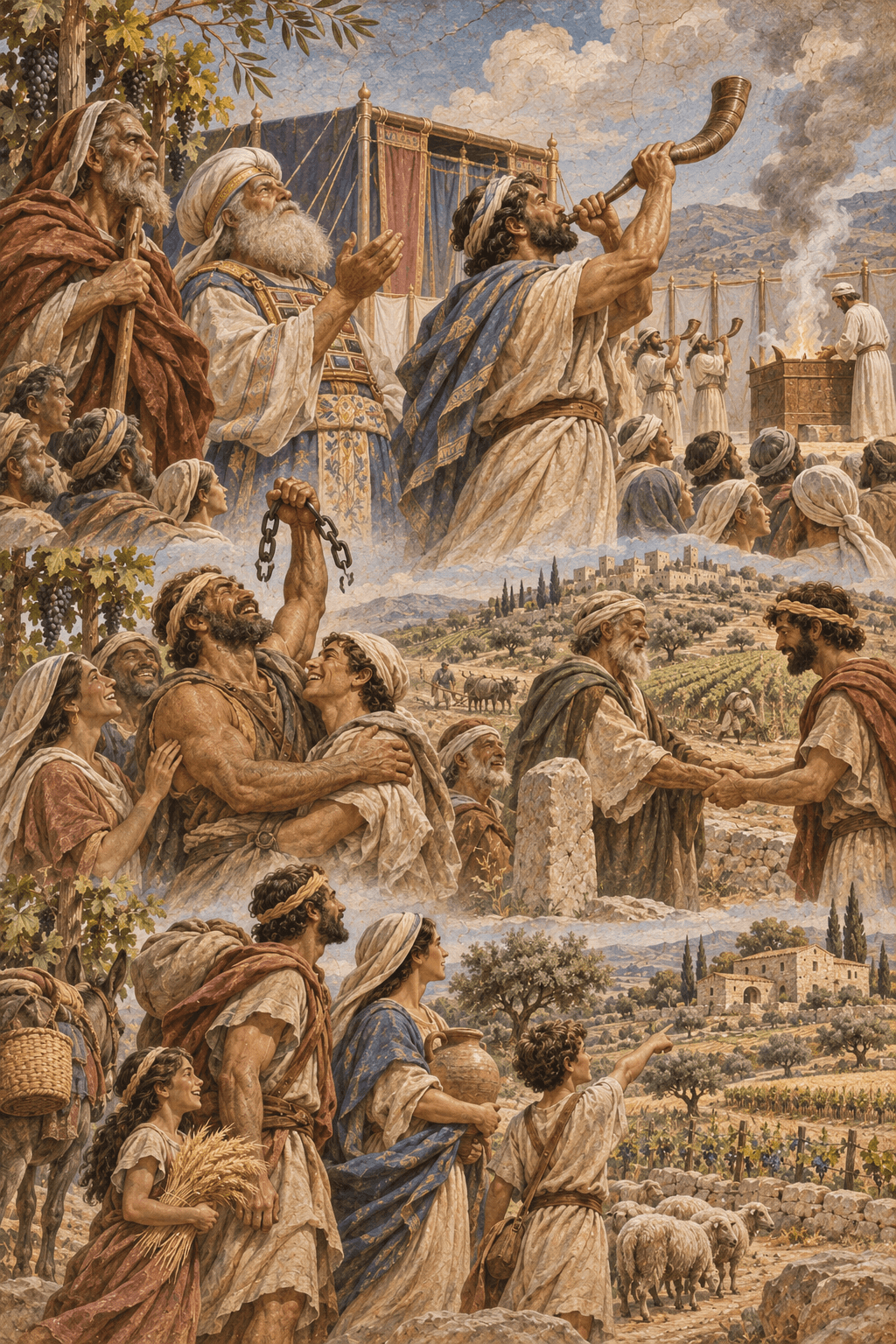
As man sanctifies the seventh day so that the Lord may bless all the days of the week, the seventh month so that He may bless all the months, and the seventh year so that He may bless the other six years, so he also sanctifies the fiftieth year, which comes as a sabbath for every unit of seven years: it is the sabbath of the weeks of years. For this reason this feast, the “Jubilee,” is the completion of the sabbatical order which the Lord set up for His people.
The word “Jubilee” comes from a word meaning “horn”, [306] for the year was proclaimed by blowing the trumpet on the tenth day of the seventh month, beginning with the Day of Atonement.
This feast was called “the year of liberty” (Ezekiel 46:17), for in it the slaves were set free, the lands that had been sold or mortgaged returned to their owners, and creditors released their debtors… Therefore this feast, which recurred every fifty years, was among the most wonderful and joyful feasts in the hearts of the people.
The rite of this feast was as follows:
First: “And ye shall hallow the fiftieth year, and proclaim liberty throughout all the land unto all the inhabitants thereof: it shall be a jubile unto you; and ye shall return every man unto his possession, and ye shall return every man unto his family” (10). This is the most prominent part of the rite: the release of the land and its liberation. Every man recovers his land, and every family recovers its possessions of village houses or fields, whether they had been sold or mortgaged. Its purpose was the following:
A) That all may feel that they are strangers (23). If someone has grown rich and has been able with his money to take another’s portion in pledge or buy it, he leaves it in the Jubilee year by his own will, before all leave everything against their will. Perhaps the Jubilee year bears a shadow of eternal life, where there is neither rich nor poor, but all rejoice in receiving their portion, without coveting what belongs to another.
B) To affirm that the land belongs to the Lord (23). He gave it to us to make use of, but not at the expense of our poor brethren. So we return their portion to them, not as a gift from us, for it is not truly ours but the Lord’s.
C) That every tribe, every family and every household may keep its portion in the land that was given to them by the hand of Moses the prophet and Joshua the son of Nun.
Second: He set before them an important principle for their dealings: “And if thou sell ought unto thy neighbour, or buyest ought of thy neighbour’s hand, ye shall not oppress one another” (14). No one should exploit the Jubilee by selling his land before the appointed time at its full price, only to recover it in the fiftieth year; rather, the price of the sale is to be reckoned according to the time remaining until the Jubilee, so that no one wrongs another. At the same time, the buyer should not exploit the seller’s need by offering a paltry price; let him value the price according to the benefit he will receive during the period remaining until the Jubilee. Let our dealings rest not on gaining the most from others, but on the fear of the Lord, for He says: “Ye shall not therefore oppress one another; but thou shalt fear thy God: for I am the LORD your God” (17). It is as though every wrong done to our brethren were an insult to the Lord Himself, who defends the oppressed and the wronged.
Third: the Jubilee year, like the sabbatical year, is a year of rest, for it is said: “ye shall not sow, neither reap that which groweth of itself in it, nor gather the grapes in it of thy vine undressed” (11). This conduct rests on faith, that God provides for them by His blessing more than they gain by their own work, for He says: “Then I will command my blessing upon you in the sixth year, and it shall bring forth fruit for three years” (21). He assured them that the harvest of the sixth year would be threefold, enough for them through the seventh and the eighth years until its harvest came at the beginning of the ninth…
Though God asks us to work, in our work we lean on the blessing of the Lord Himself, the Giver of good things.
3. The Laws of the Sale of Lands
KJV · Verses 23–28
23 The land shall not be sold for ever: for the land is mine, for ye are strangers and sojourners with me. 24 And in all the land of your possession ye shall grant a redemption for the land. 25 If thy brother be waxen poor, and hath sold away some of his possession, and if any of his kin come to redeem it, then shall he redeem that which his brother sold. 26 And if the man have none to redeem it, and himself be able to redeem it; 27 Then let him count the years of the sale thereof, and restore the overplus unto the man to whom he sold it; that he may return unto his possession. 28 But if he be not able to restore it to him, then that which is sold shall remain in the hand of him that hath bought it until the year of jubile: and in the jubile it shall go out, and he shall return unto his possession.
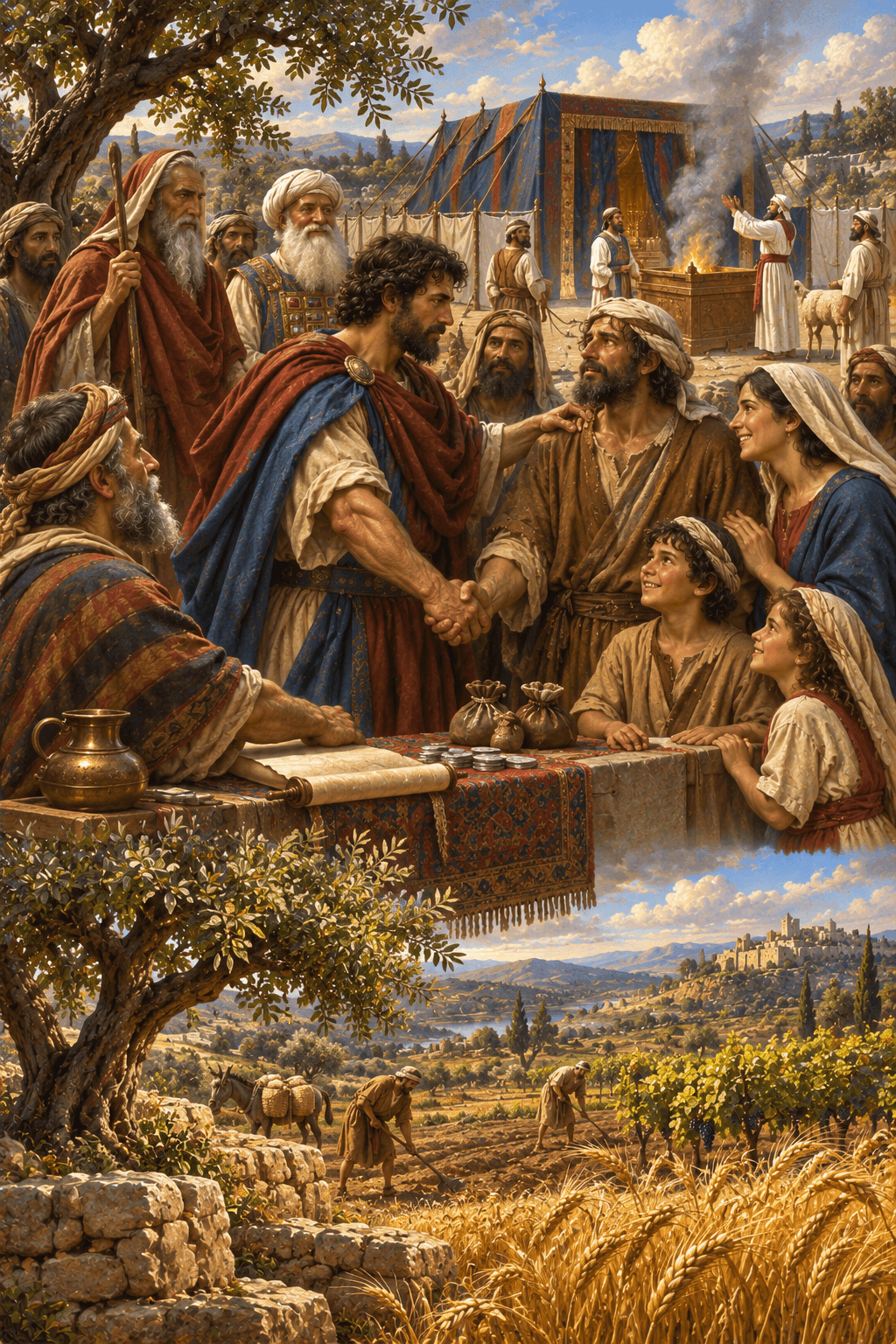
When Moses and Joshua divided the lands for the tribes to possess, every tribe, every family and every household was bound, as far as it could, to keep its land as a sign that the heart is attached not to the promised land but to the new land, that is, eternal life, the heavenly Canaan. This appeared powerfully in the story of Naboth the Jezreelite, who exposed his life to death rather than give up the vineyard of his fathers, despite the king’s enticements.
If someone was forced to sell his land, he or his kinsman could redeem the land (25), as Boaz did when he redeemed the land of Elimelech and married Ruth, the wife of his son, to raise up a son for the dead and so that the son might enjoy the inheritance of his grandfather.
A man or his kinsman could redeem the land at any time by paying the price, which decreased with the passing of the years because of the buyer’s use of the land… If neither the man nor the kinsman could pay, the Jubilee came and the land returned to its owner for nothing.
We lost our eternal inheritance because of sin, in exchange for an earthly or bodily lust, as Esau sold his birthright for a meal of lentils. Neither we nor our first kinsman, the Law, could pay, and we lost everything until the year of Jubilee came, the fiftieth year, when the Lord sent His Holy Spirit at the feast of Pentecost, on the fiftieth day. Then we gained the right to recover our spiritual land, after Christ the Lord paid His blood as the price of redemption.
In our earlier study [307] we saw that the number 50 points to “liberty,” which we receive through the Holy Spirit, who lifts up our souls, our hearts, our thoughts and all our senses, as on the two wings of a dove, so that we may rise toward heavenly things, freed from the bonds of the world, its enticements and its snares! Let all our days be a continual Jubilee, in which we enjoy the fiery Holy Spirit burning within us without ceasing, He who rested in us in the sacrament of the Holy Myron (Chrismation), and who grants us liberty in Christ Jesus, establishing us in Him, not so that we may have a land for an inheritance, but so that we may have a place in the bosom of the Father.
What is this land, or this field, that was sold and then redeemed, if not the Church of God, which the leaders of the Jews sold for the sake of their honour and their temporal fullness? But in the fullness of time Christ the Lord came, the true Kinsman, who redeemed her, offering His blood as the price of the Church (Revelation 5:9).
4. The Laws of the Sale of Houses
KJV · Verses 29–34
29 And if a man sell a dwelling house in a walled city, then he may redeem it within a whole year after it is sold; within a full year may he redeem it. 30 And if it be not redeemed within the space of a full year, then the house that is in the walled city shall be established for ever to him that bought it throughout his generations: it shall not go out in the jubile. 31 But the houses of the villages which have no wall round about them shall be counted as the fields of the country: they may be redeemed, and they shall go out in the jubile. 32 Notwithstanding the cities of the Levites, and the houses of the cities of their possession, may the Levites redeem at any time. 33 And if a man purchase of the Levites, then the house that was sold, and the city of his possession, shall go out in the year of jubile: for the houses of the cities of the Levites are their possession among the children of Israel. 34 But the field of the suburbs of their cities may not be sold; for it is their perpetual possession.
Divine revelation presents to us laws concerning the selling or mortgaging of houses and how to redeem them from pledge, offering us through the letter deep spiritual meanings that touch the inner liberty of our souls. The Law distinguished four cases:
A) Houses in walled cities (29–30).
B) Houses in villages (31).
C) The houses of the Levites in their cities (32–33).
D) The fields of the Levites (34).
First: Houses in Walled Cities
If a man sold his house in a (walled) city, he could redeem the house within a year of its sale: he, his kinsman, or his heir if he had died. In this way the seller who had passed through a hard circumstance was given the opportunity to return and settle with his family in his home. If the house was not redeemed within a year of the sale, the buyer took possession of it and did not return it even in the Jubilee, because the seller, his kinsman and his heirs had let the opportunity slip, and the buyer must be given his right to settle. The reason the houses inside the cities were not returned in the Jubilee is that houses were not given to the people by lot as the lands were; they built them with their own hands as they wished.
Second: Houses in Villages
As for houses built in unwalled cities, that is, in villages, they could be redeemed within a year like the former. If the seller, his kinsman or his heirs could not redeem it, the house remained until the year of Jubilee, when it was returned to the seller, or to his family if he had died. Perhaps the wisdom in this is that these houses were in fact attachments to farmland or pastureland and could not be separated from it; so, in order that every tribe might keep its land with its attachments, the lands were returned together with the farm buildings.
Third: The Houses of the Levites in Their Cities
Divine revelation affirms: “Notwithstanding the cities of the Levites, and the houses of the cities of their possession, may the Levites redeem at any time” (32). So if a Levite was forced to sell his plot of dwelling land or his house, he could redeem it at any time whatever; he did not lose his right of redemption even if a year had passed since the sale. And if one of his brethren the Levites redeemed it, the house remained in his hand until the year of Jubilee, when he returned it to its original owner (33).
Fourth: The Fields of the Levites
The cities of the Levites were surrounded by suburbs a thousand cubits wide from the border of the city on each of the four sides, and the suburbs were surrounded by fields two thousand cubits wide on each side. The suburbs were set apart for the folds of the Levites’ cattle and flocks, while the fields they cultivated, not for farming for sale or trade. The Levites were not permitted to sell anything of their suburbs or their fields, for they were their perpetual possession.
The Spiritual Meaning of the Sale and Redemption of Houses
The Apostle Paul comments on the law that cares even for the ox, that it be not muzzled while it treads out the corn so that it may eat of what it treads (Deuteronomy 25:4), saying: “Doth God take care for oxen? Or saith he it altogether for our sakes? For our sakes, no doubt, this is written: that he that ploweth should plow in hope; and that he that thresheth in hope should be partaker of his hope” (1 Corinthians 9:9–10). In the same spirit we say: Does God care for houses and fields? Or were these written for our sakes, since we are God’s holy house and His field?
Origen says:
Let us hasten to apply the laws of houses to ourselves. For when we follow the law of Christ we are not permitted to own land or houses in a city. What then does this law concerning houses mean? If we are not permitted to have more than one coat (Mark 6:9), nor to gather much money, for it is written: “And having food and raiment let us be therewith content” (1 Timothy 6:8)… then let us consider the laws concerning houses in walled cities or in villages without walls.
In other places in Holy Scripture the word of God uses the expression “house” in a hidden sense. It is said in praise of Jacob: “Jacob was a plain man, dwelling in tents” (Genesis 25:27); and on the other hand it is written of the midwives: “And it came to pass, because the midwives feared God, that he made them houses” (Exodus 1:21), as though the making of houses for them was because of their fear of God… What then is this house? What is this building which the Apostle Paul sets forth more clearly when he says: “For we know that if our earthly house of this tabernacle were dissolved, we have a building of God, an house not made with hands, eternal in the heavens” (2 Corinthians 5:1)? This is the house which no one can build unless he has the fear of the Lord. This is the house which no one can raise up or dwell in unless he bears simplicity of spirit and purity of heart. But it usually happens that one who raises up a heavenly house by his good works, his good conduct and the uprightness of his faith falls into sin, and becomes like one who has transferred his works to another… “and himself be able to redeem it” (26). With what price? Without doubt it is the abundant tears of repentance and the practice of good works. In this year, which may be understood as the year Christ proclaimed, “an acceptable time” (Isaiah 49:8; 2 Corinthians 6:2), forgiveness and the enjoyment of salvation are granted to those who confess their sins. [308]
What is meant by the houses in walled cities? Perhaps they signify those who say with the Apostle Paul: “For our conversation is in heaven” (Philippians 3:20). As we know, the heavenly Jerusalem is surrounded by a wall (Revelation 21:14). Whoever has attained the heavenly life and tasted the earnest of eternal glory, let him beware lest he sell his house through sin, especially sin that touches his faith, and so lose it… And if he falls, let him hasten, lest the year of his life pass and he lose his house forever, beyond recovery!
As for the owner of a house in a village without walls, Origen sees in him those who walk in simplicity of heart and are exposed to continual passing faults… They need continual, unceasing repentance so as not to lose their eternal inheritance.
Concerning the houses or fields of the priests and the Levites, Origen [309] says that the priest represents the soul consecrated to the Lord, and the Levite represents the one who stands before the Lord without ceasing and in the service of His will. The priest represents the perfection of faith and understanding, and the Levite the perfection of works. Such holy souls, through a living and working faith, if they fall into any fault, enjoy forgiveness and redemption: their inner houses are always redeemed and their fields are not touched. If their houses are taken from them, this is only for a time; they may be redeemed at any time and return to them. As Origen says:
The possession of the saints and their houses is never lost and is never taken from them. For how can the house which is built “upon the foundation of the apostles and prophets, Jesus Christ himself being the chief corner stone” (Ephesians 2:20) be taken from the priests?… But if he sells the house to a base buyer, that is, to the devil… God forbid! He redeems himself quickly and covers himself while there is still time for covering and room for repentance. Let us ask earnestly that we may not fail to enjoy the eternal dwelling, that we may be worthy to be received into the everlasting habitations (Luke 16:9), in Christ Jesus, to whom be all glory and honour forever. Amen. [310]
5. The Laws of Loans to Brethren
KJV · Verses 35–38
35 And if thy brother be waxen poor, and fallen in decay with thee; then thou shalt relieve him: yea, though he be a stranger, or a sojourner; that he may live with thee. 36 Take thou no usury of him, or increase: but fear thy God; that thy brother may live with thee. 37 Thou shalt not give him thy money upon usury, nor lend him thy victuals for increase. 38 I am the Lord your God, which brought you forth out of the land of Egypt, to give you the land of Canaan, and to be your God.
As God cared for our inner liberty, expressing it through the laws of the sabbatical year (1–7) and the laws of the Jubilee (8–22), especially the release of lands and houses (23–34), so He desires that we bear His features and long for the liberty of others. If a man is in debt and “fallen in decay,” unable to pay the debt and its interest (35), whether this brother is a Jew, a stranger or a proselyte, he must be treated with kindness, and no usury or interest may be asked of him.
Thus the Law of Moses forbids usury, that is, interest, and also increase, a kind of usury taken in the form of crops or gifts rather than cash… This prohibition rests on the fact that the loan was given to a man in need. The matter is no doubt different if the loan was given to a rich man who uses it to add profits to his profits; therefore the Scripture makes clear that the debtor has “fallen in decay with thee” (35).
6. The Law of the Hebrew Slave
KJV · Verses 39–43
39 And if thy brother that dwelleth by thee be waxen poor, and be sold unto thee; thou shalt not compel him to serve as a bondservant: 40 But as an hired servant, and as a sojourner, he shall be with thee, and shall serve thee unto the year of jubile. 41 And then shall he depart from thee, both he and his children with him, and shall return unto his own family, and unto the possession of his fathers shall he return. 42 For they are my servants, which I brought forth out of the land of Egypt: they shall not be sold as bondmen. 43 Thou shalt not rule over him with rigour; but shalt fear thy God.
We have already spoken at length of the law of the Hebrew slave and his release after six years. If he refused, he had his ear bored with an awl at the door and remained a slave by his own will until the year of Jubilee. We saw that this slave points to Christ the Lord, who, being Lord of all, became a servant and declared His acceptance, not by the boring of His ear but by His wounds, that He might set us free in Him and we might enjoy sonship to God. [311]
7. The Law of the Foreign Slave
KJV · Verses 44–46
44 Both thy bondmen, and thy bondmaids, which thou shalt have, shall be of the heathen that are round about you; of them shall ye buy bondmen and bondmaids. 45 Moreover of the children of the strangers that do sojourn among you, of them shall ye buy, and of their families that are with you, which they begat in your land: and they shall be your possession. 46 And ye shall take them as an inheritance for your children after you, to inherit them for a possession; they shall be your bondmen for ever: but over your brethren the children of Israel, ye shall not rule one over another with rigour.
If God showed kindness to His people and asked the brethren to free their brethren from slavery as far as they could, why did He allow them to enslave the foreign peoples?
First: God did not command slavery, but allowed it within certain limits and under special circumstances, namely as a chastisement of those fallen into evil, so that they might realize their bitter slavery to sin and their inner humiliation to the enemy of good. Therefore it was said: “Cursed be Canaan; a servant of servants shall he be unto his brethren” (Genesis 9:25).
Second: this concept bears the meaning of spiritual authority. The believer bears an authority that brings his body into subjection, with all its powers and abilities, as though he hears this divine promise: “And he that overcometh, and keepeth my works unto the end, to him will I give power over the nations” (Revelation 2:26). If the falling of the nations under slavery reveals their slavery to sin, the lordship of the believer in the Old Testament pointed to his spiritual authority, not over others but over himself.
8. The Law of the Hebrew Enslaved to a Foreigner
KJV · Verses 47–55
47 And if a sojourner or stranger wax rich by thee, and thy brother that dwelleth by him wax poor, and sell himself unto the stranger or sojourner by thee, or to the stock of the stranger's family: 48 After that he is sold he may be redeemed again; one of his brethren may redeem him: 49 Either his uncle, or his uncle's son, may redeem him, or any that is nigh of kin unto him of his family may redeem him; or if he be able, he may redeem himself. 50 And he shall reckon with him that bought him from the year that he was sold to him unto the year of jubile: and the price of his sale shall be according unto the number of years, according to the time of an hired servant shall it be with him. 51 If there be yet many years behind, according unto them he shall give again the price of his redemption out of the money that he was bought for. 52 And if there remain but few years unto the year of jubile, then he shall count with him, and according unto his years shall he give him again the price of his redemption. 53 And as a yearly hired servant shall he be with him: and the other shall not rule with rigour over him in thy sight. 54 And if he be not redeemed in these years, then he shall go out in the year of jubile, both he, and his children with him. 55 For unto me the children of Israel are servants; they are my servants whom I brought forth out of the land of Egypt: I am the Lord your God.
If a stranger grew rich and bought a Hebrew who had become poor, it was fitting for his uncle, his uncle’s son or one of his kin to redeem him from slavery and set him free; and if the man himself was able to redeem himself, let him do so. The wonderful thing in this commandment is that it requires the one who redeems his Hebrew brother not to wrong the foreigner, but to pay him what is due, the amount of the price according to the service remaining as a slave until the year of Jubilee.
He urged them to redeem their brethren and rescue them from humiliation, but without wronging the strangers!
Notes and References
[306] McKenzie, Dictionary of the Bible, p. 460.
[307] See Fr. Tadros Yacoub Malaty, The Book of Exodus, p. 182.
[308] Origen, Homilies on Leviticus 15.2.
[309] Ibid. 15.3.
[310] Ibid.
[311] Fr. Tadros Yacoub Malaty, The Book of Exodus, commentary on chapter 21.