
The aim of this book is the enjoyment of holy life with the Holy God. This chapter comes as a kind of conclusion to the book. It reveals the blessings that come upon the man who accepts God’s work in obedience to His commandments, and it declares the curses that come upon the one who rejects the commandment and does not accept the holy life. These curses are the natural fruit of sin and disobedience.
1. The Worship of the Holy God
KJV · Verses 1–2
1 Ye shall make you no idols nor graven image, neither rear you up a standing image, neither shall ye set up any image of stone in your land, to bow down unto it: for I am the Lord your God. 2 Ye shall keep my sabbaths, and reverence my sanctuary: I am the Lord.
Since He asks them to be bound to Him, He asked them not to set up a graven image of stone or a standing image of wood, nor to carve a stone in order to bow down to it in worship as the heathen do.
The sign of their bond with Him is this: “Ye shall keep my sabbaths, and reverence my sanctuary: I am the LORD” (2)… This commandment, with its two branches, keeping the Sabbath, that is, sanctifying it to the Lord, and behaving with reverence in the Lord’s sanctuary or house, is the sign of our love for God and our bond with Him. Keeping the Sabbath means sanctifying time for the Lord, and reverencing the sanctuary means sanctifying place. It is as though the believer sanctifies all the time of his life and every place, so as to be consecrated to the Lord without ceasing. We keep the Sabbath so that God may lift us by His Holy Spirit to what is above time, that is, carry us into His eternity; and we reverence His sanctuary so that we may enjoy His heavenly sanctuaries. In this way we live for the Lord forever, on a heavenly level.
2. The Blessings of Obedience to the Holy God
KJV · Verses 3–13
3 If ye walk in my statutes, and keep my commandments, and do them; 4 Then I will give you rain in due season, and the land shall yield her increase, and the trees of the field shall yield their fruit. 5 And your threshing shall reach unto the vintage, and the vintage shall reach unto the sowing time: and ye shall eat your bread to the full, and dwell in your land safely. 6 And I will give peace in the land, and ye shall lie down, and none shall make you afraid: and I will rid evil beasts out of the land, neither shall the sword go through your land. 7 And ye shall chase your enemies, and they shall fall before you by the sword. 8 And five of you shall chase an hundred, and an hundred of you shall put ten thousand to flight: and your enemies shall fall before you by the sword. 9 For I will have respect unto you, and make you fruitful, and multiply you, and establish my covenant with you. 10 And ye shall eat old store, and bring forth the old because of the new. 11 And I set my tabernacle among you: and my soul shall not abhor you. 12 And I will walk among you, and will be your God, and ye shall be my people. 13 I am the Lord your God, which brought you forth out of the land of Egypt, that ye should not be their bondmen; and I have broken the bands of your yoke, and made you go upright.

Having called us to worship Him alone, declaring our acceptance of His kingdom by sanctifying His Sabbath forever and by our reverence for His heavenly sanctuary, He reveals to us the blessings of this meeting with God, especially through obedience to His commandment and the keeping of His commandments, responding to the Holy One by submitting to His holy constitution:
First: the enjoyment of rain in its season: “If ye walk in my statutes, and keep my commandments, and do them; Then I will give you rain in due season” (3–4).
Rain in its literal sense is God’s gift to all, for God sends rain on the just and on the unjust (Matthew 5:45); it is not a special reward for those who keep His commandments alone. In its spiritual sense, however, it belongs to the messianic age. In our study of many of the books of the prophets we saw that rain is one of the basic features of this age, for it is the gift of the Holy Spirit, poured out abundantly upon the Church on the day of Pentecost, so that the believers may live abiding in Christ by the Holy Spirit, who rains upon them to turn their barren heart into a fruitful paradise and a heavenly garden that gladdens the heart of the Bridegroom.
Origen sees in the rain a sign of the enjoyment of the divine words, understood spiritually, which refresh our souls. He says:
Search the Holy Scriptures: what rain is given to the saints alone…? It is written in Deuteronomy: “Give ear, O ye heavens, and I will speak; and hear, O earth, the words of my mouth. My doctrine shall drop as the rain, my speech shall distil as the dew” (Deuteronomy 32:1–2). Is this saying my own? Did not Moses proclaim this rain…? Besides what is said in the prophets, that God opens His mouth and sends down His words like water on the face of the earth (Ezekiel 34:26), the Apostle Paul says: “For the earth which drinketh in the rain that cometh oft upon it, and bringeth forth herbs meet for them by whom it is dressed, receiveth blessing from God: But that which beareth thorns and briers is rejected, and is nigh unto cursing; whose end is to be burned” (Hebrews 6:7–8). The Apostle says of this earth that it receives the Lord’s blessing when it drinks the rain and brings forth fruit, and that curses from the Lord come upon it when it is deprived of the rain and brings forth thorns and briers. If our earth, that is, our heart, receives the rain of the teaching of the Law which falls on us always, and if it bears the fruits of works, it enjoys the blessings. But if, on the contrary, it has no spiritual works, it has thorns and briers, that is, the cares of this world and its lusts, and it is near to destruction and deserves the burning. [312]
So let us receive the word of the Lord as heavenly rain watering our inner earth, so that it brings forth ever-increasing fruit and our depths are turned into a joyful garden. This rain falls “in due season,” not meaning that it is given at one time and withheld at another, but that it is given to the believers according to their capacity and readiness: some receive it lightly and others as swift torrents, for the word of God is given at times as milk for babes (1 Corinthians 3:2), and at other times as the fatness of His house from the river of His pleasures (Psalm 36:8). Perhaps the words “in due season” point to the abundant gift of the Holy Spirit which came upon the Church as heavy rain after the Lord’s crucifixion, resurrection and ascension.
Second: “and the land shall yield her increase” (4). What is this land that yields its increase, if not the earthly body which is sanctified by the rain of the Holy Spirit, so that its barrenness is taken away and it is turned into a fruitful spiritual paradise? What is this land that bore fruit, if not our body, which lived for so long a time without fruit, until God the Word took it in His Incarnation and offered surpassing fruit that gladdens the heart of the Father? Therefore Saint Gregory the Theologian says: “You blessed my nature in Yourself.” [313]
Some see this land that bore fruit as Saint Mary, who is earth like us and offered the greatest fruit, our Lord Jesus Christ, by His Incarnation in her womb.
Third: “and the trees of the field shall yield their fruit” (4). Ezekiel the prophet saw in the new temple the waters flowing from the threshold of the house on the side of the altar, until they became like a great river, and there were trees of every kind on both banks (Ezekiel 47). The Psalmist likens the believer to a tree planted by the rivers of water that brings forth its fruit in its season.
Origen speaks to us of the inner trees, saying:
Within us there are trees, either good or corrupt (Matthew 7:18). The righteous cannot bear evil fruits; they are trees that bring forth good fruits. Do you want me to tell you the names of the trees within our souls? There is no apple tree or grapevine in them; rather, there is a tree called righteousness and another called watchfulness, and also strength and temperance. If you want to know, within us are many kinds of trees that make up the garden of the Lord, planted by the Lord Himself. Truly there are trees of godliness, of wisdom, of teaching, and of the knowledge of good and evil; and above all these there is the tree of life (Genesis 2:9). [314]
Fourth: “And your threshing shall reach unto the vintage, and the vintage shall reach unto the sowing time: and ye shall eat your bread to the full” (5). By threshing is meant the threshing of the crops. Because of the abundance of the harvest the threshing season stretches on until the time comes to gather the fruit from the trees, and they gather the fruit of the trees until the time of sowing comes. It is as though their life becomes an endless overflowing: the believer spends his whole life gathering new fruit every day and enjoying an unceasing harvest. Therefore it is said: “The meek shall eat and be satisfied” (Psalm 22:26). On this Origen says:
Let there be no emptiness in our life… “he that soweth to the Spirit shall of the Spirit reap life everlasting” (Galatians 6:8). [315]
He also says:
I do not understand the words “ye shall eat your bread to the full” as a bodily blessing, as though whoever keeps the Law of the Lord enjoys ordinary bread until he is full; for even the godless and the criminals eat of it, not only to the full but with greed…! Rather, let us look to the One who says: “I am the living bread which came down from heaven: if any man eat of this bread, he shall live for ever” (John 6:51). Let us consider that the One who speaks this is “the Word” (John 1:1), who satisfies souls. So we understand that the bread which is from the Lord belongs to the blessings… Solomon gives us similar declarations in the Proverbs, saying: “The righteous eateth to the satisfying of his soul: but the belly of the wicked shall want” (Proverbs 13:25)… The righteous eats the bread of life always without ceasing, and his soul is satisfied with the heavenly food, which is the Word of the Father and His Wisdom. [316]
Fifth: “and dwell in your land safely” (5).
In the Conferences of Saint John Cassian, one of the fathers was asked: How is God’s promise fulfilled, that whoever leaves houses and lands for the Lord’s sake receives a hundredfold in this world, while we see that the monks have left all and own nothing? The father answered that the monk has left his house so as to find all men his brethren, and has left land so as to find the whole earth in his hands. To this day we see, as an example, the monk Father Abd al-Masih the Ethiopian: how he left much, yet received, even in temporal things, more than he left. He sleeps in the desert in any place, without locked doors, and the wild beasts cannot come near him or harm him; while many have houses and try to secure their doors, yet their heart is troubled, their life is threatened and their peace is lost.
Origen has a comment on this divine promise. He says:
The unrighteous man is never safe, but is in constant turmoil, “carried about with every wind of doctrine, by the sleight of men, and cunning craftiness, whereby they lie in wait to deceive” (Ephesians 4:14). But the righteous man, keeping the Law of the Lord, dwells safely in his land, having the steadfast mind that says to the Lord: “strengthen thou me according unto thy word” (Psalm 119:28). Strengthen me in safety, and plant me, that I may dwell in the land, the rock founded in faith (Ephesians 3:17; Colossians 1:23), for his house is not founded upon the sand (Matthew 7:24, 26). [317]
The Lord completes His promise, saying: “And I will give peace in the land, and ye shall lie down, and none shall make you afraid” (6). This is the peace that comes upon the inner land of our heart, “the peace of God, which passeth all understanding” (Philippians 4:7). Our land had been a stage of constant turmoil, anxiety and bitterness; but having been sanctified by our Lord Jesus Christ and having enjoyed the work of His Holy Spirit, it has become a temple of God, filled with God’s surpassing peace. The lion, that is, Satan with all his angels (Revelation 12:7), cannot terrify it, and so a man says with the Psalmist: “Thou shalt not be afraid for the terror by night; nor for the arrow that flieth by day; Nor for the pestilence that walketh in darkness” (Psalm 91:5–6); and also: “The LORD is my light and my salvation; whom shall I fear? the LORD is the strength of my life; of whom shall I be afraid?” (Psalm 27:1); and also: “Though an host should encamp against me, my heart shall not fear” (Psalm 27:3).
Through this surpassing peace we sleep even in the midst of the prison of tribulations: not the sleep of sluggishness or slackness, but the sleep of trust, as Peter the apostle did when the angel woke him in the prison to bring him out and lead him through to the outer gate… In this way we understand the divine promise that He gives His beloved sleep (Psalm 127:2)!
Sixth: “I will rid evil beasts out of the land” (6).
If our gates have been opened to every evil beast, and our inner life has become a lodging for every evil and defilement; if our inner city is without walls, so that the wild beasts creep into it without hindrance; then our Lord Jesus Christ has come to drive these evil beasts out of our land, which is His land, so that He Himself may dwell in it.
Origen says:
The evil spiritual beasts are those whom the Apostle calls “spiritual wickedness in high places” (Ephesians 6:12). Of these beasts the Scripture says: “Now the serpent was more subtil than any beast of the field” (Genesis 3:1)… And as it is said: “your adversary the devil, as a roaring lion, walketh about, seeking whom he may devour: Whom resist stedfast in the faith” (1 Peter 5:8–9). If you want to know other evil beasts, Isaiah the prophet teaches you, for in his visions he called them the beasts of the wilderness, saying: “into the land of trouble and anguish, from whence come the young and old lion, the viper and fiery flying serpent, they will carry their riches upon the shoulders of young asses, and their treasures upon the bunches of camels, to a people that shall not profit them” (Isaiah 30:6). Does this happen with the physical beasts of the wilderness? How can a lioness, a lion, a viper and a fiery serpent carry their riches on the back of an ass or a camel? It is clear, then, that the prophet, filled with the Holy Spirit, is listing the hostile powers of the most terrible demons. He means that the demons lay their riches, which are their deceptions of souls, through folly (the ass) and defilement (the camel). And so that we may not be delivered to these beasts, the soul that fears God must say: “O deliver not the soul of thy turtledove unto the beasts” (Psalm 74:19). [318]
Seventh: safety from the sword. Origen comments on the words “neither shall the sword go through your land” (6), saying:
Many are the swords that pass through our land if we do not keep the Law of the Lord and follow His commandments! Let each one enter into himself and examine his inner self, lest our land, that is, our body, be stirred up by the spirit of fornication, or troubled by the spirit of anger and fury, or by the stirring of avarice, or by the bow of lust and pleasures… The Apostle Paul knows this, for he says: “Casting down imaginations, and every high thing that exalteth itself against the knowledge of God” (2 Corinthians 10:5). So let us not submit to this sword and to those wars, but may the Lord keep our land in safety. [319]
Eighth: “And ye shall chase your enemies” (7). Origen says:
What enemies are these, if not Satan and his angels, that is, the evil spirits and the unclean devils (Luke 4:33)? We pursue them and drive them out. If we keep the divine commandments, God bruises Satan under our feet (Romans 16:20), and the enemies fall dead beneath our feet. [320]
“And five of you shall chase an hundred, and an hundred of you shall put ten thousand to flight: and your enemies shall fall before you by the sword” (8).
Who are the five who chase a hundred, if not the holy senses which bear power and defeat the multitude of evil and the throngs of sin? And who are the hundred who put ten thousand to flight, if not the multitude of our holy thoughts and the host of our energies blessed in the Lord, as they drive out the tens of thousands of evil spirits?
Thus man takes hold of the word of God as a two-edged sword, with which he strikes down sin as an enemy and brings to nothing the wiles of the demons, and so treads the enemy under his feet (1 Corinthians 15:25).
Ninth: continual growth: “For I will have respect unto you, and make you fruitful, and multiply you” (9). The matter does not stop at our crushing the enemy, however great he seems in number and violent in strength; we also increase in strength and in number. For it is said of God’s work even in our dry bones: they “stood up upon their feet, an exceeding great army” (Ezekiel 37:10)… “then shall ye know that I the LORD have spoken it, and performed it, saith the LORD” (Ezekiel 37:14).
The secret of spiritual strength is “I will have respect unto you”… One look from God toward us is enough to give much fruit. His looks are like the rays of the sun: if it shines on the crops, the harvest increases; but if the sun is hidden from our inner field, it cannot yield a harvest.
He has respect unto us, not to judge us here, but to fulfil His covenant with us (9), for He says: “and establish my covenant with you. And ye shall eat old store, and bring forth the old because of the new” (9–10). Origen says:
How do we bring forth the old so that the new may find room…? We bring forth the letter of the Law so that we may keep it according to the spirit (as new)… We can say that before the Heavenly One came and was born, we were all earthy and bore the image of the earthy (1 Corinthians 15:47–49). Now “the new man, which after God is created” (Ephesians 4:24) has come, and we have brought forth the old by putting off the old man and putting on the new (Ephesians 4:22), who according to the inward man “is renewed day by day” (2 Corinthians 4:16). [321]
Tenth: God concludes His words on the blessings of obedience to His commandment with the greatest promise, namely His dwelling in the midst of His people and within His believers, for He says: “And I will set my tabernacle among you: and my soul shall not abhor you. And I will walk among you, and will be your God, and ye shall be my people” (11–12). And clearly the Lord says on the night of His passion: “If a man love me, he will keep my words: and my Father will love him, and we will come unto him, and make our abode with him” (John 14:23)… And the heavenly Jerusalem is called: “the tabernacle of God is with men, and he will dwell with them, and they shall be his people, and God himself shall be with them, and be their God” (Revelation 21:3). This is the eternal gift: God dwells with us and receives us to Himself as His heavenly people, and He is our God, revealed in us.
God’s dwelling in us takes away our inner emptiness, which nothing but God Himself will satisfy; for the soul made in the image of its Creator is satisfied only by its Original Himself. Saint Irenaeus says:
Man is either empty or full. Whoever receives God dwelling in him is full; but whoever has no knowledge of the heavenly Father, has not the Holy Spirit, and has not received Christ, the Life, within him, is empty. [322]
Saint Augustine says:
What is meant by His saying through the prophet, “and will be your God, and ye shall be my people,” except that I shall be their satisfaction, I shall be everything that men reverently seek: life, health, food, plenty, glory, honour, peace and every good? This is also how the words of the Apostle are explained: “that God may be all in all” (1 Corinthians 15:28). He will be the end of our desires, which are without end! [323]
3. The Curses upon the Disobedient
KJV · Verses 14–39
14 But if ye will not hearken unto me, and will not do all these commandments; 15 And if ye shall despise my statutes, or if your soul abhor my judgments, so that ye will not do all my commandments, but that ye break my covenant: 16 I also will do this unto you; I will even appoint over you terror, consumption, and the burning ague, that shall consume the eyes, and cause sorrow of heart: and ye shall sow your seed in vain, for your enemies shall eat it. 17 And I will set my face against you, and ye shall be slain before your enemies: they that hate you shall reign over you; and ye shall flee when none pursueth you. 18 And if ye will not yet for all this hearken unto me, then I will punish you seven times more for your sins. 19 And I will break the pride of your power; and I will make your heaven as iron, and your earth as brass: 20 And your strength shall be spent in vain: for your land shall not yield her increase, neither shall the trees of the land yield their fruits. 21 And if ye walk contrary unto me, and will not hearken unto me; I will bring seven times more plagues upon you according to your sins. 22 I will also send wild beasts among you, which shall rob you of your children, and destroy your cattle, and make you few in number; and your high ways shall be desolate. 23 And if ye will not be reformed by me by these things, but will walk contrary unto me; 24 Then will I also walk contrary unto you, and will punish you yet seven times for your sins. 25 And I will bring a sword upon you, that shall avenge the quarrel of my covenant: and when ye are gathered together within your cities, I will send the pestilence among you; and ye shall be delivered into the hand of the enemy. 26 And when I have broken the staff of your bread, ten women shall bake your bread in one oven, and they shall deliver you your bread again by weight: and ye shall eat, and not be satisfied. 27 And if ye will not for all this hearken unto me, but walk contrary unto me; 28 Then I will walk contrary unto you also in fury; and I, even I, will chastise you seven times for your sins. 29 And ye shall eat the flesh of your sons, and the flesh of your daughters shall ye eat. 30 And I will destroy your high places, and cut down your images, and cast your carcases upon the carcases of your idols, and my soul shall abhor you. 31 And I will make your cities waste, and bring your sanctuaries unto desolation, and I will not smell the savour of your sweet odours. 32 And I will bring the land into desolation: and your enemies which dwell therein shall be astonished at it. 33 And I will scatter you among the heathen, and will draw out a sword after you: and your land shall be desolate, and your cities waste. 34 Then shall the land enjoy her sabbaths, as long as it lieth desolate, and ye be in your enemies' land; even then shall the land rest, and enjoy her sabbaths. 35 As long as it lieth desolate it shall rest; because it did not rest in your sabbaths, when ye dwelt upon it. 36 And upon them that are left alive of you I will send a faintness into their hearts in the lands of their enemies; and the sound of a shaken leaf shall chase them; and they shall flee, as fleeing from a sword; and they shall fall when none pursueth. 37 And they shall fall one upon another, as it were before a sword, when none pursueth: and ye shall have no power to stand before your enemies. 38 And ye shall perish among the heathen, and the land of your enemies shall eat you up. 39 And they that are left of you shall pine away in their iniquity in your enemies' lands; and also in the iniquities of their fathers shall they pine away with them.
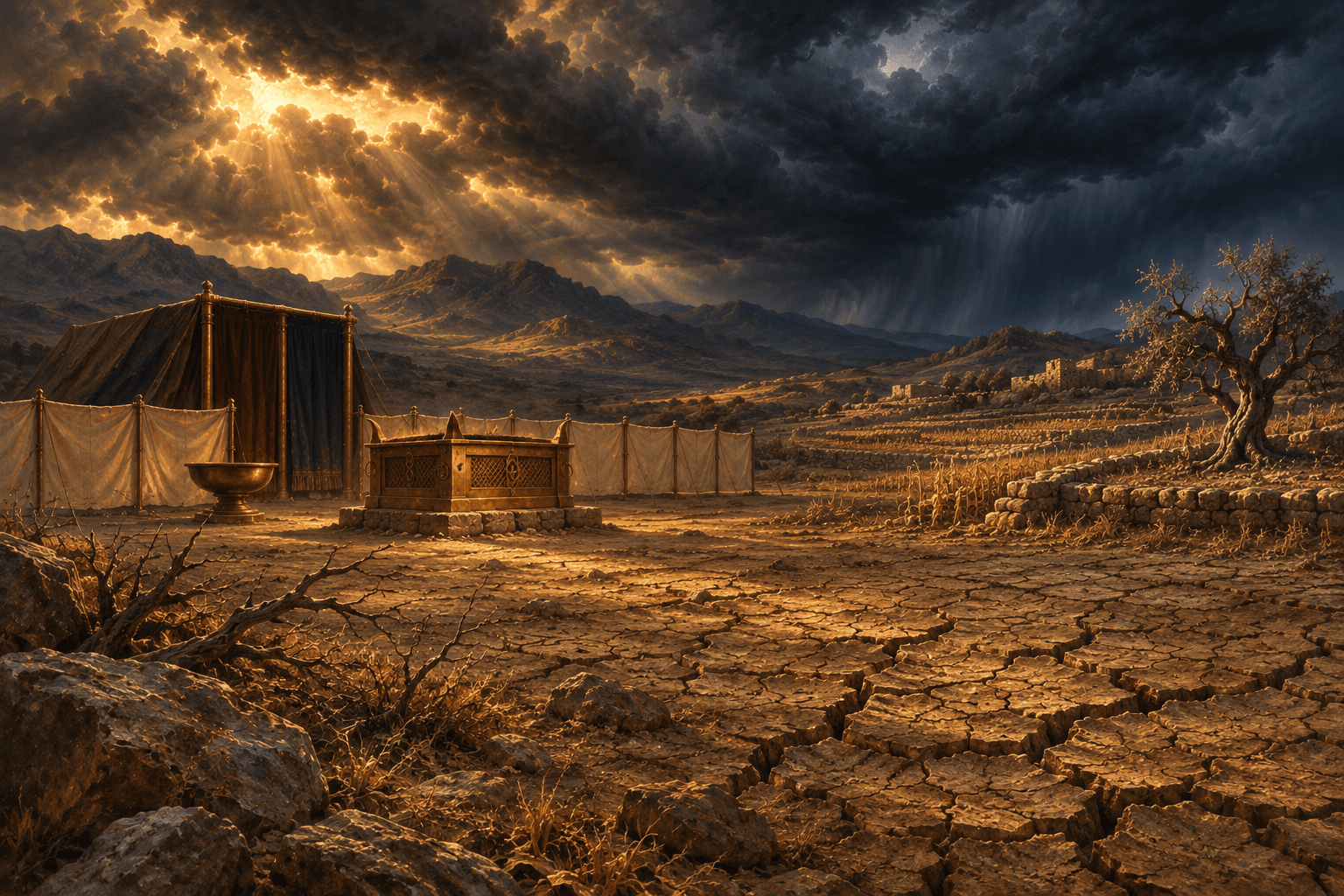
Having presented the positive side, declaring God’s gifts to the man who keeps His commandment, He began on the negative side to declare the natural fruit of rejecting the commandment, since this is counted as breaking His covenant (15) and rejecting His Person. This bitter fruit is:
First: “I will even appoint over you terror, consumption, and the burning ague, that shall consume the eyes, and cause sorrow of heart” (16). If God punishes man with terror, with the disease of consumption, with fever and the loss of sight, this happens by God’s forsaking the one who rejects Him, so that the man falls into this bitterness and lives without inner peace, without bodily health and without insight! He loses his heart (his peace), his body and his insight! Perhaps God permits these outward things so that he may become aware of what has befallen him inwardly because of his disobedience. The chastisement then comes like a thermometer revealing the inner corruption, so that he says: “My breath is corrupt, my days are extinct” (Job 17:1).
Second: “and ye shall sow your seed in vain, for your enemies shall eat it” (16). They work, but not for the Lord; they sow their own seed, so the Lord does not bless it, and it becomes plunder for the enemies.
Third: “And I will set my face against you, and ye shall be slain before your enemies: they that hate you shall reign over you; and ye shall flee when none pursueth you” (17). When man loses his inner peace and loses his fellowship with God, he becomes weak before his spiritual enemies, even if the enemy in himself is as nothing. As the wise man says: “The wicked flee when no man pursueth” (Proverbs 28:1). The secret of weakness and defeat lies not in the strength of the enemy but in man’s inner collapse.
Fourth: if we do not respond to these weaknesses with repentance, God chastises with a double chastisement, for He says: “And I will break the pride of your power; and I will make your heaven as iron, and your earth as brass: And your strength shall be spent in vain: for your land shall not yield her increase, neither shall the trees of the land yield their fruits” (19–20). God begins to chastise through diseases and the plunder of enemies; if we do not take heed, He multiplies the strokes through humiliation, to break our pride. Man stands humiliated, finding nature itself as though it were hard toward him: the heaven becomes like iron, giving no rain, and the earth like brass, unfit for sowing. If man lifts his eyes to heaven, hoping it may answer him, he finds it hard iron; and if he looks to the earth, he finds all around him become brass that has no pity for him.
If heaven points to the human soul and earth to the body, then when man does not listen to the divine commandment and does not respond to the word of God, he receives his reward at once: his soul becomes like iron and his body like brass, neither submitting to him nor responding to his inner voice…
Fifth: being devoured by beasts: “I will also send wild beasts among you, which shall rob you of your children, and destroy your cattle, and make you few in number; and your high ways shall be desolate” (22). When the people murmured in the wilderness, He let the fiery serpents bite them (Numbers 21:5–6); when some children mocked Elisha the prophet, He permitted two bears that killed forty-two of them; and when the king of Assyria sent heathen people to dwell in the land of Canaan after he had carried Israel captive, God sent beasts that devoured them (2 Kings 17:24–26).
What are these beasts let loose upon us, if not the sins from which God keeps us as long as we are in His presence and respond to His voice? If we turn our back to Him and not our face, He lets the beasts rob us of our children, that is, our inner fruits, and destroy our cattle, that is, corrupt our body.
Sixth: the stroke of the sword and the pestilence (25), meaning chastisement through the enemy’s sword, and the permitting of pestilence so that the strength of the wicked is broken and they cannot resist the enemy.
Seventh: the stroke of famine (26): “And when I have broken the staff of your bread, ten women shall bake your bread in one oven, and they shall deliver you your bread again by weight: and ye shall eat, and not be satisfied” (26).
God breaks the staff of their bread, that is, He cuts off from them the bread of life, the divine word, so that their souls live in hunger and find no staff to lean on. The sign of the famine is that, instead of each woman having her own oven in which to bake her bread, every ten women use one oven, because they have no bread needing an oven, or they have not the fuel needed to light more than one oven. The second sign of famine is carefulness with bread: they use it by weight because of its small quantity and the withdrawal of blessing from them. The famine reaches its extreme when parents stretch out their hands to eat the flesh of their children, as happened in the days of Jehoram the son of Ahab, king of Israel, when two women agreed that each would cook her son on one day so that they might eat him together (2 Kings 6:24–30); and also in the days of the siege of Jerusalem by the king of Babylon, when it was said: “The hands of the pitiful women have sodden their own children: they were their meat in the destruction of the daughter of my people” (Lamentations 4:10). The same thing happened again when Titus the Roman besieged Jerusalem.
When we turn our backs on the divine commandment, an inner famine strikes us that deprives us of necessary food, so that we stretch out our hands to our children, that is, our inner fruits, to eat them, and we die!
Eighth: “And I will destroy your high places, and cut down your images, and cast your carcases upon the carcases of your idols, and my soul shall abhor you” (30).
When the people rejected the commandment, they worshipped idols in the high places and set up sun images, that is, statues for the worship of the sun; or perhaps it means they set up booths in which to stay during their worship on the high places, so that the sun would not strike them… God in His jealousy breaks down the strange gods on which the transgressors of the commandment leaned, declaring the end of rejecting the commandment: certain death and the loss of the gods made by our own hands! With the casting of the carcases the smell of death and corruption spreads; therefore He says: “my soul shall abhor you.”
Ninth: when man rejects God’s commandment, the fortified cities turn into ruins and the sanctuaries into desolate places where no one takes refuge. Even the land in which they dwell rejects them and casts them out among the nations, to become scattered and persecuted. In their wickedness they were not bound by the sabbatical year to let the land rest, and so the land casts them out of itself, and keeps its sabbath from them. They are driven out to live in a strange land with a spirit of cowardice; they fall with no real pursuer, for their pursuer is their own inner wickedness.
4. The Acceptance of Repentant Sinners
KJV · Verses 40–46
40 If they shall confess their iniquity, and the iniquity of their fathers, with their trespass which they trespassed against me, and that also they have walked contrary unto me; 41 And that I also have walked contrary unto them, and have brought them into the land of their enemies; if then their uncircumcised hearts be humbled, and they then accept of the punishment of their iniquity: 42 Then will I remember my covenant with Jacob, and also my covenant with Isaac, and also my covenant with Abraham will I remember; and I will remember the land. 43 The land also shall be left of them, and shall enjoy her sabbaths, while she lieth desolate without them: and they shall accept of the punishment of their iniquity: because, even because they despised my judgments, and because their soul abhorred my statutes. 44 And yet for all that, when they be in the land of their enemies, I will not cast them away, neither will I abhor them, to destroy them utterly, and to break my covenant with them: for I am the Lord their God. 45 But I will for their sakes remember the covenant of their ancestors, whom I brought forth out of the land of Egypt in the sight of the heathen, that I might be their God: I am the Lord. 46 These are the statutes and judgments and laws, which the Lord made between him and the children of Israel in mount Sinai by the hand of Moses.
Having declared the bitterness to which man comes because of his disobedience to God, He returns to affirm that the only remedy by which man may enjoy the blessing instead of the curse is to return to Him in repentance. So God remembers His promise, declaring that even in their worst moments God did not want to destroy them, but to chastise them.
Notes and References
[312] Origen, Homilies on Leviticus 16.2.
[313] The Liturgy of St. Gregory.
[314] Origen, Homilies on Leviticus 16.4.
[315] Ibid. 16.4.
[316] Ibid. 16.5.
[317] Ibid.
[318] Ibid. 16.6.
[319] Ibid.
[320] Ibid.
[321] Ibid. 16.7.
[322] Ante-Nicene Fathers, vol. 1, p. 72.
[323] St. Augustine, City of God 22.30.