
Chapters 18–22: The Laws of Holiness
The Book of Leviticus has brought out the ugliness of sin and its bitter results in man’s life, and the separation it causes between the soul and God, the source of its life. It has given us the various sacrifices, revealing different sides of the cross as the way of man’s return to God, the source of his life and sanctification. Since the believers are bound to respond to the work of the sacrifice in their daily life in all its sides, God gave the practical laws touching their eating, drinking, clothing, dwellings, and health (Leviticus 11–15). Now He gives the practical laws touching dealings, whether with God, with the brethren, or with inanimate creation, and conduct toward the divine holy things. These laws dealt with the holiness of God’s people, then the holiness of the priests, then the holiness of the divine holy things:
- Laws concerning the holiness of the people (Leviticus 18–20).
- Laws concerning the holiness of the priests (Leviticus 21).
- Laws concerning the holiness of the holy things (Leviticus 22).
Holiness and Bodily Relations
He opens His discussion here of the laws of sanctification, especially the law of forbidden marriages, not as orders which the congregation must keep by force, but as a way by which the congregation enjoys the holy life which the nations did not enjoy, so that the congregation may be made fit to be counted the people of the Holy God, and finally, so that they do not defile the land with evil and it spue them out.
1. Introduction to the Laws
KJV · Verses 1–5
1 And the Lord spake unto Moses, saying, 2 Speak unto the children of Israel, and say unto them, I am the Lord your God. 3 After the doings of the land of Egypt, wherein ye dwelt, shall ye not do: and after the doings of the land of Canaan, whither I bring you, shall ye not do: neither shall ye walk in their ordinances. 4 Ye shall do my judgments, and keep mine ordinances, to walk therein: I am the Lord your God. 5 Ye shall therefore keep my statutes, and my judgments: which if a man do, he shall live in them: I am the Lord.
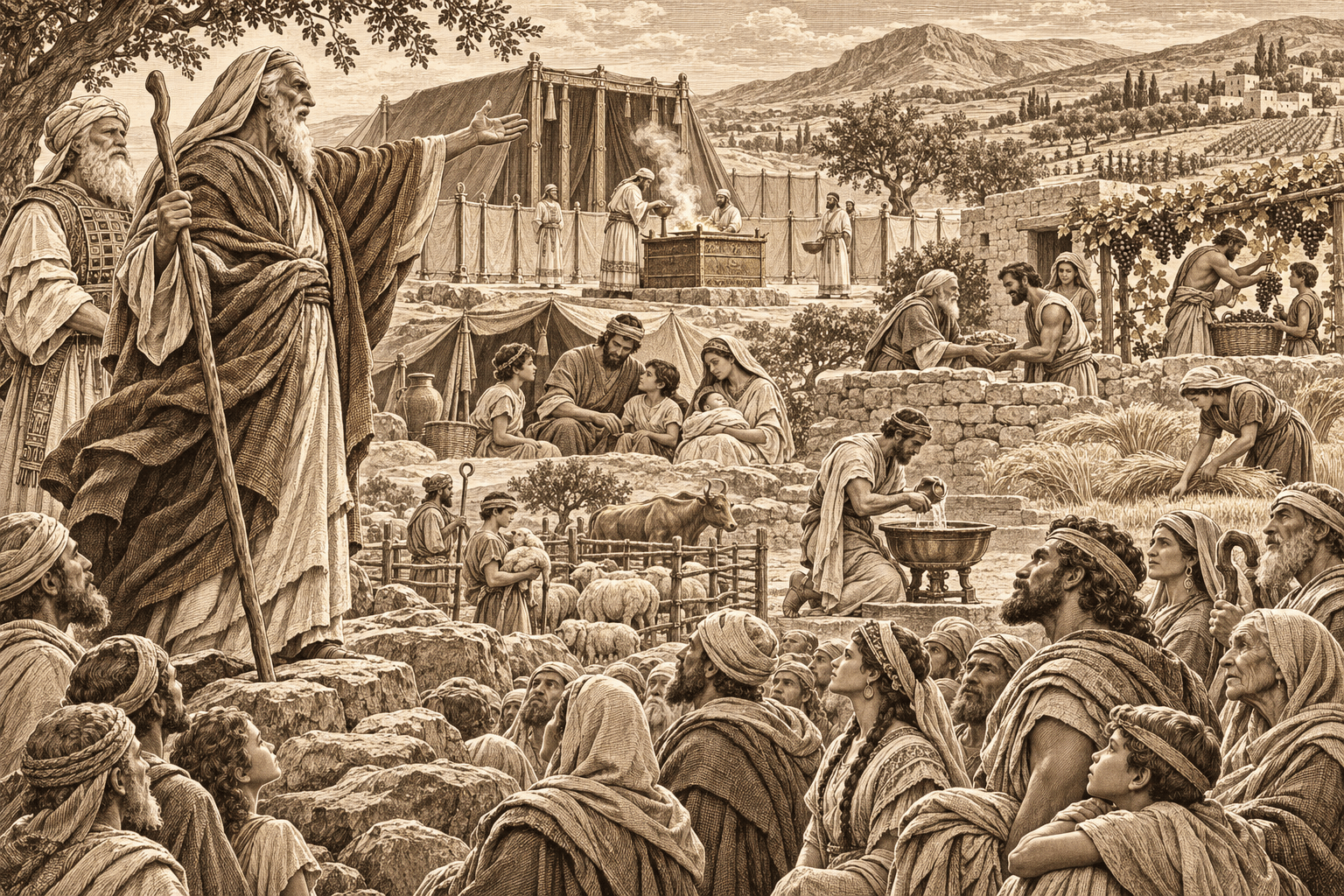
Since the Lord opens these laws with the law of “forbidden marriages,” lest they think the law is deprivation and prohibition, He declared its purpose: “I am the LORD your God. After the doings of the land of Egypt, wherein ye dwelt, shall ye not do: and after the doings of the land of Canaan, whither I bring you, shall ye not do: neither shall ye walk in their ordinances. Ye shall do my judgments, and keep mine ordinances, to walk therein: I am the LORD your God. Ye shall therefore keep my statutes, and my judgments: which if a man do, he shall live in them: I am the LORD” (2–5).
Notice in this opening the following:
A) He begins it with “I am the LORD your God” and ends it with “I am the LORD,” and in the middle too He says “I am the LORD your God,” repeating this expression throughout the text of the laws themselves. It is as if He wants to say: I am the LORD your God; I am the beginning, I am the end, and I am your way… What I give you of laws is not deprivation or giving up anything, but acquiring Me, who satisfy you! God is the goal of the commandment; we accept His commandment and law to discover Him and acquire Him as the mystery of our life.
B) He made clear in this opening that by these laws He wanted to set them apart for Himself. If He had released them from the land of bondage and given them Canaan as an inheritance, it does not befit them to walk in the conduct of those who enslaved them or of those whose land they acquired. It befits God’s people, and every member of it, to have its spiritual law that distinguishes it from the lovers of the world.
C) Saint Clement of Alexandria [232] sees in this phrase that Egypt points to the love of the world and the people of Canaan to deceit; the divine commandment came to warn us against the love of the world as against deceit.
D) Saint John Chrysostom comments on the phrase “Ye shall therefore keep my statutes, and my judgments: which if a man do, he shall live in them”:
There is no other way by which a man can be righteous except by keeping the whole Law; but this is not in anyone’s power at all, and the Jews failed to enjoy this righteousness. [233]
So there was need of One who would keep the Law and not break one commandment of it, our Lord Jesus Christ, who bowed under the Law to fulfill it of His own will, freeing us from its curse, which came upon us through our breaking its commandments. That is why the Apostle Peter said: “Lord, to whom shall we go? thou hast the words of eternal life” (John 6:68).
2. Forbidden Marriages
KJV · Verses 6–18
6 None of you shall approach to any that is near of kin to him, to uncover their nakedness: I am the Lord. 7 The nakedness of thy father, or the nakedness of thy mother, shalt thou not uncover: she is thy mother; thou shalt not uncover her nakedness. 8 The nakedness of thy father's wife shalt thou not uncover: it is thy father's nakedness. 9 The nakedness of thy sister, the daughter of thy father, or daughter of thy mother, whether she be born at home, or born abroad, even their nakedness thou shalt not uncover. 10 The nakedness of thy son's daughter, or of thy daughter's daughter, even their nakedness thou shalt not uncover: for theirs is thine own nakedness. 11 The nakedness of thy father's wife's daughter, begotten of thy father, she is thy sister, thou shalt not uncover her nakedness. 12 Thou shalt not uncover the nakedness of thy father's sister: she is thy father's near kinswoman. 13 Thou shalt not uncover the nakedness of thy mother's sister: for she is thy mother's near kinswoman. 14 Thou shalt not uncover the nakedness of thy father's brother, thou shalt not approach to his wife: she is thine aunt. 15 Thou shalt not uncover the nakedness of thy daughter in law: she is thy son's wife; thou shalt not uncover her nakedness. 16 Thou shalt not uncover the nakedness of thy brother's wife: it is thy brother's nakedness. 17 Thou shalt not uncover the nakedness of a woman and her daughter, neither shalt thou take her son's daughter, or her daughter's daughter, to uncover her nakedness; for they are her near kinswomen: it is wickedness. 18 Neither shalt thou take a wife to her sister, to vex her, to uncover her nakedness, beside the other in her life time.
After the previous opening He set out the forbidden marriages, forbidding approach to the flesh of near kin and uncovering their nakedness, that is, refraining from union with them in a marriage relationship. He defined the forbidden marriages thus:
A) Marriage with the father or the mother (7), so that no one falls into what Lot’s two daughters did (Genesis 19:30–38), who bore for the world Moab and Ammon, who founded two nations hostile to God.
B) Marriage with the father’s wife (8), whether in his father’s lifetime or after his death. Jacob’s soul was embittered when he heard that his firstborn Reuben lay with his concubine Bilhah (Genesis 35:22), counting that he had defiled his father’s bed, and because of this he lost his birthright (Genesis 49:3–4). Absalom committed the same wrong when he rebelled against his father David, made himself king, and lay with his father’s concubines (2 Samuel 16:22).
C) Marriage with the sister (9).
D) Marriage with the granddaughter (10).
E) Marriage with the daughter of the father’s wife (11), when she is begotten of his father… Perhaps He means by this that the daughter of his father’s wife, even if she is not of his mother nor of his father, is counted begotten of his father because of her mother’s bond with him as a wife. In other words, one may not marry the daughter of his father’s wife even if she is from another father, for she is his father’s daughter through her mother’s union with him.
F) Marriage with the father’s sister or the mother’s sister (12–13).
G) Marriage with the wife of the father’s brother (14).
H) Marriage with the daughter-in-law (15).
I) Marriage with a woman and her daughter, or a woman and her son’s daughter or her daughter’s daughter (17).
J) Marriage with a sister as a rival to her sister (18); that is, a man should not marry his wife’s sister after he divorces her sister, lest the first feel hatred toward her sister; and all the more, a man should not marry two sisters together in their lifetime, as Jacob did when he married Leah and Rachel before the Law.
Now, why did the Law forbid marriage with these near kinswomen?
A) The prohibition came to preserve the holiness of family life, especially since families lived under one roof. The young man looks on his parents, his brothers, his uncles on both sides and their wives, and his cousins with holiness, especially since they are of his flesh and blood… He knows he will not marry any of them, so he deals with them in pure brotherly or filial love, with a view far removed from any carnal thought.
B) From the standpoint of health, geneticists hold that marriage between relatives, such as cousins, exposes the offspring to hereditary diseases more than if a person marries someone not related.
C) Saint John Chrysostom [234] holds that refraining from marrying the close relatives of the wife or husband means entering into strong bonds of love, so that a person counts his wife’s family as his own family; he does not join himself to them by marriage, because he is joined to them through his wife.
In the same thought Saint Basil the Great [235] holds that a man cannot marry his wife’s sister even after her death, for the Law forbids marriage with near kin joined to him. By marriage, since a man has become one with his wife, he may not marry her mother or her daughter, for they have become his mother and his daughter; and so he may not marry her sister, for she has become his sister.
D) These forbidden marriages perhaps widen the circle of family ties, so that each family does not close in on itself… but the children take from other families, and the families are bound together.
3. Bodily Perversions
KJV · Verses 19–23
19 Also thou shalt not approach unto a woman to uncover her nakedness, as long as she is put apart for her uncleanness. 20 Moreover thou shalt not lie carnally with thy neighbour's wife, to defile thyself with her. 21 And thou shalt not let any of thy seed pass through the fire to Molech, neither shalt thou profane the name of thy God: I am the Lord. 22 Thou shalt not lie with mankind, as with womankind: it is abomination. 23 Neither shalt thou lie with any beast to defile thyself therewith: neither shall any woman stand before a beast to lie down thereto: it is confusion.
After forbidding marriage with very near kinswomen, the Law warned against the bodily perversions that were widespread among some pagan peoples, such as:
A) “Also thou shalt not approach unto a woman to uncover her nakedness, as long as she is put apart for her uncleanness” (19). The Law forbids a man to have relations with his wife during her monthly sickness or if she has an issue of blood… If this was done deliberately, both were cut off from the people (Leviticus 20:18); but if by oversight, the man was counted unclean seven days (Leviticus 15:24). The prohibition rests on a health basis, for the wife is usually not ready, physically and emotionally, for marital relations. The spiritual basis is as the Apostolic Constitutions say: “They do this not to beget children but for pleasure. The lover of God should not be a lover of pleasure.” [236]
B) Refraining from adultery (20). The punishment of a man who committed adultery with another man’s wife was death by stoning, he and the woman (Leviticus 20:10; Deuteronomy 22:22).
C) Refraining from offering children as human sacrifices to Molech, the god of Ammon, by making them pass through the fire before the idol (21).
D) Refraining from sexual perversion, such as lying with males (22) or with beasts (23).
4. The Results of License
KJV · Verses 24–30
24 Defile not ye yourselves in any of these things: for in all these the nations are defiled which I cast out before you: 25 And the land is defiled: therefore I do visit the iniquity thereof upon it, and the land itself vomiteth out her inhabitants. 26 Ye shall therefore keep my statutes and my judgments, and shall not commit any of these abominations; neither any of your own nation, nor any stranger that sojourneth among you: 27 (For all these abominations have the men of the land done, which were before you, and the land is defiled;) 28 That the land spue not you out also, when ye defile it, as it spued out the nations that were before you. 29 For whosoever shall commit any of these abominations, even the souls that commit them shall be cut off from among their people. 30 Therefore shall ye keep mine ordinance, that ye commit not any one of these abominable customs, which were committed before you, and that ye defile not yourselves therein: I am the Lord your God.
If in the opening God declared His longing for His people to live holy, so that the people would be marked by what befits its God and have its own mark that sets it apart from the pagan nations, now at the end of this law He reveals the negative side, the fruit of sin, especially bodily license:
A) When man plays in abominations, the land is defiled by him, then it spues him out, as though repaying him for what he did to it (25). If God created the world for the sake of man, then when man, the master of the earth, is corrupted, he corrupts the earth, so it cannot bear him but vomits him out. Of old Adam and Eve sinned, and the earth fell under the curse, bringing forth thorns and thistles (Genesis 3:17–18); and when Cain shed the blood of Abel, it was said: “It shall not henceforth yield unto thee her strength” (Genesis 4:12)… And the Apostle says: “For we know that the whole creation groaneth and travaileth in pain together until now” (Romans 8:22). Now, as we return to the Lord sanctified in His blood, creation blesses and glorifies Him!
B) If the earth, or creation, cannot bear corruption and casts it out, all the more God’s holy Church cannot bear the wicked who persists in his wickedness, but sets him apart and drives him out of membership in the holy body: “For whosoever shall commit any of these abominations, even the souls that commit them shall be cut off from among their people” (29). Cutting off in the Old Testament was usually by stoning; in the New Testament it is by excommunication, as the Apostle Paul says of the one who did evil with his father’s wife: “For I verily, as absent in body, but present in spirit, have judged already, as though I were present, concerning him that hath so done this deed, In the name of our Lord Jesus Christ… To deliver such an one unto Satan for the destruction of the flesh, that the spirit may be saved in the day of the Lord Jesus” (1 Corinthians 5:3–5). He is like one who delivers him to Satan by driving him out of the fellowship of life, not out of hatred, but so that, as his life grows bitter, he returns repentant and hears the words of the same Apostle about the same person: “Ye ought rather to forgive him, and comfort him, lest perhaps such a one should be swallowed up with overmuch sorrow” (2 Corinthians 2:7).
Notes and References
[232] St. Clement of Alexandria, Stromata 2:10.
[233] St. John Chrysostom, In Rom. hom. 17.
[234] St. John Chrysostom, In 1 Cor. hom. 34:6.
[235] St. Basil the Great, Ep. 140 (as printed; the letter to Diodorus is usually numbered 160).
[236] Apostolic Constitutions 6:28:5.