
In this chapter divine revelation presents the second kind of trespass offering, the sacrifice with which the offerer is bound to give compensation to his brethren to whom he has caused material harm (1–7). It also sets before the priests some sides of the rites of the sacrifices and offerings that concern them more than they occupy the people, since the earlier chapters spoke of them as suited those who offer them.
1. The Second Kind of Trespass Offering
KJV · Verses 1–7
1 And the Lord spake unto Moses, saying, 2 If a soul sin, and commit a trespass against the Lord, and lie unto his neighbour in that which was delivered him to keep, or in fellowship, or in a thing taken away by violence, or hath deceived his neighbour; 3 Or have found that which was lost, and lieth concerning it, and sweareth falsely; in any of all these that a man doeth, sinning therein: 4 Then it shall be, because he hath sinned, and is guilty, that he shall restore that which he took violently away, or the thing which he hath deceitfully gotten, or that which was delivered him to keep, or the lost thing which he found, 5 Or all that about which he hath sworn falsely; he shall even restore it in the principal, and shall add the fifth part more thereto, and give it unto him to whom it appertaineth, in the day of his trespass offering. 6 And he shall bring his trespass offering unto the Lord, a ram without blemish out of the flock, with thy estimation, for a trespass offering, unto the priest: 7 And the priest shall make an atonement for him before the Lord: and it shall be forgiven him for any thing of all that he hath done in trespassing therein.
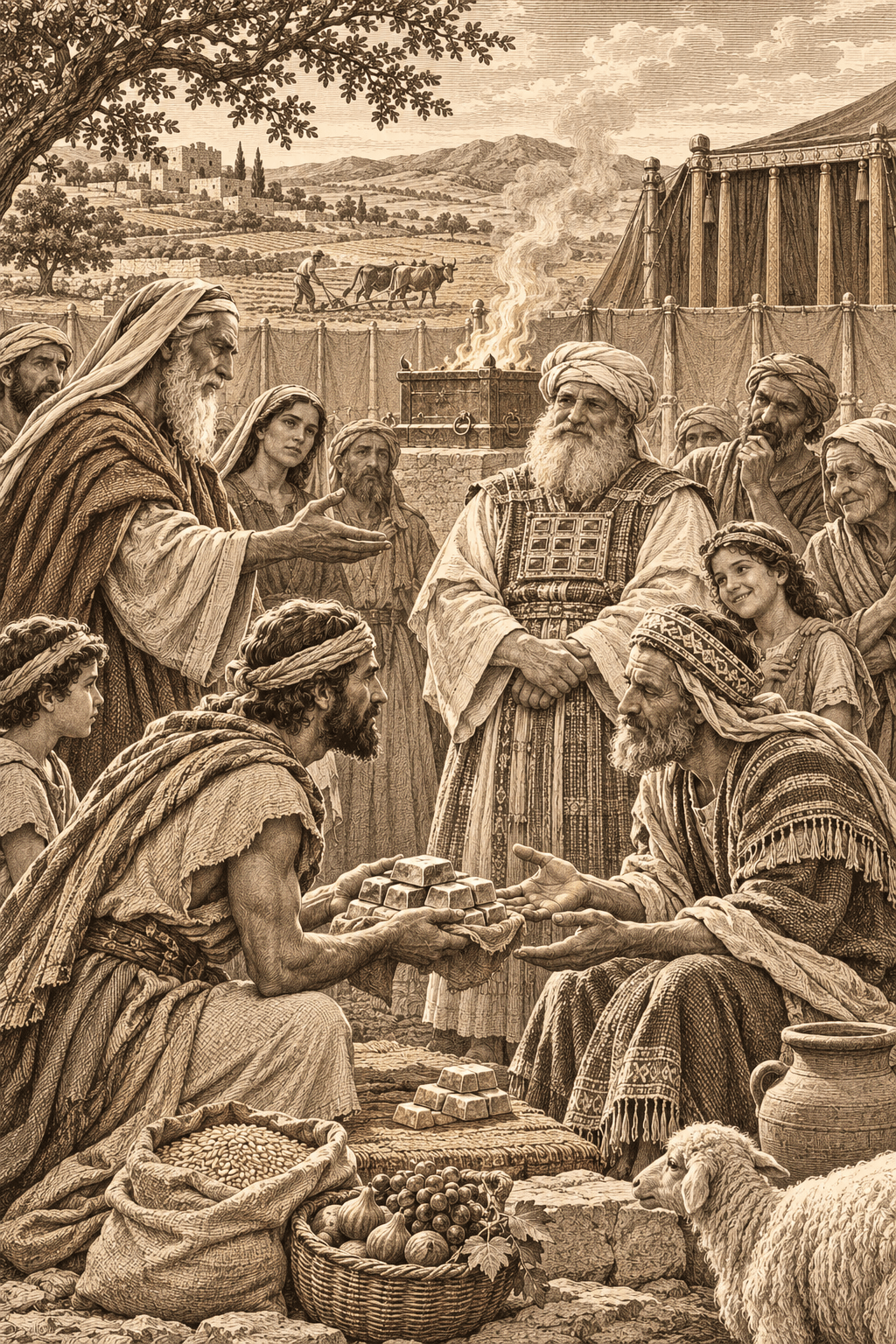
After speaking of the trespass offering offered for one who trespasses against the holy things of the Lord, he goes on to speak of that which concerns one who lies to his neighbour in a matter of a deposit, or of fellowship (something put in trust), or denies something lost that he found and picked up… In this way he robs his brother or takes away his right.
A deposit means what a person entrusts to another for a time, to be returned. Fellowship, or a breach of trust, often has a wider meaning: it means what a person has undertaken in managing the affairs of another, like a guardian who manages the affairs of a minor, a sick person, or one under restraint; and when we are in the position of guardians we must seek complete faithfulness. That which was lost means that a person finds something lying and picks it up; he may not hide it or deny it, but must seek to return it to its owner.
Origen comments that committing such a betrayal is something unfitting even to enter the mind of a believer:
Let them know that whoever “commit[s] a trespass against the LORD, and lie[s] unto his neighbour in that which was delivered him to keep, or in fellowship, or in a thing taken away by violence…” (2) falls under condemnation for a grave sin. May God preserve His Church! For I do not think that anyone of this company of saints behaves so wretchedly as to deny his neighbour’s deposit, or cheat him in a trust, or rob him of a good that is not his, or hide things stolen from others, and if asked about them swear against his conscience. As I said, this thought is far from any believer. For I say with confidence: “But ye have not so learned Christ,” nor so “have been taught by him” (Ephesians 4:20–21). And the Law itself does not give commandments for the saints and the believers… “The law is not made for a righteous man, but for the lawless and disobedient, for the ungodly and for sinners, for unholy and profane” (1 Timothy 1:9–10), and the like. Since the Apostle says that the Law was laid down for such people, may God preserve His Church from being trodden down by such sins, and may His Church be taught and sanctified by the Spirit. [86]
Now if the commandment in its literal meaning should not even be thought of, for how could a believer betray his neighbour in a deposit, a trust, or something he found, what do these things mean in the spiritual sense?
A) The deposit. The first deposit man received is his spirit, made in the image and likeness of God. He received it from God to hand it back as it is, without disfigurement. As Origen says:
You must return this deposit sound and whole, in the same state in which you received it. If you are merciful, as your Father also is merciful (Luke 6:36), the image of God is within you… If you are perfect, as your Father which is in heaven is perfect (Matthew 5:48), the deposit of the image of God stands within you; and so in all other things: if you are pure, righteous, holy, and pure in heart, imitating the things that are in God by nature, the deposit of the holy image is sound and whole. But if your conduct is the opposite, and you are harsh instead of merciful, wicked instead of godly, violent instead of gentle, sowing division instead of planting peace, stealing instead of giving generously, then you have rejected the image of God to take the image of the devil, denying the good deposit which God gave you in trust. Is not this the Apostle’s commandment to his chosen disciple Timothy: “O Timothy, keep that which is committed to thy trust” (1 Timothy 6:20)? [87]
The Lord Christ asks you to return the deposit when He says: “Render therefore unto Caesar the things which are Caesar’s; and unto God the things that are God’s” (Matthew 22:21). As Saint Augustine says:
As Caesar seeks his image on the coin, so God seeks His image in us. [88]
B) The tradition. The deposit we received from the Church is the Church’s tradition, which in its essence is the living faith in the Holy Trinity, translated practically through worship and conduct in Christ Jesus. We must hand on this deposit faithfully to the next generation, not only through writing or preaching but through our whole life of worship and our conduct at home, at work, and in the street… presenting it as a living tradition without deviation. Saint Gregory of Nyssa says:
It is enough to prove our worship that tradition which has come down to us from the fathers, being the inheritance handed down in succession from the apostles through the saints who followed them. [89]
This holy deposit which we received, the tradition or handing on, includes our faith in salvation, the work of the Holy Trinity in us, our enjoyment of the Holy Scripture in both its Testaments, our practice of worship, our walking by the Spirit, and so on.
C) Fellowship. Origen holds that not denying the trust means keeping the life of fellowship with God in His Son Jesus Christ, and our fellowship with the saints and the heavenly ones in the Lord, without deviation. He says:
Let us now see what we should understand by the word “fellowship.” Do you think there is need to warn against cheating a partner in matters of money or other things? What bitter misery it is for a person to practice such cheating! Because of weakness the Apostle did not neglect to give this warning: “That no man go beyond and defraud his brother in any matter: because that the Lord is the avenger of all such” (1 Thessalonians 4:6). Now let us seek “fellowship” spiritually. Hear what the Apostle expresses in his words: “If there be therefore any consolation in Christ, if any comfort of love, if any fellowship of the Spirit, if any bowels and mercies, Fulfil ye my joy” (Philippians 2:1–2). Do you see how the Apostle Paul understood the law of “fellowship”? Hear also John, declaring in the same spirit: “Truly our fellowship is with the Father, and with his Son Jesus Christ” (1 John 1:3). Peter says the same thing: “That… ye might be partakers of the divine nature” (2 Peter 1:4), that is, that we might have fellowship with Him. The Apostle Paul says: “What communion hath light with darkness?” (2 Corinthians 6:14). If there can be no fellowship between light and darkness, and we have come to have fellowship with the Father, the Son, and the Holy Spirit, we must watch lest we deny this holy divine fellowship; for if we do “the works of darkness” (Romans 13:12), we certainly deny our fellowship with the light. [90]
Our faithfulness in the fellowship, or in the trust God has committed to us, binds us to walk in the light and reject the works of darkness. In this way we enjoy fellowship by the work of the Holy Spirit, the Giver of fellowship with God in our Lord Jesus Christ. This fellowship binds us in fellowship with the saints, as children of light with us, and also with the heavenly ones. Origen says:
If we are indeed in fellowship with the Father and the Son, how can we not be so in fellowship with the saints, not only those on earth but also those in heaven?! For Christ by His blood reconciled the heavenly with the earthly (Colossians 1:20), to unite heaven with earth. He showed this fellowship clearly when He said that there is joy in heaven over one sinner that repenteth (Luke 15:7), and also when He said: “In the resurrection they… are as the angels of God in heaven” (Matthew 22:30), plainly promising men the kingdom of heaven (Matthew 13:11). We deny this fellowship when we part from the heavenly ones by our wicked deeds and our evil feelings. [91]
D) Robbery. As for stealing and robbing others, Origen says:
There are wicked robbers and there are good robbers. The good are those of whom the Saviour said that they take the kingdom of heaven by force (Matthew 11:12). But there are wicked robbers, of whom the prophet speaks: “The spoil of the poor is in your houses” (Isaiah 3:14); and the Apostle gives a sharp declaration: “Be not deceived: neither fornicators, nor idolaters, nor adulterers, nor effeminate, nor abusers of themselves with mankind, Nor thieves… shall inherit the kingdom of God” (1 Corinthians 6:9–10). [92]
Stealing in the spiritual sense is when a person hides among the saints and steals their spiritual thought and divine knowledge without his life being renewed; he is like one who stole new wine and put it into old bottles, so the bottles burst and the wine runs out (Matthew 9:17).
E) That which was lost. Whoever finds lost things and hides them without returning them to their owner is counted one who seizes what he has no right to. Perhaps this points to the heretics, who seize the souls of the simple and rob the Church of her children, or rob God Himself and His children. When they turn from their error and heresies, they must also bring back the souls that strayed and left the true faith because of them.
Now, returning to the sacrifice offered by one who committed one of these sins, we notice the following:
A) The Lord counted this denial a trespass against Him personally. Every injustice, betrayal, denial, or theft we practice against our brethren God counts as directed against Himself, since He is the Lover of mankind who cares for their salvation; and every love, kindness, and gentleness we offer them He counts as offered to Him personally. On the last day He will say: “Inasmuch as ye have done it unto one of the least of these my brethren, ye have done it unto me” (Matthew 25:40). So Saint Jerome says: “Every time you stretch out your hand to give, remember Christ.” [93]
B) He asks the wrongdoer to restore what he robbed, seized, or denied. Though the sacrifice can forgive the sin, it does not work in a heart that clings to evil. Returning what was seized to its owner is a true declaration of repentance and of our practical acceptance of God’s saving work. Note that the Law asked Moses the prophet to estimate the loss or harm, but not by the shekel of the sanctuary (Leviticus 5:15), as in the sin against the holy things…
C) Here too he asks the wrongdoer to add the fifth to what he robbed. This fifth represents moral and material compensation for the losses the injured one suffered; on the other hand it is counted discipline for the wrongdoer, so that he does not repeat what he did or make light of sin. In a third respect, this fifth which he gives to the injured one is counted as offered to God… If his senses have been defiled by sin, he must hand them over to the Lord, as in the first kind of this sacrifice (chapter 5).
D) He offers a trespass offering, a ram without blemish out of the flock… for there is no cleansing from trespass without the shedding of the blood of the Lamb of God, even if a person restores double what he seized! Origen holds that the trespasser buys the ram or the lamb from the sellers, the prophets and the apostles, who offered the word of prophecy and preaching so that we might acquire by faith the blood of the Lord Christ, which forgives sin. They urge us to repent of our sins and return to God by accepting faith in the Saviour of the world.
2. The Law of the Burnt Offering
KJV · Verses 8–13
8 And the Lord spake unto Moses, saying, 9 Command Aaron and his sons, saying, This is the law of the burnt offering: It is the burnt offering, because of the burning upon the altar all night unto the morning, and the fire of the altar shall be burning in it. 10 And the priest shall put on his linen garment, and his linen breeches shall he put upon his flesh, and take up the ashes which the fire hath consumed with the burnt offering on the altar, and he shall put them beside the altar. 11 And he shall put off his garments, and put on other garments, and carry forth the ashes without the camp unto a clean place. 12 And the fire upon the altar shall be burning in it; it shall not be put out: and the priest shall burn wood on it every morning, and lay the burnt offering in order upon it; and he shall burn thereon the fat of the peace offerings. 13 The fire shall ever be burning upon the altar; it shall never go out.
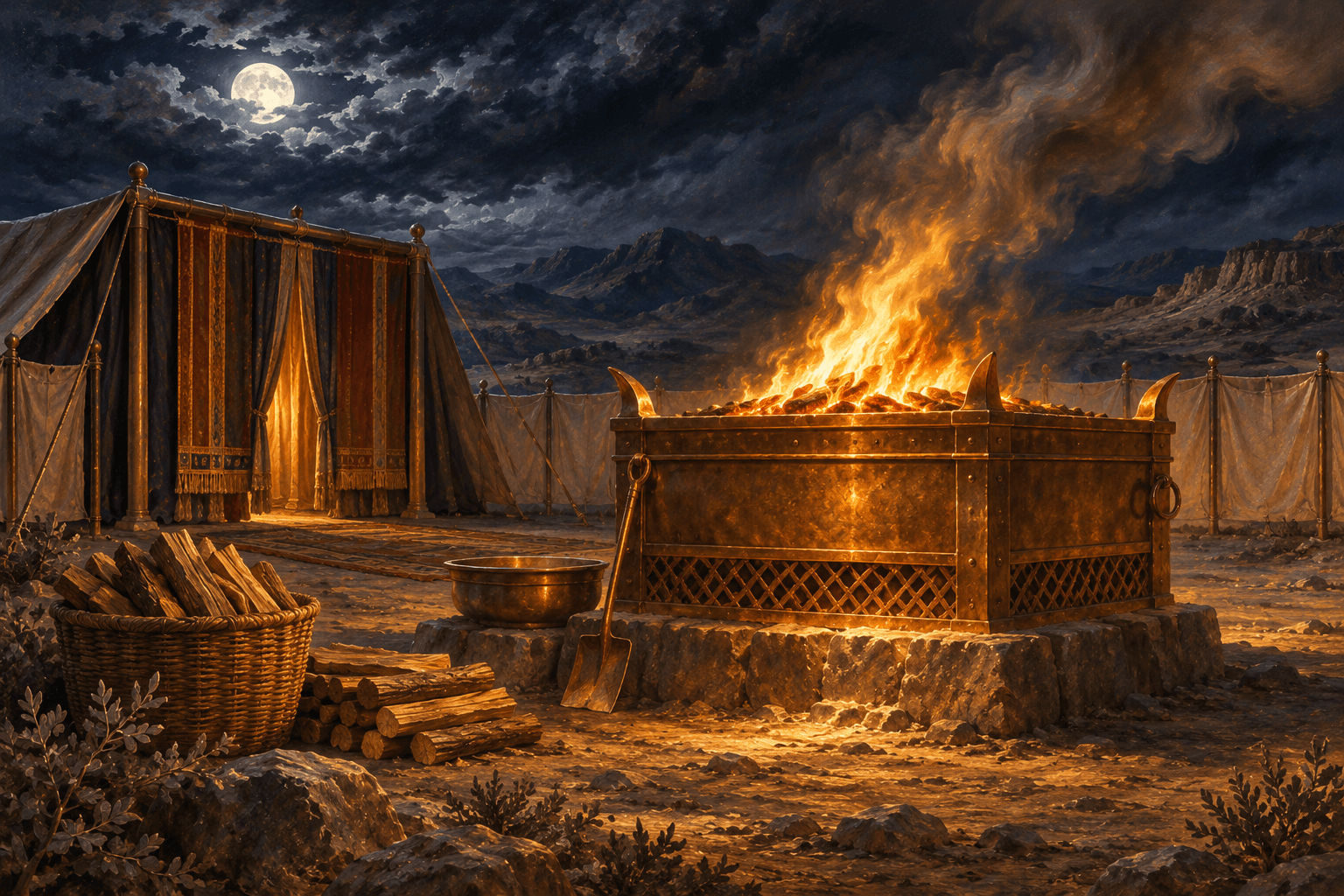
In the previous chapters the Lord’s words to Moses were: “Speak unto the children of Israel, and say unto them” (Leviticus 1:2; 4:2). But here He says: “Command Aaron and his sons, saying” (9, 25). This led some scholars to believe that this part and what follows in these two chapters (Leviticus 6–7) is addressed to the priests, not to the people.
Now, as He gives the priests the law of the burnt offering, He brings out some important points for them:
A) The evening burnt offering was laid at about six in the evening, to remain on the fire of the altar until morning, for the fire had to stay burning without ceasing. He says: “It is the burnt offering, because of the burning upon the altar all night unto the morning, and the fire of the altar shall be burning in it” (9). What is this burnt offering, laid on the hearth of the altar all night until morning, but our life, which we offer by the fire of the Holy Spirit as a burnt offering of love to God all the night of this world, without our hearts cooling or our spirit slackening, until the morning of eternity dawns, without darkness, and we meet the Sun of Righteousness face to face?!
Origen speaks to us of this sacrifice which we offer on the fire without ceasing, since we are priests of God, in the general spiritual sense which we receive through the sacrament of baptism. He says:
You must have fire on the altar without ceasing, if you want to be a priest of the Lord, as it is written: “But ye shall be named the Priests of the LORD” (Isaiah 61:6), and it is also written of you that you are “a chosen generation, a royal priesthood, an holy nation” (1 Peter 2:9). If you want to exercise your priesthood, never depart from the fire of your altar. This is the Lord’s commandment in the Gospel: “Let your loins be girded about, and your lights burning” (Luke 12:35). Let the fire of faith and the lamp of your knowledge shine always without ceasing. [94]
B) In the morning, when taking up the ashes left from the sacrifices, the priest was bound to put on the holy priestly garments, the linen garment and linen breeches (Exodus 28:40–42), so that the priests might realize the holiness of this work. In appearance it is taking up ashes, which would call for wearing old clothes; but in the spiritual understanding it is not merely taking up leftover ashes but the practice of an inseparable part of a holy work that touches the sanctification of man through his reconciliation with the Holy God.
If the animal sacrifices left ashes, which the priests carried beside the altar with holiness and awe and then took outside themselves, the sacrifice of the Lord Christ saw no corruption. The Lord rose from the dead, giving us His body as the mystery of life, carrying us from our ashes to eternity. The Lord Christ Himself is the sacrifice that gives life to us, who are dust and ashes!
C) When the priests had to carry the ashes outside the camp, they took off the garments of service and put on other garments, so as not to go outside in the garments of service. They cast the ashes in a holy place called “where the ashes are poured out” (Leviticus 4:12), surrounded by a wall so that no one would take any of the ashes in it and the winds would not scatter them… How wonderful: even the remains of the ashes are holy and not to be touched! It is a picture of the sanctification of everything that touches the true sacrifice, like the tomb of the Lord Christ, in which the Giver of life lay, of which it is said: “and his rest shall be glorious” (Isaiah 11:10).
When we carry the sacrifice within us, we, the dust, become holy… our souls and spirits are sanctified, and our earthly bodies too! We become like the tomb of the Lord Christ, blessed by His dwelling in us!
D) The priests were bound to keep the fire of the altar burning day and night: “The fire shall ever be burning upon the altar; it shall never go out” (13). This fire, which came from God after the anointing of Aaron and his sons (Leviticus 9:24), the Jews kept by kindling wood and sacrifices on it, and they placed it in three places on the altar of burnt offering… The Second Book of Maccabees relates that when the Jews were carried captive to Babylon, they hid the holy fire in a pit that had no water. When the king of Persia sent Nehemiah and his companions to Jerusalem, they wanted to bring the fire out of the pit but did not find it; instead they found water. So they put the wood on the altar and laid the sacrifices on it, then poured water from the pit on it; and when the sun, which had been hidden by clouds, shone out, a great fire was kindled on the altar, and all glorified God. When the king of Persia learned of this, he marvelled and ordered that the pit be enclosed and counted it a holy place (2 Maccabees 1:19–36).
3. The Law of the Meat Offering
KJV · Verses 14–23
14 And this is the law of the meat offering: the sons of Aaron shall offer it before the Lord, before the altar. 15 And he shall take of it his handful, of the flour of the meat offering, and of the oil thereof, and all the frankincense which is upon the meat offering, and shall burn it upon the altar for a sweet savour, even the memorial of it, unto the Lord. 16 And the remainder thereof shall Aaron and his sons eat: with unleavened bread shall it be eaten in the holy place; in the court of the tabernacle of the congregation they shall eat it. 17 It shall not be baken with leaven. I have given it unto them for their portion of my offerings made by fire; it is most holy, as is the sin offering, and as the trespass offering. 18 All the males among the children of Aaron shall eat of it. It shall be a statute for ever in your generations concerning the offerings of the Lord made by fire: every one that toucheth them shall be holy. 19 And the Lord spake unto Moses, saying, 20 This is the offering of Aaron and of his sons, which they shall offer unto the Lord in the day when he is anointed; the tenth part of an ephah of fine flour for a meat offering perpetual, half of it in the morning, and half thereof at night. 21 In a pan it shall be made with oil; and when it is baken, thou shalt bring it in: and the baken pieces of the meat offering shalt thou offer for a sweet savour unto the Lord. 22 And the priest of his sons that is anointed in his stead shall offer it: it is a statute for ever unto the Lord; it shall be wholly burnt. 23 For every meat offering for the priest shall be wholly burnt: it shall not be eaten.
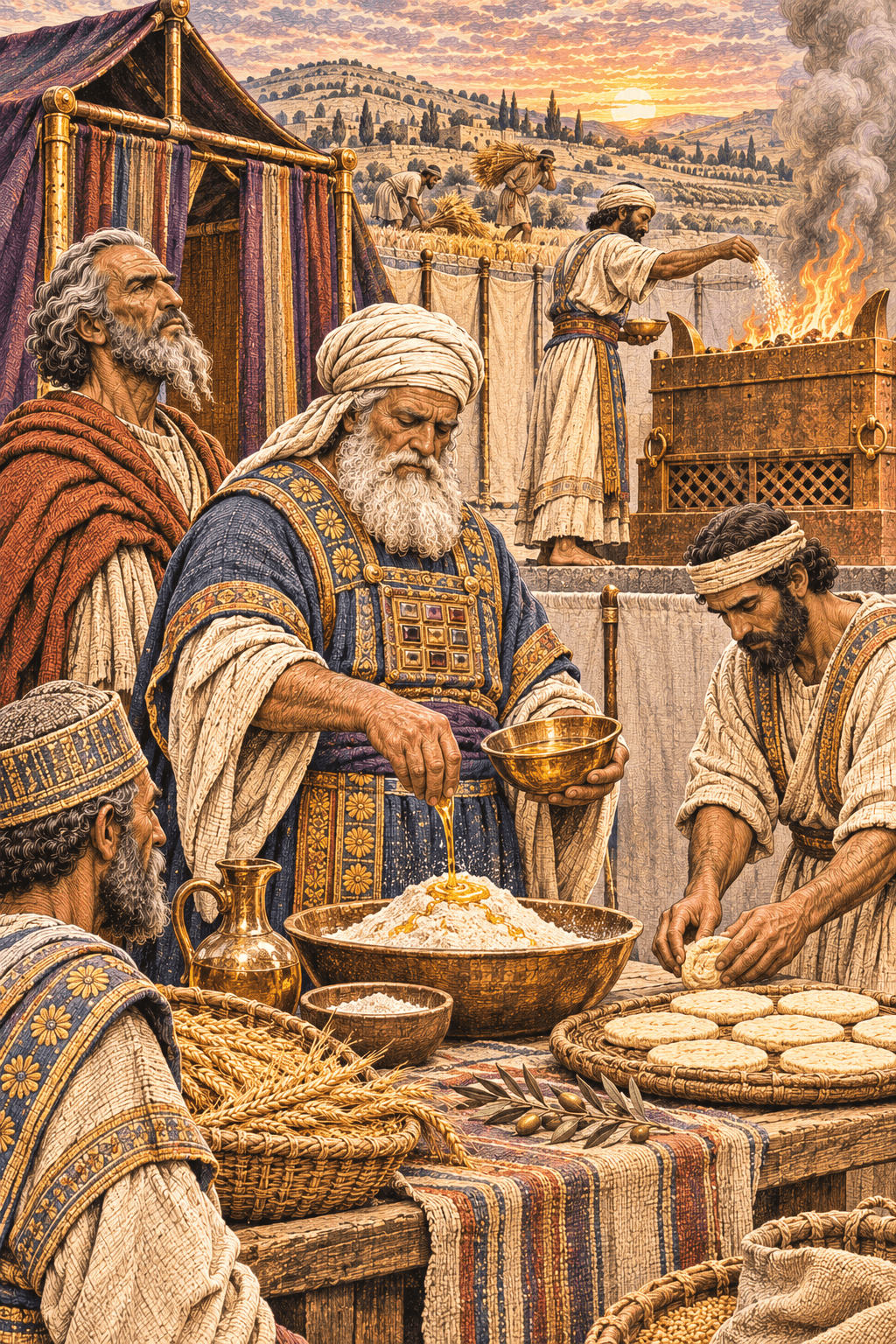
In the second chapter God addressed all the children of Israel through Moses about the meat offering, which we spoke of in some detail; here He focuses on the role of the priest from several sides.
A) He takes his handful of the flour of the offering and its oil, and all the frankincense on the offering, and burns it on the altar for a sweet savour, its memorial, unto the Lord (15). In our earlier study of some books of the Old Testament we saw that the arm and the hand point to the incarnate Word of God, who came to accomplish salvation practically, as by His hand, [95] while the finger of God points to His Holy Spirit. Perhaps the priest’s hand grasping the flour and oil points to the Lord Christ, who took hold of our nature as in His grasp so that in Him we might become an offering of love to God. As we said, the oil points to the Holy Spirit, by whom the incarnation of the Word in the virgin womb was accomplished, the Spirit He gave us for our sanctification, so that we are truly counted an offering of delight to God.
B) What remained of the flour and oil the priests ate as unleavened bread in the court of the tabernacle of the congregation, without using leaven… The males ate it, not the women and children, for it points to our enjoyment of union with the Lord Christ through His body given for us. The pampered (the women) and the spiritually immature (the children) do not enjoy it; the spiritual ones enjoy it, who walk as men of God in maturity and earnestness.
His saying: “It is most holy… every one that toucheth them shall be holy” (17–18) points to the holiness of this offering: only the priests eat it, and they eat it within the court of the tabernacle, prepared spiritually and bodily… Perhaps he means that everyone who touches it becomes holy to the Lord, consecrated to His divine service.
Origen comments on this phrase:
Christ our Passover sacrificed (1 Corinthians 5:7) is the one perfect sacrifice, of which all these sacrifices were offered as figures. Whoever touches the body of Christ is sanctified if he is unclean, and healed of his sufferings, like the woman with the issue of blood, who realized that Christ is the body of the sacrifices; He is the holy body, so she drew near and touched Him. [96]
The Church realized the power and holiness of this sacrifice. So Saint John Chrysostom called the mystery of the Eucharist “a divine mystery,” [97] “an awesome divine table,” [98] “a fearful mystery,” [99] “unspeakable,” [100] and “a holy and awesome sacrifice.” [101]
Eating it within the court points to our enjoyment of the heavenly life through this sacrifice. Saint John Chrysostom expressed this strongly: “It is as though a man were taken up to heaven itself, standing beside the throne of glory, flying with the seraphim and singing the holy hymn.”
Wonderfully, the priest, while enjoying a portion of this offering, of its flour and oil, is himself bound to offer an offering to the Lord, morning and evening (20). The Jewish historian Josephus and most Jewish scholars mention that the high priest offered this offering daily because of the seriousness of his position, while the ordinary priest offered it only once, on the day of his anointing. [102]
Perhaps the wisdom of the priests’ offering is that they realize their mission: though in the name of the Lord they enjoy many portions from the people, as an inseparable part of the people they too are bound to offer offerings. On the other hand, the priest who takes must give… He gives his heart to God and to his spiritual children, as he gives his effort and what his hands possess, as the Apostle Paul said of himself that he would “very gladly spend and be spent” (2 Corinthians 12:15).
What is the morning offering to which the priest is bound but the offering of the Law of the Lord, which the Church of the Old Testament received as in the morning, at the beginning of the spiritual life? He offers it as on the fire of the Holy Spirit, who removes the letter and gives forth the sweet savour of the spirit. The evening offering is the offering of the Gospel, of the Lord Christ, who offered His life as a ransom for humanity in the fullness of time, as in the evening of our life on earth. So on the same altar we receive the Law spiritually, joined to the preaching of the Gospel.
The Law affirmed that the priest’s offering be wholly burnt and not eaten (23)… for he should give his whole life as a burnt offering to the Lord; even if he gives his whole life to others, he gives it to the Lord alone!
4. The Law of the Sin Offering
KJV · Verses 24–30
24 And the Lord spake unto Moses, saying, 25 Speak unto Aaron and to his sons, saying, This is the law of the sin offering: In the place where the burnt offering is killed shall the sin offering be killed before the Lord: it is most holy. 26 The priest that offereth it for sin shall eat it: in the holy place shall it be eaten, in the court of the tabernacle of the congregation. 27 Whatsoever shall touch the flesh thereof shall be holy: and when there is sprinkled of the blood thereof upon any garment, thou shalt wash that whereon it was sprinkled in the holy place. 28 But the earthen vessel wherein it is sodden shall be broken: and if it be sodden in a brasen pot, it shall be both scoured, and rinsed in water. 29 All the males among the priests shall eat thereof: it is most holy. 30 And no sin offering, whereof any of the blood is brought into the tabernacle of the congregation to reconcile withal in the holy place, shall be eaten: it shall be burnt in the fire.
Two basic points stand out in the law of the sin offering:
A) The priests’ portions of it are counted “most holy.” The priests eat it in the court of the tabernacle, and whoever touches its flesh shall be holy. That is, only one who is prepared may eat of it; and on the other hand, whoever touches it is counted the Lord’s own possession.
B) What stands out most in the law of this sacrifice is the holiness of the blood. If any of its blood was sprinkled on a garment, what it was sprinkled on was washed in a holy place; the earthen vessel in which it was sodden was broken; and if it was a bronze pot, it was scoured well and rinsed in water, because bronze absorbs nothing of the sacrifice.
Saint John Chrysostom speaks of the power of the blood of the slain Lord Christ:
This blood makes the image of our King clear in us, brings us unspeakable beauty, and does not allow our nobility to be taken away, but always waters and refreshes it… This blood, when we receive it rightly, drives away the demons and keeps them far from us, while it calls the angels to us. For when the Lord’s blood appears, the demons flee and the angels gather. This blood, poured out, cleanses the whole world… This blood cleanses the secret place and the Holy of Holies… This blood sanctifies the golden altar… This blood sanctifies the priests… This blood is the salvation of our souls… By it the soul is washed, adorned, and set aflame. By it our understanding is kindled like fire, and the soul shines more than gold. [103]
Notes and References
[86] Origen, In Lev. hom. 4:2.
[87] Ibid. 4:4.
[88] St. Augustine, In Ioan. tract. 41:2.
[89] St. Gregory of Nyssa, Against Eunomius 4.
[90] Origen, In Lev. hom. 4:4.
[91] Ibid.
[92] Ibid.
[93] St. Jerome, Ep. 54:21.
[94] Origen, In Lev. hom. 4:6.
[95] Fr. Tadros Yacoub Malaty, Ezekiel, 1981, p. 54.
[96] Origen, In Lev. hom. 4:8.
[97] St. John Chrysostom, Hom. in Pascha, PG 52:769.
[98] St. John Chrysostom, Hom. in Nat. Dom., PG 49:360.
[99] St. John Chrysostom, In Matt. hom. 25.
[100] St. John Chrysostom, De prod. Judae hom. 2.
[101] By the author: Christ in the Mystery of the Eucharist, pp. 379, 441.
[102] Archdeacon Naguib Guirguis, The Book of Leviticus, p. 73.
[103] St. John Chrysostom, In Ioan. hom. 46:3.