
Moses met God through the bush, then met Aaron at the mount of God, and the two went out to all the elders and all the people. Now they must go in to Pharaoh himself, to meet the lion in his den. The commentary on chapters 5 and 6 forms one unit; this chapter covers its first three sections.
1. A Meeting Inside the Palace
KJV · Verses 1–5
1 And afterward Moses and Aaron went in, and told Pharaoh, Thus saith the LordGod of Israel, Let my people go, that they may hold a feast unto me in the wilderness. 2 And Pharaoh said, Who is the Lord, that I should obey his voice to let Israel go? I know not the Lord, neither will I let Israel go. 3 And they said, The God of the Hebrews hath met with us: let us go, we pray thee, three days' journey into the desert, and sacrifice unto the Lord our God; lest he fall upon us with pestilence, or with the sword. 4 And the king of Egypt said unto them, Wherefore do ye, Moses and Aaron, let the people from their works? get you unto your burdens. 5 And Pharaoh said, Behold, the people of the land now are many, and ye make them rest from their burdens.
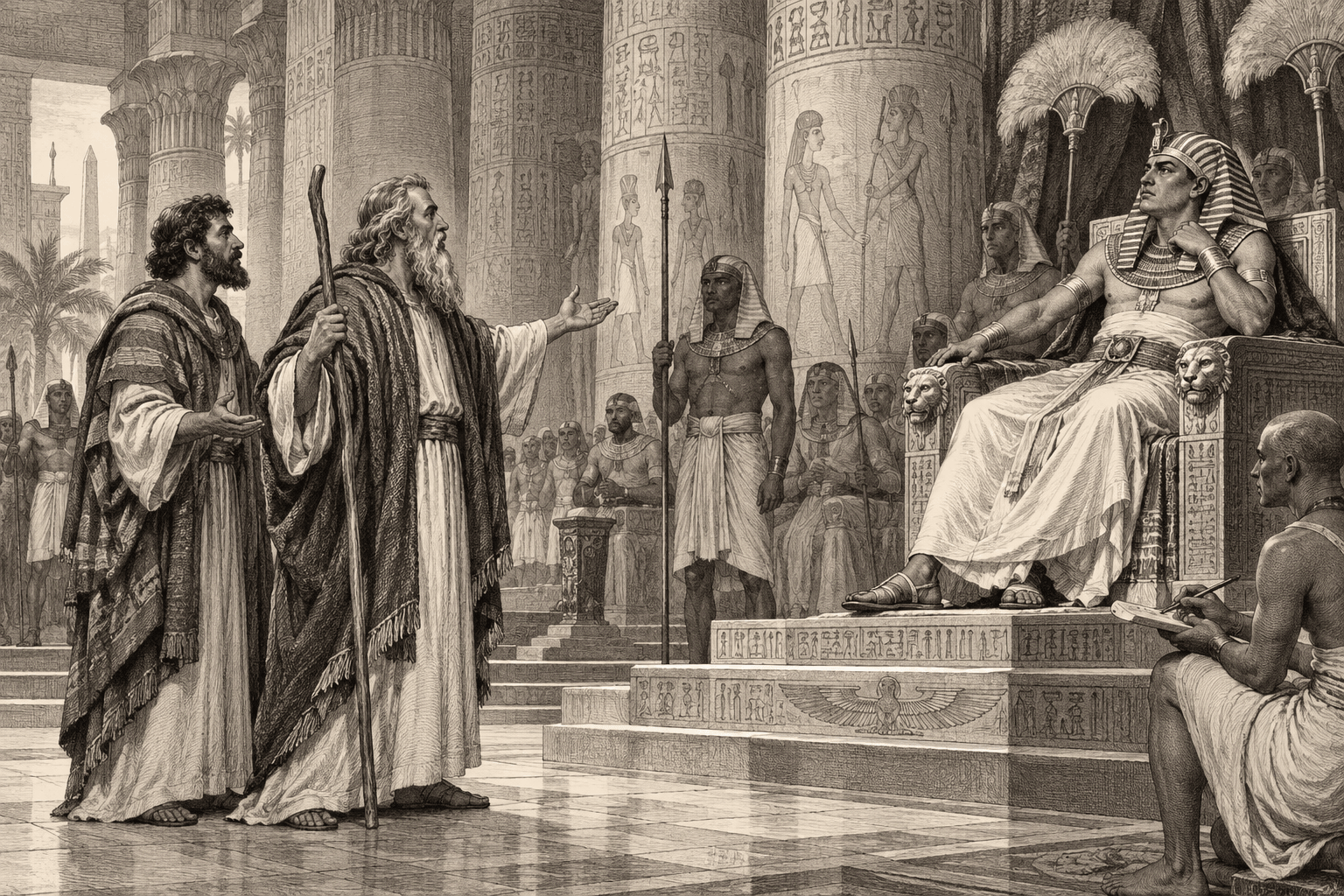
A) When Moses and Aaron asked Pharaoh to let the people go to worship the Lord a three days’ journey away, that is, through the power of the Lord’s resurrection, Pharaoh raged, saying: “Who is the LORD, that I should obey his voice to let Israel go? I know not the LORD” (2). Is this not the same spirit with which the council spoke when it called the two apostles Peter and John, “and commanded them not to speak at all nor teach in the name of Jesus” (Acts 4:18)? As the philosopher Athenagoras wrote to the emperors Marcus Aurelius Antoninus and Commodus, the real charge against the Christians is “the name”: they bear the name of the Lord Christ upon them, and this the world cannot bear.
B) We have seen before that Pharaoh’s words, “I know not the LORD,” reveal the darkness of ignorance in which the enemy of good lives…
C) Origen sees in Pharaoh’s complaint that Moses and Aaron “let the people from their works” (4) the complaint of the enemy of good in every generation, for many see young people’s consecration of their lives to worship and service as a waste of human energy. Pharaoh is a material man who knows nothing but bricks and clay, and he wants to plunge everyone’s life into them; but whoever has freed his mind for spiritual things is, to him, a man wasting his time!
2. The Burden Is Made Heavier
KJV · Verses 6–15
6 And Pharaoh commanded the same day the taskmasters of the people, and their officers, saying, 7 Ye shall no more give the people straw to make brick, as heretofore: let them go and gather straw for themselves. 8 And the tale of the bricks, which they did make heretofore, ye shall lay upon them; ye shall not diminish ought thereof: for they be idle; therefore they cry, saying, Let us go and sacrifice to our God. 9 Let there more work be laid upon the men, that they may labour therein; and let them not regard vain words. 10 And the taskmasters of the people went out, and their officers, and they spake to the people, saying, Thus saith Pharaoh, I will not give you straw. 11 Go ye, get you straw where ye can find it: yet not ought of your work shall be diminished. 12 So the people were scattered abroad throughout all the land of Egypt to gather stubble instead of straw. 13 And the taskmasters hasted them, saying, Fulfil your works, your daily tasks, as when there was straw. 14 And the officers of the children of Israel, which Pharaoh's taskmasters had set over them, were beaten, and demanded, Wherefore have ye not fulfilled your task in making brick both yesterday and to day, as heretofore? 15 Then the officers of the children of Israel came and cried unto Pharaoh, saying, Wherefore dealest thou thus with thy servants?
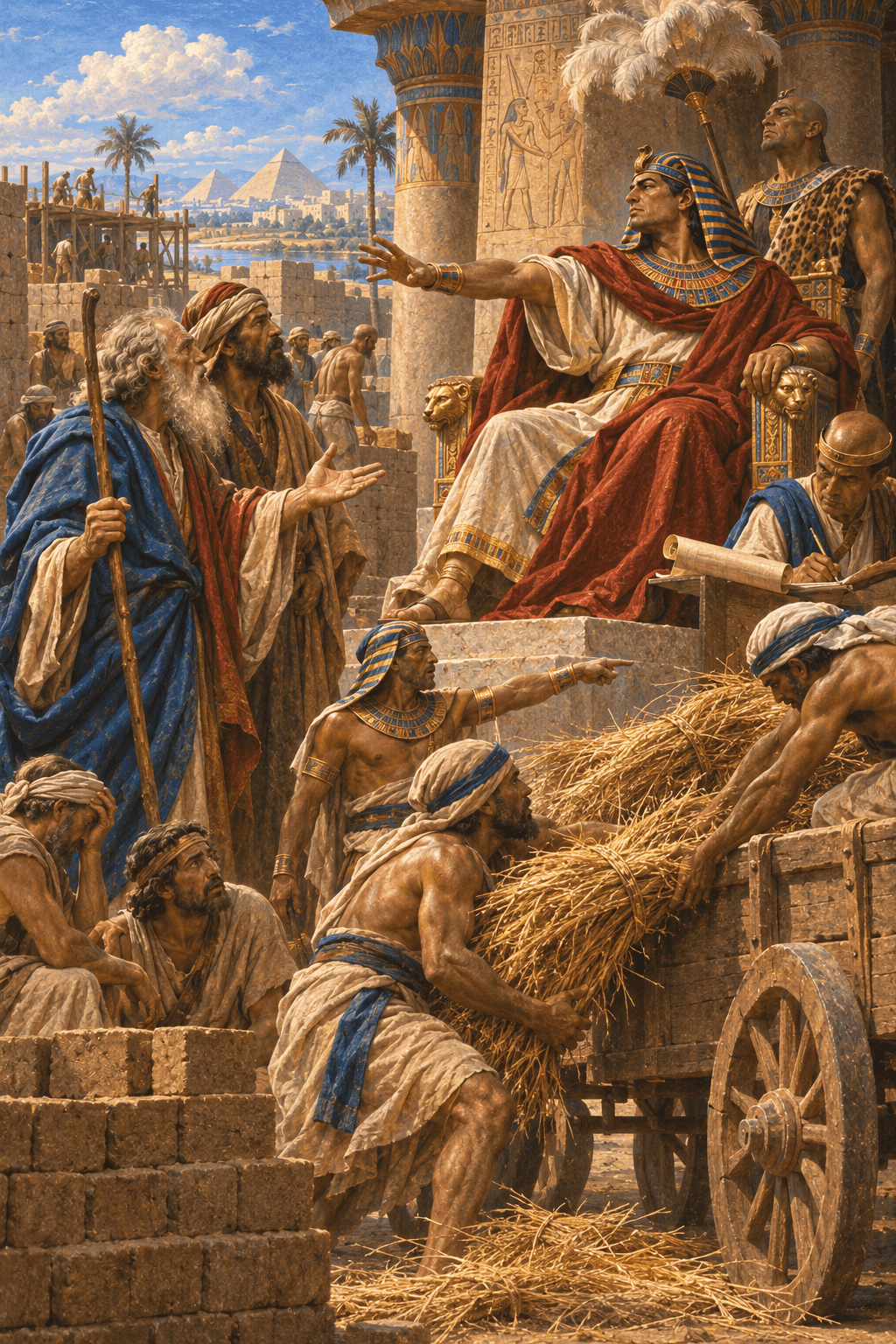
Instead of letting the people go to worship the Lord, Pharaoh made his orders against the people harsher, to humiliate them, accusing them of being idle. Origen comments on this, saying:
Truly, before the preaching is known, there are no afflictions and trials. The war does not begin before the trumpet is sounded. But as soon as the trumpet of preaching sounds, the signal is given for the (spiritual) war, and affliction comes. [115]
He also says:
Before the battles of the virtues against the vices begin… the vices live in peace within your soul. But when each vice begins to be put on trial, a great stir arises, and a relentless war is born within you; for what fellowship has righteousness with unrighteousness, fornication with chastity, truth with error…?! So do not be greatly troubled if our savour has been made to stink before Pharaoh, for to vice the fragrance of virtue is a stench. [116]
3. The People Murmur
KJV · Verses 16–23
16 There is no straw given unto thy servants, and they say to us, Make brick: and, behold, thy servants are beaten; but the fault is in thine own people. 17 But he said, Ye are idle, ye are idle: therefore ye say, Let us go and do sacrifice to the Lord. 18 Go therefore now, and work; for there shall no straw be given you, yet shall ye deliver the tale of bricks. 19 And the officers of the children of Israel did see that they were in evil case, after it was said, Ye shall not minish ought from your bricks of your daily task. 20 And they met Moses and Aaron, who stood in the way, as they came forth from Pharaoh: 21 And they said unto them, The Lord look upon you, and judge; because ye have made our savour to be abhorred in the eyes of Pharaoh, and in the eyes of his servants, to put a sword in their hand to slay us. 22 And Moses returned unto the Lord, and said, Lord, wherefore hast thou so evil entreated this people? why is it that thou hast sent me? 23 For since I came to Pharaoh to speak in thy name, he hath done evil to this people; neither hast thou delivered thy people at all.
When Pharaoh made the order harsher, the people said to Moses and Aaron: “The LORD look upon you, and judge; because ye have made our savour to be abhorred in the eyes of Pharaoh, and in the eyes of his servants, to put a sword in their hand to slay us” (21).
When fear entered the heart of the people, the word of God in the mouths of Moses and Aaron, which has a sweet fragrance, “the savour of life unto life,” became to them “the savour of death unto death” (2 Corinthians 2:15–16).
The cause of this murmuring was not Pharaoh’s violence or the heavier burden; rather, it was a nature that clung to this people throughout their journey in the wilderness, in spite of God’s surpassing care for them… Therefore, when we murmur, we should not blame the circumstances around us, but our heart, which is full of fear and lack of trust in God the Savior.
Notes and References
[115] Origen, In Exod. hom. 3:3.
[116] Ibid.