
This chapter speaks of the need for sanctification (1–3), the washing of the priests (4), their putting on the priestly garments and anointing (5–9), the sin offering (10–14), the burnt offering (15–19), the ram of consecration (20–22), filling the priests’ hands and waving (23–28), anointing the holy garments (29–30), the priests eating at the door of the tabernacle (31–35), the sanctification of the altar (36–37), and the daily offering (38–46).
1. The Need for Sanctification
KJV · Verses 1–3
1 And this is the thing that thou shalt do unto them to hallow them, to minister unto me in the priest's office: Take one young bullock, and two rams without blemish, 2 And unleavened bread, and cakes unleavened tempered with oil, and wafers unleavened anointed with oil: of wheaten flour shalt thou make them. 3 And thou shalt put them into one basket, and bring them in the basket, with the bullock and the two rams.
God called Aaron and his sons to the priestly work and fixed the garments they would wear, so that they might know that the secret of strength is not in them, but in God who called them and covered them Himself. Now, before they practice any priestly work, the Lord gives them a long rite for their sanctification, the sanctification of their priestly garments, and the sanctification of the altar they serve. It is as if the three form one unit: there is no sanctification of the priests unless they put on the Lord Christ Himself (the holy garments), bear His marks in them, and serve the holy altar (the Cross).
The choosing of the priests, their call, and their sanctification were a sign of the choosing of the holy only-begotten Son, who sanctified Himself for this work of salvation. Though He is the Holy One without blemish, He says: “And for their sakes I sanctify myself, that they also might be sanctified through the truth” (John 17:19). This does not mean that He takes on a new holiness, but that He offered His holy life for this work, a Priest after the order of Melchisedec (Psalm 110:4; Hebrews 5:6; 7:11). As the priests were bound to put on the holy priestly garments to draw near to the altar, so, with the difference, the holy Son of God put on our body and became as one of us, so that He might draw near to the Cross on our behalf and accomplish the redemption. The sanctification of the altar points to the Cross, which became holy by the precious blood.
2. The Washing of the Priests
KJV · Verses 4
4 And Aaron and his sons thou shalt bring unto the door of the tabernacle of the congregation, and shalt wash them with water.
Aaron and his sons come to the door of the tabernacle of meeting, and Moses washes them with water (4). It is as if God’s choosing them and calling them to this holy work requires them first to be cleansed before entering the tabernacle or practicing any priestly work. Though the priest has received the honor of praying for his people, this should not create pride in him, so that he thinks he has become better than they or more righteous; on the contrary, it lays on him the responsibility to struggle for himself too, lest the people perish because of him.
In the Divine Liturgy the priest learns to include himself in his petitions for the people, saying: “Grant, O Lord, that our sacrifice may be acceptable for my sins and the ignorances of Your people.” [384]… In all the secret prayers he asks first for himself, that God may forgive his sins, and for the people of God, that He may forgive their ignorances; as if he feels that when he sins he does so knowingly, while the people of God do so without knowledge.
The fathers perceived their need for God’s continual care and teaching together with the people of God. Saint Augustine says:
We are as shepherds to you, but we too are under God’s care, for we are fellow sheep with you. We are teachers to you, but with God He is the one Master, and we are your fellow pupils in His school. [385]
His call to the priesthood affirms his membership in the holy community of God; he remains always seeking cleansing in the merits of the blood and continual teaching at the hands of God. Therefore Paul the Apostle wrote to his disciple Timothy: “This is a faithful saying, and worthy of all acceptation, that Christ Jesus came into the world to save sinners; of whom I am chief” (1 Timothy 1:15). The Apostle does not look on himself as head, teacher, and ruler, but first and before all as the chief of sinners, needing to remain always in the embrace of his Savior!
Saint John Chrysostom sees that God allows priests to feel weakness so that they may be gentle with the weak, their brethren!
3. Putting On the Priestly Garments and Anointing
KJV · Verses 5–9
5 And thou shalt take the garments, and put upon Aaron the coat, and the robe of the ephod, and the ephod, and the breastplate, and gird him with the curious girdle of the ephod: 6 And thou shalt put the mitre upon his head, and put the holy crown upon the mitre. 7 Then shalt thou take the anointing oil, and pour it upon his head, and anoint him. 8 And thou shalt bring his sons, and put coats upon them. 9 And thou shalt gird them with girdles, Aaron and his sons, and put the bonnets on them: and the priest's office shall be theirs for a perpetual statute: and thou shalt consecrate Aaron and his sons.
Putting on the priestly garments is part of the rite of sanctifying the priests, as we saw before.
As soon as the high priest put on the golden plate or holy crown (6), on which was engraved “Holiness to the Lord,” he came to represent the Lord Christ. So the holy anointing oil was poured on him (7) before any sacrifice was offered, a sign of the Holy Spirit’s dwelling in the Lord Christ hypostatically from eternity, as His eternal Spirit, and not as a grace given to Him.
Aaron and his sons the priests, who had put on their coats, came again for the holy anointing (21), so that Aaron and the priests of God might know that they are not anointed priests except after sacrifices are offered for them and the blood of the Lord Christ is sprinkled for their sanctification. The divine revelation affirmed to them that they need sanctification, for no human being is without sin, even if his life on earth is but one day. We will leave speaking of the holy anointing for the next chapter, if the Lord wills.
4. The Sin Offering
KJV · Verses 10–14
10 And thou shalt cause a bullock to be brought before the tabernacle of the congregation: and Aaron and his sons shall put their hands upon the head of the bullock. 11 And thou shalt kill the bullock before the Lord, by the door of the tabernacle of the congregation. 12 And thou shalt take of the blood of the bullock, and put it upon the horns of the altar with thy finger, and pour all the blood beside the bottom of the altar. 13 And thou shalt take all the fat that covereth the inwards, and the caul that is above the liver, and the two kidneys, and the fat that is upon them, and burn them upon the altar. 14 But the flesh of the bullock, and his skin, and his dung, shalt thou burn with fire without the camp: it is a sin offering.
The details of this sacrifice, “the sin offering,” are given at length in Leviticus (Leviticus 4; 5:1–13), and they carry many wonderful meanings for which there is no room here. But we can bring out the following sides:
A) This sacrifice expresses the Lord Christ, on whom we laid our hands, for He bore our sins and was led to death (1 Peter 2:24). Therefore Aaron and his sons put their hands on the head of the bullock, and the bullock is killed before the Lord at the door of the tabernacle of meeting (10–11)… We do not hear of it as being for a sweet savour, as in the burnt offering, for it points to the weight and bitterness of what the Lord bears for us, priests and people! Therefore the Lord was sorrowful and cried: “My soul is exceeding sorrowful, even unto death” (Matthew 26:38)!
B) He takes of the blood of the bullock and puts it on the horns of the altar with his finger, and pours all the rest of the blood at the bottom of the altar; and he takes all the fat that covers the inwards, the caul above the liver, and the two kidneys and the fat on them, and burns them on the altar (12–13)… It is as if God wanted to assure the priests that He came with all their sins, even the hidden ones in the inward parts, and atoned for them by His blood on the altar, so that they may live in inner purity.
C) Burning the flesh of the bullock, its skin, and its dung outside the camp (14) points to Christ’s suffering outside the camp, so that the priests may go forth with Him bearing His reproach (Hebrews 13:13) in their service to His people.
5. The Burnt Offering
KJV · Verses 15–19
15 Thou shalt also take one ram; and Aaron and his sons shall put their hands upon the head of the ram. 16 And thou shalt slay the ram, and thou shalt take his blood, and sprinkle it round about upon the altar. 17 And thou shalt cut the ram in pieces, and wash the inwards of him, and his legs, and put them unto his pieces, and unto his head. 18 And thou shalt burn the whole ram upon the altar: it is a burnt offering unto the Lord: it is a sweet savour, an offering made by fire unto the Lord. 19 And thou shalt take the other ram; and Aaron and his sons shall put their hands upon the head of the ram.
After the sin offering, a ram is offered as a burnt offering to the Lord, “a sweet savour, an offering made by fire unto the LORD” (18). This sacrifice presents another side of the Cross. If the first bears the weight of our sins, and so was offered with groaning and crying, this sacrifice declares in the Cross the side of delight and the savour of good pleasure, for it reveals “the perfect obedience of the Lord Christ to the Father” (John 6:38; Philippians 2:8; Hebrews 5:8; 10:7), a voluntary, not forced, obedience (John 10:18).
Aaron and his sons put their hands on the head of the ram so that they and the sacrifice become one, and they bear in them the spirit of the perfect obedience of the Lord Christ, so that God smells in their priesthood the savour of delight and good pleasure (Leviticus 1:9, 13, 17). So they cleave to the Lord to bear His Spirit: “But he that is joined unto the Lord is one spirit” (1 Corinthians 6:17).
The ram is killed, its blood sprinkled round about upon the altar, and it is cut in pieces; its inwards and its legs are washed and put with the pieces and the head (16–17). It is as if by this all its depths are shown. The Lord Christ passed before the Father and was found without blemish (Isaiah 53:9; John 8:46; Luke 23:22), and He accepted Him as the object of His delight. So it is fitting for the priest to be sanctified in his inner depths, so as to pass before God without blemish and be the object of His delight and good pleasure in Christ Jesus.
6. The Ram of Consecration
KJV · Verses 20–22
20 Then shalt thou kill the ram, and take of his blood, and put it upon the tip of the right ear of Aaron, and upon the tip of the right ear of his sons, and upon the thumb of their right hand, and upon the great toe of their right foot, and sprinkle the blood upon the altar round about. 21 And thou shalt take of the blood that is upon the altar, and of the anointing oil, and sprinkle it upon Aaron, and upon his garments, and upon his sons, and upon the garments of his sons with him: and he shall be hallowed, and his garments, and his sons, and his sons' garments with him. 22 Also thou shalt take of the ram the fat and the rump, and the fat that covereth the inwards, and the caul above the liver, and the two kidneys, and the fat that is upon them, and the right shoulder; for it is a ram of consecration:
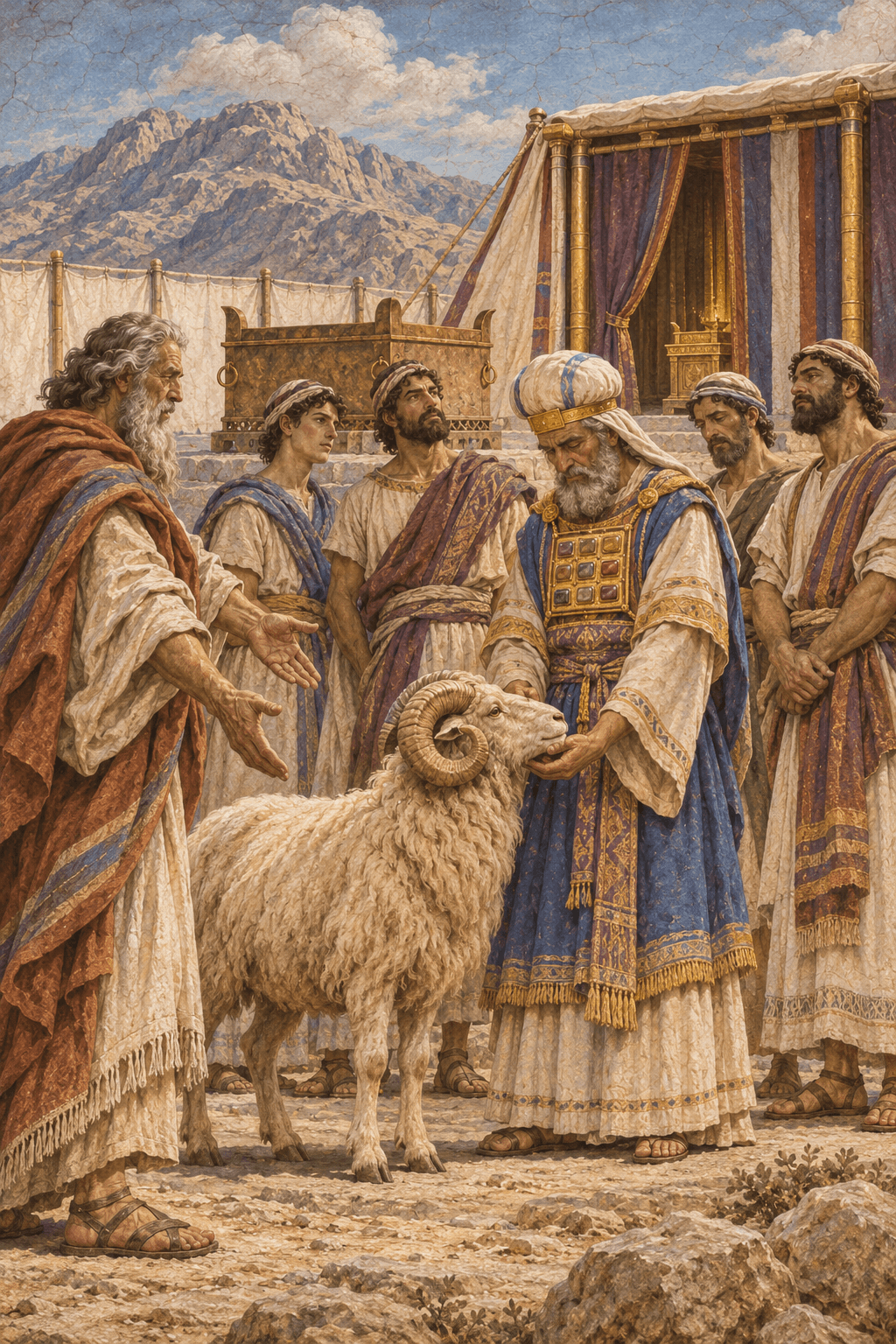
This work carries a living picture of sanctification. After Aaron and his sons put their hands on the head of the ram, that is, declare their union with it, its life is offered as a ransom for them in its blood, which is sprinkled on their bodies and garments to cleanse and sanctify them wholly, so that their life and all their works are for the Lord.
Moses takes of the blood and puts it upon the tip of their right ear, upon the thumb of their right hand, and upon the great toe of their right foot (20). It is as if their ears, hands, and feet have been sanctified and consecrated completely to the service of God. Every word the priest hears, every movement, and every work is for the account of the One who appointed him. He has been sanctified wholly to Him; therefore this sacrifice of sanctification is “for a sweet savour before the LORD: it is an offering made by fire unto the LORD” (25).
7. Filling the Priests’ Hands and Waving
KJV · Verses 23–28
23 And one loaf of bread, and one cake of oiled bread, and one wafer out of the basket of the unleavened bread that is before the Lord: 24 And thou shalt put all in the hands of Aaron, and in the hands of his sons; and shalt wave them for a wave offering before the Lord. 25 And thou shalt receive them of their hands, and burn them upon the altar for a burnt offering, for a sweet savour before the Lord: it is an offering made by fire unto the Lord. 26 And thou shalt take the breast of the ram of Aaron's consecration, and wave it for a wave offering before the Lord: and it shall be thy part. 27 And thou shalt sanctify the breast of the wave offering, and the shoulder of the heave offering, which is waved, and which is heaved up, of the ram of the consecration, even of that which is for Aaron, and of that which is for his sons: 28 And it shall be Aaron's and his sons' by a statute for ever from the children of Israel: for it is an heave offering: and it shall be an heave offering from the children of Israel of the sacrifice of their peace offerings, even their heave offering unto the Lord.
Since the priests’ hands have been sanctified, Moses places in them the holy portions of the ram of consecration, and they wave them, that is, offer them to the Lord (24). It is as if this is the first sacrifice their holy hands reach out to offer before the Lord.
8. Anointing the Holy Garments
KJV · Verses 29–30
29 And the holy garments of Aaron shall be his sons' after him, to be anointed therein, and to be consecrated in them. 30 And that son that is priest in his stead shall put them on seven days, when he cometh into the tabernacle of the congregation to minister in the holy place.
The garments are sanctified with the blood and the anointing (Leviticus 8:30), for the priest to wear for seven days without going out of the door of the tabernacle of meeting (Leviticus 8:33), for the Lord says: “Therefore shall ye abide at the door of the tabernacle of the congregation day and night seven days, and keep the charge of the LORD, that ye die not: for so I am commanded” (Leviticus 8:35).
This is a grave warning for the priest who has offered his life as a sacrifice of love to God and to His service. After he has put on the holy priestly garments, and all his inner life and outward conduct have been sanctified, he should remain all the days of his life (seven days) keeping the charge of the Lord and not entangled in worldly business.
9. The Priests Eat at the Door of the Tabernacle
KJV · Verses 31–35
31 And thou shalt take the ram of the consecration, and seethe his flesh in the holy place. 32 And Aaron and his sons shall eat the flesh of the ram, and the bread that is in the basket by the door of the tabernacle of the congregation. 33 And they shall eat those things wherewith the atonement was made, to consecrate and to sanctify them: but a stranger shall not eat thereof, because they are holy. 34 And if ought of the flesh of the consecrations, or of the bread, remain unto the morning, then thou shalt burn the remainder with fire: it shall not be eaten, because it is holy. 35 And thus shalt thou do unto Aaron, and to his sons, according to all things which I have commanded thee: seven days shalt thou consecrate them.
God commands Aaron and his sons to eat at the door of the tabernacle (32). Perhaps it is a sign of entering into a covenant together: God pledges to keep them as His servants, and they pledge to consecrate their whole life to Him. Perhaps He also wanted to declare to them that even their eating and drinking and all their conduct should be in His presence, for they are His portion and He is theirs.
Aaron and his sons eat the flesh of the ram and the bread in the basket, which is of three kinds (23):
A) Unleavened bread of wheaten flour. We have spoken of unleavened bread as a symbol of the new life. [386] The priest does not eat leavened bread for seven days; that is, all the days of his life he does not love evil, but forgets the old man and his works, to live always according to the works of the new man. His life and thoughts are renewed every day by continual repentance without ceasing.
B) Cakes of unleavened bread tempered with oil, pointing to his life mingled within with the gifts of the Holy Spirit, so that it bears fruit continually.
C) Wafers of unleavened bread anointed with oil, that is, the fruits of the Holy Spirit appear in their outward life too.
If the cakes tempered with oil point to the witness of those within about them, the wafers anointed with oil point to the need for the witness of those without about them (1 Timothy 3:7). As Saint John Chrysostom says:
Even the pagans revere the blameless man… So let us too live thus, that no enemy or unbeliever may be able to speak evil of us. For whoever has a good life is respected even by these; truly he shuts the mouths even of enemies… [387]
And Saint Irenaeus says:
The Christian bishop must be such that those who contend with him in doctrine cannot contend with him in his life. [388]
10. The Sanctification of the Altar
KJV · Verses 36–37
36 And thou shalt offer every day a bullock for a sin offering for atonement: and thou shalt cleanse the altar, when thou hast made an atonement for it, and thou shalt anoint it, to sanctify it. 37 Seven days thou shalt make an atonement for the altar, and sanctify it; and it shall be an altar most holy: whatsoever toucheth the altar shall be holy.
“Seven days thou shalt make an atonement for the altar, and sanctify it; and it shall be an altar most holy: whatsoever toucheth the altar shall be holy” (37).
So God receives from His people this altar, which He sanctifies and makes most holy; through it the sacrifices are accepted for the sanctification of His people and atonement for them.
11. The Daily Offering
KJV · Verses 38–46
38 Now this is that which thou shalt offer upon the altar; two lambs of the first year day by day continually. 39 The one lamb thou shalt offer in the morning; and the other lamb thou shalt offer at even: 40 And with the one lamb a tenth deal of flour mingled with the fourth part of an hin of beaten oil; and the fourth part of an hin of wine for a drink offering. 41 And the other lamb thou shalt offer at even, and shalt do thereto according to the meat offering of the morning, and according to the drink offering thereof, for a sweet savour, an offering made by fire unto the Lord. 42 This shall be a continual burnt offering throughout your generations at the door of the tabernacle of the congregation before the Lord: where I will meet you, to speak there unto thee. 43 And there I will meet with the children of Israel, and the tabernacle shall be sanctified by my glory. 44 And I will sanctify the tabernacle of the congregation, and the altar: I will sanctify also both Aaron and his sons, to minister to me in the priest's office. 45 And I will dwell among the children of Israel, and will be their God. 46 And they shall know that I am the Lord their God, that brought them forth out of the land of Egypt, that I may dwell among them: I am the Lord their God.
God commanded a daily offering with a special rite in the morning and the evening. The reason for this rite is: “And there I will meet with the children of Israel, and the tabernacle shall be sanctified by my glory” (43)… As God is glorified in their life and conduct, they are sanctified by His meeting in their midst. He wants to dwell in our midst to sanctify us for Himself!
Notes and References
[384] The Liturgy of St. Basil, the Prayer of Preparation.
[385] Fr. Tadros Yacoub Malaty, Pastoral Love (Arabic, 1965), p. 137.
[386] See the commentary on chapter 12.
[387] Pastoral Love, p. 655.
[388] Pastoral Love, p. 655.