
This chapter speaks of the setting up of the golden calf (1–6), God’s anger against Moses’ people (7–14), Moses’ anger and the breaking of the two tables (15–19), the grinding of the golden calf (20), Moses’ discipline of the people (21–29), and Moses’ intercession (30–35).
1. The Setting Up of the Golden Calf
KJV · Verses 1–6
1 And when the people saw that Moses delayed to come down out of the mount, the people gathered themselves together unto Aaron, and said unto him, Up, make us gods, which shall go before us; for as for this Moses, the man that brought us up out of the land of Egypt, we wot not what is become of him. 2 And Aaron said unto them, Break off the golden earrings, which are in the ears of your wives, of your sons, and of your daughters, and bring them unto me. 3 And all the people brake off the golden earrings which were in their ears, and brought them unto Aaron. 4 And he received them at their hand, and fashioned it with a graving tool, after he had made it a molten calf: and they said, These be thy gods, O Israel, which brought thee up out of the land of Egypt. 5 And when Aaron saw it, he built an altar before it; and Aaron made proclamation, and said, To morrow is a feast to the Lord. 6 And they rose up early on the morrow, and offered burnt offerings, and brought peace offerings; and the people sat down to eat and to drink, and rose up to play.
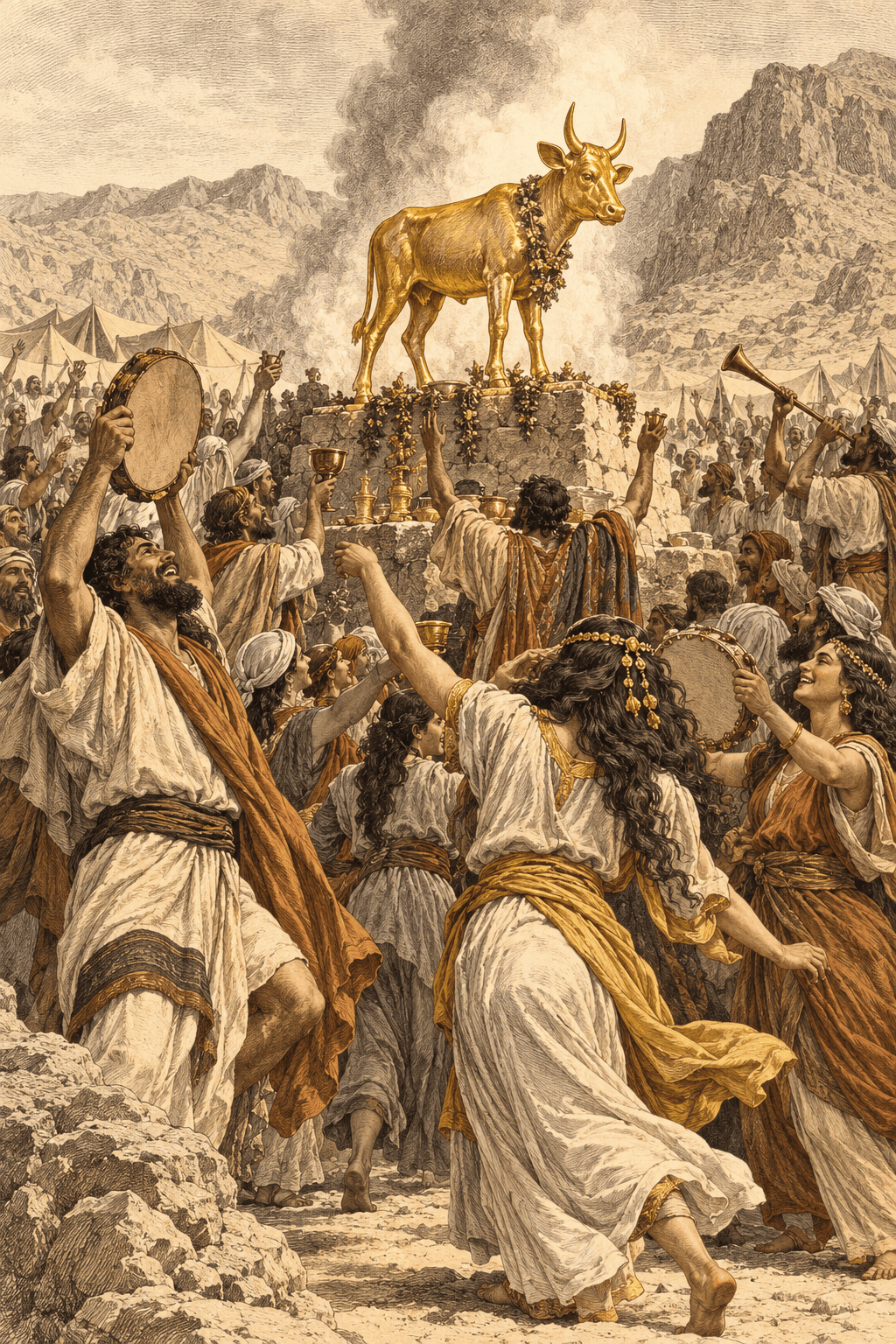
In Egypt the people had worshipped goat-idols and gone a whoring after them (Leviticus 17:7; Joshua 24:14; Ezekiel 20:8), so they were accustomed to worship a visible god, embodied before them. The presence of Moses the prophet before them, continually showing them God’s wonderful, tangible works, had for a time covered over their need for an embodied god before their eyes. So when Moses was absent from them they asked Aaron, saying: “Up, make us gods, [400] which shall go before us; for as for this Moses, the man that brought us up out of the land of Egypt, we wot not what is become of him” (1). They did not mean to ignore the God who brought them out of the land of Egypt, but they wanted to worship Him through the calf [401] that was in their heart. This appears from Aaron’s words: “To morrow is a feast to the LORD (Yahweh)” (5).
Yet we do not ignore that what they made was the effect of their old worship of the calf, which was still within them, for Saint Ephrem the Syrian says:
Moses was removed from them for a while, so that the calf which was before them might appear, and they might worship openly what they had been worshipping secretly in their hearts! [402]
He also said:
Moses was taken from them so that the idol worship that was within them might appear. [403]
In truth they were without excuse. If Moses had delayed, God’s works through Moses had not stopped: the manna came down on them every morning, the rock followed them, the pillar of light guided them by night, and the pillar of cloud shaded them by day… They were without excuse.
The Book of Deuteronomy gives another reason for this deviation: concern with bodily pleasure through eating, drinking, and play. It says: “But Jeshurun waxed fat, and kicked: thou art waxen fat, thou art grown thick, thou art covered with fatness; then he forsook God which made him… They sacrificed unto devils, not to God… Of the Rock that begat thee thou art unmindful, and hast forgotten God that formed thee” (Deuteronomy 32:15–18).
Saint John Chrysostom sees that luxury and drunkenness drew the people to idol worship, [404] just as “Esau through gluttony lost his birthright and became a murderer of his brother.” [405]
Saint Jerome cites the words of Scripture, “And the people sat down to eat and to drink, and rose up to play” (6), on the effect of gluttony in stirring up sins, saying:
When there is surfeit in the belly, then the other members rise up. [406]
He also comments on this event:
The labor of so many days was lost through one hour of fullness. [407]
And he said:
Moses boldly broke the two tables, for he knew that drunkards cannot hear the word of God. [408]
Finally, this people represents the corrupt human nature that wants to set up for itself a god according to its passions. It wants a god who pleases its evil conscience and gives free rein to the lusts of its body, and it does not want a cross and sufferings!
2. God’s Anger Against Moses’ People
KJV · Verses 7–14
7 And the Lord said unto Moses, Go, get thee down; for thy people, which thou broughtest out of the land of Egypt, have corrupted themselves: 8 They have turned aside quickly out of the way which I commanded them: they have made them a molten calf, and have worshipped it, and have sacrificed thereunto, and said, These be thy gods, O Israel, which have brought thee up out of the land of Egypt. 9 And the Lord said unto Moses, I have seen this people, and, behold, it is a stiffnecked people: 10 Now therefore let me alone, that my wrath may wax hot against them, and that I may consume them: and I will make of thee a great nation. 11 And Moses besought the Lord his God, and said, Lord, why doth thy wrath wax hot against thy people, which thou hast brought forth out of the land of Egypt with great power, and with a mighty hand? 12 Wherefore should the Egyptians speak, and say, For mischief did he bring them out, to slay them in the mountains, and to consume them from the face of the earth? Turn from thy fierce wrath, and repent of this evil against thy people. 13 Remember Abraham, Isaac, and Israel, thy servants, to whom thou swarest by thine own self, and saidst unto them, I will multiply your seed as the stars of heaven, and all this land that I have spoken of will I give unto your seed, and they shall inherit it for ever. 14 And the Lord repented of the evil which he thought to do unto his people.
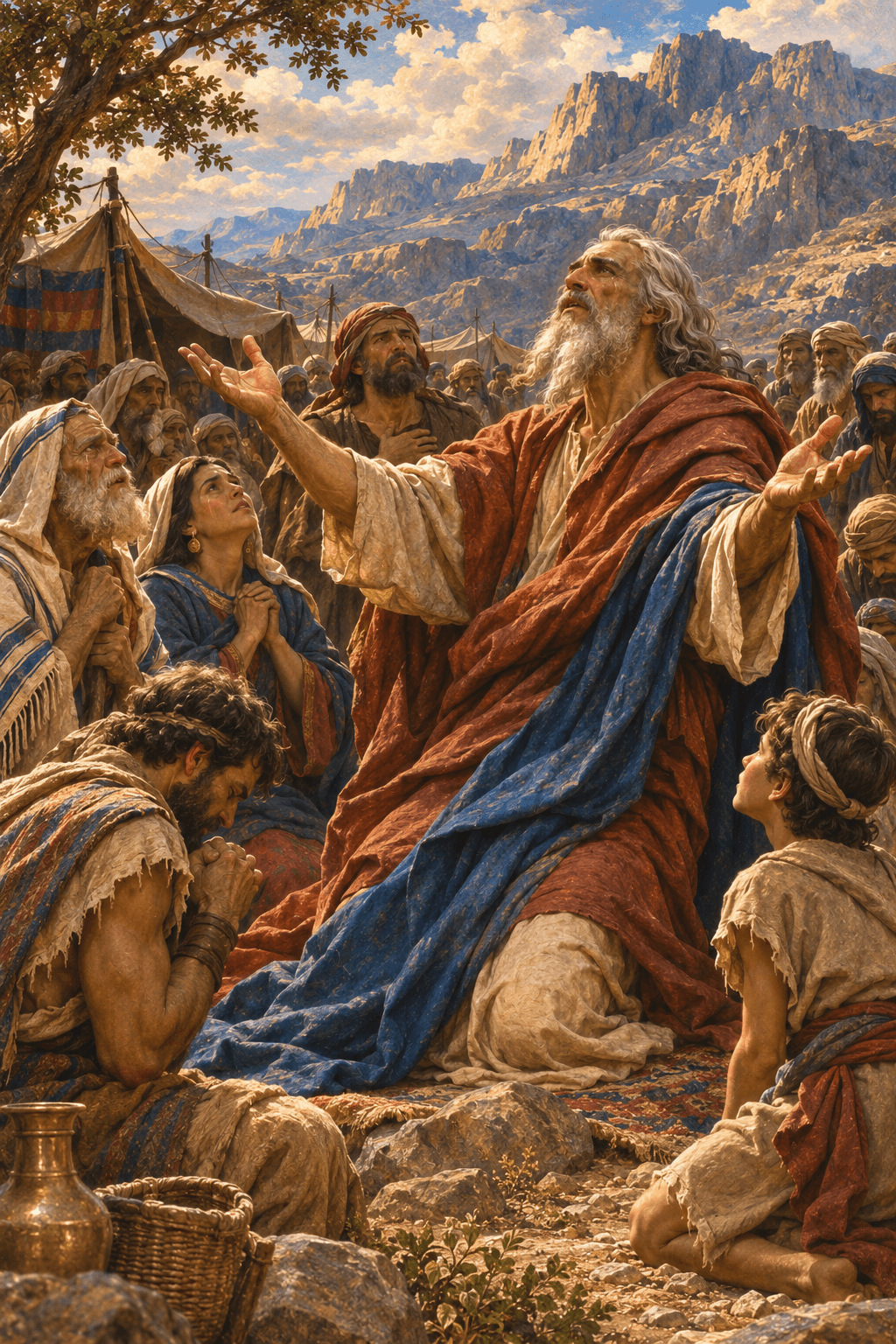
When the people chose for themselves another god according to their evil passions, the Lord could not bear to attribute this people to Himself. He no longer called them “my people,” but we see Him say to Moses the prophet: “Go, get thee down; for thy people, which thou broughtest out of the land of Egypt, have corrupted themselves” (7). Origen comments on this:
As the people, when they do not sin, are counted the people of God, but when they sin He no longer speaks of them as His people, so also the feasts: when God’s soul hates them, He calls them the feasts of sinners, though when He gave the law concerning them He called them the feasts of the Lord. [409]
God was angry at what man had come to; yet He opens the door before Moses to intercede, for He says to him: “I have seen this people, and, behold, it is a stiffnecked people: Now therefore let me alone, that my wrath may wax hot against them, and that I may consume them: and I will make of thee a great nation” (9–10). In saying “Let me alone,” He leaves him room to intercede and to declare his love for his people, that is, to practice his fatherly work.
And indeed Moses interceded for his people before God, offering Him three arguments. First, he reminds Him that they are His people, whom He cared for of old and brought out with great power and with a mighty hand (11). Second, that the enemy would rejoice at the defeat of His children, saying: “For mischief did he bring them out, to slay them in the mountains, and to consume them from the face of the earth” (12). Third, he reminds Him of His promises to their fathers, Abraham, Isaac, and Israel, His servants, to whom God swore by Himself that He would bless their seed and give them the land of promise (13).
Before Moses’ boldness Scripture says: “And the LORD repented of the evil which he thought to do unto his people” (14). We will leave for now speaking of Moses’ loving, fatherly heart; but I would like to make clear that God is not like other human beings, who err and then repent. He speaks to us here in human language, in the way we understand: when we offer repentance we fall under God’s mercies and compassions, and do not fall under the punishment (the evil).
3. Moses’ Anger and the Breaking of the Two Tables
KJV · Verses 15–19
15 And Moses turned, and went down from the mount, and the two tables of the testimony were in his hand: the tables were written on both their sides; on the one side and on the other were they written. 16 And the tables were the work of God, and the writing was the writing of God, graven upon the tables. 17 And when Joshua heard the noise of the people as they shouted, he said unto Moses, There is a noise of war in the camp. 18 And he said, It is not the voice of them that shout for mastery, neither is it the voice of them that cry for being overcome: but the noise of them that sing do I hear. 19 And it came to pass, as soon as he came nigh unto the camp, that he saw the calf, and the dancing: and Moses' anger waxed hot, and he cast the tables out of his hands, and brake them beneath the mount.
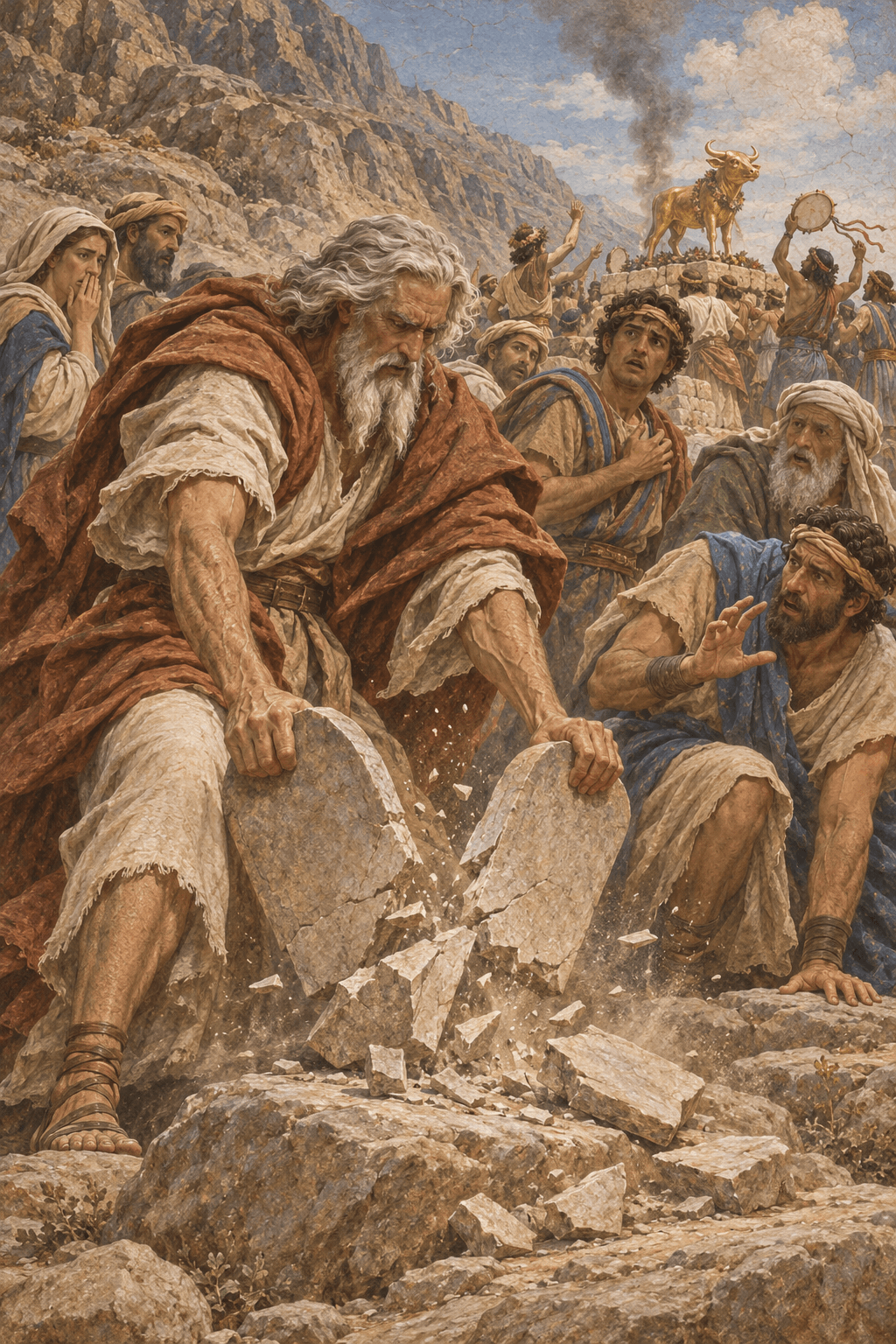
Moses the prophet, who could not bear the Lord’s words against his people and interceded for them until the Lord repented of what He would have done to them, when he came down to the foot of the mountain could not bear to see the people dancing around the calf. His anger waxed hot, and he cast the two tables out of his hands and broke them (19). On the mountain of knowledge Moses entered into the glories and received the divine commandment; but when he came down to the foot of the mountain he broke the two tables. So it is fitting for us to remain always lifted up and ascending from glory to glory; but coming down to the foot makes us break the commandment and fall under wrath!
Moses prophesied even in his anger. By breaking the two tables he declared the state of fallen humanity under the curse of the Law because of its breaking the commandment, now waiting for the work of divine grace in place of the Law, as Saint John says: “For the law was given by Moses, but grace and truth came by Jesus Christ” (John 1:17). And in the Epistle of Barnabas it is said: “Moses cast the two tables out of his hands, and their covenant was broken, so that the covenant of the beloved Jesus might be sealed in our heart, in the hope that springs from our faith in Him.” [410]
By the breaking of the two stone tables, the weight of the Law and its curse upon humanity, unable to carry it out, appeared. So this stone, that is, the killing letter of the Law, had to be removed, so that the grace of the Lord Christ might take its place.
This is what Saint Augustine explained in his symbolic interpretation of the Lord Christ’s words, “Take ye away the stone,” at the raising of Lazarus from the tomb. He says:
What do the words “Take ye away the stone” mean? They mean: Preach grace. For Paul the Apostle calls the ministry of the New Covenant the ministration of the spirit, not of the letter, for he says: “For the letter killeth, but the spirit giveth life” (2 Corinthians 3:6). The letter that kills is like the stone that crushes. Therefore He says: Take away the stone. Take away the weight of the Law, and preach grace. “For if there had been a law given which could have given life, verily righteousness should have been by the law. But the scripture hath concluded all under sin, that the promise by faith of Jesus Christ might be given to them that believe” (Galatians 3:21–22). [411]
4. The Grinding of the Golden Calf
KJV · Verses 20
20 And he took the calf which they had made, and burnt it in the fire, and ground it to powder, and strawed it upon the water, and made the children of Israel drink of it.
Scripture says: “And he took the calf which they had made, and burnt it in the fire, and ground it to powder, and strawed it upon the water, and made the children of Israel drink of it” (20).
Why did Moses act thus? He burned the calf with fire, ground it, and strewed it on the water so that the people would drink of this water mixed with the powder, as a sign that every person is bound to drink the fruits of his sins. So the Law commanded that a woman suspected of having conceived by a man other than her husband, with no witness against her, should drink the bitter water that causeth the curse. If she was innocent she would bear children and no harm would befall her; but if she was defiled, her belly would swell and her thigh rot, and she would be a curse among her people (Numbers 5:11–28).
Saint Augustine comments on what Moses the prophet did with the calf:
The head of the calf is a great mystery, for it is the head of a body of wicked men who are like the calf in eating grass, for they seek earthly things every day; for “all flesh is grass” (Isaiah 40:6). [412]
He (Moses) cast it into the fire so that its form would disappear, then ground it piece by piece so that it would be destroyed little by little, and cast it into the water and gave it to the people to drink. What does this mean but that the worshippers of Satan had become a body conformed to him? Just as those who confess Christ become the body of Christ, so that it is said to them: “Now ye are the body of Christ, and members in particular” (1 Corinthians 12:27). [413]
Saint Augustine sees that the people drank this image, ground and strewn on the water, and so consumed it, a sign of the destruction of Satan’s body by the Israelites, from whom came the apostles who preached among the nations and so made Satan lose his members. [414]
5. Moses’ Discipline of the People
KJV · Verses 21–29
21 And Moses said unto Aaron, What did this people unto thee, that thou hast brought so great a sin upon them? 22 And Aaron said, Let not the anger of my lord wax hot: thou knowest the people, that they are set on mischief. 23 For they said unto me, Make us gods, which shall go before us: for as for this Moses, the man that brought us up out of the land of Egypt, we wot not what is become of him. 24 And I said unto them, Whosoever hath any gold, let them break it off. So they gave it me: then I cast it into the fire, and there came out this calf. 25 And when Moses saw that the people were naked; (for Aaron had made them naked unto their shame among their enemies:) 26 Then Moses stood in the gate of the camp, and said, Who is on the Lord's side? let him come unto me. And all the sons of Levi gathered themselves together unto him. 27 And he said unto them, Thus saith the Lord God of Israel, Put every man his sword by his side, and go in and out from gate to gate throughout the camp, and slay every man his brother, and every man his companion, and every man his neighbour. 28 And the children of Levi did according to the word of Moses: and there fell of the people that day about three thousand men. 29 For Moses had said, Consecrate yourselves today to the Lord, even every man upon his son, and upon his brother; that he may bestow upon you a blessing this day.
Moses saw that the people were naked because of their wickedness and had become a derision among their enemies (25). He had interceded for the people before he saw the evil with his own eyes, and the Lord had accepted his intercession (14). Yet at the same time he firmly commanded all who were on the Lord’s side, the sons of Levi, to slay their brethren who were outside the doors of their tents, and there fell of the people that day about three thousand men (28). The people had sinned, and discipline was necessary. Those who had entered their tents in shame at their sin, repenting, were spared the sword. The proof of this is that when they gathered with Moses the next day he said to them: “Ye have sinned a great sin: and now I will go up unto the LORD; peradventure I shall make an atonement for your sin” (30). But those who did not care about what they had done, and were outside their tents, were slain.
6. Moses’ Intercession
KJV · Verses 30–35
30 And it came to pass on the morrow, that Moses said unto the people, Ye have sinned a great sin: and now I will go up unto the Lord; peradventure I shall make an atonement for your sin. 31 And Moses returned unto the Lord, and said, Oh, this people have sinned a great sin, and have made them gods of gold. 32 Yet now, if thou wilt forgive their sin--; and if not, blot me, I pray thee, out of thy book which thou hast written. 33 And the Lord said unto Moses, Whosoever hath sinned against me, him will I blot out of my book. 34 Therefore now go, lead the people unto the place of which I have spoken unto thee: behold, mine Angel shall go before thee: nevertheless in the day when I visit I will visit their sin upon them. 35 And the Lord plagued the people, because they made the calf, which Aaron made.
God asked Moses to let Him alone, that His wrath might wax hot against them and He might consume them (10), and make of him a great nation. But the fatherly heart refused to abandon his people, however hard their hearts, and interceded for them with power, [415] saying: “Yet now, if thou wilt forgive their sin—; and if not, blot me, I pray thee, out of thy book which thou hast written” (32)… This intercession has remained a living spring from which shepherds and servants draw fatherly love to this day. The following are some comments of the fathers on this intercession:
He said (God to Moses), “I will make of thee a great nation” (Exodus 32:10); but he did not accept, but clung to the sinners and prayed for them. How did he pray? It is a sign of love, my brethren! How did he pray? Notice that his conduct was like one who bears a mother’s tenderness, a thing I often speak of. God threatened the people who had defiled the holy things, but Moses’ tender heart trembled, exposing himself to God’s anger for their sake, for he said: O Lord, “Yet now, if thou wilt forgive their sin—; and if not, blot me, I pray thee, out of thy book which thou hast written” (32). In this he looked to God’s justice and His mercy at the same time: being just, He does not destroy the righteous man (that is, Moses); being merciful, He forgives the sinners. [416]
O the power of love! O its perfection, surpassing all perfection! The servant speaks to his Master with all freedom, asking forgiveness for the people, or to perish with the multitude. [417]
How great his perfection, for he wishes to die with the people rather than be saved alone! [418]
He says: It is easier for me to perish with them than to be saved without them! Truly it is love even to madness, love without limits! What are you saying, Moses? Do you not care for heaven…? Yes, for I love those who have sinned against me! Do you pray that your name be blotted out? Yes, for what can I do before love?! [419]
He said this because he was a friend of God, bearing His character (love)! [420]
Such was the first concern of great and noble men: they seek not their own, but every man another’s. By this they grew brighter and more splendid! Moses worked many great wonders and signs, but one thing made him so great: his blessed word with God, “If thou wilt forgive their sin—; and if not, blot me…” [421]
What did Moses do? Is this not he who fled for fear of one Egyptian (Pharaoh) and went into exile? Yet this fugitive, who could not bear the threats of one man, when he tasted the honey of love, came forward with all nobility, and with no one compelling him, to die with his beloved, saying: “If thou wilt forgive their sin—; and if not, blot me, I pray thee, out of thy book which thou hast written” (32). [422]
Such are the bowels of the saints: they count death with their children sweeter than life without them. [423]
The fathers also see that Moses the prophet was sure of the love of God, who would accept his intercession and not expose his life to death. Saint Augustine says:
For he knew that he was doing this before the Merciful One, who would never blot out his name, but would forgive them for his sake. [424]
And Saint Ambrose says:
God did not blot out his name; rather, grace overflowed upon him, for no evil was found in him. [425]
Through this work Moses became a living example of love, meekness, and forbearance, so that Saint John Chrysostom sees in his appearing with Elijah at the Transfiguration of the Lord Christ before His disciples a declaration of the marks the disciples should have: bearing the meekness and forbearance of Moses, who turned away God’s anger from His people, and the firmness and zeal of Elijah, who asked that famine come for three and a half years for discipline.
On the effectiveness of Moses’ intercession for his people Saint John Chrysostom comments:
Truly the prayers of the saints have great power, on condition of our repentance and the amendment of our souls. For even Moses, who saved his brother and six hundred thousand men from the wrath of God, could not save his sister. [426]
Speaking of the intercession of the saints, Saint Jerome says:
If one man, Moses, won from God pardon for six hundred thousand men of war, and Stephen the Christian martyr prayed for forgiveness for his persecutors (Acts 7:60), will their power be less when they have entered with their lives into Christ?! [427]
Finally, with the acceptance of Moses’ intercession for the people, He says: “Nevertheless in the day when I visit I will visit their sin upon them” (34). He accepted the intercession of Moses the prophet, so He does not consume them, but gives help so that His promises to the people may be fulfilled. Yet not without condition: since they accepted sin, when He visits them with salvation He also visits sin in them, that is, disciplines them. So He plagued them with discipline (35), so that He might again declare His work of salvation in their life.
God’s love or mercy does not conflict with His justice. If He forgives, He does not accept carelessness, nor does He unite with man while he is still in his sin. Perhaps by saying, “I will visit their sin upon them,” He pointed to His paying the price of sin and accepting death for them on the day of His visiting them on the Cross, so that He might bring them over into the true land of promise.
Notes and References
[400] The exact translation is “a god,” not “gods.”
[401] Edersheim, Bible History, vol. 2, p. 126.
[402] St. Ephrem the Syrian, Homily 2 on Our Lord 1:17.
[403] Ibid. 1:42.
[404] St. John Chrysostom, In Matt. hom. 57:5.
[405] St. John Chrysostom, In Acts hom. 27.
[406] St. Jerome, Epistle 22:8.
[407] St. Jerome, Against Jovinianus 2:15.
[408] Ibid.
[409] Origen, Commentary on John 10:11.
[410] Epistle of Barnabas 4.
[411] St. Augustine, On the Gospel of St. John, tractate 49:22.
[412] St. Augustine, On Psalm 62.
[413] St. Augustine, On Psalm 74.
[414] St. Augustine, On Psalm 74.
[415] St. John Chrysostom sees that the opportunity came for Moses to rid himself of this hard and stubborn people by divine command; but as a holy shepherd and loving father he could not bear, nor accept, to abandon his weak children in order to look for other children. This is what befits the shepherd of souls. On St. John, hom. 13:1.
[416] St. Augustine, Sermons on New Testament Lessons 38:24.
[417] St. Clement of Rome, First Epistle 53.
[418] Clement of Alexandria, Stromata 4:19.
[419] St. John Chrysostom, In Eph. hom. 7.
[420] St. John Chrysostom, In Rom. hom. 27.
[421] St. John Chrysostom, In 1 Cor. hom. 25.
[422] St. John Chrysostom, In 1 Cor. hom. 34.
[423] St. John Chrysostom, Concerning the Statues, hom. 3:2.
[424] St. Augustine, On Psalm 78.
[425] St. Ambrose, On the Holy Spirit 3:10.
[426] St. John Chrysostom, In Matt. hom. 5:7.
[427] St. Jerome, Against Vigilantius 6.