
When the old world drowned in the waters of the flood, a new world arose, represented by Noah and his family. God Himself cared for their salvation and the renewal of the earth. He accepted man’s sacrifice as a sweet savour, that He might enter into a new covenant with him.
1. A Wind Passes over the Earth
Genesis 8:1-5
1 And God remembered Noah, and every living thing, and all the cattle that was with him in the ark: and God made a wind to pass over the earth, and the waters asswaged; 2 The fountains also of the deep and the windows of heaven were stopped, and the rain from heaven was restrained; 3 And the waters returned from off the earth continually: and after the end of the hundred and fifty days the waters were abated. 4 And the ark rested in the seventh month, on the seventeenth day of the month, upon the mountains of Ararat. 5 And the waters decreased continually until the tenth month: in the tenth month, on the first day of the month, were the tops of the mountains seen.
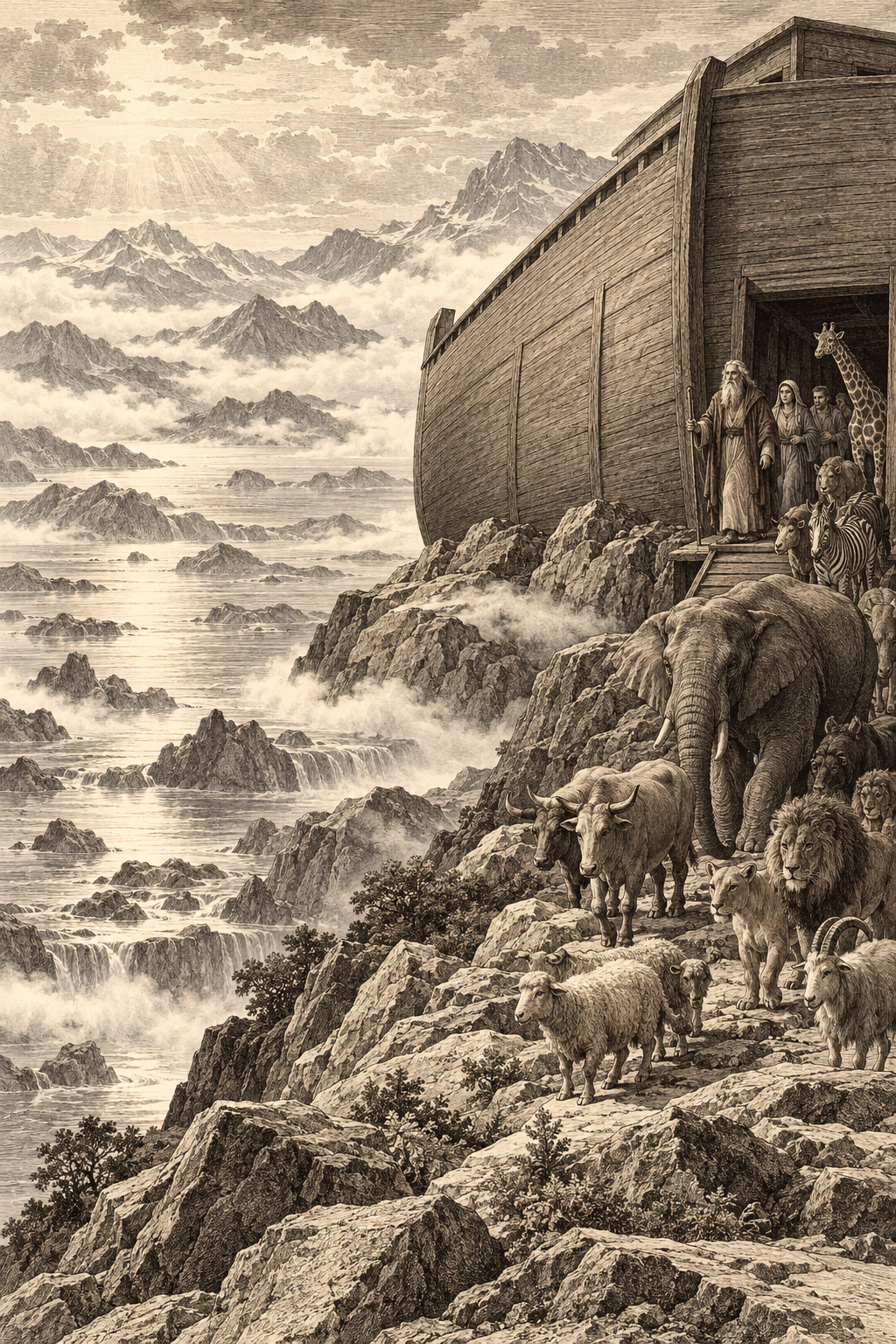
“And God remembered Noah, and every living thing, and all the cattle that was with him in the ark: and God made a wind to pass over the earth, and the waters asswaged … in the tenth month, on the first day of the month, were the tops of the mountains seen” (Genesis 8:1, 5).
Although God had shut Noah in, He did not forget him amid the waters. He was like a potter watching an earthen vessel inside the furnace, bringing it out at the proper time as a vessel of honour. For righteous Noah’s sake the fountains of the deep burst forth and the windows of heaven opened, washing and renewing the earth for him so that he might enjoy a new world in place of the old. For his sake the Lord shut him in, keeping him safe from all the currents surrounding him; and for his sake He also sent a wind over the earth. We know that “wind” and “spirit” are one word in Hebrew. It is as though, amid the waters of baptism, God breathes His Holy Spirit to sanctify our earth, preparing us to become members of the body of the Lord Christ and a temple of His Holy Spirit. Saint Clement of Alexandria says:
“The Instructor creates man from dust, renews him through water, and makes him grow through the Spirit. [187]”
Now, as the waters grew calm and receded, the ark rested on the seventeenth day of the seventh month upon Mount Ararat in Armenia. Its name is derived from the Akkadian word “Urartu,” meaning “a high place.” It may be the peak now called in Turkish “Ağrı Dağı,” meaning “a lofty mountain,” rising 16,916 feet above sea level.
On the first day of the tenth month, the tops of the lower mountains began to appear. If the number 10 signifies the Law, then when a person begins to live by the commandment—the spiritual Law—the mountain peaks of virtue, formerly covered and hidden by our sins, appear within him. If the ark, that is, the Lord Christ, rests within us as upon Mount Ararat, His lofty and steadfast mountain, He reveals Himself in us. The life of godliness appears in our depths like the tops of living mountains when we accept His spiritual Law; we become like those who have reached the first day of the tenth month.
2. Sending Out a Raven and a Dove
Genesis 8:6-12
6 And it came to pass at the end of forty days, that Noah opened the window of the ark which he had made: 7 And he sent forth a raven, which went forth to and fro, until the waters were dried up from off the earth. 8 Also he sent forth a dove from him, to see if the waters were abated from off the face of the ground; 9 But the dove found no rest for the sole of her foot, and she returned unto him into the ark, for the waters were on the face of the whole earth: then he put forth his hand, and took her, and pulled her in unto him into the ark. 10 And he stayed yet other seven days; and again he sent forth the dove out of the ark; 11 And the dove came in to him in the evening; and, lo, in her mouth was an olive leaf pluckt off: so Noah knew that the waters were abated from off the earth. 12 And he stayed yet other seven days; and sent forth the dove; which returned not again unto him any more.
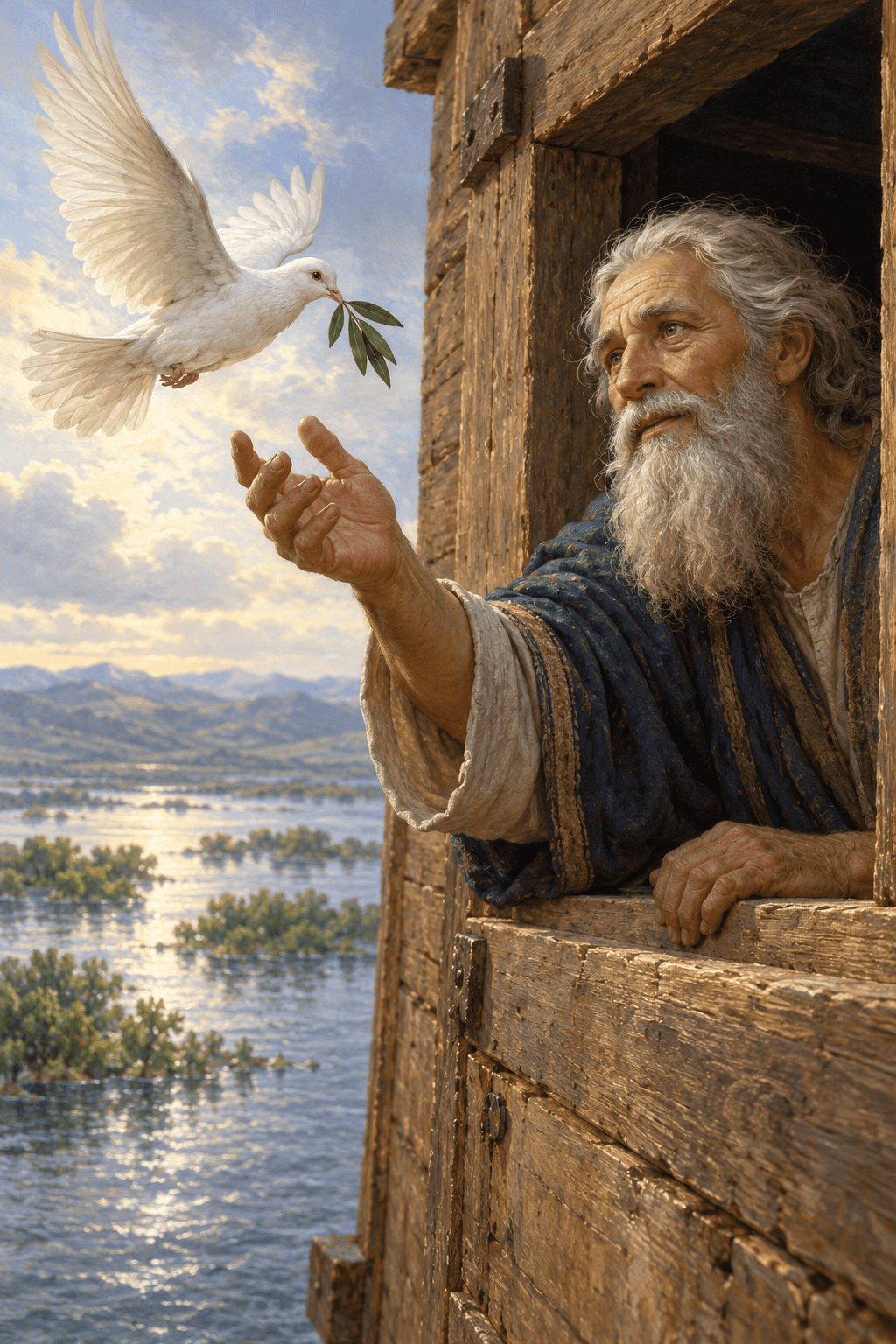
Forty days passed after the mountain peaks appeared. Noah then opened the window of the ark which he had made and sent out a raven. The raven went to and fro (Genesis 8:7), flying to the putrid corpses and returning again to stand outside the ark. Thus Noah saw it coming and going. Noah suffered, so he sent out a dove. Finding no resting place for her foot, she returned to him into the ark (Genesis 8:9). He stretched out his hand and took her in to himself. He waited another seven days and sent her again. She came to him in the evening with a fresh olive leaf in her mouth. After seven more days he sent her out, and she did not return to him.
If the ark signifies the Church, it contained both the raven and the dove. As Saint Augustine says:
“Noah sent forth these two kinds of birds; he had both the raven and the dove.… If the ark was the Church, then truly, as she is seen amid the flood of this present world, she necessarily contains both kinds: the dove and the raven. What are the ravens? Those who seek their own things. What are the doves? Those who seek the things of Christ (Philippians 2:21). [188]”
The raven signifies sin, which must be driven out. It departs and does not enter the ark again, but continues to move between the corrupt corpses and the outside of the ark. Noah does not stretch out his hand to bring it in to himself as he did with the dove. Saint Ambrose says:
“The raven is a symbol of sin, which departs and does not return, provided that righteousness is preserved in you inwardly and outwardly. [189]”
Saint Jerome also says:
“The raven was sent out from the ark and did not return; afterward the dove proclaimed peace to the earth. So also in the baptism of the Church the devil, the most unclean of birds, is driven away, and the dove, the Holy Spirit, proclaims peace to our earth. [190]”
He also says:
“When the world fell into sin, nothing could wash it anew except the waters of the flood. The dove of the Holy Spirit flew toward Noah after the raven had gone far away, as though she were coming toward Christ in the Jordan (Matthew 3:16). She came carrying in her beak a branch symbolizing restoration and light, to proclaim peace to the whole world. [191]”
While the raven found food and a resting place upon the corrupt corpses, the dove—the believing soul—could rest only in Noah’s hands. She went out from the ark three times.
A. The First Departure
The first time, she found no resting place for her foot. This signifies the soul aflame with the Holy Spirit, the heavenly Dove, which cannot settle or rest upon corrupt corpses. In her sojourning she is drawn toward the ark, finding the hand of her Christ stretched out to carry her into His bosom as her place of rest.
B. The Second Departure
The second time, she went out into the world and returned to proclaim Christ’s peace through the new world, after the corpses had disappeared and corruption had been removed by the appearance of new life in Christ Jesus. Saint Augustine sees the olive branch as a symbol of peace in many ways. The olive tree is evergreen, as though it represents a person filled with peace whose greenness storms cannot take away. Again, when another liquid such as water is poured upon olive oil, the oil is not spoiled; it floats above the water without mixing with it. It resembles a person who, when struck by the waters of trials, rises above them and floats above affliction.
C. The Third Departure
The third time, she left the ark and did not return. This was not to abandon Noah, but to signify the departure of the whole company into the new earth. She represents the person who has departed into eternity as into a new life. He no longer returns bodily into the visible Church on earth, yet, remaining a member of her, he has gone to the place where the whole company meets upon the clouds and enters into glory.
3. Removing the Covering of the Ark
Genesis 8:13-14
13 And it came to pass in the six hundredth and first year, in the first month, the first day of the month, the waters were dried up from off the earth: and Noah removed the covering of the ark, and looked, and, behold, the face of the ground was dry. 14 And in the second month, on the seven and twentieth day of the month, was the earth dried.
“Noah removed the covering of the ark, and looked, and, behold, the face of the ground was dry” (Genesis 8:13). This took place in the six hundred and first year of Noah’s life, on the first day of the first month. It is as though Noah ended the six hundred years of his life and began his seventh century by uncovering the ark and looking out from it upon the new earth. In this he signifies the Lord Christ, the true Noah, the Leader of the Church who dwells in her midst for her rest. He works through the six days for the salvation of His flock of a hundred sheep (Luke 15:4), throughout all the days of the Church’s sojourning: 6 × 100 = 600. When time passes away and the seventh day, the day of rest, arrives, the Lord removes every covering so that we may meet Him face to face. As the Apostle Paul says, “For now we see through a glass, darkly; but then face to face: now I know in part; but then shall I know even as also I am known” (1 Corinthians 13:12).
Thus, despite all the divine revelations, fellowship with God, and foretaste of heavenly life that the Apostle enjoyed here, he considered himself in all this to be seeing through a mirror or in a riddle when compared with what he would receive in the eternal encounter with God face to face. Saint John Chrysostom says:
“If God hastens toward us now that we may cleave to Him, then we shall know many things that are now considered a mystery, and we shall enjoy the most blessed life and wisdom. [192]”
4. Noah Goes Out into the New Earth
Genesis 8:15-19
15 And God spake unto Noah, saying, 16 Go forth of the ark, thou, and thy wife, and thy sons, and thy sons’ wives with thee. 17 Bring forth with thee every living thing that is with thee, of all flesh, both of fowl, and of cattle, and of every creeping thing that creepeth upon the earth; that they may breed abundantly in the earth, and be fruitful, and multiply upon the earth. 18 And Noah went forth, and his sons, and his wife, and his sons’ wives with him: 19 Every beast, every creeping thing, and every fowl, and whatsoever creepeth upon the earth, after their kinds, went forth out of the ark.
On the twenty-seventh day of the second month, the earth was completely dry and Noah was commanded to go out. This was eight weeks after he removed the covering of the ark, and at the end of the fifty-third week from the beginning of the flood. The following is a simple chronology of the flood’s events.
The Chronology of the Flood
1. Noah entered the ark and the flood began in year 600 of his life, month 2, day 17, seven days after the command to gather the animals and birds. The source repeats 600/2/17 in its bracketed statement about the command.
2. Rain fell and the fountains of the deep burst forth: 40 days.
3. The waters prevailed over the earth for 150 days, including the first 40 days of the flood: a further 110 days.
4. The waters decreased until the mountain peaks appeared, in year 600, month 10, day 1 (Genesis 8:5): 74 days.
5. The raven was sent out after 40 days (Genesis 8:6-7): 40 days.
6. The dove was sent out for the first time after 7 days: 7 days. [*]
7. The dove was sent out a second time: 7 days.
8. The dove was sent out a third time: 7 days.
9. From sending out the dove to removing the covering, in year 601, month 1, day 1: 29 days.
10. From removing the covering until Noah went out (Genesis 8:14): 57 days. The printed chronology gives the date as 601/2/7; the biblical passage and the preceding commentary give the twenty-seventh day.
The duration of the flood’s events from its beginning until Noah left the ark was one year and 11 days: 371 days (360 + 11).
5. Noah Builds an Altar to the Lord
Genesis 8:20-22
20 And Noah builded an altar unto the LORD; and took of every clean beast, and of every clean fowl, and offered burnt offerings on the altar. 21 And the LORD smelled a sweet savour; and the LORD said in his heart, I will not again curse the ground any more for man’s sake; for the imagination of man’s heart is evil from his youth; neither will I again smite any more every thing living, as I have done. 22 While the earth remaineth, seedtime and harvest, and cold and heat, and summer and winter, and day and night shall not cease.
The first thing Noah did after leaving the ark was to build an altar to the Lord upon the new earth, washed by the waters of the flood. It is as though the Church can offer the sacrifice of the Lord Christ—the Eucharist—only after receiving baptism. For this reason also, this is the first time Holy Scripture announces the building of an altar to the Lord, although sacrifices had undoubtedly been offered to Him since the departure from Paradise.
God declared His good pleasure toward man after smelling a sweet savour through the sacrifice of reconciliation, affirming that He would not again destroy humanity together because of its weakness. How wonderful God is in His forgiveness and pardon!
The new life began with worship through sacrifice, as through the Cross, and the curse was removed from the earth (Genesis 8:21). Then man began to work for his daily needs.
Finally, what Noah offered was a symbol of the sacrificial work of the Lord Christ in His Church. As the priest says:
“He who offered Himself as an acceptable sacrifice upon the Cross for the salvation of our race, and His good Father smelled Him at evening time on Golgotha. [193]”
Notes and References
[187] The author, Divine Love, p. 866.
[188] In Ioan. Tr. 6:2.
[189] In Mystr. 3.
[190] Dial. adv. Lucif. 22.
[191] Ep. 96:6.
[192] In 1 Cor. hom. 34:2.
[*] Addition from the website: Scripture does not explicitly state that Noah first sent out the dove seven days after the raven. But Genesis 8:10 reads, “And he stayed yet other seven days; and again he sent forth the dove out of the ark.” The words “yet” and “other” suggest an earlier period of seven days, followed by a second period of seven days concerning the dove. Some interpretations hold that the prophet Noah followed a Sabbath cycle—a weekly observance every seven days. Matthew Henry, in his commentary on Genesis 8, says that Noah observed the Sabbath, prayed, and then sent out a bird every seven days on the Sabbath, awaiting heaven’s blessing: “Note here that Noah sent forth the dove the second time seven days after the first time, and the third time was after seven days too; and probably the first sending of her out was seven days after the sending forth of the raven. This intimates that it was done on the sabbath day, which, it should seem, Noah religiously observed in the ark.”
[193] The Raising of Incense (the Divine Liturgy).