
When God smelled a sweet savour in the sacrifice of renewed humanity, He blessed mankind, giving it a law to obey, a covenant binding it to Him, and a sign to sustain it during the days of its sojourn.
1. God Blesses Noah and His Sons
Genesis 9:1
1 And God blessed Noah and his sons, and said unto them, Be fruitful, and multiply, and replenish the earth.
When Noah and his sons came out onto the earth renewed by the waters of the flood, God blessed them and gave them what He had previously granted Adam and Eve: “Be fruitful, and multiply, and replenish the earth.” It was as though humanity had begun again, or the world had received a new beginning through Noah in place of the first Adam. This blessing is, in truth, a symbol of the blessing received by the Church in the New Testament through the true Noah, our Lord Jesus, the Giver of rest. In place of the first Adam, the Second Adam has become our Head; in place of the first Eve, the Church has become our new Eve, through whom the children of God are born, multiply, and grow exceedingly. Through the first Adam we received bodily birth; through the new Adam, the true Noah, we received spiritual birth.
Saint Jacob of Serugh says:
“Our first father was bitten by the serpent, which brought him down to Hades. There he lies within destruction, cast down in humiliation, surrounded by mud and every kind of worm. Moths have become his clothing, and spiders his robe. Earth lies beneath him and decay above him. He has sunk into the dust, which embraces his clay, and he is afflicted by the abyss. This is our first father, and this is his country. Had this birth not been changed, we would have remained in great humiliation. Flee, you who hear, from this great humiliation, and seek another Father for yourselves in heaven. Hasten, take refuge in baptism, and ask her to be your mother, for she offers you a rich Father, full of good things. She gives birth to you even if you are an old man, making you a child beloved by the King, your Father. [194]”
Saint Augustine says:
“We have two births: one earthly and the other heavenly. The first is of the flesh, the second of the Spirit. The first proceeds from a perishable beginning, the second from an eternal beginning. The first is from a man and a woman, the second from God and the Church. The first makes us children of the flesh, the second children of the Spirit. The first makes us children of death, the second children of the resurrection. The first makes us children of this age, the second children of God. The first makes us children of the curse and wrath, the second children of blessing and love. The first binds us with the chains of original sin; the second frees us from the bonds of every sin. [195]”
2. The Law of Noah
Genesis 9:2-7
2 And the fear of you and the dread of you shall be upon every beast of the earth, and upon every fowl of the air, upon all that moveth upon the earth, and upon all the fishes of the sea; into your hand are they delivered. 3 Every moving thing that liveth shall be meat for you; even as the green herb have I given you all things. 4 But flesh with the life thereof, which is the blood thereof, shall ye not eat. 5 And surely your blood of your lives will I require; at the hand of every beast will I require it, and at the hand of man; at the hand of every man's brother will I require the life of man. 6 Whoso sheddeth man's blood, by man shall his blood be shed: for in the image of God made he man. 7 And you, be ye fruitful, and multiply; bring forth abundantly in the earth, and multiply therein.
Having granted humanity a blessing through the waters of baptism, so that it might receive a new beginning through Noah in place of Adam, God gave it a law in place of the commandment previously given to Adam. This law, which may be called “the law of Noah,” contains the following provisions.
First: Permission to Eat Meat
God permitted the eating of the flesh of animals, birds, and fish, saying: “And the fear of you and the dread of you shall be upon every beast of the earth, and upon every fowl of the air, upon all that moveth upon the earth, and upon all the fishes of the sea; into your hand are they delivered. Every moving thing that liveth shall be meat for you; even as the green herb have I given you all things” (Genesis 9:2-3). Previously, humanity's food had been the green herb; now it was permitted to eat animals, birds, and fish. Why? To prepare the way for accepting the Mosaic Law, under which the priest was required to eat of the peace offering, as a symbol of enjoying communion in the Body and Blood of our Lord Jesus. As He says: “For my flesh is meat indeed, and my blood is drink indeed”; and, “Whoso eateth my flesh, and drinketh my blood, hath eternal life” (John 6:54-55).
Sacrifice is therefore not, as some pagans suppose, a means of appeasing God's anger. God does not delight in burnt offerings, nor does He eat flesh or fat. Rather, the holy sacrifice, proclaiming God's reconciliation with humanity, is His gift to mankind. Through it the soul is satisfied and the heart refreshed on a spiritual level beyond nature.
Second: The Prohibition of Blood
When God permitted the eating of meat, He warned against eating it with its blood, preparing the way for revealing the importance of the Blood poured out for us as the essential element of atonement and redemption: “without shedding of blood is no remission” (Hebrews 9:22), and “the precious blood of Christ, as of a lamb without blemish and without spot” (1 Peter 1:19).
On the bodily level, He forbade eating or drinking blood to preserve humanity's health. On the moral level, He guarded against savagery and violence. On the spiritual level, He wished blood to be held sacred, since it represents the life poured out for humanity's salvation.
Third: The Prohibition of Murder
God was concerned that permission to eat animal flesh might lead people to stretch out their hands against their fellow human beings. He therefore warned against shedding human blood.
3. Renewing the Covenant
Genesis 9:8-17
8 And God spake unto Noah, and to his sons with him, saying, 9 And I, behold, I establish my covenant with you, and with your seed after you; 10 And with every living creature that is with you, of the fowl, of the cattle, and of every beast of the earth with you; from all that go out of the ark, to every beast of the earth. 11 And I will establish my covenant with you; neither shall all flesh be cut off any more by the waters of a flood; neither shall there any more be a flood to destroy the earth. 12 And God said, This is the token of the covenant which I make between me and you and every living creature that is with you, for perpetual generations: 13 I do set my bow in the cloud, and it shall be for a token of a covenant between me and the earth. 14 And it shall come to pass, when I bring a cloud over the earth, that the bow shall be seen in the cloud: 15 And I will remember my covenant, which is between me and you and every living creature of all flesh; and the waters shall no more become a flood to destroy all flesh. 16 And the bow shall be in the cloud; and I will look upon it, that I may remember the everlasting covenant between God and every living creature of all flesh that is upon the earth. 17 And God said unto Noah, This is the token of the covenant, which I have established between me and all flesh that is upon the earth.
God established a covenant with Noah and his sons, making the rainbow a sign of the covenant between Himself and them, and between Himself and their descendants after them. Since chastisement had come through nature—the flood—God set the sign in nature, the rainbow. In the New Testament, however, when the Lord Christ bore our chastisement in His Body, He placed the sign in that Body through the wounds of the cross.
The rainbow appears around the divine throne (Revelation 4:3; Revelation 10:1), for God's glory is not only might and majesty, but also boundless love. The rainbow is the sign of love God gave when He established His covenant with Noah after the flood. God remains the Lover of mankind, offering us every love through His covenant with us.
This bow has many colours, proclaiming God's goodness and His manifold gifts. As a bow, it recalls the weapon used in warfare: it is as though God defends us with His bow, yet without an arrow, for He does not love the shedding of blood. Through Him we overcome sin and trample upon Satan. [196]
How wonderful that God, in His love for humanity, cherishes His covenant with it, saying “my covenant” (Genesis 9:9, 11, 15) and “my bow” (Genesis 9:13).
4. Noah and His Nakedness
Genesis 9:18-23
18 And the sons of Noah, that went forth of the ark, were Shem, and Ham, and Japheth: and Ham is the father of Canaan. 19 These are the three sons of Noah: and of them was the whole earth overspread. 20 And Noah began to be an husbandman, and he planted a vineyard: 21 And he drank of the wine, and was drunken; and he was uncovered within his tent. 22 And Ham, the father of Canaan, saw the nakedness of his father, and told his two brethren without. 23 And Shem and Japheth took a garment, and laid it upon both their shoulders, and went backward, and covered the nakedness of their father; and their faces were backward, and they saw not their father's nakedness.
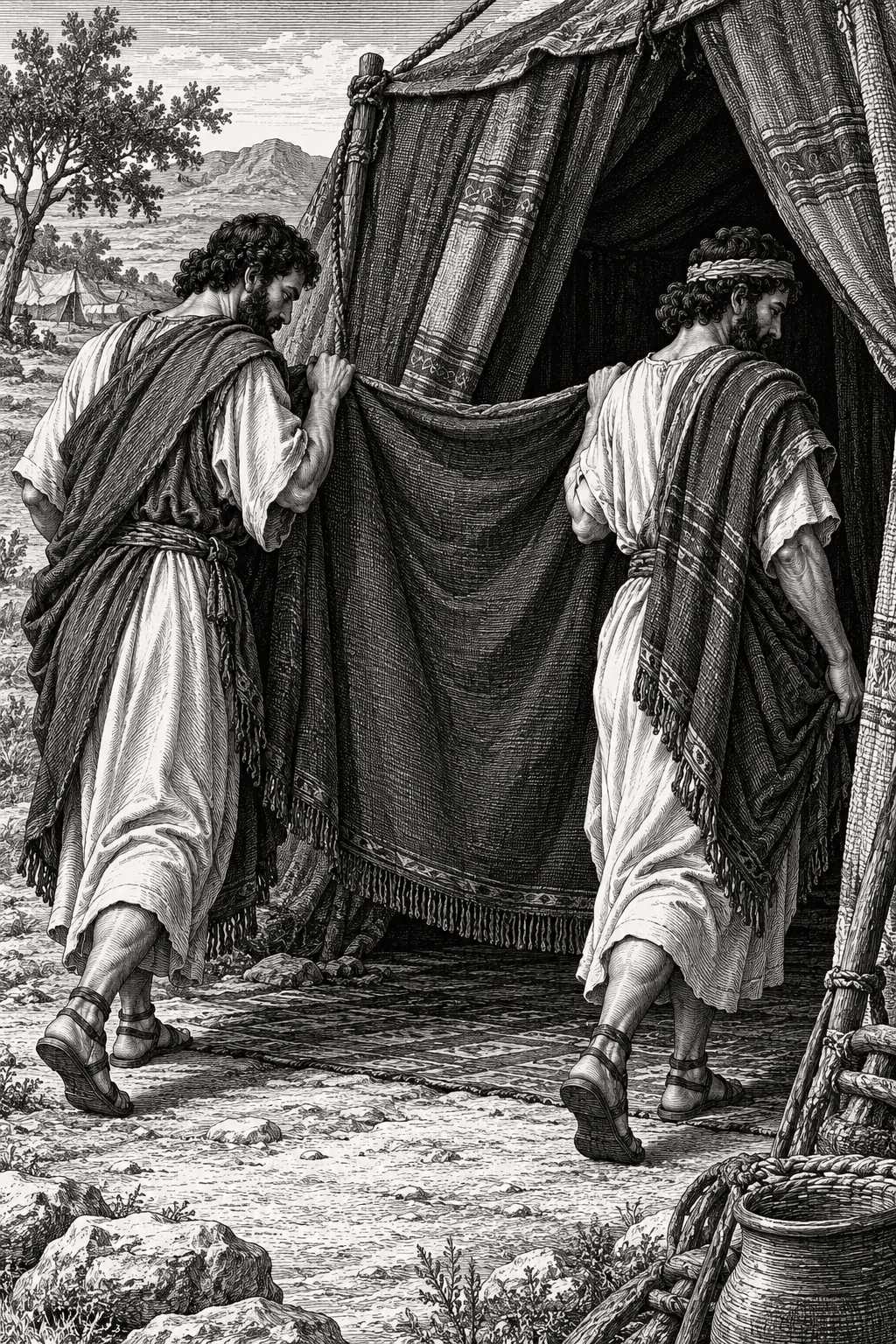
Coming out onto the new earth washed by the flood, “Noah began to be an husbandman, and he planted a vineyard” (Genesis 9:20). He was not “a tiller of the ground” like Cain (Genesis 4:2), but a husbandman planting a vineyard. Cain represents the person who directs his work towards the earth and earthly things, spending all his energy on temporal concerns. Noah, however, points to the Lord Christ, who came to us as a husbandman to plant His vineyard anew: the Church, which has become as a new earth, watered by the waters of the Holy Spirit and washed in the Blood of the all-holy Christ. A Jewish legend relates that Noah obtained a cutting from a vine that had fallen from Paradise and planted it. [197]
In any event, Noah planted a vineyard, most likely without understanding the effects of fermented grape juice. Some of the Fathers therefore consider him the first person to experience intoxicating drink. [198] Whether knowingly or unknowingly, he became drunk and was uncovered. Holy Scripture recorded this weakness to assure us that salvation was not the result of Noah's own righteousness. If he was righteous, it was because of the grace that sustained him in his struggle.
What Does This Incident Reveal?
First: the danger of drunkenness, which strips a person of his covering and exposes him even before his children. Saint Jerome says:
“No one may say that drunkenness is not a sin. We read that Noah became drunk once, but God warns us against supposing him to have been a drunkard and an addict of wine. [199]”
He also says:
“One hour's drunkenness exposed him who for six hundred years had remained covered with dignity. [200]”
And again:
“After his drunkenness his body was uncovered, for self-indulgence leads in the end to falling into lust. The belly is first filled to excess, and then the members are stirred up. [201]”
Saint Ambrose says:
“O power of wine! You made him whom the waters of the flood could not overcome become naked! [202]”
If wine intoxicates a person in this way, exposing one who had remained clothed in dignity for more than six hundred years, one whom the waters of the flood could not reach, then sin is truly the intoxicating wine that strips the soul and exposes it. The Lord Christ, however, is the glorious garment that covers the soul against its eternal disgrace. Saint Jerome says:
“We are Christ's garment, for He clothes Himself with us through our faith in Him; and we too put Him on as our garment. As the Apostle says, Christ is our clothing: we put Him on when we are baptized (Galatians 3:27). When we put on Christ, Christ also puts us on! [203]”
Second: when Noah was uncovered, Ham saw his father's nakedness; Shem and Japheth, however, guided by the natural law, took care not to see their father's nakedness. Here the unity and agreement of the natural law and the written Law appear, for the Law warns against uncovering the nakedness of one's father or mother (Leviticus 18:6-18). Uncovering nakedness is not to be understood only in a strictly literal sense: it may also mean violating one's father's wife, or a girl committing evil with her mother's husband. Ham's action, however, involved mockery of his father, who was literally uncovered.
If through faith we see every person as our father, mother, brother, or sister, let us expose no one. Rather, let us cover others in love as far as we can, in Christ Jesus, who covers our sins!
Third: although Noah erred by drinking wine and becoming drunk until he was uncovered, God in His love did not conceal the weaknesses of His servants. He even turns weaknesses to good, just as He turned the plan of Joseph's brothers to destroy him into good for both them and their brother. Saint Jerome saw in this story of Noah a symbolic image of the Lord Christ, who drank the cup of suffering and was stripped upon the cross for our sake. The wicked mocked Him, represented by Ham, while the nations believed in Him, represented by Shem and Japheth. Saint Jerome says:
“All this was spoken as a type of the Saviour, who drank suffering upon the cross, saying, “O my Father, if it be possible, let this cup pass from me” (Matthew 26:39). He drank, became drunk, and His body was uncovered. The elder, Ham—that is, the Jews—came and laughed; but the younger—that is, the Gentiles—covered His sufferings. As the Father became drunk through His sufferings, so the saints become drunk with the fragrance of their faith: they become drunk with the Holy Spirit. Yesterday you were gathering gold, and now you cast it away. Is this not reckoned drunkenness in the eyes of one who does not understand these things? Finally, when the Holy Spirit descended upon the disciples, filled them, and they spoke in many tongues, they were accused of being drunk with new wine. [204]”
Notice that Saint Jerome considers Ham the elder, perhaps meaning older than Japheth or Shem; by the younger, representing the Gentiles, he may mean Japheth or Shem. Opinions have differed concerning the order of Noah's sons. Some consider the order to be Shem, Ham, and Japheth, because they are listed this way in many places in Holy Scripture. Others hold that Shem was not the firstborn according to the flesh, but was mentioned first because the patriarchs Abraham, Isaac, and Jacob descended from him, and from him came the ancient people from whom the Lord Christ was born according to the flesh. Ham was mentioned after him because of his proximity to his brother Shem, followed by Japheth because of his relative distance from his brothers. In support of this, the author points to the genealogies listed with Japheth first, then Ham, and finally Shem. [Translator's note: the Arabic text places this list in chapter 11; the genealogies themselves are in Genesis 10.]
5. Noah's Prophecy concerning Canaan, Shem, and Japheth
Genesis 9:24-29
24 And Noah awoke from his wine, and knew what his younger son had done unto him. 25 And he said, Cursed be Canaan; a servant of servants shall he be unto his brethren. 26 And he said, Blessed be the LORD God of Shem; and Canaan shall be his servant. 27 God shall enlarge Japheth, and he shall dwell in the tents of Shem; and Canaan shall be his servant. 28 And Noah lived after the flood three hundred and fifty years. 29 And all the days of Noah were nine hundred and fifty years: and he died.
“And Noah awoke from his wine, and knew what his younger son had done unto him” (Genesis 9:24). Some think that “his younger son” here means his grandson Canaan, Ham's son, but it is more likely that Ham is intended.
Origen considers that Canaan saw his grandfather's nakedness and told his father Ham, and says that Canaan mocked his grandfather greatly. In any event, it appears that Ham and his son Canaan shared in mocking Noah. They therefore represented those who crucify the crucified Lord to themselves afresh and put Him to an open shame through their evil deeds (Hebrews 6:6). Noah cursed his grandson Canaan, blessed the God of Shem, and asked good things for Japheth. His words carried a prophecy concerning future generations. We may observe the following.
First: Noah did not curse his son Ham, but his grandson Canaan. Perhaps the grandson mocked him more than the son. Saint Justin Martyr considers that the son whom God Himself had already blessed with his brothers could not be cursed. The curse fell instead upon the son who practised his father's sin in a more hideous manner. Moreover, calling Canaan a “servant of servants”—descending to the lowest condition of servitude—is a prophecy concerning the Canaanites, who resisted God and turned aside to pagan abominations, such as offering their children as sacrifices to idols (Leviticus 18:25-28; Deuteronomy 20:17-18).
Second: speaking of Shem, Noah blessed “the God of Shem.” The Lord was associated with Shem's descendants, from whom came Abraham, Isaac, and Jacob. As Saint Augustine says:
“The prophecy was fulfilled in the birth of the Lord Christ from them according to the flesh. [205]”
If the name “Shem” means “exalted” or “high,” what name is more exalted than the Lord Christ, whose fragrance has spread everywhere?
Third: the prophecy concerning Japheth, whose name means “enlargement” or “fulness,” was that God would make room for him, so that he might dwell in the tents of Shem. Shem's tents—the Church of the Lord Christ—have indeed been enlarged to receive the fulness of the Gentiles: that is, to receive Japheth within them.
Notes and References
[194] Homily on Holy Baptism.
[195] In Ioan. hom. 19.
[196] The author, Ezekiel, 1981, pp. 37–38.
[197] Edersheim, vol. 1, p. 55.
[198] Among these Fathers are Saint John Chrysostom and Saint Jerome (Letter 22).
[199] On Forgiveness of Sins and Baptism 12.
[200] Ep. 69:6.
[201] Ep. 22.
[202] Conc. Virgins 1:9 (53).
[203] On Ps. 45.
[204] On Ps. hom. 13.
[205] City of God 16:2.