
The Age of the Patriarchs (Genesis 12–50)
The age of the patriarchs (the fathers) began as a preparatory path for God’s entry with mankind into successive covenants, sealed by the covenant God establishes with man in Christ Jesus through the precious blood on the cross. The work begins with the call of Abraham as the father of the fathers, through whom all mankind — the circumcision and the uncircumcision — received the promise of blessing. By faith he was justified while still uncircumcised (Romans 4), and he received circumcision as a seal of this faith; so Abraham bore a fleshly fatherhood for the circumcision and a spiritual fatherhood for all who walk in his faith.
The Lord Christ declared that Abraham saw His day and rejoiced (John 8:56); therefore everyone who accepts Christ and grasps His saving work enjoys sonship to Abraham and the rejoicing of his heart.
God’s Dealings with Abraham (Genesis 12–25)
To follow what is recorded in Genesis 12–25, it is fitting to present the main lines of God’s dealings with our father Abraham before studying each chapter separately:
First: His Life before Reaching Canaan
1. He lived with his father Terah and his brothers in Ur of the Chaldees, where he married Sarai, his sister by his father but not by his mother (Genesis 20:12). He, his wife, and his brother’s son Lot went out under the leadership of his father Terah heading for Canaan; they came to Haran and dwelt there (Genesis 11:31), and Terah died in Haran. Whatever the motive for this migration, Stephen declared that it rested on God’s call to Abraham in Mesopotamia before he dwelt in Haran (Acts 7:2).
2. When Abraham was seventy-five years old he was called to depart to Canaan (Genesis 12:1). He probably chose the road through Damascus, since Eliezer of Damascus, the steward of his house, came from there (Genesis 15:2), and the road between Mesopotamia and Canaan by way of Damascus was a well-travelled route. It seems he did not stop long along the way.
Second: His Unsettled Life in Canaan
He first stayed at Shechem (Genesis 12:6), then went to Bethel (Genesis 12:8), and moved south toward the Negeb (Genesis 12:9). When a famine came he went down to Egypt and said of Sarai that she was his sister, out of fear of Pharaoh (Genesis 12:10–20). He returned to the south of Palestine (Genesis 13:1) and went to Bethel (Genesis 13:3), where he parted from Lot and went to the oaks of Mamre in Hebron (Genesis 13:12–18).
Third: His Stay at the Oaks of Mamre
Abraham stayed at the oaks of Mamre between fifteen and twenty-five years. He entered into a covenant with the kings of the Amorites (Genesis 14:13), defeated Chedorlaomer to rescue Lot and his goods (Genesis 14:1–16), and on his return Melchizedek king of Salem blessed him (Genesis 14:17–24). There the Lord appeared to him and confirmed the promise that he would inherit the land (Genesis 15:7), and Hagar bore Ishmael (Genesis 16). When Abraham was ninety-nine years old the Lord appeared to him and made a covenant with him (circumcision), assuring him of the birth of Isaac from Sarah (Genesis 17); Abraham also hosted God and His two angels, who confirmed the birth of Isaac (Genesis 18). There too he entered into dialogue with God over the destruction of Sodom and Gomorrah (Genesis 18).
Fourth: His Stay in the South Country
He moved from the oaks of Mamre to the south country, and there Abimelech king of Gerar sent to take Sarah his wife, but the Lord prevented him (Genesis 20). God tested Abraham and asked him to sacrifice his son Isaac on Mount Moriah; and when Abraham was proved, he returned with his son Isaac, and then they went to Beersheba (Genesis 22:1–19).
Fifth: In Hebron
Abraham returned to Hebron, and there Sarah died and was buried in the cave of Machpelah (Genesis 23).
Sixth: Probably in the South Country
After Sarah’s death, when Abraham was 140 years old (Genesis 24:67; 25:20), he sent to Mesopotamia to bring a wife for his son Isaac (Genesis 24). Abraham took Keturah as a wife, and died at the age of 175 and was buried in the cave of Machpelah (Genesis 25:1–9).
The Call of Abram
Even after the flood mankind gathered against God, treating Him as an adversary and not as a loving friend. But God in His love did not turn His back on it; rather He searched among men until He found one man worthy to enjoy the call to become a father for the people of God, in whose seed the nations would be blessed. This father, “Abram,” was called to go out from his land, his people, and his father’s house, to set out with mankind on a new beginning in its relationship with God.
1. The Call of Abram
KJV · Verses 1
1 Now the Lord had said unto Abram, Get thee out of thy country, and from thy kindred, and from thy father's house, unto a land that I will shew thee:
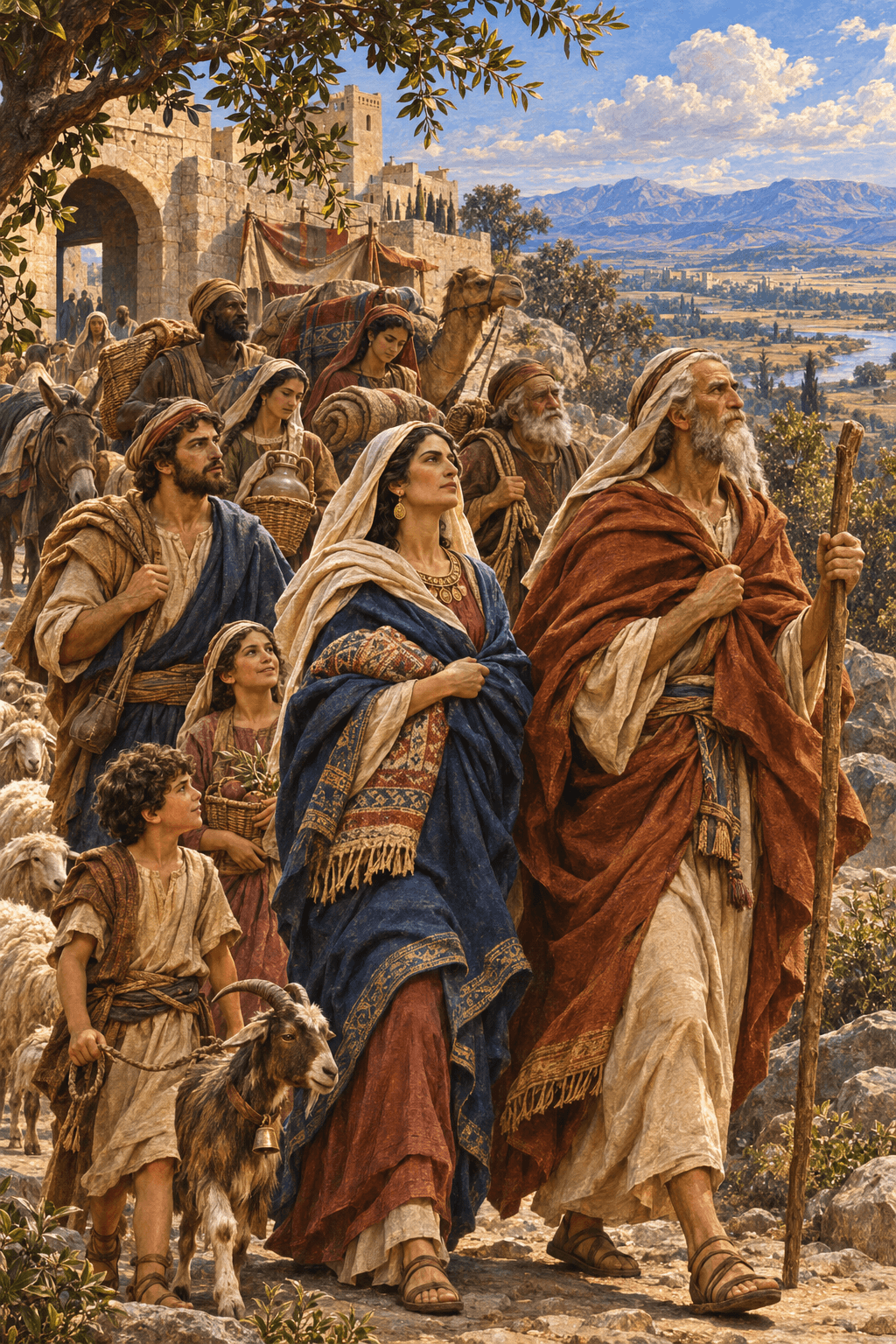
Abram is the tenth in the line of fathers born of Shem after the flood. The word “Abram” means “exalted father,” and God changed his name to “Abraham,” which means “father of a multitude” (Genesis 17:5). Having begun his life as an honored and exalted father, God made him a father of a great multitude — the father of the fathers, a father of all believers.
Abraham lived with his father Terah and the rest of the family in Ur of the Chaldees, usually identified with the famous city of that name (Ur) south of Babylon, whose site is ruins called al-Muqayyar. Modern discoveries show that it existed about a thousand years before the time of Abraham, and that it was formerly on the coast of the Gulf. It was also famous for its god “Nannar,” the moon god, and the bitter abominations that accompanied his worship.
Abram lived in the midst of this coastal, commercial atmosphere, with its great wealth together with pagan abominations, yet he remained faithful in his witness to God throughout his life. The Lord bore witness of him: “Your fathers dwelt on the other side of the flood in old time, even Terah, the father of Abraham, and the father of Nachor: and they served other gods. And I took your father Abraham from the other side of the flood, and led him throughout all the land of Canaan, and multiplied his seed, and gave him Isaac” (Joshua 24:2–3). In this region the sons of Shem lived closely joined to the sons of Ham, and evil crept into the sons of Shem until there was found in the whole region — indeed in the whole world at that time — no one who worshiped God in truth except Abram. He remained a witness to God, and drew to himself Sarai his wife and Lot his brother’s son to live a holy life in the Lord.
When God saw Abram’s faithfulness, He called him to go out of Ur of the Chaldees, and He repeated the call to him in Haran after he had stayed there a long time with his father, his wife, and his brother’s son, and his father died there (Genesis 11:31–32). It is true that Genesis does not mention the call to go out from Ur of the Chaldees, contenting itself with the call he received in Haran; but Holy Scripture confirms the divine call to him in Ur of the Chaldees before he entered Haran (Acts 7:2).
God did not overlook one faithful man in the midst of a whole city — indeed in the midst of the whole world at that time — but made him a rock from which believers are hewn. As it is said in Isaiah: “Hearken to me, ye that follow after righteousness, ye that seek the LORD: look unto the rock whence ye are hewn, and to the hole of the pit whence ye are digged. Look unto Abraham your father, and unto Sarah that bare you: for I called him alone, and blessed him, and increased him. For the LORD shall comfort Zion” (Isaiah 51:1–3). Thus God asks those who follow righteousness and seek the Lord to look to their father Abraham as a rock from which they were hewn, that they may truly be “Abraham’s children.” Let them see how the Lord called him “alone,” not despising the one, but making him a “multitude” and a comfort for the heavenly Zion. God loved him so much that it pleased Him to call Himself “the God of Abraham,” and to count His heavenly paradise as “Abraham’s bosom.”
In the midst of a dark pagan atmosphere God saw one heart longing to meet Him, so He called him to go out, whether from Ur of the Chaldees or from Haran — both cities being centers of the worship of the moon god. He called him to go out so that from his seed He might raise up a “holy Church.”
The divine call to Abram came thus: “Now the LORD had said unto Abram, Get thee out of thy country, and from thy kindred, and from thy father’s house, unto a land that I will shew thee” (1).
Saint Jerome comments on this divine call, saying:
He left Ur of the Chaldees, he left Mesopotamia, and went seeking a land he did not know, so as not to lose Him whom he had found (God). He did not think it easy to keep both his land and his Lord at the same time; from his early days he was ready to fulfill the words of the prophet: “I am a stranger with thee, and a sojourner, as all my fathers were” (Psalm 39:12). He was called a “Hebrew,” which means “passer-over,” because he was not content with present (temporal) advantages, but forgetting those things which are behind, he was ever reaching forth unto those things which are before (Philippians 3:13), keeping before him the words of the psalmist: “They go from strength to strength” (Psalm 84:7). Thus his name bears a mystical meaning, for it opens the way before you to seek the things of others and not your own… [229]
He also says:
The patriarch was asked to leave Ur of the Chaldees, and to leave the city of Babel (confusion) and Rehoboth (Genesis 10:11) and the broad places; to leave also the plain of Shinar, where the tower of pride rose up to heaven (Genesis 11:2, 4). He had to cross the waves of this world and pass over its rivers, by which the saints sat down and wept when they remembered Zion (Psalm 137:1)… so as to dwell in the land of promise, which drinks water from above, and not like Egypt with water from below (Deuteronomy 11:10)… seeking the first rain and the latter rain (Deuteronomy 11:14). [230]
This divine call is addressed to every human soul, that it may set out — not from a particular place, clan, or house, but going out in the heart beyond the love of the world and of self (the ego) — to meet the heavenly Lord and live with Him in His embrace. It is a call to all generations, and it has drawn the hearts of many of the fathers, who perceived it as a divine call touching their personal lives. We mention briefly some of the fathers’ comments on it:
Abba Paphnutius sees it as a divine call to practice the ascetic life, by which a person abandons his land, that is, the love of the world’s riches; his kindred, that is, his old life with its evil habits; and his earthly father’s house, to seek the house of the heavenly Father. Among his words:
He said to him: First, “Get thee out of thy country,” that is, from (the love of) the possessions of this world and its earthly wealth. Second, “from thy kindred,” that is, from your former life with its habits and sins that clung to you from your first birth and were bound to you as though by a bond of friendship and kinship. Third, “from thy father’s house,” that is, from everything in the world that your eyes see. For of the two fathers (the earthly and the heavenly), one must be left and the other sought, as David says in the person of God: “Hearken, O daughter, and consider, and incline thine ear; forget also thine own people, and thy father’s house” (Psalm 45:10). He who says, “Hearken, O daughter,” is certainly a father. [231]
This saint sees the call as directed toward enjoying the three stages of renunciation: bodily renunciation; casting off the old conduct; and the liberation of the spirit from visible things and its occupation with heavenly things. It is not enough for a person to leave his land, as by practicing fasting and all kinds of material or bodily asceticism; nor to leave his kindred, that is, to abandon his old evil habits; but he must also leave his old father’s house to enter into the bosom of his heavenly Father, saying: “For our conversation is in heaven” (Philippians 3:20).
Father Caesarius of Arles sees that this divine call is fulfilled in the waters of baptism by the Holy Spirit, who removes the sins from our land (the body), destroys its evil habits (the kindred), and snatches us from the house of our old father, the devil, to dwell in the house of our new Father. Among his words:
We believe and understand, brethren, that all these things have been fulfilled in us through the sacrament of baptism. Our land is our body; we rightly go out of our land when we abandon our fleshly habits and follow Christ. Is a man not counted to have left his land, that is, himself, when he becomes humble after being proud, patient after being quick-tempered, when he leaves dissoluteness and enters into chastity, and passes from greed to generosity, from the flesh to tenderness, and from harshness to gentleness? Truly, brethren, whoever is changed in this way through his love for God has left his land… Our land, that is, our body, before baptism was counted the land of the dead, but by baptism it became the land of the living, which the psalmist pointed to, saying: “I had fainted, unless I had believed to see the goodness of the LORD in the land of the living” (Psalm 27:13). By baptism we become the land of the living, not of the dead; that is, the land of virtues, not of vices… The Lord says: “(Come) into the land that I will shew thee”; so we come with joy into the land that God shows us, if with His help we drive sins and vices out of our land, that is, our body. “Get thee out… from thy kindred”: here kindred is understood as the vices and sins which were in some way partly born with us and which grew and flourished after childhood through our evil habits. We leave our kindred if through the grace of baptism we are emptied of sins and vices… and do not return like the dog to his vomit. “Get thee out… from thy father’s house”: let us receive this phrase in a spiritual sense, dearly beloved brethren, for the devil was our father before the grace of Christ; of him the Lord speaks in the Gospel when He rebuked the Jews, saying: “Ye are of your father the devil, and the lusts of your father ye will do” (John 8:44)… Therefore, brethren, it befits us to be made worthy to receive these things through the grace of baptism and not by our own strength, so that we leave our land, that is, (the lusts of) our body, and our kindred, that is, vices and sins (habits), and flee from the house of the devil our father. Let us strive with all effort, with His help, not to return to the company or friendship of the devil… but rather let us imitate the faith of Abraham and ever do good works, not only to obtain forgiveness but to enter into friendship and fellowship with God. Let us consider with great fear and reverence what the Lord said to Moses in this matter… “Take heed to thyself, lest thou make a covenant with the inhabitants of the land whither thou goest, lest it be for a snare in the midst of thee” (Exodus 34:12). Now we believe that by the grace of baptism all sins and transgressions are taken away from us; if we return and make a covenant with them, they become a snare to us. [232]
Abram’s going out was not easy, for he lived in a coastal city known for its wealth, progress, and culture, besides his attachment to his family — especially since the call came to him at no young age: he went out from Haran at seventy-five years old, that is, at a time when he needed stability. Moreover, he had no son to inherit from him or care for him in his old age. We know that a person tends to move flexibly when young, but the older he grows the harder it is for him to move, especially if moving means a comprehensive change in his way of life and conduct… Yet Abram, with the flexibility of childhood, moved in obedience to God. Saint Ambrose says:
Behold our father Abraham, who was appointed to be an example for generations to come: when he was commanded to forsake his country, his kindred, and his father’s house, despite all the family ties by which he was bound, did he not give proof that he subjected affection to reason?… He resolved with all deliberation to pass through the difficulties without inventing excuses for himself. [233]
Thus Abraham accepted the divine call and obeyed, overcoming the difficulties and human emotions. What is wonderful is that God, in calling him to go out, did not specify the place where he would settle, but said: “Get thee… unto a land that I will shew thee” (1). What is this land that God shows us in return for our leaving old things, other than our enjoyment of entering into His new heavens and His new earth? He does not wish to leave a person in deprivation or loss, but gives more than we leave; He gives us a new land, or as Saint Paphnutius says:
It is a land you cannot know or discover by your own effort, but the land that I will show you — the one you have not seen and of which you are ignorant. [234]
Saint Gregory of Nyssa sees that the goal of this going out is an entry into a new land, that is, the enjoyment of (the knowledge of God). He says:
If, with the lofty spirit of the Apostle, we can take the words in their symbolic sense and penetrate to the mystical meaning of the history without losing the true view of its events, we certainly find that Abraham, the father of faith, went out according to the divine command from his land and his kindred on a journey befitting a prophet thirsting for the knowledge of God. For I think that the blessings he was found worthy to receive are not proportionate to an ordinary migration from place to place; his going out from himself and from his land — as I understand it — is a going out from his earthly, carnal mind, rising as far as he can above the limits of ordinary nature, and casting off the soul’s attachment to its senses, so that his eyes might be opened to invisible things without any sensory hindrance. Then no sight or sound occupies the mind from its work, but it walks “by faith, not by sight,” as the Apostle says. Thus (Abraham) rose high by the loftiness of his knowledge until he reached what is considered the summit of human perfection, knowing of God all that the limited capacities of man can grasp… [235]
2. Abram, a Blessing to the Nations
KJV · Verses 2–3
2 And I will make of thee a great nation, and I will bless thee, and make thy name great; and thou shalt be a blessing: 3 And I will bless them that bless thee, and curse him that curseth thee: and in thee shall all families of the earth be blessed.
If the divine call carries many difficulties, these difficulties cannot be compared with God’s promises to him; for with every call or commandment God offers a promise. When it is said, “Come out from among them, and be ye separate,” God’s promise is: “And will be a Father unto you, and ye shall be my sons and daughters” (2 Corinthians 6:17–18). God called Abram, who had no son, and promised him: “And I will make of thee a great nation, and I will bless thee, and make thy name great” (2). And since He asked him to leave the wealth of Ur of the Chaldees, He promised him: “And thou shalt be a blessing: and I will bless them that bless thee, and curse him that curseth thee”; and since He asked him to leave his kindred and his father’s house, He said to him: “And in thee shall all families of the earth be blessed” (3).
God does not accept to be a debtor to any man; He only seeks an opportunity to give him abundantly. He wants His children in a state of true fullness, not deprivation.
Perhaps Abram had resigned himself in Ur of the Chaldees to his condition of having no son of his own body to inherit from him; but God gives him not only a son but makes him “a great nation,” blessed. He does not promise to bless his possessions — many of which he would lose in his wanderings — but makes him a blessing. He does not promise him relatives and friends, but in him all the families of the earth would be blessed.
God longs to give His children without measure or reckoning, making them not merely blessed people but each one of them “a blessing”… We bear God within us, and so our life is changed into a “light” shining in the world, and a leaven able to leaven the whole lump… He longs to give us Himself so that we become a blessing, if we truly, like Abram, leave our land, our people, and our old father’s house — even leaving our name to bear the name “Abraham” instead of “Abram,” that is, abandoning the old carnal name to bear a new name in the Lord. Origen the scholar says:
He cannot receive the covenant with God and the sign of circumcision… and enjoy the conversation full of mysteries… while he is in his father’s house and among his carnal kindred, bearing the name Abram… as long as he is bound to flesh and blood. [236]
What is wonderful is that when a person gives up everything, he does not live deprived but enjoys God’s promises; and he enjoys not only what is for himself but what is for the whole community, indeed for all mankind, as it was said to Abram: “And in thee shall all families of the earth be blessed.” This was fulfilled by the coming of the Lord Christ from the seed of Abram, by whom the peoples were blessed; and it can be fulfilled in another way in the life of every believer who enjoys the transfiguration of the Lord Christ on the mountain of his inner heart, so that he becomes a blessing for many. This is what the Lord Christ declared in His famous sermon, saying: “Ye are the salt of the earth… Ye are the light of the world” (Matthew 5:13–14).
Saint Augustine speaks of this blessing which Abram received, saying:
Let us note that Abraham received two promises. The first, that his seed would possess the land of Canaan, was pointed to by the words, “I will make of thee a great nation”; but the other promise is far greater, for it is not a carnal but a spiritual promise, through which he becomes the father not of the Israelite nation alone, but of all the nations that follow in the footsteps of his faith. [237]
3. Abram’s Practical Faith
KJV · Verses 4–9
4 So Abram departed, as the Lord had spoken unto him; and Lot went with him: and Abram was seventy and five years old when he departed out of Haran. 5 And Abram took Sarai his wife, and Lot his brother's son, and all their substance that they had gathered, and the souls that they had gotten in Haran; and they went forth to go into the land of Canaan; and into the land of Canaan they came. 6 And Abram passed through the land unto the place of Sichem, unto the plain of Moreh. And the Canaanite was then in the land. 7 And the Lord appeared unto Abram, and said, Unto thy seed will I give this land: and there builded he an altar unto the Lord, who appeared unto him. 8 And he removed from thence unto a mountain on the east of Bethel, and pitched his tent, having Bethel on the west, and Hai on the east: and there he builded an altar unto the Lord, and called upon the name of the Lord. 9 And Abram journeyed, going on still toward the south.
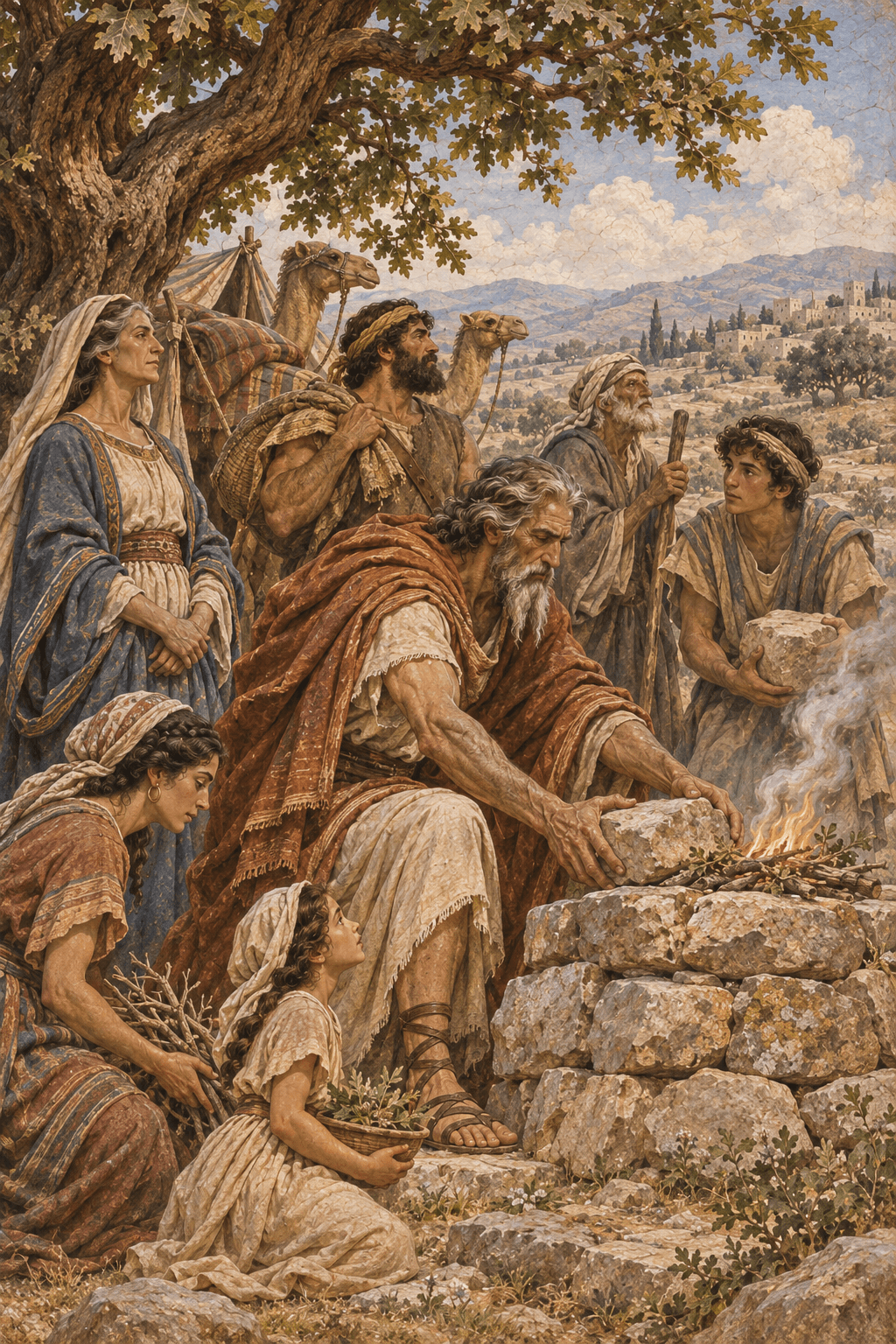
Abram’s faith did not stop at knowing God through theoretical ideas that he memorized and defended, nor did it stop, in translating that knowledge, at offering certain acts of worship; rather it was a living faith expressed in obedience. The Apostle Paul says: “By faith Abraham, when he was called to go out into a place which he should after receive for an inheritance, obeyed” (Hebrews 11:8). By faith Abraham’s heart set out beyond Ur of the Chaldees, and later beyond Haran, for he looked for “a city which hath foundations, whose builder and maker is God” (Hebrews 11:10).
It is true that Abraham’s obedience was complete in his heart, but it was partial in its carrying out. He went out first from Ur of the Chaldees with his father Terah, and we do not know why Terah went out. Was he attached to his son Abraham? Or did he find the opportunity suitable to leave pagan worship…? In any case, Terah went out with Abraham to Haran, and the procession stopped in Haran about fifteen years, for Abraham could not set out from it until after the death of his father Terah, who most likely found the move toward Canaan burdensome and so held back the whole procession.
May we not have, in our going out from Ur of the Chaldees, a Terah accompanying us, lest we stop in Haran for long years; but let us set out swiftly toward the heavenly Canaan, enjoying God’s promises without hindrance.
If the word “Ur” means “light,” [238] and the word “Terah” most likely means “wild goat,” and the word “Haran” means “mountainous,” [239] it befits us to go out from the light of the Chaldeans and their attractive glitter, setting out without attachment to trivial things such as “the wild goat,” lest we go off to Haran, that is, the mountainous regions; but let us hasten toward Canaan, which flows with milk and honey.
Finally, when “Terah” died after about fifteen years in Haran, Abram was able to obey the divine call, not partially but with exceeding speed, heading toward Canaan; and it seems the whole journey took no more than a year.
The first town Abraham reached in the land of Canaan was “Shechem,” which means “shoulder.” The Canaanites inhabited it with a shoulder stubborn against God; and with a stubborn shoulder Joseph’s brothers left Shechem and went to Dothan, which means “revolt” (Genesis 37:14–17)… But afterward it came to represent the shoulder bowed in love for God, bearing burdens, for it became part of the land of promise, a city belonging to the tribe of Levi and one of the cities of refuge.
Shechem was a walled city (Genesis 33:18; 34:20) at the foot of Mount Gerizim (Judges 9:7). In the days of Jacob, when he returned to Canaan, he found the Hivites dwelling in it (Genesis 34:2), and he bought a parcel of a field where he spread his tent (Genesis 33:18–19); and there the body of Joseph was buried (Joshua 24:32). When Shechem the son of Hamor the Hivite wronged Dinah, Jacob’s daughter, her brothers Simeon and Levi slew every male in the city (Genesis 34:25–29). Near Shechem Joseph’s brothers fed their flocks (Genesis 37:12–13). There, at Mount Gerizim and Mount Ebal, Joshua read the book of the Law (Joshua 8:30–35). It was chosen as a city of refuge (Joshua 20:7; 21:21). There Joshua called the tribes to hear his farewell address (Joshua 24:1). Shechem became the capital of Israel in the reign of Jeroboam, who led the ten tribes in revolt against Rehoboam (1 Kings 12); and after the fall of the northern kingdom Shechem remained (Jeremiah 41:5), and became the capital of the Samaritans. [240]
Shechem, or Nablus, lies about 41 miles north of Jerusalem and 5.5 miles southeast of Samaria. It is situated in the upper valley enclosed by Mount Ebal on the north and Mount Gerizim on the south, and the valley was known as “Mabartha,” that is, “passage,” being a passage from the coast to the Jordan.
It seems Abram did not enter Shechem but camped near it and passed on to “the plain of Moreh” (6), which means “the oak of the teacher” or “the oak of the soothsayer”; it seems it took its name from a “teacher” or “soothsayer” who lived there, whom people met under the oak tree.
In this place Abram built “an altar unto the LORD” (7) for the first time in the land of Canaan. It is said that there Jacob buried all the strange gods that were in the hands of his household and the earrings that were in their ears (Genesis 35:4), which they had brought from Haran; and there Joshua “took a great stone, and set it up there under an oak, that was by the sanctuary of the LORD. And Joshua said unto all the people, Behold, this stone shall be a witness unto us; for it hath heard all the words of the LORD which he spake unto us: it shall be therefore a witness unto you, lest ye deny your God” (Joshua 24:26–27).
The place was sanctified when Abram offered a sacrifice of thanksgiving to God, who had brought him into the land of Canaan which He had promised would be for his seed after him. Where God is glorified and the strange gods are buried, the place is changed into a place of preaching for the true Joshua, and the people hear the voice of the divine Word.
This is the first time we hear that the Lord appeared to a man (7), confirming His promise to Abram: “Unto thy seed will I give this land” (7). Abram could do nothing but build an altar to the Lord, offering on it a sacrifice of thanksgiving to Him who had called him, accompanied him on the way, and confirmed His care for him.
Abram moved on toward Bethel… “and there he builded an altar unto the LORD, and called upon the name of the LORD” (8). Then he journeyed, going on still toward the south, “the Negeb” (9).
4. Abram in Egypt
KJV · Verses 10–13
10 And there was a famine in the land: and Abram went down into Egypt to sojourn there; for the famine was grievous in the land. 11 And it came to pass, when he was come near to enter into Egypt, that he said unto Sarai his wife, Behold now, I know that thou art a fair woman to look upon: 12 Therefore it shall come to pass, when the Egyptians shall see thee, that they shall say, This is his wife: and they will kill me, but they will save thee alive. 13 Say, I pray thee, thou art my sister: that it may be well with me for thy sake; and my soul shall live because of thee.
“And there was a famine in the land: and Abram went down into Egypt to sojourn there; for the famine was grievous in the land” (10).
Famines recurred in the land of Canaan, and the remedy was to go down to Egypt, where the Nile flows.
The aged Abram had not yet stayed long in the land of promise when the famine came; yet Abram did not feel he had acted wrongly in going out from his land, his kindred, and his father’s house. He did not murmur against God, nor did he make light of God’s promise to give this land to his seed, though it was a land exposed to famines.
Egypt was blessed by receiving Abram, the father of the fathers, to sustain him in the time of famine, and by receiving his grandson Jacob and his family, so that the people of Israel would go forth from Egypt. Greater than all, the Lord Christ Himself took refuge there in His childhood, blessing it (Matthew 2:13), fulfilling what Isaiah the prophet had foretold (Isaiah 19). But many feel that Abraham erred in going down to Egypt, since he came there without an explicit message from God, as happened with his grandson Jacob, to whom the Lord said: “I will go down with thee into Egypt” (Genesis 46:4). Abraham’s going down represents the person who has entered the land of promise but soon leans on the human arm, going down to seek human help rather than divine, as it is said in Isaiah: “Woe to them that go down to Egypt for help; and stay on horses, and trust in chariots, because they are many; and in horsemen, because they are very strong; but they look not unto the Holy One of Israel, neither seek the LORD!” (Isaiah 31:1).
As much as Holy Scripture has portrayed Abram in his most splendid image — going out in obedience to the divine call, leaning in faith on God’s promise — so it reveals his weakness in a painful human picture. He leaned on the land of Egypt, and knowing the carnal lusts that marked the Egyptians at that time, he was afraid, asking his wife to say that she was his sister… “that it may be well with me for thy sake; and my soul shall live because of thee” (13).
When Scripture speaks here of the famine, it says: “And there was a famine in the land” (10); it did not say “the famine was sore upon Abram,” as it said of the Egyptians: “because the famine prevailed over them” (Genesis 47:20). And what was said of the famine in the days of Abram was said of the one in the days of his grandson Jacob: “And the famine was sore in the land” (Genesis 43:1). Famines may surround believers, but they touch only the land, that is, the body; unbelievers, however, bow before them and are broken, “because the famine prevailed over them” (Genesis 47:20). As Origen the scholar says:
The famine did not prevail over Abraham, nor over Jacob or his sons; if it prevails, it prevails only “in the land.” In the days of Isaac it was also said: “And there was a famine in the land, beside the first famine that was in the days of Abraham” (Genesis 26:1). But the famine could not overcome Isaac, so that the Lord said to him: “Go not down into Egypt; dwell in the land which I shall tell thee of: sojourn in this land, and I will be with thee” (Genesis 26:2–3). In my opinion, what was said later by the psalmist agrees with this observation: “I have been young, and now am old; yet have I not seen the righteous forsaken, nor his seed begging bread” (Psalm 37:25). And elsewhere: “The LORD will not suffer the soul of the righteous to famish” (Proverbs 10:3). All these texts declare that the land can suffer from famine, and so can those who mind earthly things (Philippians 3:19). But those who have the bread by which they do the will of the heavenly Father (Matthew 7:21), and whose souls are refreshed by the bread that came down from heaven (John 6:51, 58), will not suffer the privation of famine. [241]
Let us not fear famine, then, for it strikes the land and those who are earthly; but those who cleave to the Lord and have received His holy Body as spiritual food will suffer no hunger, for they eat of the tree of life (Revelation 2:7) and drink the juice of the true vine (John 15:1) new in the kingdom of the Father (Matthew 26:29).
Let us cease to be earth, and famine will not strike us; let us enjoy the heavenly life, and we shall have eternal fullness.
5. Sarai and Pharaoh
KJV · Verses 14–20
14 And it came to pass, that, when Abram was come into Egypt, the Egyptians beheld the woman that she was very fair. 15 The princes also of Pharaoh saw her, and commended her before Pharaoh: and the woman was taken into Pharaoh's house. 16 And he entreated Abram well for her sake: and he had sheep, and oxen, and he asses, and menservants, and maidservants, and she asses, and camels. 17 And the Lord plagued Pharaoh and his house with great plagues because of Sarai Abram's wife. 18 And Pharaoh called Abram and said, What is this that thou hast done unto me? why didst thou not tell me that she was thy wife? 19 Why saidst thou, She is my sister? so I might have taken her to me to wife: now therefore behold thy wife, take her, and go thy way. 20 And Pharaoh commanded his men concerning him: and they sent him away, and his wife, and all that he had.
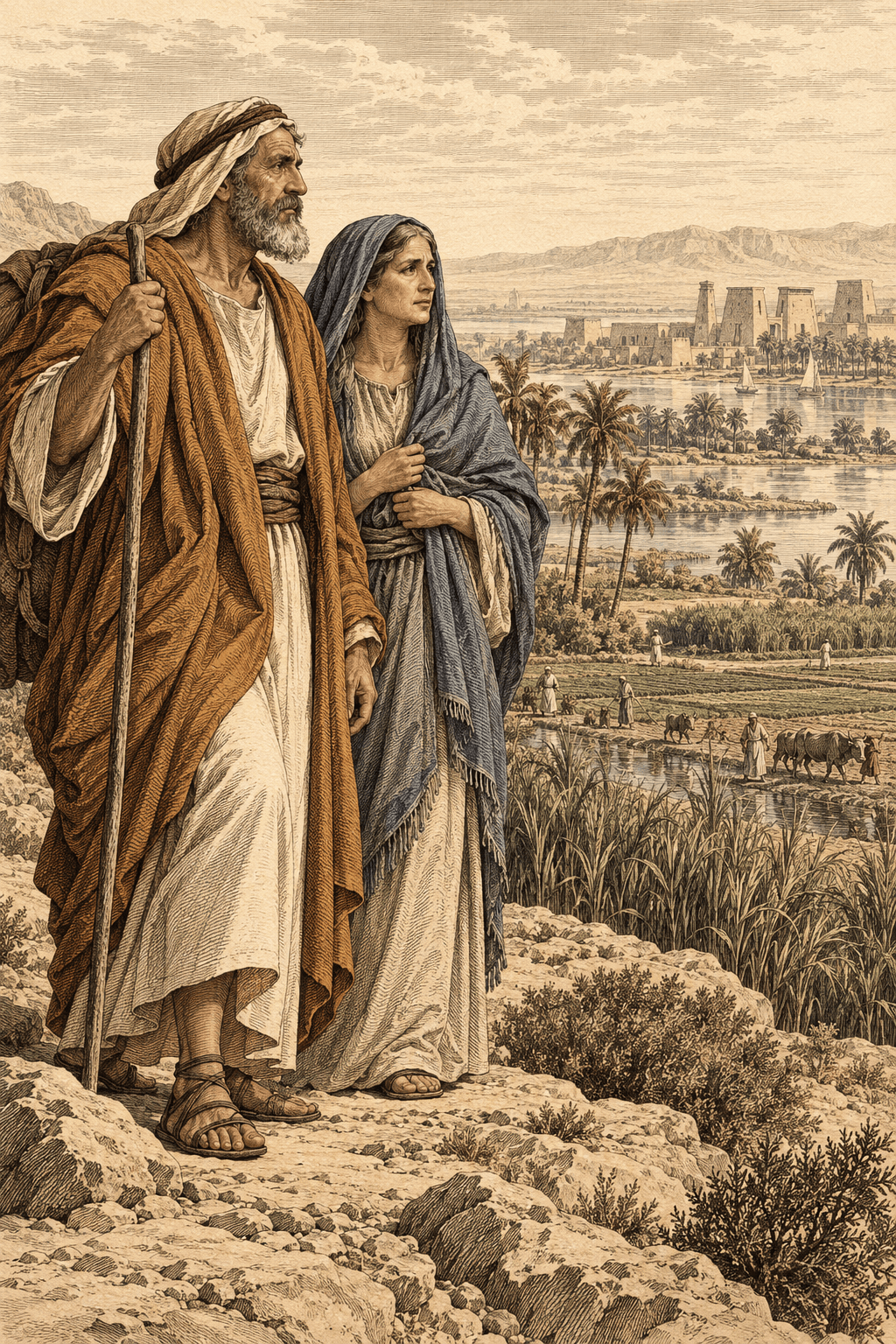
Abram erred in going down to Egypt without returning to God or waiting for His revelations to him, and the error drew him into successive errors… The natural fruit was that he was deprived of his wife for a time, when Pharaoh took her from him. What is wonderful is that what Abram was unable to declare — that Sarai was his wife — God declared to Pharaoh, so that he restored her to him without touching her; and Abram even received wealth and honor.
What is wonderful is that God does not deal with a person according to his weaknesses. Had God allowed Pharaoh to touch Abram’s wife, Abram would have remained tormented in conscience all the days of his life, whatever blessings or gifts he received… Therefore the Lord kept her from the hands of Pharaoh, and even restored wealth and honor to Abram… so that we may say with the psalmist: “He hath not dealt with us after our sins; nor rewarded us according to our iniquities. For as the heaven is high above the earth, so great is his mercy toward them that fear him” (Psalm 103:10–11). Abram was one of those who feared the Lord and loved Him, so he enjoyed mercies higher than the earth, and in him was fulfilled the saying: “Touch not mine anointed, and do my prophets no harm” (Psalm 105:15). And as Saint Augustine says, [242] Abram waited for God’s work with him, and what Abram hoped for, the Lord did for him.
Notes and References
[229] Jerome, Ep. 71:2.
[230] Jerome, Ep. 46:2.
[231] Cassian, Conferences 3.
[232] Caesarius of Arles, Serm. 81:1–4.
[233] Ambrose, Duties of the Clergy 1:24.
[234] Cassian, Conferences 3:10.
[235] Gregory of Nyssa, Answer to Eunomius 2.
[236] Origen, In Gen. hom. 3:3.
[237] Augustine, City of God 16:16.
[238] Hastings, Dictionary of the Bible (Ur).
[239] Ibid. (Haran).
[240] New Westminster Dictionary of the Bible, p. 861; Josephus, Antiquities 11.8.6.
[241] Origen, In Gen. hom. 16:3.
[242] Augustine, City of God 16:19.