
Although death had entered the human race, it revealed another, hidden death that was more dangerous: the death and corruption of the soul within. This appeared when the hearts of the children of God were drawn toward the daughters of men and the earth became corrupt. The earth therefore needed renewal once more, through the flood and Noah’s ark.
1. Introduction to the Ark and the Flood
The story of the flood occupies a central place in the history of salvation and the renewal of the world through water. God declared, “The end of all flesh is come before me,” not to annihilate humanity, but to renew the world. He turns the catastrophe of the flood into a greater good for humanity, which had cast itself into eternal destruction. Thus the outward flood revealed the inward flood of sin that destroys the soul.
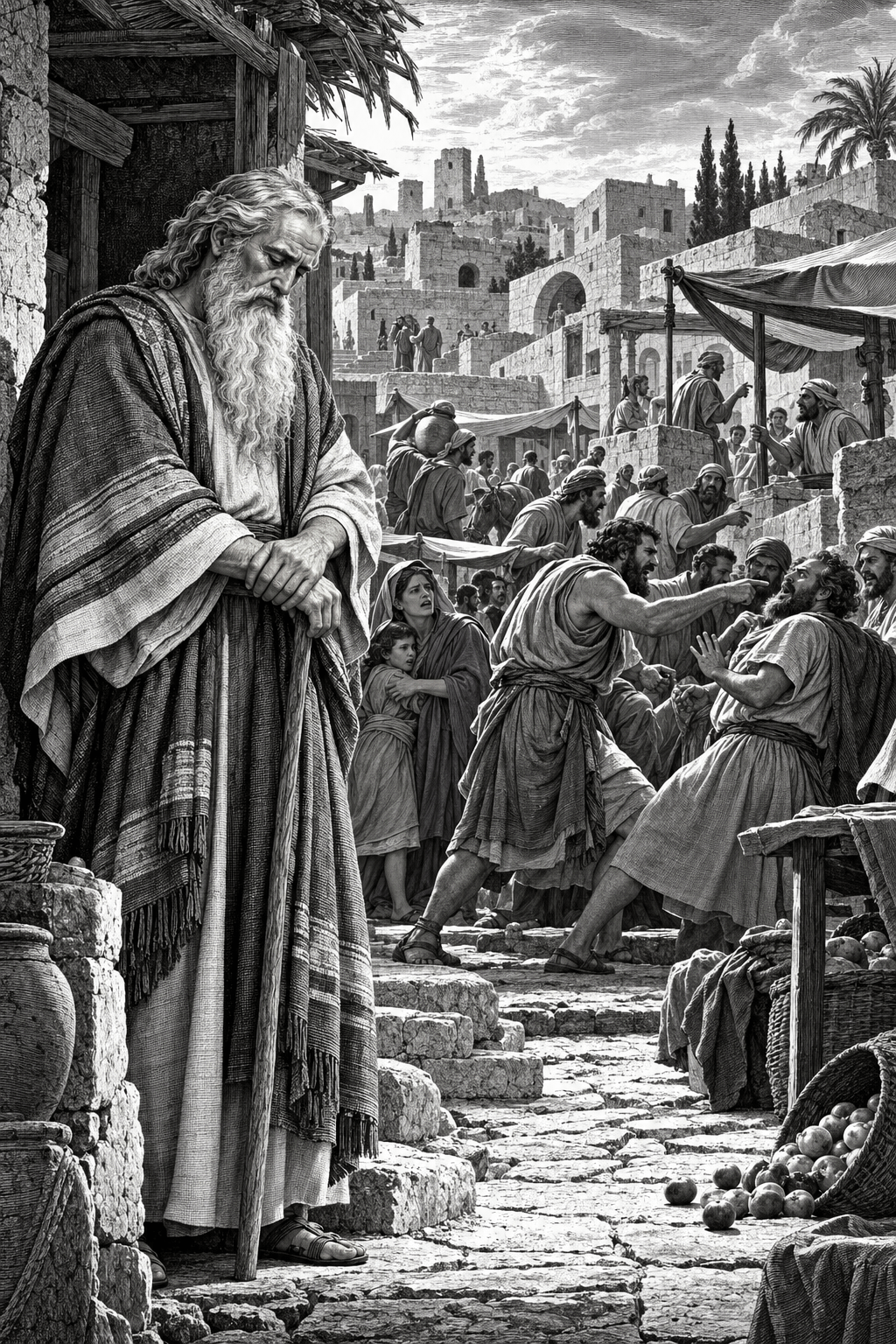
Humanity handed down this story, and different peoples presented it in various forms that departed from its true purpose and became mixed with many myths. The following is a brief account of some ancient traditions concerning it.
A. Babylonian Traditions
In the Babylonian accounts transmitted by Berossus, a priest of the third century BC whom the source describes as Egyptian, a flood occurred in the reign of King Xisuthras. The king built an ark and took into it his family and close friends, gathering birds, animals, and provisions. When the rain ceased, he sent out birds. They returned with mud on their feet; this happened again the second time, but the third time they did not return. The ark came to rest in a place the source calls Aridina.
An older Babylonian account of the flood is the Epic of Gilgamesh. Gilgamesh asked Utnapishtim how he had attained endless life. He told him the story of the flood: four gods decided to destroy the world by a flood, but Ea, the god of wisdom, ordered him to make an ark and enter it with his family. He sent out birds to examine the condition of the earth, and they returned with olive foliage. After leaving the ark, he offered sacrifices of thanksgiving. The god of wisdom came, blessed him and his wife, and granted them immortal life.
B. Indian Traditions
A picture was found in a Buddhist temple showing Noah inside the ark, with the gods looking compassionately toward him. A dove was also depicted flying toward the ark with an olive branch.
Among the Indian stories is the account that the god Brahma appeared to Manu in the form of a fish and ordered him to build an ark and enter it with seven righteous men. Manu tied the ark to the fish’s horns, and it carried him through the flood for long ages. When he came out, it commanded him to create the world anew.
C. Greek Traditions
It is related that the god Jupiter ordered the righteous Deucalion to enter the ark with his wife and the rest of his family. When the ark rested on Mount Parnassus, a dove showed him that the flood had ended. He came out and offered sacrifices of thanksgiving.
D. Phrygian Traditions in Asia Minor
It was said that “Abachus,” a name that may be a corruption of “Noah,” learned of the flood and wept for humanity. Coins found at Apamea in Phrygia depict an ark with people inside it and birds outside, one carrying an olive branch. Beside it is a picture of the same people offering sacrifices of thanksgiving for their deliverance. The name Noah was inscribed on them. The city’s ancient name was “Kibotos,” meaning “ark,” because its inhabitants believed that the ark had settled in their city.
E. Other Peoples
Similar stories were found among the Persians, Chinese, Phoenicians, Syrians, Armenians, and indigenous peoples of Mexico, among others.
Although these ancient traditions contain myths, the author sees them as witnesses to a real event handed down by humanity and distorted through pagan worship.
2. The Sons of God and the Daughters of Men
Genesis 6:1-4
1 And it came to pass, when men began to multiply on the face of the earth, and daughters were born unto them, 2 That the sons of God saw the daughters of men that they were fair; and they took them wives of all which they chose. 3 And the LORD said, My spirit shall not always strive with man, for that he also is flesh: yet his days shall be an hundred and twenty years. 4 There were giants in the earth in those days; and also after that, when the sons of God came in unto the daughters of men, and they bare children to them, the same became mighty men which were of old, men of renown.
“And it came to pass, when men began to multiply on the face of the earth, and daughters were born unto them, That the sons of God saw the daughters of men that they were fair; and they took them wives of all which they chose” (Genesis 6:1-2).
In The City of God, Saint Augustine speaks of two cities, one earthly and the other heavenly. The first represents the company of the wicked, attached to earthly things; the other represents believers, attached to heavenly things. When he considers this passage, he sees the marriage of the sons of God to the daughters of men as the mingling of the two cities, corrupting the citizens of the heavenly city. The apostle Paul warns us about this: “Be ye not unequally yoked together with unbelievers: for what fellowship hath righteousness with unrighteousness? and what communion hath light with darkness? And what concord hath Christ with Belial?” (2 Corinthians 6:14-15).
The expression “sons of God” appears in the Septuagint as “angels,” while the literal Hebrew expression is rendered “sons of the gods.” Saint Augustine, who relies chiefly on the Septuagint, therefore asks whether angels marry human women. He answers at length; here I give only the principal points briefly. [162]
First, the Greek word angelos, άγγελος, means “messenger.” Thus “angels” here can refer to God’s servants: the children of God, or His ministers, who became occupied with marrying wicked women instead of serving God.
Second, Saint Augustine says that many pagan superstitions in his time alleged that certain demons assaulted women in an impure bodily manner. Such a notion cannot be accepted, especially concerning God’s angels. Therefore the apostle Peter’s words, “For if God spared not the angels that sinned, but cast them down to hell, and delivered them into chains of darkness, to be reserved unto judgment” (2 Peter 2:4), do not mean that they fell into bodily lust with human women. Their fall occurred before the creation of humanity, through pride.
Third, Aquila’s translation has “sons of the gods,” which applies to believers of whom it was said, “I have said, Ye are gods; and all of you are children of the most High” (Psalm 82:6). In other words, whether the wording is “angels” or “sons of the gods,” Scripture means the descendants of Seth, who should have lived as God’s angels and servants, burning with the fire of divine love, or as gods. Instead they were attracted to the wicked daughters of Cain by their bodily beauty. In this way the righteous mingled with the wicked and everyone became corrupt, so that the whole creation needed renewal through the waters of the flood. The Lord declared His displeasure:
“My spirit shall not always strive with man, for that he also is flesh: yet his days shall be an hundred and twenty years” (Genesis 6:3).
As humanity turned aside to evil, God declared that His Spirit would not remain in man forever: He would not abide in him while he continued in wickedness. His days would be shortened to a hundred and twenty years. This came about gradually after the flood. Although some were allowed to live longer than a hundred and twenty years, they lacked their former vitality. The hundred and twenty years may also refer to the period during which Noah warned the people before entering the ark.
Perhaps the words “My spirit shall not always strive with man” mean that, as long as someone persists in wickedness and stubbornness, he is deprived of the Holy Spirit’s conviction, and God gives him over to a reprobate mind. Some understand “my spirit” here as the spirit God gave to humanity rather than the Holy Spirit: it would not remain in the body forever, but would be withdrawn after 120 years. This interpretation, however, is not accepted here.
Notice that when humanity turned toward bodily lust, the Lord called him “flesh”: “for that he also is flesh.” The Septuagint likewise says “flesh.” Through carnal conduct he became like a body without a spirit, for the body’s lusts enslave the soul as well and direct it according to their passions. Saint John Chrysostom says:
“Just as those who have the wings of the Spirit make the body spiritual, so those who abandon this and become slaves to their bellies and to pleasure make the soul carnal. They do not change its essence, but corrupt the nobility of its birth. [163]”
He also says:
“Although they have souls, because those souls have become dead within them, He calls them “flesh.” Likewise, although the godly have bodies, we say that they are wholly soul or wholly spirit. Saint Paul says of those who do not fulfil the works of the flesh, “But ye are not in the flesh” (Romans 8:9). But someone who lives in luxury lives neither in the soul nor in the spirit, but in the flesh. [164]”
Thus, when God’s children became absorbed in bodily things and loved the daughters of men, they became fleshly and ceased to be spiritual. The fruit of this was the birth of tyrannical children who loved temporal honour: “There were giants in the earth in those days … the same became mighty men which were of old, men of renown” (Genesis 6:4). Each sin brings another. When someone surrenders to weakness, he becomes a plaything among sins, each handing him over to the next. Here it began with God’s children looking carnally at the beauty of the daughters of men. They abandoned their spiritual mission, turned to carnal thinking, became flesh, and brought forth violence and love of temporal honour in place of the Spirit’s fruits of kindness, gentleness, and humility.
3. Noah the Righteous
Genesis 6:5-10
5 And GOD saw that the wickedness of man was great in the earth, and that every imagination of the thoughts of his heart was only evil continually. 6 And it repented the LORD that he had made man on the earth, and it grieved him at his heart. 7 And the LORD said, I will destroy man whom I have created from the face of the earth; both man, and beast, and the creeping thing, and the fowls of the air; for it repenteth me that I have made them. 8 But Noah found grace in the eyes of the LORD. 9 These are the generations of Noah: Noah was a just man and perfect in his generations, and Noah walked with God. 10 And Noah begat three sons, Shem, Ham, and Japheth.
The Lord saw that human wickedness had increased on earth and that the imagination of the human heart was continually evil. Scripture therefore speaks of His grief and of His determination to blot out humanity, together with beasts, creeping things, and birds (Genesis 6:5-7).
The holy God could not tolerate the evil that had multiplied on earth, nor could He meet with the soul He had created as His dwelling while its thoughts were evil every day. Therefore He grieved that He had made humanity on earth. When Scripture says that He “grieved,” “was sorry in His heart,” or “repented,” we must not understand these expressions as emotional outbursts of anger. This is Scripture’s language addressed to us as human beings, so that we may understand the bitterness of sin itself and the impossibility of communion between divine holiness and human corruption. Saint Augustine explains the meaning of God’s sorrow at making humanity:
“God’s anger is not a disturbance that clouds His mind, but a judgment by which punishment is imposed upon sin. [165]”
He also says:
“The unchangeable God changes things, and He does not, like a human being, repent of anything He has done. His decision concerning all things is fixed, and His knowledge of the future is certain. Yet unless He used such expressions, He could not be understood by human minds that need Him to speak familiarly, in language suited to them, for their benefit: to warn the proud, awaken the careless, train the inquisitive, and satisfy the understanding. This could not happen unless He first stooped and came down to where they were, speaking in their language. By announcing the death of the animals of earth, air, and sea, He revealed the greatness of the approaching catastrophe. He did not threaten irrational animals with destruction as though they had committed sin. [166]”
Thus Saint Augustine sees God’s declaration of sorrow at creating humanity as His condescension to speak our language. It enables us to recognize how far we have made communion with God, the source of our life, impossible. God’s heart toward us has not changed; we have changed and separated ourselves from Him by accepting corruption, which is alien to Him. His threat to destroy animals and birds expresses His surpassing love, calling us to reconsider our position and recognize its seriousness.
Yet amid this painful picture of humanity, God does not overlook one person walking in righteousness in a wicked generation: “But Noah found grace in the eyes of the LORD” (Genesis 6:8). In deep darkness He does not ignore a beautiful gleam, however small and faint it may appear. In every generation God rejoices in His saints, even if they are only a small remnant amid corruption filling the earth. Noah found grace in the eyes of the Lord, who testified of him, “Noah was a just man and perfect in his generations” (Genesis 6:9). The words “in his generations” show that his righteousness and perfection were not absolute, but were considered in relation to the corruption of his contemporaries. Human righteousness is relative.
4. The Corruption of the Earth
Genesis 6:11-12
11 The earth also was corrupt before God, and the earth was filled with violence. 12 And God looked upon the earth, and, behold, it was corrupt; for all flesh had corrupted his way upon the earth.
“The earth also was corrupt before God, and the earth was filled with violence … for all flesh had corrupted his way upon the earth” (Genesis 6:11-12).
Notice how often the word “earth” occurs in this chapter, especially in verses 5-13, where the author counts seven occurrences. Each repetition reveals God’s desire to see a heavenly character in human life. Instead, by becoming corrupt, humanity became earthly dust bearing corruption. Lest we imagine that the earth’s substance, resources, fruits, and so forth had themselves become corrupt, Scripture emphasizes, “for all flesh had corrupted his way upon the earth.” It is as though human corruption had disfigured the irrational creatures.
5. Noah’s Ark
Genesis 6:13-22
13 And God said unto Noah, The end of all flesh is come before me; for the earth is filled with violence through them; and, behold, I will destroy them with the earth. 14 Make thee an ark of gopher wood; rooms shalt thou make in the ark, and shalt pitch it within and without with pitch. 15 And this is the fashion which thou shalt make it of: The length of the ark shall be three hundred cubits, the breadth of it fifty cubits, and the height of it thirty cubits. 16 A window shalt thou make to the ark, and in a cubit shalt thou finish it above; and the door of the ark shalt thou set in the side thereof; with lower, second, and third stories shalt thou make it. 17 And, behold, I, even I, do bring a flood of waters upon the earth, to destroy all flesh, wherein is the breath of life, from under heaven; and every thing that is in the earth shall die. 18 But with thee will I establish my covenant; and thou shalt come into the ark, thou, and thy sons, and thy wife, and thy sons’ wives with thee. 19 And of every living thing of all flesh, two of every sort shalt thou bring into the ark, to keep them alive with thee; they shall be male and female. 20 Of fowls after their kind, and of cattle after their kind, of every creeping thing of the earth after his kind, two of every sort shall come unto thee, to keep them alive. 21 And take thou unto thee of all food that is eaten, and thou shalt gather it to thee; and it shall be for food for thee, and for them. 22 Thus did Noah; according to all that God commanded him, so did he.
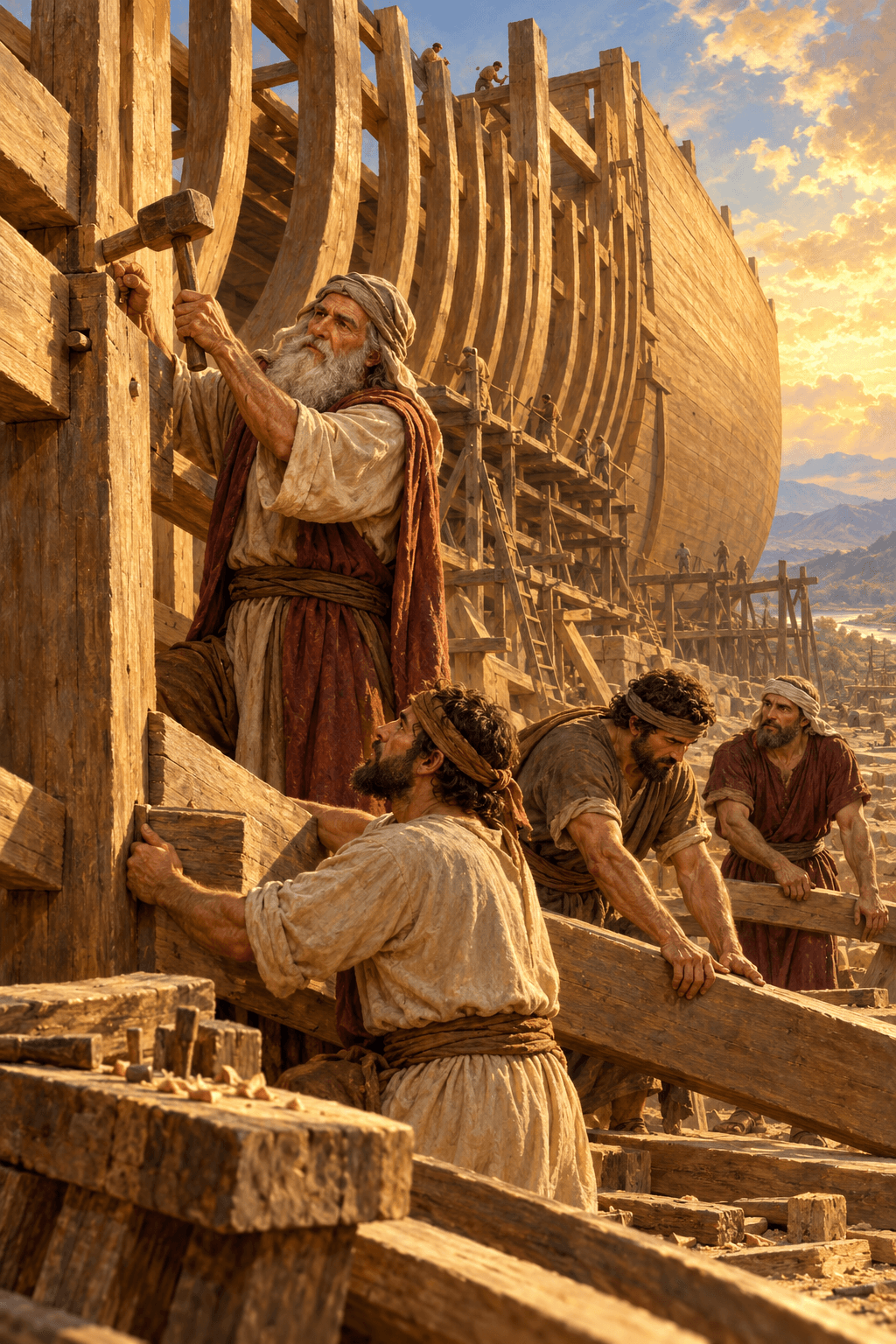
God revealed to His righteous servant Noah what He intended to do: “The end of all flesh is come before me; for the earth is filled with violence through them; and, behold, I will destroy them with the earth” (Genesis 6:13). God could have ordered Noah to build the ark, and Noah would have obeyed in faith and confidence. But God, the Lover of mankind, does not wish simply to command and forbid. He is the loving Friend who converses with humanity and reveals His wisdom and mysteries. As the psalmist says, “The secret of the LORD is with them that fear him; and he will shew them his covenant” (Psalm 25:14).
He revealed that, although He would destroy them with the earth, their destruction was the natural fruit of the corruption they themselves had chosen. This appears in His words, “The end of all flesh is come before me,” as though He said: I did not desire this, but they have brought about a destruction that leads to their end; they have freely chosen it.
Although the wicked had acted in this way and brought destruction even upon the earth, God would not leave His children to perish with them. He therefore commanded Noah to make an ark for his salvation. Scripture describes the ark accurately and in some detail because of its symbolic significance for our salvation through the cross.
First: The Significance of the Ark
In our study of baptism, we saw how the Church’s liturgies and the sayings of the Fathers shed light on Noah’s ark. The flood symbolizes the true renewal of human nature, and the ark symbolizes the cross that bore Christ, who was suspended upon it for us. In Him He bore the Church, His holy body. The old world, the old man, had to perish in the waters of baptism so that the new world, the new man formed in his Creator’s image, might arise with newness of life: the risen life in Christ Jesus (Romans 6:3-4). The flood, as a symbol of baptism, marks the boundary between the dark old life and the new life shining with the light of the Lord Jesus’ resurrection. [167]
This patristic understanding of the Church extends the apostolic teaching. The apostle Peter says, “when once the longsuffering of God waited in the days of Noah, while the ark was a preparing, wherein few, that is, eight souls were saved by water. The like figure whereunto even baptism doth also now save us (not the putting away of the filth of the flesh, but the answer of a good conscience toward God,) by the resurrection of Jesus Christ” (1 Peter 3:20-21).
Since we have already presented the liturgical and patristic understanding of this subject, I shall be content with a few brief sayings. [168]
“God created humanity from dust, renewed him through water, made him grow through His Spirit, and trained him through His Word for adoption and salvation. He directed him through holy commandments, so that at His coming He might transform the human being born of dust into a holy, heavenly being. — Saint Clement of Alexandria [169]”
“In the flood, in Noah’s days, all flesh died, but righteous Noah was preserved with his family. The outward man perishes, but the inward man is renewed. This happens not only in baptism but also through repentance: the lusts of the body perish and the spirit grows. The apostolic authority teaches us this: “I … have judged already, as though I were present, concerning him that hath so done this deed … To deliver such an one unto Satan for the destruction of the flesh, that the spirit may be saved in the day of the Lord Jesus” (1 Corinthians 5:3, 5). — Saint Ambrose [170]”
Second: The Material of the Ark
“Make thee an ark of gopher wood” (Genesis 6:14): this may mean cypress wood. In the Septuagint it is rendered “squared beams.” Saint Augustine says:
“It points to the Church, or to the firm and steadfast life of the saints, for squared beams remain upright however they are turned. [171] [172]”
Saint Ambrose says:
“You see the water, the wood, and the dove. Do you stand bewildered before the mystery? The water is that into which the body is immersed so that every bodily sin may be washed away and every evil buried. The wood is that upon which the Lord was fastened when He suffered for us. The dove is the form in which the Holy Spirit descended, as you have read in the New Testament: He grants you peace of soul and tranquillity of mind. The raven symbolizes sin, which goes away and does not return, while righteousness is preserved in you within and without. [173]”
Origen sees the squared wooden beams, regular in shape and standing at right angles, as a reference to the prophets and apostles. Through them a library of divine knowledge is established in the soul. He sees the ark as a symbol of entering the mysteries of knowing God and His work through His divine Word. [174]
Third: The Dimensions of the Ark
If the ark signifies enjoyment of Christ’s freely given salvation and entrance through the cross into the knowledge of God’s surpassing mysteries, so that Origen calls it “the library of the divine Word” or “the library of divine knowledge,” its length, breadth, and height point to faith, love, and hope. He says:
“Whoever can hear the Lord’s words and divine things, despite the weight of evil and the multitude of vices, leaving behind fleeting and perishable affairs, builds the ark of salvation within his heart and consecrates within himself a library of the divine Word. He is given faith, love, and hope as length, breadth, and height. Faith in the Holy Trinity is the length extending into immortality. Breadth is love, spread abroad by gentle and tender affections. Height is hope, which carries him toward heavenly truth, so that while we are on earth, “our conversation is in heaven” (Philippians 3:20). [175]”
In greater detail, he explains that the length is 300 cubits because the number 100 signifies Christ’s rational flock, from which He takes care that not one sheep is lost (Luke 15:4-5). This flock is sanctified through knowing and believing in the Holy Trinity: 100 × 3.
The breadth is 50 cubits. In our study of Exodus and Numbers we saw that 50 points to the enjoyment of forgiveness of sins, as in the Jubilee, the fiftieth year, when there was a general pardon and release for slaves and the land. Likewise, on the day of Pentecost the Holy Spirit descended upon the disciples in the upper room, giving the Church a heavenly nature freed from sin. [176] The breadth therefore signifies love: God’s forgiving love and our love that covers others’ weaknesses.
The height is 30 cubits, signifying humanity’s ascent to God, just as Joseph, at the age of thirty, went from prison to the palace to take charge of the kingdom’s affairs. Let the spiritual ark therefore be built in us, so that we may possess true, experienced knowledge: its length is living faith in the Holy Trinity, its breadth is true love for God and humanity, and its height is hope in heavenly things.
Saint Augustine sees the ark’s dimensions as a symbol of the Lord Christ’s body. Its measurements are 300 × 50 × 30. In his account of the well-proportioned human body, the length from the crown of the head to the soles of the feet is six times its breadth from side to side, 300:50, and ten times its depth, 300:30. Thus the ark points to the Word of God made flesh, who carried us in Himself through the flood into His new earth. [177]
Fourth: Pitching the Ark Within and Without
Origen says:
“He wishes us to be holy outwardly and pure inwardly in the heart, protected on every side, guarded by the virtue of self-denial, the outer pitch, and purity, the inner pitch. [178]”
Fifth: The Door in Its Side
Saint Augustine says:
“Its side door surely points to the wound made by the spear in the side of the Crucified One. Through it those who come to Him enter, and from it flowed the sacraments through which believers are joined to His membership. [179]”
Sixth: The Three Stories
Saint Augustine sees in these three stories a living picture of the Church gathered from every people and nation, made complete from the descendants of Noah’s three sons: Shem, Ham, and Japheth. They may also signify the three virtues commanded by the apostle: faith, hope, and love. He further sees in them believers bringing forth three different measures of harvest: a hundredfold, sixtyfold, and thirtyfold (Matthew 13:23; Mark 4:8). Or they represent the heavenly city, the eternal Church, whose members include chaste married people, pure widows, and virgins. [180]
Origen sees the three stories as a reference to three ways of interpreting Scripture: the literal, the moral or practical, and the spiritual. Whoever stops at the literal interpretation resembles someone remaining in the lowest story with the animals. Whoever rises to the moral interpretation and then enjoys the spiritual interpretation becomes like Noah, the man of God, and his family, meeting with God. [181]
Seventh: Noah and His Family Within the Ark
Origen says:
“As we ascend through the ark’s different stories, we reach Noah himself, whose name means “rest” or “righteousness.” Noah is Jesus Christ, for the words spoken by his father Lamech do not find their fulfilment in the ancient Noah: “This same shall comfort us concerning our work and toil of our hands, because of the ground which the LORD hath cursed” (Genesis 5:29). Look instead to our Lord Jesus Christ, of whom it was said, “Behold the Lamb of God, which taketh away the sin of the world” (John 1:29), and, “Christ hath redeemed us from the curse of the law, being made a curse for us: for it is written, Cursed is every one that hangeth on a tree” (Galatians 3:13). He also said, “Come unto me, all ye that labour and are heavy laden, and I will give you rest” (Matthew 11:28). You see that He truly grants humanity rest and delivers the earth from the curse. [182]”
The apostle Peter noticed that the number of souls saved through the ark was eight (1 Peter 3:20-21). This number points to the Church hidden in the cross of our Lord Jesus Christ, or to its heavenly nature and new character through its enjoyment of risen life in Christ Jesus. We know that eight signifies life beyond time: seven refers to the days of the week, so eight signifies passing beyond the limits of time.
Notes and References
[162] City of God 15:23. The source notes that Dr Omnia Kamel Metry translated Book Fifteen.
[163] In Romans, Homily 8.
[164] In 1 Timothy, Homily 13.
[165] City of God 15:25.
[166] Ibid.
[167] The author, The Holy Spirit: Between the New Birth and Continual Renewal, 1981, pp. 29-32.
[168] The preceding reference.
[169] Instructor 1:7. Printed as “Insdtr.” in the source.
[170] Duties of the Clergy 3:18 (108).
[171] On Psalm 87.
[172] City of God 15:26.
[173] On the Mysteries 3:11.
[174] Homilies on Genesis 2:6.
[175] Ibid.
[176] Exodus, 1981, p. 182; Numbers, 1981, pp. 33-34.
[177] City of God 15:26.
[178] Homilies on Genesis 2:4.
[179] City of God 15:26.
[180] Ibid.
[181] Homilies on Genesis 2:6.
[182] Ibid. 2:3.