
Without doubt Jacob lived all his days in Padan-aram dreaming of the day when he would return to Bethel, where he had seen the heavenly ladder, sensed the awe of the house of God, and vowed a vow to God… Now God fulfills the desire of his heart by calling him to go up to Bethel.
1. Jacob Journeys to Bethel
KJV · Verses 1–15
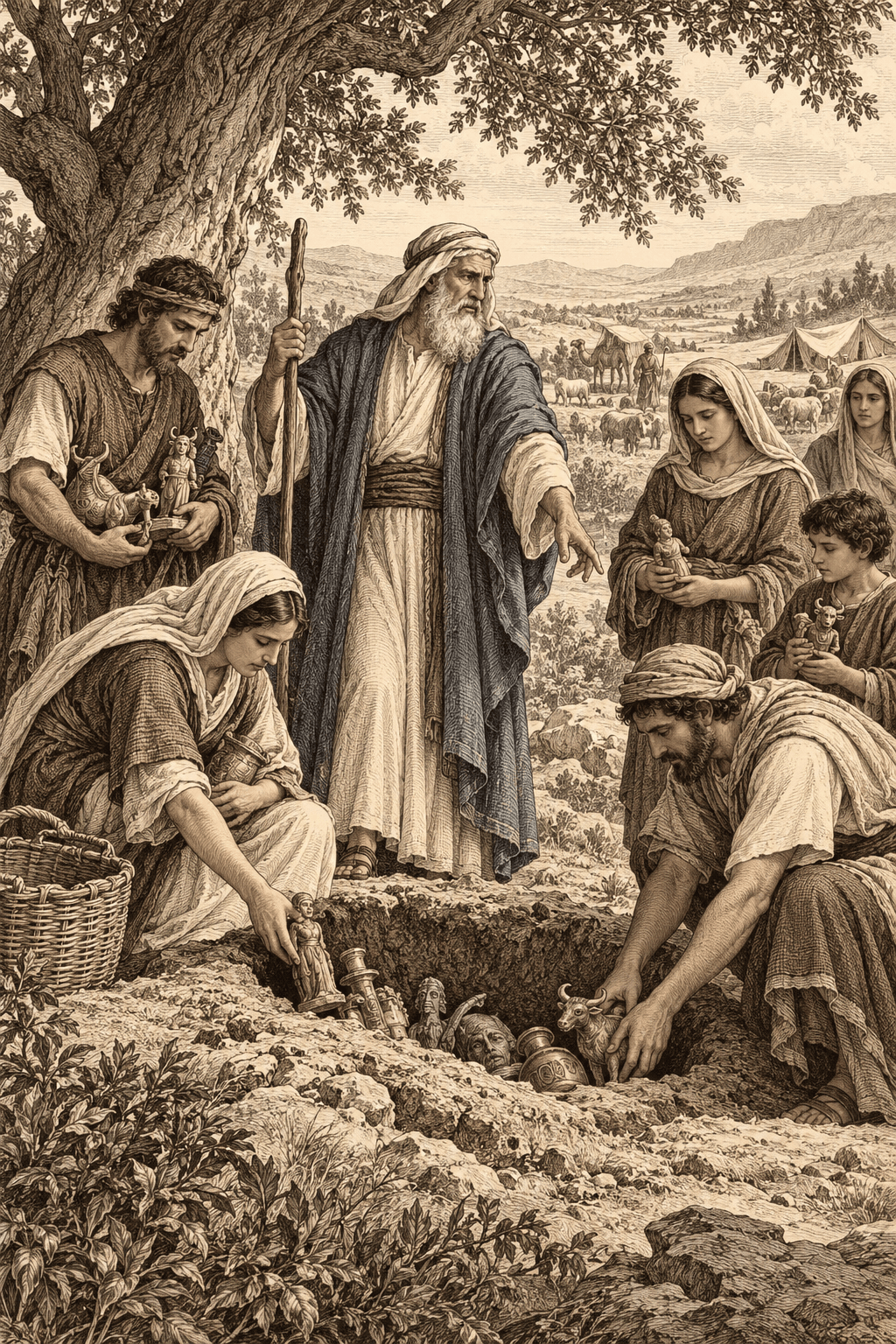
1 And God said unto Jacob, Arise, go up to Bethel, and dwell there: and make there an altar unto God, that appeared unto thee when thou fleddest from the face of Esau thy brother. 2 Then Jacob said unto his household, and to all that were with him, Put away the strange gods that are among you, and be clean, and change your garments: 3 And let us arise, and go up to Bethel; and I will make there an altar unto God, who answered me in the day of my distress, and was with me in the way which I went. 4 And they gave unto Jacob all the strange gods which were in their hand, and all their earrings which were in their ears; and Jacob hid them under the oak which was by Shechem. 5 And they journeyed: and the terror of God was upon the cities that were round about them, and they did not pursue after the sons of Jacob. 6 So Jacob came to Luz, which is in the land of Canaan, that is, Bethel, he and all the people that were with him. 7 And he built there an altar, and called the place Elbethel: because there God appeared unto him, when he fled from the face of his brother. 8 But Deborah, Rebekah's nurse died, and she was buried beneath Bethel under an oak: and the name of it was called Allonbachuth. 9 And God appeared unto Jacob again, when he came out of Padanaram, and blessed him. 10 And God said unto him, Thy name is Jacob: thy name shall not be called any more Jacob, but Israel shall be thy name: and he called his name Israel. 11 And God said unto him, I am God Almighty: be fruitful and multiply; a nation and a company of nations shall be of thee, and kings shall come out of thy loins; 12 And the land which I gave Abraham and Isaac, to thee I will give it, and to thy seed after thee will I give the land. 13 And God went up from him in the place where he talked with him. 14 And Jacob set up a pillar in the place where he talked with him, even a pillar of stone: and he poured a drink offering thereon, and he poured oil thereon. 15 And Jacob called the name of the place where God spake with him, Bethel.
“And God said unto Jacob, Arise, go up to Bethel, and dwell there: and make there an altar unto God, that appeared unto thee when thou fleddest from the face of Esau thy brother” (1).
At the time when Jacob was tied down in Shechem because of what his sons had done, and was afraid of the surrounding nations and peoples, behold God Himself calls him to go up to Bethel, to dwell there and make an altar to God. And indeed he went to the city of “Luz” in Canaan, which became Bethel; we have already spoken of this city (Genesis 28:16–22). We notice in this act the following:
First: Jacob asked his household to put away the strange gods, such as the teraphim Rachel had stolen from Laban her father, the gods that perhaps were with his servants before they entered into the divine covenant, and the images his sons may have plundered from Shechem… For the sanctification of the house of God (Bethel) cannot be declared while the community is unholy! The holiness of God’s house harmonizes with the holiness of the community, so that both — the building and the community — are a living icon of heaven, which is without blemish.
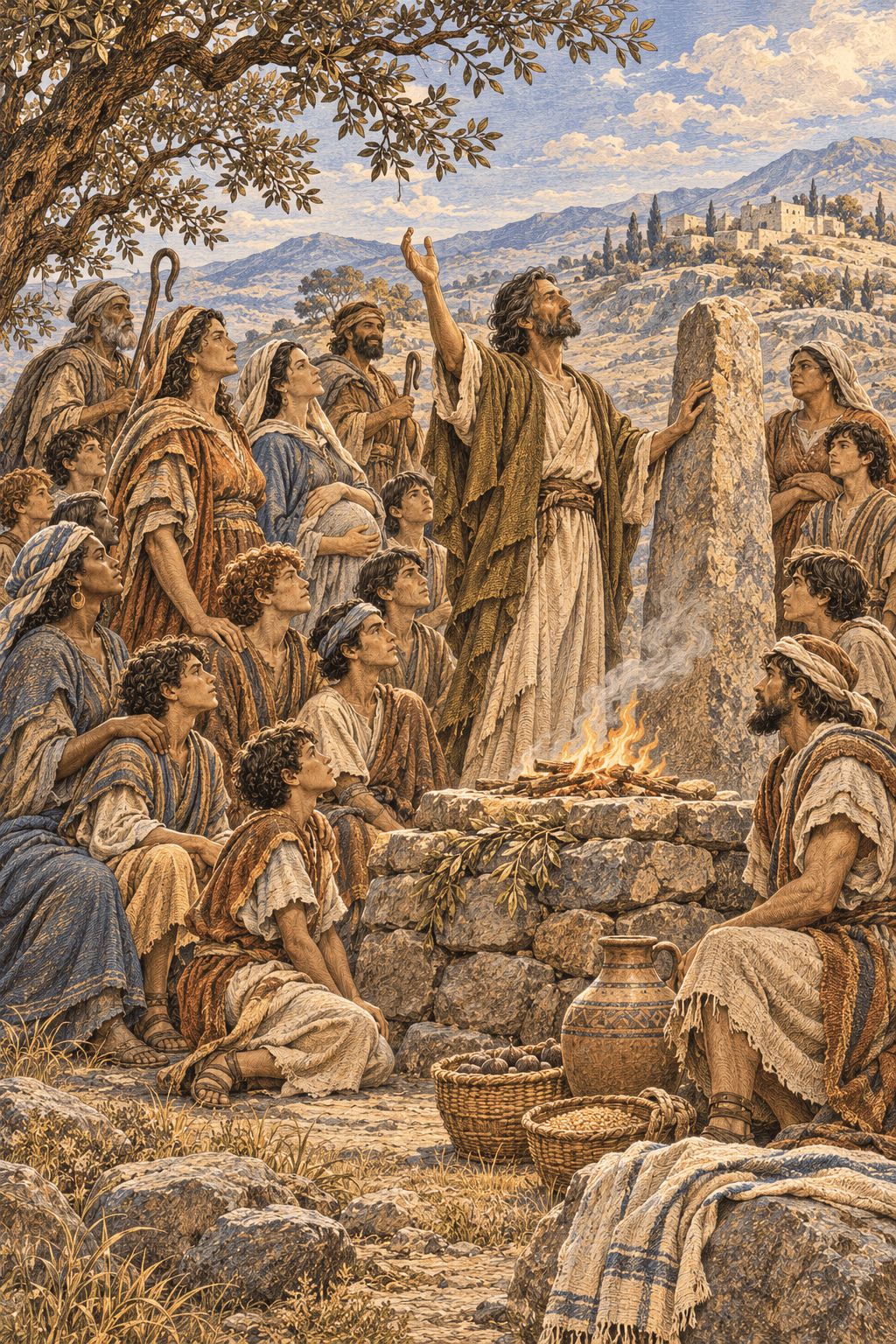
Second: Jacob also asked his household to change their garments. If putting away the strange gods points to the sanctification of the soul, changing the garments points to the purity of the body.
Third: All gave up the earrings in their ears with the strange gods, for Jacob to hide them under the oak which was by Shechem. It is likely that these earrings were not used only for adornment but also for superstitious religious purposes, such as bringing good luck and warding off envy, and so on. [395] The hiding of the earrings with the strange gods under the oak points to the burial of every satanic work and every evil thought under the wood of the cross. For if the house of God in its essence is the dwelling of God amid His people, then in meeting God we must bury all that is of the devil by the power of the cross.
Fourth: We have seen that “Bethel,” that is, “house of God,” was formerly called the city of Luz, and that “luz” (almond) points to the word of God; [396] as though there is a close relationship between the Church as the house of God and the word of God. If the house of God is our entry into God’s bosom, to be found in Him enjoying His life, the goal of the word of God is our abiding in God and our enjoyment of union with Him in His only-begotten Son.
Fifth: When Jacob moved to Bethel, none of the neighboring nations dared to follow his trail, for “the terror of God was upon the cities that were round about them” (5). The nations sensed the awe of God in the life of Jacob, hidden in the house of God, and could not pursue him.
Sixth: As Jacob’s procession set out to Bethel, it is said: “But Deborah Rebekah’s nurse died, and she was buried beneath Bethel under an oak: and the name of it was called Allon-bachuth” (8). This did not happen by chance, nor did Scripture record this event without meaning. God wished that Deborah, Rebekah’s nurse, be buried in Bethel under the oak called Allon-bachuth, that is, “the oak of weeping.” If Bethel gathers the community of believers in the Lord who dwells in their midst, among these believers are those who have fallen asleep before them, who strove like a bee (“Deborah”) and nursed many and raised them in the Lord, as Deborah did with Rebekah. In other words, in the house of the Lord all gather together: the strivers who are still on earth completing the days of their sojourning, with their brethren who preceded them in the striving, so that all are one Church, one house for the Lord.
Jacob buried his mother Rebekah’s nurse, whom her family had given her as a gift on the day of her betrothal (Genesis 24:59). Nurses had great standing and respect, close to the standing and respect of a mother. Some think Deborah died at the age of 180; Jacob had brought her from his father Isaac’s house in Hebron. It seems Jacob visited his father more than once and asked his permission to take Deborah, to receive her blessing as a mother to his mother, who had probably died before he came to Canaan from his uncle Laban.
It seems all wept for her greatly, so that the place of her burial was called “Allon-bachuth,” beneath Bethel, that is, in a low place in Bethel or near it.
Seventh: When Jacob had put away the strange gods and hidden them with the earrings under the oak, as under the cross, and set out to Bethel in clean garments, that is, purity of the body; when God had surrounded him with awe so that the peoples could not approach him; and when Deborah’s death and burial there became a sign of the unity of the holy community on the level of the living and those fallen asleep — now Jacob enjoys a divine appearance and confirmation of the renewal of his name and of the divine promises. For Scripture says: “And God appeared unto Jacob again… And God said unto him, Thy name is Jacob: thy name shall not be called any more Jacob, but Israel shall be thy name… And God said unto him, I am God Almighty: be fruitful and multiply; a nation and a company of nations shall be of thee, and kings shall come out of thy loins; and the land which I gave Abraham and Isaac, to thee I will give it, and to thy seed after thee will I give the land” (9–12).
In Bethel, that is, the holy Church, we meet God Almighty, “El Shaddai,” not only as the One able to do all things, but as the One who gives us ability in Him, so that we live by Him strong and able, singing with the Apostle Paul: “I can do all things through Christ which strengtheneth me” (Philippians 4:13). We meet God Almighty, the Giver of spiritual strength, to make all things new in us, and we bear a new name, being no longer called “Jacob” but “Israel.” We are fruitful and multiply according to His promise, so that our gifts, energies, and all our senses set out by the Holy Spirit bearing the increasing fruit of the Spirit; and we become in God’s eyes a nation, indeed a company of nations, for our life is changed into spiritual energies without number. And kings come out of our loins: the mind becomes a king having authority over every thought, and the soul like a queen governing all the affairs of the body and its senses with precision and authority, so that no feeling escapes her and no unacceptable glance slips in behind her, and so on… Finally, He gives us and our seed the land which He gave to our father Abraham and our father Isaac; that is, we have the sanctified body (the land) as an inheritance that gladdens our heart, and not as an opponent of the work of God’s Spirit.
Eighth: Finally, Jacob consecrated the first house of God after the fall, for it is said: “And Jacob set up a pillar in the place where he talked with him, even a pillar of stone: and he poured a drink offering thereon, and he poured oil thereon” (14). Jacob offered a stone pillar, a drink offering of wine, and oil… and God accepted them from Jacob’s hands, to make of the place a dwelling for Himself and His angels — He whom heaven and earth cannot contain. Out of His condescension He accepts this place as a sign of His dwelling amid His people, His cleaving to His children, and His entering with love into their lives.
This pillar also points to the Lord Christ, the cornerstone, who in the midst of His saving sufferings declared the drink offering of wine, that is, the offering of joy in the gladness of His resurrection, and received the oil of anointing as the Messiah, the Savior of the world. In Him alone we enter to dwell in His Father’s bosom as an eternal house that gathers the whole Church in divine love.
2. The Birth of Benjamin and the Death of Rachel
KJV · Verses 16–20
16 And they journeyed from Bethel; and there was but a little way to come to Ephrath: and Rachel travailed, and she had hard labour. 17 And it came to pass, when she was in hard labour, that the midwife said unto her, Fear not; thou shalt have this son also. 18 And it came to pass, as her soul was in departing, (for she died) that she called his name Benoni: but his father called him Benjamin. 19 And Rachel died, and was buried in the way to Ephrath, which is Bethlehem. 20 And Jacob set a pillar upon her grave: that is the pillar of Rachel's grave unto this day.
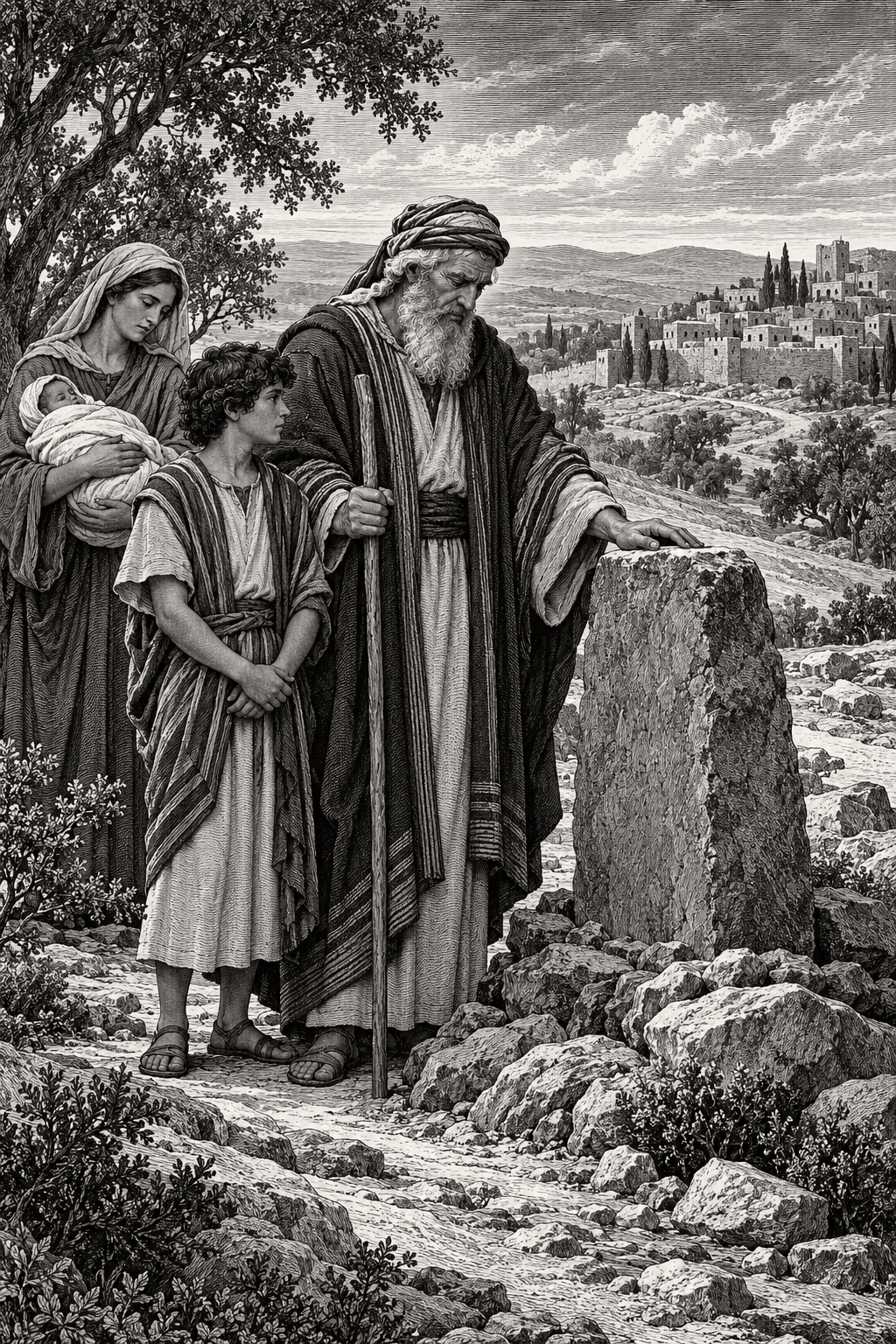
When Jacob and all his procession journeyed from Bethel toward Ephrath, about a mile north of Ephrath, Rachel travailed and had hard labor. As her soul was departing, for she died, she called her son “Ben-oni,” that is, “son of my sorrow,” because of the intensity of the pain and sorrow she suffered; but his father called him Benjamin, which means “son of the right hand.” Rachel was buried there near Bethlehem, and Jacob set a pillar on her grave; and her tomb still exists today.
Without doubt Rachel’s heart burned with longing that her son Joseph have a brother from his father and mother… and she lived the days of her pregnancy rejoicing over this gift… Why then did God allow her death at his birth?
First: God wished to assure man that birth and death walk side by side in the life of mankind, and our joys are mixed with our sorrows as long as we are in the body.
Second: Rachel represented the Church of the Gentiles, and Jacob symbolizes the Lord Christ. The Church remains in travail with her children, in pain, until, when the elect are complete, the whole Church departs to rest eternally… And what pains the Church here, so that she calls him “Ben-oni,” the Lord rejoices in and calls “Benjamin.” She suffers for a time and grieves, but our grief is turned into joy when we all set out with the Lord on the clouds and are at His right hand.
3. Reuben’s Sin
KJV · Verses 21–26
21 And Israel journeyed, and spread his tent beyond the tower of Edar. 22 And it came to pass, when Israel dwelt in that land, that Reuben went and lay with Bilhah his father's concubine: and Israel heard it. Now the sons of Jacob were twelve: 23 The sons of Leah; Reuben, Jacob's firstborn, and Simeon, and Levi, and Judah, and Issachar, and Zebulun: 24 The sons of Rachel; Joseph, and Benjamin: 25 And the sons of Bilhah, Rachel's handmaid; Dan, and Naphtali: 26 And the sons of Zilpah, Leah's handmaid: Gad, and Asher: these are the sons of Jacob, which were born to him in Padanaram.
After Rachel’s death Israel journeyed beyond Migdal-edar, that is, the tower of Edar or tower of the flock, a place in the shepherds’ plain about a mile east of Bethlehem… At that time Reuben, the firstborn son, dared to lie with Bilhah, Rachel’s maid, whom she had given to Jacob to bear her children… and because of this defilement Reuben lost the blessing of the birthright… which Jacob recalls with bitterness on his deathbed (Genesis 49:4).
What Reuben the firstborn did — going up boldly to his father’s bed — points to the work of the enemy of good, who was formerly the morning star, to whom God had given surpassing capacities and gifts; but in the pride of his heart he deceived man, to draw him away from his heart, the dwelling of God, so that the devil might occupy it as a usurper and defiler of the bed!
After mentioning Reuben’s sin, Scripture gives us a list of Jacob’s twelve sons, of whom we have already spoken (chapter 30).
4. The Death of Isaac
KJV · Verses 27–29
27 And Jacob came unto Isaac his father unto Mamre, unto the city of Arbah, which is Hebron, where Abraham and Isaac sojourned. 28 And the days of Isaac were an hundred and fourscore years. 29 And Isaac gave up the ghost, and died, and was gathered unto his people, being old and full of days: and his sons Esau and Jacob buried him.
“And the days of Isaac were an hundred and fourscore years. And Isaac gave up the ghost, and died, and was gathered unto his people, being old and full of days” (28–29).
Though Isaac lived to this age, he offered the fruits of many years; for age is not counted by years but by a practical, godly life.
Notes and References
[395] Naguib Guirguis, The Book of Genesis (Arabic), p. 334.
[396] See the commentary on Genesis 28:16–21.