
Jacob managed to take the birthright from his brother Esau for a meal of lentils; and now his mother arranges the matter for him so that he takes the blessing from his father Isaac in place of Esau.
1. Isaac Calls Esau
KJV · Verses 1–4
1 And it came to pass, that when Isaac was old, and his eyes were dim, so that he could not see, he called Esau his eldest son, and said unto him, My son: and he said unto him, Behold, here am I. 2 And he said, Behold now, I am old, I know not the day of my death: 3 Now therefore take, I pray thee, thy weapons, thy quiver and thy bow, and go out to the field, and take me some venison; 4 And make me savoury meat, such as I love, and bring it to me, that I may eat; that my soul may bless thee before I die.
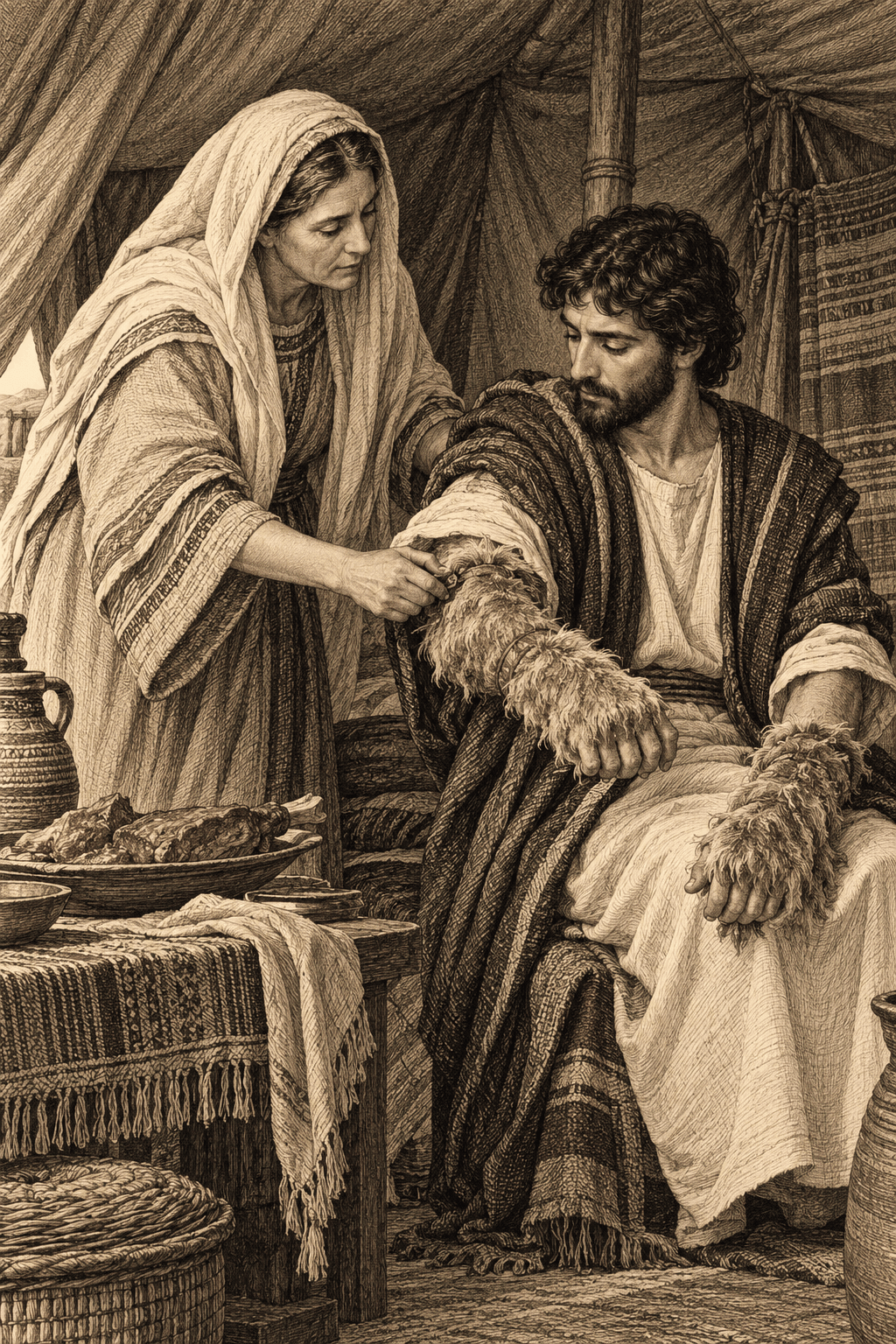
“And it came to pass, that when Isaac was old, and his eyes were dim, so that he could not see, he called Esau his eldest son, and said unto him, My son… Behold now, I am old, I know not the day of my death: now therefore take, I pray thee, thy weapons, thy quiver and thy bow, and go out to the field, and take me some venison; and make me savoury meat, such as I love, and bring it to me, that I may eat; that my soul may bless thee before I die” (1–4).
Isaac had already known that the elder would serve the younger (Genesis 25:23); he had heard that Esau recklessly sold his birthright for a meal of lentils, despising it; and he had seen in his life his attachment to two pagan wives, far from his father’s faith, who were a cause of bitterness to him and to Rebekah his wife. Yet he called him to eat of the venison of his hands, that his soul might bless him before he died, bequeathing to him the blessing he had received from his father Abraham. Was he moved, we wonder, by his human fatherly emotions, or did he carry out a prophetic act without willing it?!
If we blame Rebekah for intervening in a human way so that Jacob, her beloved, would receive the blessing in place of his brother Esau — even if in this the divine voice that the elder would serve the younger was fulfilled — we cannot deny Isaac’s weakness in wanting to bless a man like Esau, of whom God had declared that he would serve the younger. But Saint Jerome offers us a brief symbolic interpretation, which he took from Saint Hippolytus, revealing the prophetic symbolic work this chapter carried, declaring the messianic age. We can present it thus:
Isaac, in calling his son Esau to bless him when he was old and his eyes were dim, points to the heavenly Father, who in the last times called the community of the Jews as the firstborn son, longing to give them the evangelical blessing, that they might enjoy eternal salvation, reign with the Lord Christ, and keep the new Sabbath. Rebekah points to the Holy Spirit, who knew that the elder would serve the younger, and so cared for the community of the Gentiles (the younger son), that it might seize the evangelical blessing in place of the Jews after the Jews refused to believe in the Messiah, the Savior. If the kid points to the salvation of sinners, the two good kids of the goats which Jacob offered as food to his father point to the gathering of some Jews with the Gentiles. Rebekah clothed Jacob in the garments of his brother Esau — a sign of the men of the New Covenant who, by the Holy Spirit, acquired the Holy Scriptures and took from the Jews the Law, the covenants, and the prophecies which had been a garment for them, stripping them off through their denial of Christ Jesus. The goatskins which Jacob put on his hands and neck point to the sin which the Lord Christ bore for us, though it was not His sins, for He is the Holy One, the bearer of our sins. The food he offered is the unique sacrifice that gladdens the Father’s heart, through which the Church receives God’s blessing; while Esau received the curse because of unbelief. Jacob’s flight to Haran from the face of Esau was a symbol of the faith setting out to the strangers, that is, the Gentiles, after the Jews resisted it.
Through this patristic understanding we can perceive the true mystery of Esau’s being called to receive the blessing, which Jacob then took from him by the arrangement of his mother Rebekah.
2. Rebekah Supports Jacob
KJV · Verses 5–25
5 And Rebekah heard when Isaac spake to Esau his son. And Esau went to the field to hunt for venison, and to bring it. 6 And Rebekah spake unto Jacob her son, saying, Behold, I heard thy father speak unto Esau thy brother, saying, 7 Bring me venison, and make me savoury meat, that I may eat, and bless thee before the Lord before my death. 8 Now therefore, my son, obey my voice according to that which I command thee. 9 Go now to the flock, and fetch me from thence two good kids of the goats; and I will make them savoury meat for thy father, such as he loveth: 10 And thou shalt bring it to thy father, that he may eat, and that he may bless thee before his death. 11 And Jacob said to Rebekah his mother, Behold, Esau my brother is a hairy man, and I am a smooth man: 12 My father peradventure will feel me, and I shall seem to him as a deceiver; and I shall bring a curse upon me, and not a blessing. 13 And his mother said unto him, Upon me be thy curse, my son: only obey my voice, and go fetch me them. 14 And he went, and fetched, and brought them to his mother: and his mother made savoury meat, such as his father loved. 15 And Rebekah took goodly raiment of her eldest son Esau, which were with her in the house, and put them upon Jacob her younger son: 16 And she put the skins of the kids of the goats upon his hands, and upon the smooth of his neck: 17 And she gave the savoury meat and the bread, which she had prepared, into the hand of her son Jacob. 18 And he came unto his father, and said, My father: and he said, Here am I; who art thou, my son? 19 And Jacob said unto his father, I am Esau thy first born; I have done according as thou badest me: arise, I pray thee, sit and eat of my venison, that thy soul may bless me. 20 And Isaac said unto his son, How is it that thou hast found it so quickly, my son? And he said, Because the Lord thy God brought it to me. 21 And Isaac said unto Jacob, Come near, I pray thee, that I may feel thee, my son, whether thou be my very son Esau or not. 22 And Jacob went near unto Isaac his father; and he felt him, and said, The voice is Jacob's voice, but the hands are the hands of Esau. 23 And he discerned him not, because his hands were hairy, as his brother Esau's hands: so he blessed him. 24 And he said, Art thou my very son Esau? And he said, I am. 25 And he said, Bring it near to me, and I will eat of my son's venison, that my soul may bless thee. And he brought it near to him, and he did eat: and he brought him wine and he drank.
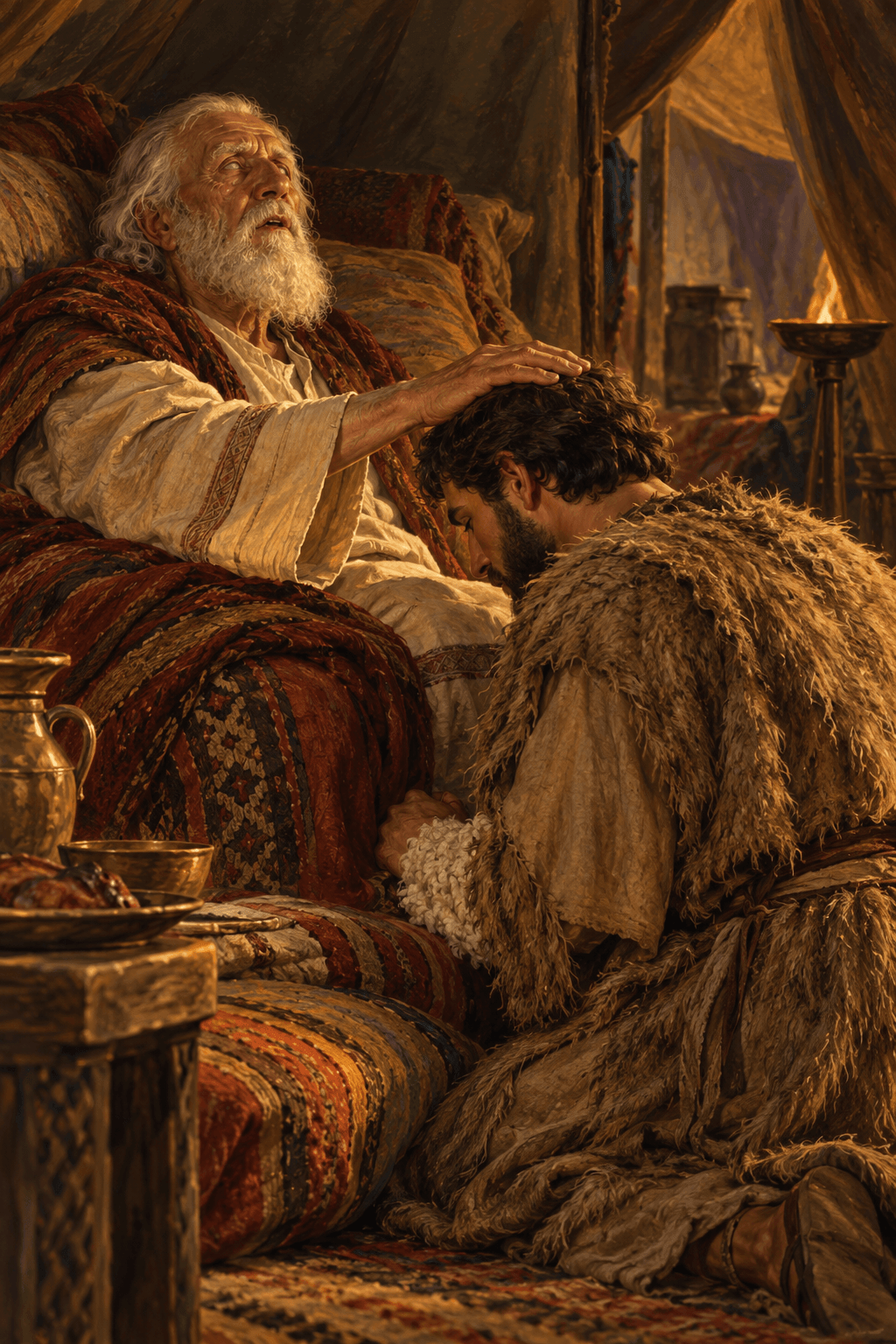
Rebekah heard what Isaac her husband said to Esau — perhaps she was present — and now, in her love for her son Jacob, she told him what had happened… What is strange is that Rebekah and Jacob did not feel they had sinned at all, nor did Isaac rebuke them for their conduct after discovering the deception; rather he confirmed his blessing to Jacob. Perhaps Isaac perceived that they were in the right, even though they had used an improper means!
Saint Augustine [364] sees that Holy Scripture wished to make clear that Jacob’s conduct was not from cunning and trickery but from simplicity of heart and faith, for it had already declared: “and Esau was a cunning hunter, a man of the field; and Jacob was a plain man, dwelling in tents” (Genesis 25:27). The Greek word translated “plain” (without fault) means blameless, or simple, or without pretense; therefore he deserved to receive the blessing.
We would have expected Rebekah, as a wise mother and a wife who loved her husband, to be frank with Isaac about what was in her heart and to remind him of the divine word concerning the blessing of the younger; but God used even her weakness for good, though she tasted the bitterness of her hasty conduct.
Rebekah played her part perfectly. She prepared for Isaac the food he loved, gave Jacob his brother’s garments bearing his smell to wear, and put skins on his hands and neck; so Isaac would find the food, the smell, and the touch, and bless his son. Concerning the garments, some think that Esau, as firstborn, had a priestly garment which he wore in his father’s old age to offer sacrifices for the family. As for the skin placed around Jacob’s arms, as Saint Augustine says:
It signifies his bearing the sins of others. [365]
Without doubt Jacob here represents the Lord Christ, the Head of the Church, who offered His life as a sacrifice of love — heavenly food that gladdens the Father’s heart — and put on our form and our garments, and bore our sins, that He might receive in our name and on our behalf eternal glory and the good pleasure of His heavenly Father!
Isaac said: “The voice is Jacob’s voice, but the hands are the hands of Esau” (22)… and he blessed him! It is a living picture of the Lord Christ: His voice is the voice of the only-begotten Son, but His hands are our hands, for He bore our nature in Himself! He became like Esau, bearing our weaknesses and sins, while He is the righteous Jacob!
3. Jacob Receives His Father’s Blessing
KJV · Verses 26–29
26 And his father Isaac said unto him, Come near now, and kiss me, my son. 27 And he came near, and kissed him: and he smelled the smell of his raiment, and blessed him, and said, See, the smell of my son is as the smell of a field which the Lord hath blessed: 28 Therefore God give thee of the dew of heaven, and the fatness of the earth, and plenty of corn and wine: 29 Let people serve thee, and nations bow down to thee: be lord over thy brethren, and let thy mother's sons bow down to thee: cursed be every one that curseth thee, and blessed be he that blesseth thee.
Isaac ate and drank wine, and asked his son to come near and kiss him with the kiss of love and respect, to receive the fatherly blessing out of the overflowing fullness that filled Isaac’s life and the sweet fragrance he had lived all the days of his sojourning.
He smelled the smell of his garments, for they were Esau’s precious garments, kept amid sweet scents, and they stirred in him the smell of the fields with their flowers and delightful fruits. Therefore he began the blessing saying: “See, the smell of my son is as the smell of a field which the LORD hath blessed” (27), asking for him the dew of heaven, which turns barren land into a garden, and the fatness of the earth, that is, its fertility, and that the Lord grant him corn and wine, signs of fullness and joy. He also asked for him that peoples and nations should submit to him and his brothers bow down to him. Here Saint Irenaeus says that we cannot accept the blessing in a literal sense but in the symbolic, spiritual sense fulfilled through the blessings of the New Covenant. He explains this blessing thus:
If anyone does not accept these things as pointing to the appointed (messianic) kingdom, he falls into contradiction, as happened with the Jews, who were perplexed in the matter. For not only did the nations not serve Jacob in his life, but even after receiving the blessing he himself left his home and served his uncle Laban the Syrian for twenty years (Genesis 31:41); and not only did he not become lord of his brother, but he bowed down before Esau his brother on his return from Mesopotamia to his father’s house, offering him many gifts (Genesis 33:3). Besides, in what way did he inherit much corn and wine here — he who migrated to Egypt because of the famine that came upon the land in which he dwelt, and became subject to Pharaoh, who was then ruling Egypt?! [366]
So this blessing cannot be understood on a literal basis; rather it was fulfilled spiritually by the coming of the Lord Christ, when Jacob — that is, the Church — enjoyed the spiritual kingdom. As Saint Augustine says:
The blessing of Jacob is the proclamation of Christ to all nations, which has now been fulfilled… Isaac is the Law and the Prophecy; for even through the mouth of the Jews the blessing of Christ was proclaimed through prophecy, as by one who did not know it nor understand it. The world is like a field filled with the sweet savor of the name of Christ. His blessing is the dew of heaven, that is, the showers of divine words; and the fatness of the earth, that is, the gathering of the peoples together. His blessing is the abundance of corn and wine, that is, the multitude gathering the bread and wine in the sacrament of His Body and Blood. Him the nations serve, and to Him the princes do homage. He is lord of His brothers, for He rules the people of the Jews. To Him the sons of the Father do homage, who are the children of Abraham according to faith, for He Himself is the son of Abraham according to the flesh. Whoever curses Him becomes accursed, and whoever blesses Him is blessed. [367]
In Christ Jesus our Lord each of us becomes Jacob, who hears the blessing from his father’s mouth thus: “the smell of my son is as the smell of a field which the LORD hath blessed: therefore God give thee of the dew of heaven, and the fatness of the earth, and plenty of corn and wine… be lord over thy brethren.” Truly in Christ Jesus our heart becomes a field, indeed a garden, bearing a sweet fragrance that gladdens the heart of the Bridegroom who says: “I am come into my garden, my sister, my spouse: I have gathered my myrrh with my spice; I have eaten my honeycomb with my honey; I have drunk my wine with my milk: eat, O friends; drink, yea, drink abundantly, O beloved” (Song of Solomon 5:1). Saint Gregory of Nyssa says in his commentary on the Song of Songs:
He comes into His garden… and gathers its spices, full of the fruit of her virtues; then He speaks of His enjoyment of the feast and His delight in it, saying to His bride: I am come down into my garden, my sister, my spouse. [368]
What is the dew of heaven but the sanctification of the soul, which becomes like a heaven bearing the grace of God as dew, which the Holy Spirit uses to make many lands fruitful? The fatness of the earth points to the fertility of the body sanctified by the Holy Spirit, so that all its energies, senses, and gifts set out to work in harmony with the dew of heaven. The plenty of corn reveals the soul’s fullness in her Bridegroom, the bread that came down from heaven; and the plenty of wine points to the overflow of inner spiritual joy. Finally, the enjoyment of lordship points to the state of the spiritual person as a king having authority and as a lord who says to this thought “Come,” and it comes, and “Go,” and it goes; he has authority in the Lord over his thoughts as over his senses and all his depths!
4. Esau Is Deprived of the Blessing
KJV · Verses 30–40
30 And it came to pass, as soon as Isaac had made an end of blessing Jacob, and Jacob was yet scarce gone out from the presence of Isaac his father, that Esau his brother came in from his hunting. 31 And he also had made savoury meat, and brought it unto his father, and said unto his father, Let my father arise, and eat of his son's venison, that thy soul may bless me. 32 And Isaac his father said unto him, Who art thou? And he said, I am thy son, thy firstborn Esau. 33 And Isaac trembled very exceedingly, and said, Who? where is he that hath taken venison, and brought it me, and I have eaten of all before thou camest, and have blessed him? yea, and he shall be blessed. 34 And when Esau heard the words of his father, he cried with a great and exceeding bitter cry, and said unto his father, Bless me, even me also, O my father. 35 And he said, Thy brother came with subtilty, and hath taken away thy blessing. 36 And he said, Is not he rightly named Jacob? for he hath supplanted me these two times: he took away my birthright; and, behold, now he hath taken away my blessing. And he said, Hast thou not reserved a blessing for me? 37 And Isaac answered and said unto Esau, Behold, I have made him thy lord, and all his brethren have I given to him for servants; and with corn and wine have I sustained him: and what shall I do now unto thee, my son? 38 And Esau said unto his father, Hast thou but one blessing, my father? bless me, even me also, O my father. And Esau lifted up his voice, and wept. 39 And Isaac his father answered and said unto him, Behold, thy dwelling shall be the fatness of the earth, and of the dew of heaven from above; 40 And by thy sword shalt thou live, and shalt serve thy brother; and it shall come to pass when thou shalt have the dominion, that thou shalt break his yoke from off thy neck.
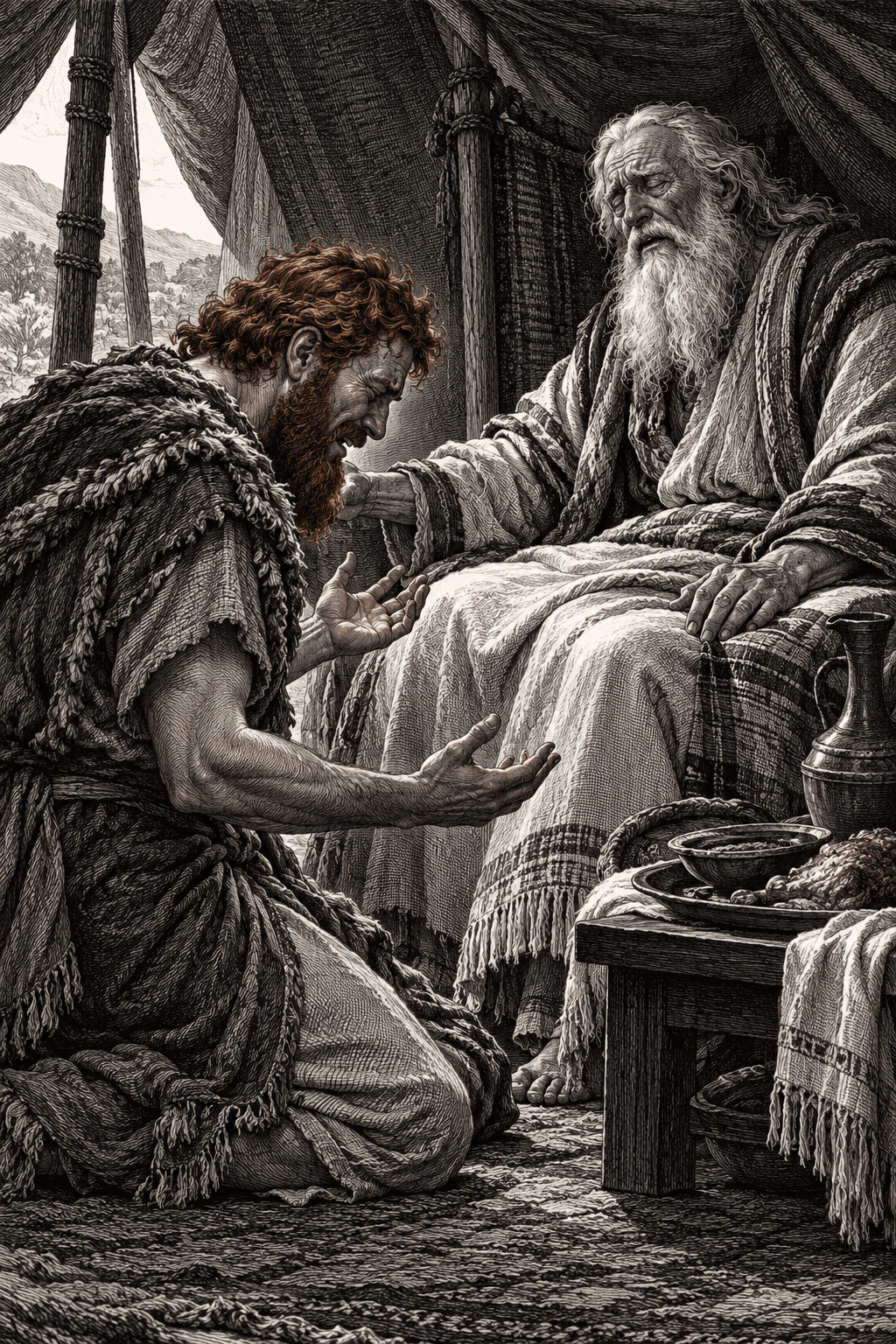
Some may ask: what was Esau’s fault, that he should be deprived of a blessing his brother took by the arrangement of their mother Rebekah? Did he not cry with a great and exceeding bitter cry when he heard from his father that his brother had taken the blessing, asking that he too be blessed?!
The answer is that Esau was negligent about what was in his hands — the birthright — and so lost the blessing against his will. Moreover, his conduct in general is what deprived him of receiving the blessing.
Esau’s great and exceeding bitter cry means that he sought the blessing with tears, as the Apostle said (Hebrews 12:17); but he did not seek it in its spiritual sense, but for the sake of temporal blessings. The proof of this is that he asked that he too receive a blessing, saying: “Hast thou not reserved a blessing for me?” (36). It is one blessing, through which one enjoys that the Lord Christ comes from his seed; how could it be for two brothers?!
5. Esau Bears a Grudge against His Brother
KJV · Verses 41–46
41 And Esau hated Jacob because of the blessing wherewith his father blessed him: and Esau said in his heart, The days of mourning for my father are at hand; then will I slay my brother Jacob. 42 And these words of Esau her elder son were told to Rebekah: and she sent and called Jacob her younger son, and said unto him, Behold, thy brother Esau, as touching thee, doth comfort himself, purposing to kill thee. 43 Now therefore, my son, obey my voice; arise, flee thou to Laban my brother to Haran; 44 And tarry with him a few days, until thy brother's fury turn away; 45 Until thy brother's anger turn away from thee, and he forget that which thou hast done to him: then I will send, and fetch thee from thence: why should I be deprived also of you both in one day? 46 And Rebekah said to Isaac, I am weary of my life because of the daughters of Heth: if Jacob take a wife of the daughters of Heth, such as these which are of the daughters of the land, what good shall my life do me?
Though Esau bore a grudge against his brother, we do not deny his nobility, for he refused to kill his brother out of respect for his father’s old age… expecting his father’s death soon, not knowing that his father would live many years after that.
Perhaps Rebekah feared to speak openly with Isaac about Esau’s grudge against Jacob, so she asked him to tell Jacob to go to Haran and marry from there, and not take a wife of the daughters of Heth as his brother Esau had done… In this way she found the outlet for her son to receive the blessing from his father before his flight from the face of his brother.
Finally, Rebekah was deprived of her son Jacob as the fruit of her human planning and her deception of her husband. Yet Saint Ambrose sees wisdom in Rebekah’s final conduct, for her natural motherly feelings prevailed, so as to turn away the anger of her son Esau and not lose both him and Jacob his brother. He says:
His mother wished him to live as a stranger until his brother’s anger was turned away. Good counsels rise above natural feelings. [369]
Notes and References
[364] Augustine, City of God 16:37.
[365] Ibid.
[366] Irenaeus, Adv. Haer. 5.33.3.
[367] Augustine, City of God 16:37.
[368] Gregory of Nyssa, Comm. on the Song of Songs, Serm. 10.
[369] Ambrose, Duties of the Clergy 1:24.