
Abram had trained himself to leave things behind for the Lord’s sake. Now, having returned from Egypt and become exceedingly rich, he asked his nephew Lot to separate from him and choose whatever portion seemed best to him. For the sake of peace, he endured parting from Lot, his companion on the journey of faith.
1. His Ascent from Egypt
Genesis 13:1-4
1 And Abram went up out of Egypt, he, and his wife, and all that he had, and Lot with him, into the south. 2 And Abram was very rich in cattle, in silver, and in gold. 3 And he went on his journeys from the south even to Beth-el, unto the place where his tent had been at the beginning, between Beth-el and Hai; 4 Unto the place of the altar, which he had made there at the first: and there Abram called on the name of the LORD.
“And Abram went up out of Egypt, he, and his wife, and all that he had, and Lot with him, into the south”—the Negeb (verse 1).
Abram had gone down to Egypt because of the famine and had almost lost his wife Sarai. Yet, because of the purity of his heart, God did not leave him in Egypt. He preserved his wife for him and gave him favor in Pharaoh’s eyes. Pharaoh urged him to go up out of Egypt, saying: “Now therefore behold thy wife, take her, and go thy way. And Pharaoh commanded his men concerning him: and they sent him away, and his wife, and all that he had” (Genesis 12:19-20).
This time the Lord did not appear to call him out. Instead, He spoke to him through Pharaoh, in whose land Abram had sought refuge, as though addressing him in the language appropriate to him at that moment. Such are God’s dealings with humanity: He addresses each person according to the condition that person has chosen. When Abram was very simple in his faith, God appeared and spoke to him directly; when he sought refuge with Pharaoh, God spoke to him through Pharaoh. When Balaam became as foolish as his ass, God spoke to him through that ass (Numbers 22:28-30). When Saul of Tarsus was exceedingly violent, God spoke to him through the language of temporary loss of sight (Acts 9:8-9). When the Magi were absorbed in astronomical studies, He addressed them through a star. Thus God speaks to a person in that person’s own language.
Abram went up from Egypt with his wife, all that he possessed, and Lot (verse 1). So it is fitting that, even if we have descended to relying upon a human arm—Pharaoh—we should not remain in weakness, but rise. Let each of us rise with his wife, all his possessions, and all his relatives: let him set out with his spirit, his body, represented by his wife, and all his energies, leaving nothing of himself entangled in temporal, human affairs. In other words, let our ascent be complete as we journey toward the promised land and live beneath the wings of our God!
Abram emerged with many blessings from the trial that had exposed his weakness. He recognized God’s surpassing care for him: Pharaoh could not touch his wife, and Abram became “very rich in cattle, in silver, and in gold” (verse 2). What was the secret of this wealth? Although Abram fell through weakness, by the power of the Spirit he did not surrender to his fall. It was as though he said: “Rejoice not against me, O mine enemy: when I fall, I shall arise; when I sit in darkness, the LORD shall be a light unto me” (Micah 7:8). For the believing soul, filled with hope, even weaknesses become opportunities to acquire greater riches.
When Theodore fell in love with a beautiful woman and abandoned the monastic life, Saint John Chrysostom wrote to assure him that despair was more bitter than fornication. He sent him two letters, until he repented and became a priest and later a bishop at Mopsuestia. Among the saint’s words to him were these:
“If the devil has such power to cast you down from a lofty height and sublime virtue into the furthest depths of evil, how much more is God able to raise you to your former confidence, making you not only as you were, but happier than before! Do not despair; do not cast away good hope; do not fall into what the ungodly have fallen into. It is not the multitude of sins that leads to despair, but the soul’s lack of piety. [243]”
Again he says:
“The evils we have committed do not provoke God as much as our unwillingness to change. Whoever sins has fallen into human weakness; but whoever persists in sin puts aside his humanity and becomes a devil. See how, through His prophet, God reproaches the second action more than the first: “And I said after she had done all these things, Turn thou unto me. But she returned not” (Jeremiah 3:7). [244]”
Abram had lost time by going down to Egypt, returning to the southern country, and then coming to Beth-el, “unto the place where his tent had been at the beginning, between Beth-el and Hai” (verse 3). He returned to where he had first been, yet he emerged from the trial enriched and greatly benefited! In the same way, God’s children do not cease growing and entering into spiritual riches, even when they encounter weaknesses or falls in their lives and imagine they have lost years, only to begin again from where they were before.
Scripture testifies that Abram was “very rich in cattle, in silver, and in gold” (verse 2). This wealth did not divert him from the riches of the soul. It could neither occupy his inner heart nor entangle his thoughts. Alongside temporal wealth, Abram enjoyed the joyful riches of the spirit. Saint Augustine says:
“So that you may know that wealth in itself is not blameworthy, Abraham was rich: he had much gold, silver, cattle, and servants. Yet he carried poor Lazarus in his bosom (Luke 16:22). The poor man was found in the rich man’s bosom. Were not both rich in God’s eyes? [245]”
2. His Separation from Lot
Genesis 13:5-9
5 And Lot also, which went with Abram, had flocks, and herds, and tents. 6 And the land was not able to bear them, that they might dwell together: for their substance was great, so that they could not dwell together. 7 And there was a strife between the herdmen of Abram’s cattle and the herdmen of Lot’s cattle: and the Canaanite and the Perizzite dwelled then in the land. 8 And Abram said unto Lot, Let there be no strife, I pray thee, between me and thee, and between my herdmen and thy herdmen; for we be brethren. 9 Is not the whole land before thee? separate thyself, I pray thee, from me: if thou wilt take the left hand, then I will go to the right; or if thou depart to the right hand, then I will go to the left.
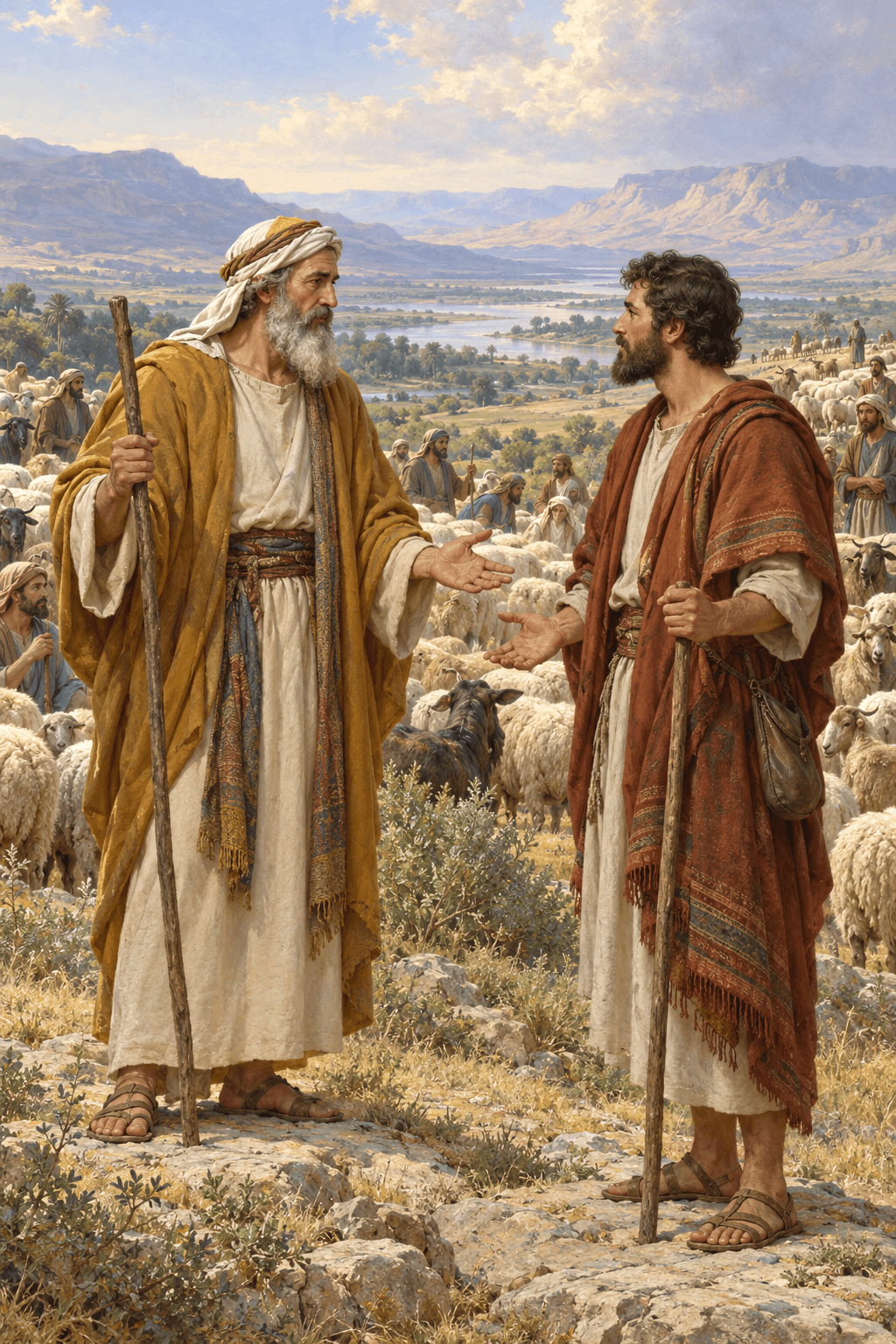
Lot, who journeyed with Abram, also had flocks, herds, and tents. The land could not support their dwelling together, because their possessions were so great. Strife arose between the herdsmen of Abram’s cattle and those of Lot’s cattle. Abram therefore said to Lot: “Let there be no strife, I pray thee, between me and thee, and between my herdmen and thy herdmen; for we be brethren. Is not the whole land before thee? separate thyself, I pray thee, from me: if thou wilt take the left hand, then I will go to the right; or if thou depart to the right hand, then I will go to the left” (verses 5-9).
Some understand the name “Lot” to mean “covering” or “veil.” [246] Although Lot accompanied Abram on his journey of faith, the difference between them was that Abram bore a simple, unveiled heart. What was within him was revealed outwardly; thus he pressed into the kingdom and continually grew in knowledge. Lot, however, traveled with the company of faith while his heart remained closed. Deep within he retained something of the love of pleasures and attachment to the world. Outwardly he appeared a man of faith, the companion of a great patriarch. Time therefore exposed his weaknesses, and trials revealed him. He deteriorated day by day until he lost his wife and possessions and was defiled with his two daughters, although we do not deny the good qualities that he possessed.
Lot was Abram’s companion, and both became rich. Yet Lot’s wealth consisted of “flocks, and herds, and tents” (verse 5); silver and gold are not mentioned for him as they are for Abram (verse 2). If silver signifies the word of God, and gold signifies the spirit or heavenly life, then Abram, amid his wealth, held fast to God’s word, or the commandment, as the secret of inward riches. As the psalmist says: “I have rejoiced in the way of thy testimonies, as much as in all riches” (Psalm 119:14). He also held fast to spiritual riches, or heavenly life—the gold—so that cattle did not distract him from eternity!
Abram was rich in cattle while his heart remained open to God’s commandment and heavenly kingdom. Lot, however, was occupied with temporal sheep, cattle, and tents, while his heart was veiled from beholding the heavenly kingdom.
Abram perceived what had happened between the herdsmen of his cattle and those of his nephew Lot. In love, for the sake of brotherly peace, he asked his nephew to separate and settle wherever seemed pleasing to him. Saint Augustine says:
“Perhaps from this arose the peaceful custom among people that, whenever earthly possessions are divided, the elder makes the division and the younger chooses. [247]”
Abram, the elder, joyfully and willingly left the younger man the right of choice. This revealed his believing heart and exposed Lot’s materialistic heart. The trial, as it were, proved Abram and laid Lot bare. Saint John Chrysostom speaks of Abraham, who held the higher place of honor, and of how he was not troubled when his nephew accepted the choice, taking the first portion for himself and leaving his uncle the smaller, second portion:
“When circumstances became worse and this father lost the first portion, he did not grow angry. Rather, he was content to take the second place. When the younger wronged the elder, the nephew his uncle, he neither resented him nor made excuses. Instead, he loved him as himself and offered him help when he needed it. [248]”
He also says:
“Abraham did not seek his own advantage, but that of many. For this reason he exposed himself to dangers and pleaded with God for people who were in no way related to him. His nephew, however, on hearing, “If thou depart to the right hand, then I will go to the left,” accepted the right of choice and pursued his own advantage. He lost his possessions when that region was burned (Genesis 19), while the surrounding regions remained unharmed. [249]”
3. Lot Chooses Sodom
Genesis 13:10-13
10 And Lot lifted up his eyes, and beheld all the plain of Jordan, that it was well watered every where, before the LORD destroyed Sodom and Gomorrah, even as the garden of the LORD, like the land of Egypt, as thou comest unto Zoar. 11 Then Lot chose him all the plain of Jordan; and Lot journeyed east: and they separated themselves the one from the other. 12 Abram dwelled in the land of Canaan, and Lot dwelled in the cities of the plain, and pitched his tent toward Sodom. 13 But the men of Sodom were wicked and sinners before the LORD exceedingly.
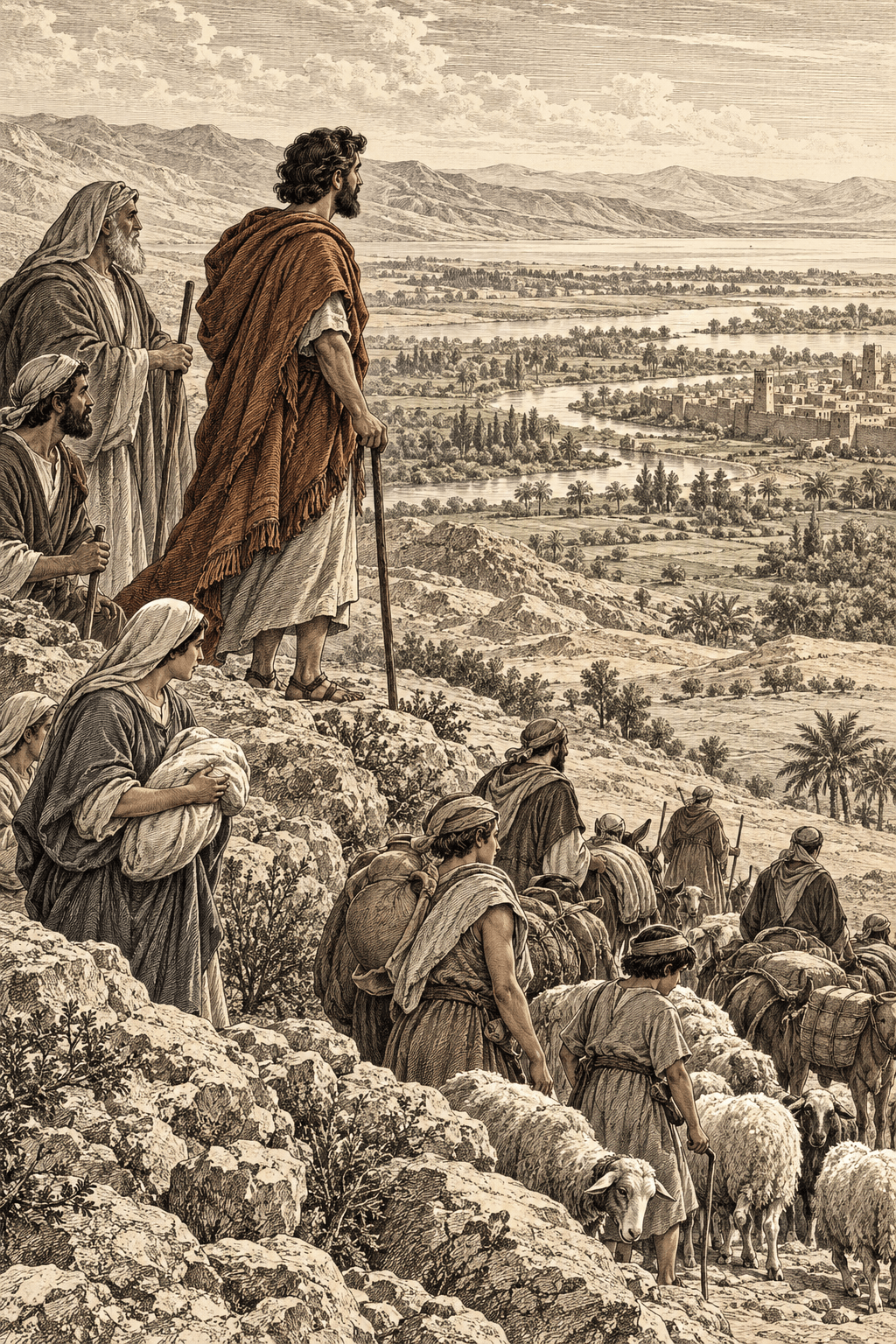
Lot lifted his eyes and saw the whole plain of Jordan, well watered before the Lord destroyed Sodom and Gomorrah, like the garden of the Lord and the land of Egypt on the way to Zoar. He chose the whole plain of Jordan for himself and pitched his tent toward Sodom, whose inhabitants were exceedingly wicked and sinful before the Lord (verses 10-13).
Perhaps Abram and his nephew Lot stood together on one of the heights of Beth-el. Abram raised his eyes and remembered Eden, from which humanity had been deprived through the devil’s envy. He embraced Lot in his heart with love, saying, “For we be brethren” (verse 8). Lot, however, lifted his eyes to see the well-watered land (verse 10). The same view drew Abram’s heart to brotherly love and Lot’s heart to selfishness. The first longed for Paradise; the other sought well-watered soil.
Lot lifted his eyes to see the land “as the garden of the LORD, like the land of Egypt.” He remembered Eden, but not its inward peace or humanity’s encounter with the Lord. He remembered its cultivation and fertility, like the land of Egypt. Thus spiritual and temporal things were mingled without discernment or discrimination. He represents the religious person who possesses theoretical knowledge and outward practices, while his heart is submerged in the love of the world and crawls upon the earth.
Lot’s third error, besides selfishness and failure to distinguish spiritual from temporal things, was his indifference to the inhabitants of the region. They were “wicked and sinners before the LORD exceedingly.” This cost him and his family much, both spiritually and materially.
4. The Lord Blesses Abram
Genesis 13:14-18
14 And the LORD said unto Abram, after that Lot was separated from him, Lift up now thine eyes, and look from the place where thou art northward, and southward, and eastward, and westward: 15 For all the land which thou seest, to thee will I give it, and to thy seed for ever. 16 And I will make thy seed as the dust of the earth: so that if a man can number the dust of the earth, then shall thy seed also be numbered. 17 Arise, walk through the land in the length of it and in the breadth of it; for I will give it unto thee. 18 Then Abram removed his tent, and came and dwelt in the plain of Mamre, which is in Hebron, and built there an altar unto the LORD.
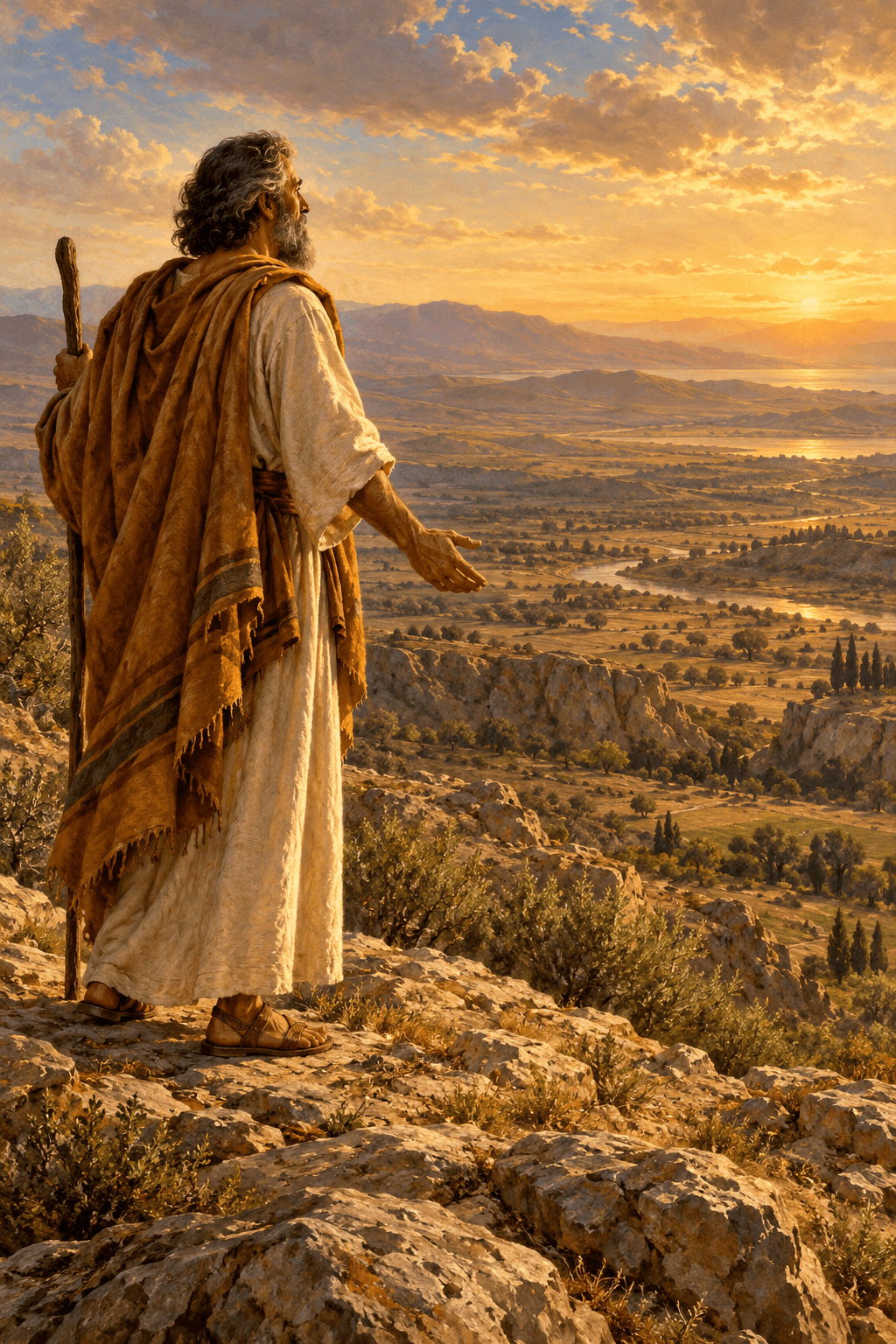
Lot’s materialistic outlook drew his eyes to the well-watered land, which he regarded as the garden of the Lord and the land of Egypt (verse 10). After he separated from Abram, Abram enjoyed God’s surpassing promises: “Lift up now thine eyes, and look from the place where thou art northward, and southward, and eastward, and westward.” And: “Arise, walk through the land in the length of it and in the breadth of it; for I will give it unto thee” (verses 14-17).
God did not wish to confine Abram to a single direction. He asked him to look toward all four directions, so that he might see the surpassing love of Christ in its length, breadth, depth, and height, a love that constrains him (2 Corinthians 3:18; 2 Corinthians 5:14). Perhaps, by looking toward the four directions, he saw by faith the cross through which the Lord Christ, born of Abram’s seed, reigns over peoples and nations that had become earth through idolatrous worship.
His words, “Arise, walk through the land in the length of it and in the breadth of it,” reveal God’s work in the lives of those who rise through the Lord who rose from the dead. They do not grow slack, but walk without ceasing until they possess the land completely. Saint Ambrose says:
“Rewards were not promised to the sleeping and the idle, but to those who struggle. [250]”
Abram received the promise that his countless descendants would inherit the land, although he had not yet begotten a son. In faith he accepted the promises without argument. He moved his tents, came to dwell by the oaks of Mamre in Hebron, and built an altar there to the Lord (verse 18). There, by the oaks of Mamre, he would receive God and two angels as guests and obtain the promise of Isaac’s birth (Genesis 18).
Leaving the discussion of the oaks of Mamre to chapter 18, we wish to note that, according to Origen, “Hebron” means “union” or “marriage,” while others understand it to mean “fellowship.” With every true encounter with God and enjoyment of His promises, we enter more deeply into a life of fellowship. Through it we reject every union with the love of temporal things, for the sake of the slain Bridegroom of our souls, our Lord Jesus.
Lot traveled toward Sodom and Gomorrah to live in well-watered land among the wicked, only to lose everything. Abram traveled toward the oaks of Mamre in Hebron to receive God and His two angels and enjoy a deeper life of fellowship with God. Our life is an unceasing journey: either toward Sodom, where there is destruction, or toward the oaks of Mamre, where we encounter the Giver of life!
Notes and References
[243] You Will Return with Greater Strength, 1967, pp. 5-6. (Arabic edition.)
[244] Ibid., p. 41.
[245] On Psalm 52.
[246] J. Strong, entry 3876.
[247] The City of God 16:20.
[248] Homilies on 1 Corinthians, homily 35.
[249] Ibid., homily 25.
[250] Cain and Abel 1:4 (12).