
After the brief account of the creation of the whole world and the sanctification of the seventh day, on which the Lord rested, divine revelation presents the condition of the first man in Paradise, showing how much God cares for his happiness.
1. The Sanctification of the Sabbath
KJV · Verses 1–3
1 Thus the heavens and the earth were finished, and all the host of them. 2 And on the seventh day God ended his work which he had made; and he rested on the seventh day from all his work which he had made. 3 And God blessed the seventh day, and sanctified it: because that in it he had rested from all his work which God created and made.

What does “he rested on the seventh day” mean? Without doubt, rest here does not mean ceasing from work; rather, He rested in the rest of His creation. As Saint Augustine says:
“God’s rest means the rest of those who rest in God. [79]”
His rest as a heavenly Father is to find His beloved ones enjoying true inner rest. Therefore Saint Augustine says:
“We rest when we do good works. As an example of this, it is written of God that He ‘rested on the seventh day’ when He had made all His works, and behold, they were very good. He neither grew tired nor needed rest; nor has He left His work even now, for our Lord Christ says plainly, ‘My Father worketh hitherto’ (John 5:17). [80]”
The Lord concluded His account of the works of creation by declaring His rest in His creation, which bore the marks of His love, especially man, who bore His image and likeness. God remains in His rest as long as man, too, rests in the bosom of his heavenly Father.
For this reason many of the Fathers saw the commandment to “keep the Sabbath,” which in Hebrew means “rest,” as a symbol of abiding in the Lord Christ, since He is the Father’s rest: in Him the Father finds His delight in us, and in Him we find our own rest as we enter the Father’s bosom. It is as if the Lord Christ Himself is our true Sabbath. [81]
This is the secret of God’s concern for keeping the Sabbath commandment and for making it a central line in the plan of His people’s salvation. Whoever breaks it has broken the divine covenant and deprived himself of membership in the holy community.
Let us, then, keep the true Sabbath by receiving the Lord Christ, risen from the dead, as the secret of our true rest. Let us receive Him as the Risen One, and so keep the Sabbath all the days of our life, especially on the first day of the week, as the apostles used to gather on the first day of the week (Sunday) for common worship around the Eucharist, the source of their true rest.
If the Lord Christ is “the seventh day,” the true Sabbath, in whom we were reconciled to the Father through the blood of His cross, then by abiding in Him we bear His features within us and are filled with His righteousness. We ourselves become a place of rest, and through Him we are counted a “Sabbath,” a “seventh day.” As Saint Augustine says:
“We ourselves become the seventh day when we are filled to overflowing with God’s blessings and sanctification. [82]”
Notice also that Holy Scripture did not say of the seventh day, “And the evening and the morning were the seventh day.” As Saint Augustine says:
“We find no evening in the Sabbath, because our rest has no end, for evening brings an end. [83]”
2. Adam in Paradise
KJV · Verses 4–14
4 These are the generations of the heavens and of the earth when they were created, in the day that the LORD God made the earth and the heavens, 5 And every plant of the field before it was in the earth, and every herb of the field before it grew: for the LORD God had not caused it to rain upon the earth, and there was not a man to till the ground. 6 But there went up a mist from the earth, and watered the whole face of the ground. 7 And the LORD God formed man of the dust of the ground, and breathed into his nostrils the breath of life; and man became a living soul. 8 And the LORD God planted a garden eastward in Eden; and there he put the man whom he had formed. 9 And out of the ground made the LORD God to grow every tree that is pleasant to the sight, and good for food; the tree of life also in the midst of the garden, and the tree of knowledge of good and evil. 10 And a river went out of Eden to water the garden; and from thence it was parted, and became into four heads. 11 The name of the first is Pison: that is it which compasseth the whole land of Havilah, where there is gold; 12 And the gold of that land is good: there is bdellium and the onyx stone. 13 And the name of the second river is Gihon: the same is it that compasseth the whole land of Ethiopia. 14 And the name of the third river is Hiddekel: that is it which goeth toward the east of Assyria. And the fourth river is Euphrates.
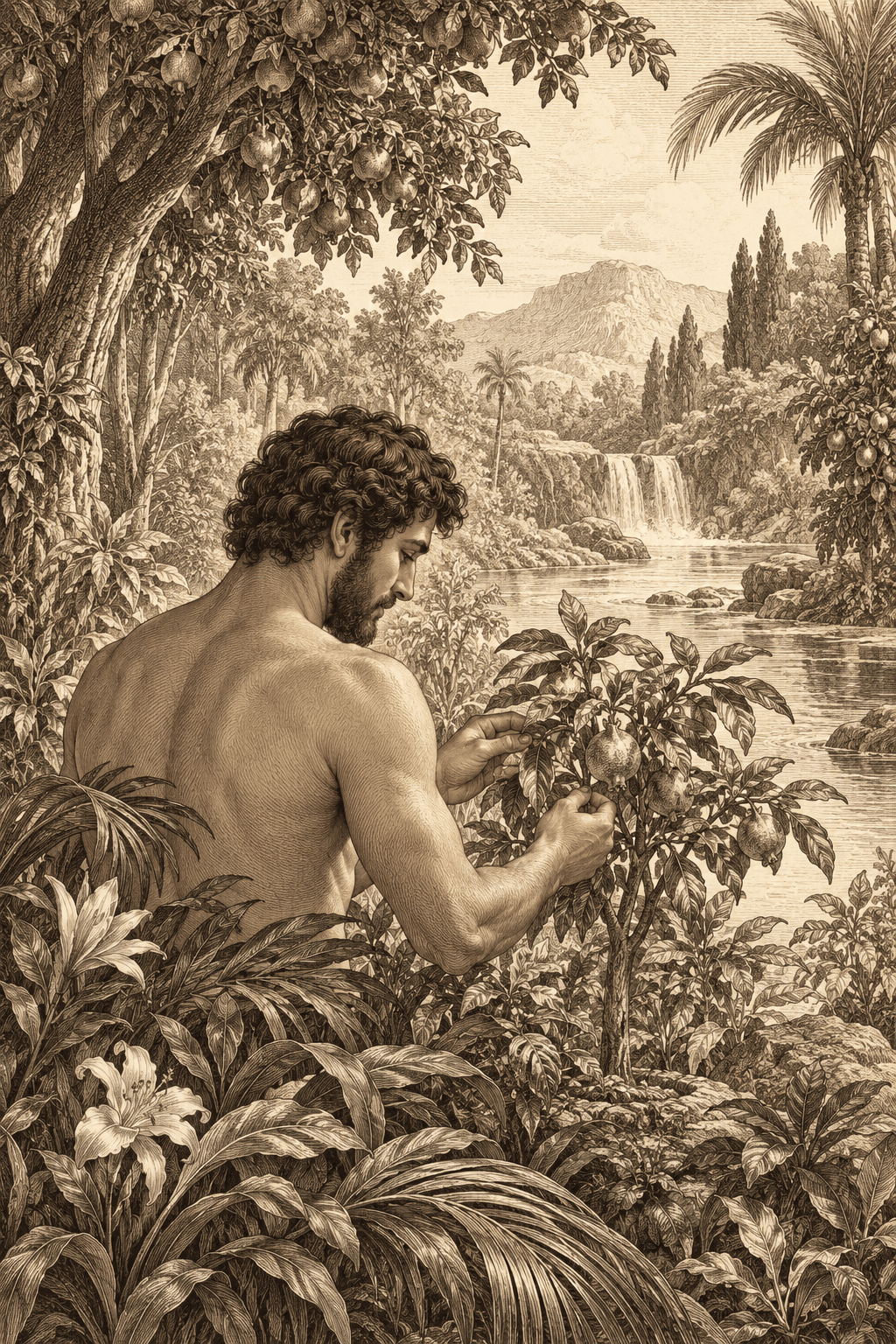
God created for man the whole universe, the earth, the firmament, space and the stars, so that man might sense in it God’s fatherhood and His surpassing care. He then revealed this fatherhood by speaking in some detail about the creation of man and the planting of the Garden of Eden eastward for his sake.
In the second century, Origen apparently viewed the story of Adam and Eve, and what happened to them, as a purely symbolic story given by revelation to unveil spiritual meanings touching man’s life with God. He held that Paradise was not on earth but in the third heaven, where Adam and Eve were spirits without real bodies before the fall; that they came down from Paradise to earth because of their fall; and that the bodies they received were a kind of punishment. These ideas were attacked by Saint Epiphanius, Bishop of Salamis in Cyprus, in his letter to Saint John, Bishop of Jerusalem. [84]
The Church rejects these ideas completely, because they distort our view of the world that God created as a sign of His love for us, and corrupt our understanding of the sanctification of the body. Moreover, the Lord Christ and His holy apostles proclaimed the first events of creation as real, not symbolic, events:
First: Both Testaments of Scripture rest on the proclamation of the sacrifice of salvation that humanity needed after the fall of our parents Adam and Eve in the Garden of Eden (see Romans 5). The fall of Adam required Christ’s saving work to raise up the whole man, spirit and body together, and not to save his spirit alone. If the human body were the product of sins previously committed by the spirit, there would have been no need for the divine Incarnation and the salvation of the body together with the spirit.
Second: When the Lord Christ Himself spoke about marriage, He based His teaching on what happened at the beginning of creation as a historical fact, and forbade divorce (Matthew 19:3–6; Mark 10:2–9).
Third: The Lord Christ referred to the story of our parents’ fall at the beginning of creation, explaining the role of the devil and his deceit (John 8:44).
Fourth: When the Apostle Paul spoke of the Church as the bride of the Lord Christ, he spoke of the serpent’s deception of Eve as a real event (2 Corinthians 11:3).
Fifth: In the genealogy of the Lord Christ, Luke the Evangelist names Adam as the first man of creation (Luke 3).
Sixth: The Apostle Paul spoke of Abel (the son of Adam and Eve) as a real person, not a symbol (Hebrews 11:4).
While we do not deny the reality of this garden as real history lived by Adam, we also see in it a symbol of the Lord Christ, who came to us from the East; in Him Adam enters to find his fulfillment and the joy of his heart. If the word “Eden” means “delight” or “bliss,” then the Lord Christ our Lord is the true delight and the secret of our eternal bliss.
If the garden symbolizes the Lord Christ as the secret of our delight, it also symbolizes the Church as the body of Christ, bearing in her midst “the tree of life” as a symbol of the Lord Christ, the Head of the Church and the secret of her life.
The Lord Christ came down into the world to reveal Himself as the tree of life planted in His Church; whoever enjoys Him enjoys life and wisdom. As Saint Jerome says:
“Solomon says, ‘She is a tree of life to them that lay hold upon her’ (Proverbs 3:18), speaking of wisdom. If wisdom is the tree of life, then wisdom is in truth Christ… Since this tree was planted in the Garden of Eden, we are all planted there. [85]”
In other words, we could have had no share as living trees planted in Paradise if the Tree of Life had not come down into its midst and revealed Himself as the secret of life for us.
As for the tree of the knowledge of good and evil, it points to “knowledge,” which in itself is a grace and a blessing; but if it turns toward the experience of evil, it becomes a cause of destruction. Saint Theophilus of Antioch says:
“The tree of knowledge in itself is good, and its fruit is good. It was not the tree, as some think, that carried death, but disobedience that carried it within itself. There was nothing else in the fruit but knowledge alone, and knowledge is good when it is used wisely. [86]”
The garden is watered by a river, of which it is said:
And a river went out of Eden to water the garden; and from thence it was parted, and became into four heads. [10]
If the tree of life points to the Lord Christ, the Giver of life, then the river that waters the garden is the Holy Spirit, who pours out upon our land and, through His waters, turns our desert into a garden that gladdens the heart of God. The Lord Christ spoke of this river, saying: “He that believeth on me, as the scripture hath said, out of his belly shall flow rivers of living water” (John 7:38). The Evangelist comments on these divine words: “But this spake he of the Spirit, which they that believe on him should receive: for the Holy Ghost was not yet given” (John 7:39).
Its division into four heads points to the outpouring of the Spirit upon the Church throughout the world, from east to west and from north to south.
If the river points to the Holy Spirit, who comes upon the believers to sanctify them, then its division into four heads points to His sanctification of the body, which is symbolized by the number 4, since the body is taken from the earth (the four corners of the world). It is as if man, in his relationship with God, becomes through the Holy Spirit a new Garden of Eden, sanctified by the Holy Spirit, who works in the human soul as well as in the body.
As for the location of the garden, theologians and geographers have not yet agreed on it. Some think it was in Armenia, because the Euphrates and the Tigris rise there. The prevailing opinion, however, is that the river of Eden that divided into four heads is none other than the Euphrates–Tigris, which flows into the Shatt al-Arab (in the Persian Gulf), dividing into several branches. In this view, the Garden of Eden is the fertile southern part of Iraq.
Those who hold this view explain that the land of Havilah, where there is gold (11), is part of the Arabian Peninsula bordering Iraq to the southwest, and that the land of Cush (13) most likely means the land of Elam, which was long known as Cashshu (Cossean). The plain of Babylon was also called Edinu. [87]
3. God’s Commandment to Adam
KJV · Verses 15–17
15 And the LORD God took the man, and put him into the garden of Eden to dress it and to keep it. 16 And the LORD God commanded the man, saying, Of every tree of the garden thou mayest freely eat: 17 But of the tree of the knowledge of good and evil, thou shalt not eat of it: for in the day that thou eatest thereof thou shalt surely die.
And the LORD God took the man, and put him into the garden of Eden to dress it and to keep it. [15]
Before God gave Adam the commandment of love and obedience, He placed him in the Garden of Eden to work it and keep it. If by preparing the garden for his sake He declared His love and care for him, then by appointing him to work and keep the garden He declared His esteem for man. He prepared for him every means of comfort and gave him the abilities of thought and reason. Therefore He did not place him in the garden to eat, drink, and amuse himself, but established him as a being with his own work and worth in God’s eyes.
Thus God sanctified work: He appointed the most perfect of His earthly creatures to work, and gave him wisdom to keep the garden. It is as though God appointed a steward over the work of His hands, to carry out this work with a joyful heart and with understanding!
Having given him this gift, the gift of working and keeping the garden, He gave him a commandment:
Of every tree of the garden thou mayest freely eat: But of the tree of the knowledge of good and evil, thou shalt not eat of it: for in the day that thou eatest thereof thou shalt surely die. [16–17]
Some may ask: Was there any need for this commandment? We answer that the commandment honors man, for it proclaims the freedom of his will. God wished to deal with him on a surpassing level, so He gave him the commandment to open the door of a practical dialogue with him. Thus Adam’s obedience to God would not be an instinctive, mechanical obedience governed by the laws of nature, like that of the other creatures, but would rest on his holy humanity and on true love flowing from his depths in perfect freedom.
The commandment is neither a deprivation nor a repression of man; it is a way to enjoy the holiness of free will. We have spoken about “The Commandment and Love” in a separate booklet.
Some hold that God gave man great gifts, yet even after placing him in the garden He wished to prove him and honor him with still greater gifts, perhaps through eating from the tree of life, had he lived in obedience to the divine commandment and so declared his practical love for his Creator and greatest Friend. Saint Theophilus of Antioch says:
“God wished to prove man by his submission to the commandment, and at the same time He wished man to remain longer like a child, in simplicity and sincerity. [88]”
Since the penalty of disobedience was “thou shalt surely die,” some have thought that the story of our first parents’ fall is symbolic, saying that the penalty is far too severe and out of proportion to a commandment about eating the fruit of a particular tree. Scholars answer this as follows:
First: The penalty is not due to the kind of commandment, but to the inner attitude that met God’s surpassing love and care for man with ingratitude. Punishment is the natural fruit of sin, whatever the sin may be, just as Paradise in its first delight suits the state of a man who cleaves to his God.
Second: The severity of the punishment corresponds to the gift of human freedom and to God’s esteem for man.
Third: The severity of the punishment highlights the power of the salvation that God offers man through the giving of His only-begotten Son.
Fourth: Wonderfully, the weight of the punishment fell on the earth and on the serpent. God did not curse Adam or Eve; He cursed the serpent for deceiving man, and the earth because of the one who dwells on it! In His love God showed the bitterness of sin, but He did not curse man… What love is greater than this?!
4. The Creation of Eve
KJV · Verses 18–25
18 And the LORD God said, It is not good that the man should be alone; I will make him an help meet for him. 19 And out of the ground the LORD God formed every beast of the field, and every fowl of the air; and brought them unto Adam to see what he would call them: and whatsoever Adam called every living creature, that was the name thereof. 20 And Adam gave names to all cattle, and to the fowl of the air, and to every beast of the field; but for Adam there was not found an help meet for him. 21 And the LORD God caused a deep sleep to fall upon Adam, and he slept: and he took one of his ribs, and closed up the flesh instead thereof; 22 And the rib, which the LORD God had taken from man, made he a woman, and brought her unto the man. 23 And Adam said, This is now bone of my bones, and flesh of my flesh: she shall be called Woman, because she was taken out of Man. 24 Therefore shall a man leave his father and his mother, and shall cleave unto his wife: and they shall be one flesh. 25 And they were both naked, the man and his wife, and were not ashamed.
And the LORD God said, It is not good that the man should be alone; I will make him an help meet for him. [18]
Although the creation of the whole world may have required millions of years, revelation recorded it very briefly in a single chapter, so that the whole of Holy Scripture might proclaim God’s concern for man in particular, the center of the world in God’s eyes. He cared for man’s material and psychological needs as well as his spiritual ones… And now, seeing him alone in the garden, He wished to make him a helper suitable for him.
The expression “an help meet for him” reveals the meaning of married life: the relationship of Adam to Eve, of man to woman. The wife is a helper to her husband, just as the husband is a helper to his wife. She is his counterpart; she does not exalt herself over him, nor is she less than he! Married life rests on true unity, which helps both through mutual respect.
Scripture tells us of the creation of Eve as Adam’s one and only wife, brought to him from his side after God caused a deep sleep to fall upon him… Adam saw that she was bone of his bones and flesh of his flesh (23), and he called her Woman, because she was taken out of Man. Through this event Scripture laid down the principle of marriage:
Therefore shall a man leave his father and his mother, and shall cleave unto his wife: and they shall be one flesh. [24]
The story of Eve’s creation carries a symbol of the creation of the Church, the bride of Christ, for whose sake the Bridegroom emptied Himself to cleave to her and carry her up to His heavens. The writings of the early Church speak abundantly of the creation of Eve and her relation to the Church, the bride of Christ. We select a few words of Saint Augustine on this subject:
“When was Eve created? When Adam slept! When did the sacraments of the Church flow from the side of Christ? When He slept on the cross. [89]”
“If Christ cleaves to His Church so that the two may be one flesh, in what way does He leave His Father and mother? He left His Father in the sense that, ‘being in the form of God, thought it not robbery to be equal with God: But made himself of no reputation, and took upon him the form of a servant’ (Philippians 2:6–7). In this sense He left His Father, not by forgetting Him or being separated from Him, but by appearing in human form… But how did He leave His mother? By leaving the synagogue of the Jews, from which He was born according to the flesh, in order to cleave to the Church, which He gathered from all nations. [90]”
“(Speaking of the mystery of the union between the Lord Christ and His Church as Bridegroom and bride) the Apostle says of Him: ‘This is a great mystery: but I speak concerning Christ and the church’ (Ephesians 5:32)… We are with Him in heaven by hope, and He is with us on earth by love. [91]”
“Our Lord Jesus speaks in His own person as our Head, and He also speaks in the person of His body, which is we, His Church. So the words come forth as from one mouth, and we understand the Head and the body as united together in completeness, not separated from one another, just as in marriage, of which it is said, ‘they shall be one flesh’ (24). [92]”
We conclude here with the words of Saint Ambrose, who sees in “one flesh” a unity of will through love between husband and wife:
“God placed the feelings of a good will in the man and the woman, saying, ‘they shall be one flesh’; and one may add, ‘and one spirit.’ [93]”
Finally, after speaking of the creation of Eve and her union with Adam in love, Scripture says:
And they were both naked, the man and his wife, and were not ashamed. [25]
They were naked in body but clothed in spirit; therefore they found nothing to be ashamed of. For what makes a person ashamed is not his body, but the corruption that crept into it because of sin.
For this reason some of the Fathers see in entering the baptismal font unclothed a return to Paradise, where man, in purity of heart, was naked in body and not ashamed.
Notes and References
[79] Saint Augustine, The City of God, 11:8.
[80] Saint Augustine, On Psalm 93.
[81] By the author: Christ in the Sacrament of the Eucharist, Book 1, “The Mystery of the Sabbath.”
[82] Saint Augustine, The City of God, 22:30.
[83] Saint Augustine, On Psalm 93.
[84] See Saint Jerome, Letter 51.
[85] Saint Jerome, Homily 1 on the Psalms.
[86] Saint Theophilus of Antioch, To Autolycus, 2:25.
[87] For a summary of theories concerning the location of the Garden of Eden, see New Westminster Dictionary of the Bible, pp. 238–239.
[88] Saint Theophilus of Antioch, To Autolycus, 2:25.
[89] Saint Augustine, On Psalm 41; see also On Psalm 127.
[90] Saint Augustine, Tractates on John, 9:10.
[91] Saint Augustine, On Psalm 55.
[92] Ibid., Psalm 41.
[93] Saint Ambrose, On the Duties of the Clergy, 1:32.