
If Jacob points to the Lord Christ, then he gathers to Himself the Church of the New Testament, Rachel with her children, and the Church of the Old Testament, Leah with her children, to carry them all together to the heavenly Canaan. But the pagan Laban, who represents the devil, cannot accept this heavenly procession. He sets out with his forces to hinder it, yet fails completely.
1. Jacob’s Flight
KJV · Verses 1–21
1 And he heard the words of Laban’s sons, saying, Jacob hath taken away all that was our father’s; and of that which was our father’s hath he gotten all this glory. 2 And Jacob beheld the countenance of Laban, and, behold, it was not toward him as before. 3 And the LORD said unto Jacob, Return unto the land of thy fathers, and to thy kindred; and I will be with thee. 4 And Jacob sent and called Rachel and Leah to the field unto his flock, 5 And said unto them, I see your father’s countenance, that it is not toward me as before; but the God of my father hath been with me. 6 And ye know that with all my power I have served your father. 7 And your father hath deceived me, and changed my wages ten times; but God suffered him not to hurt me. 8 If he said thus, The speckled shall be thy wages; then all the cattle bare speckled: and if he said thus, The ringstraked shall be thy hire; then bare all the cattle ringstraked. 9 Thus God hath taken away the cattle of your father, and given them to me. 10 And it came to pass at the time that the cattle conceived, that I lifted up mine eyes, and saw in a dream, and, behold, the rams which leaped upon the cattle were ringstraked, speckled, and grisled. 11 And the angel of God spake unto me in a dream, saying, Jacob: And I said, Here am I. 12 And he said, Lift up now thine eyes, and see, all the rams which leap upon the cattle are ringstraked, speckled, and grisled: for I have seen all that Laban doeth unto thee. 13 I am the God of Bethel, where thou anointedst the pillar, and where thou vowedst a vow unto me: now arise, get thee out from this land, and return unto the land of thy kindred. 14 And Rachel and Leah answered and said unto him, Is there yet any portion or inheritance for us in our father’s house? 15 Are we not counted of him strangers? for he hath sold us, and hath quite devoured also our money. 16 For all the riches which God hath taken from our father, that is ours, and our children’s: now then, whatsoever God hath said unto thee, do. 17 Then Jacob rose up, and set his sons and his wives upon camels; 18 And he carried away all his cattle, and all his goods which he had gotten, the cattle of his getting, which he had gotten in Padanaram, for to go to Isaac his father in the land of Canaan. 19 And Laban went to shear his sheep: and Rachel had stolen the images that were her father’s. 20 And Jacob stole away unawares to Laban the Syrian, in that he told him not that he fled. 21 So he fled with all that he had; and he rose up, and passed over the river, and set his face toward the mount Gilead.
Laban’s sons felt that Jacob had taken everything belonging to their father and had gained all this wealth for himself [1]. This caused Laban’s attitude toward Jacob to change. At that time, “the LORD said unto Jacob, Return unto the land of thy fathers, and to thy kindred; and I will be with thee” [3].
Without doubt, Jacob’s heart clung to the land of Canaan, the promised land that God had promised Abraham would belong to his descendants. He had longed to marry Rachel and return to receive his inheritance. The first seven years passed, then the second seven; now twenty years had gone by, and he had to leave Haran and set out. He had his beloved wife, children, many sheep and cattle, and male and female servants. How could he leave?
The Lord spoke to him through events, allowing Laban and his sons to rise against him so that he would feel himself a stranger and depart. At the same time, God spoke to him, apparently through a vision in a dream, commanding him to leave [12–13]. Jacob realized that the events of his life were neither random nor mere coincidence, but subject to divine providence and permission, so that God’s purpose might be fulfilled in him. Although Laban and his sons acted wickedly out of envy, Jacob perceived that what had happened came at the right time. Nothing in our lives proceeds in this way except for our good, if we surrender our lives into His hands. Apostle Paul experienced this and said, “And we know that all things work together for good to them that love God” (Romans 8:28).
Jacob sent for his wives, Rachel and Leah, to come to the field where his flock was, so that, seeing his wealth, they would accept his counsel and depart with their children. In a spirit of mutual understanding, he explained how their father’s attitude toward him had changed. He reminded them of his faithful service to their father, who had dealt deceitfully with him, repeatedly breaking his promises. He also told them how God’s hand had taken their father’s livestock and given it to him. Finally, God had called him to return to the land of his birth, and he was bound to obey.
His conversation with them shows that they already knew the story of the dream he had seen when fleeing from his brother, his anointing of the pillar at Bethel, and the vow he had made there [13]. It is as though Jacob, through his earlier conversations with his wives, had prepared their hearts and minds to accept departure in obedience to God. Their final response was, “whatsoever God hath said unto thee, do” [16].
We may say that Rachel and Leah’s obedience to Jacob, and their judgment of their father, did not arise in a single moment. It was the fruit of their awareness of God’s continuing dealings with their husband and of their earlier conversations with him about receiving the blessing, enjoying God’s promises, longing to return to the promised land, and making his vow at Bethel. His final conversation answered an inward conviction already filling their minds. In other words, Jacob had succeeded in winning his family for the Lord and preparing its life for joyful obedience to God.
Rachel and Leah felt that their father had treated them as strangers. Instead of giving them something of his possessions, he had sold them for their faithful husband’s service: seven years, followed by another seven. Thus they encouraged Jacob to depart.
Immediately Jacob rose, placed his sons and wives upon camels, and drove away all his cattle and the possessions he had acquired in Padan-aram, to go to Isaac his father in Canaan. He fled with everything he had, crossed the river, and set his face toward Mount Gilead [17–21].
If Jacob represents the Lord Christ, who came to our land as though to Haran and took us from our old father, the devil, represented by the idol-worshiping Laban, then He has acquired us as His bride. Whether we came from the Gentiles like Rachel or from the Jews like Leah, He carries us with our children, the fruits of the spirit; our sheep, the fruits of the sanctified body; and everything He has gained within us through sanctifying our senses, thoughts, gifts, and energies.
He departs with us from our land, from Padan-aram, to bring us across, not the Euphrates as Jacob did, but the river of holy baptism. He sets His face, not toward Isaac, but toward the bosom of the Father, that we may be with Him forever in His heavens. This is our new Jacob, who came to us and does not rest until He brings us to His heavenly glories. He carries us through our willing consent, as Rachel and Leah went with Jacob.
Let us also share the feelings of these two wives. Let us say with them that our old father, the enemy of good, treated us as strangers and sold us, robbing us of our life, freedom, and glory. Even now he schemes to imprison us in his kingdom. Let us flee his dominion with our Jacob and depart through the Holy Spirit, crossing the waters of baptism to enter into the presence of our new Father, the holy heavenly Father. We shall enjoy His inheritance in place of the inheritance of our destructive old father!
2. Laban Pursues the Procession
KJV · Verses 22–25
22 And it was told Laban on the third day that Jacob was fled. 23 And he took his brethren with him, and pursued after him seven days’ journey; and they overtook him in the mount Gilead. 24 And God came to Laban the Syrian in a dream by night, and said unto him, Take heed that thou speak not to Jacob either good or bad. 25 Then Laban overtook Jacob. Now Jacob had pitched his tent in the mount: and Laban with his brethren pitched in the mount of Gilead.
Although Jacob departed as a fugitive from Laban, he was leading the procession of the Church in her struggle and her victory through Christ and in Him. As Apostle Paul says, “Now thanks be unto God, which always causeth us to triumph in Christ, and maketh manifest the savour of his knowledge by us in every place” (2 Corinthians 2:14).
As Father Caesarius of Arles says, this procession:
“Stirs up the enemy of good, who cannot bear to see the Lord Christ carrying humanity, but pursues Him. If we have accepted the Lord Christ as our spiritual leader, carrying us in Him to victory and bringing us into His Father’s embrace, the enemy of good does not stand by as a spectator. He pursues our life, hoping to find something of his within us, so that he may seize us and claim that we belong to him or are his children. [386]”
Remarkably, while Laban had gone to shear his sheep [19], Rachel stole his idols, the teraphim, which he kept in or near his tent. He did not learn of Jacob’s flight, and of those with him, until the third day [22].
Laban, representing the enemy of good, was shearing his sheep. If the devil makes every effort to acquire each soul as his spoil, it is only to shear it and take its wool for his kingdom. He exploits his followers! Rachel, however, points to the Church of the Gentiles, which was able to take his gods from him, destroying the idols of her father that she had worshiped for so long before the coming of the Lord Christ.
His failure to discover Jacob’s flight until the third day points to the enemy’s inability truly to recognize the mystery of Christ’s saving work until the Lord’s resurrection from the dead on the third day. The enemy did not recognize the Lord Christ’s triumph and victory over him upon the cross until he knew Him as the resurrection and the giver of life!
When Laban learned of Jacob’s flight on the third day, he took his brethren with him, pursued him for seven days, and overtook him at Mount Gilead. God came to Laban the Syrian in a dream by night and warned him against speaking to Jacob either good or bad [23–24].
Although the enemy recognized our procession of victory when he came to know the Lord Christ as the giver of resurrection, he did not retreat. Instead, he took his brethren and pursued us for seven days. It is as though the enemy uses every means and employs everyone he can to fight the procession of victory. He continues his pursuit for seven days, fighting us through all the days of the week without rest. He fights us as long as we remain in the world and have not yet put off the body. He never rests, hoping to capture us for his kingdom and turn us away from the way of our salvation.
The conflict between Jacob and Laban was not merely a personal quarrel. In its spiritual meaning, it is a conflict between the kingdom of God and the kingdom of the devil. Therefore God Himself intervened at the right time and warned Laban not to touch His servant Jacob.
3. Laban Seeks What Belongs to Him in Us
KJV · Verses 26–42
26 And Laban said to Jacob, What hast thou done, that thou hast stolen away unawares to me, and carried away my daughters, as captives taken with the sword? 27 Wherefore didst thou flee away secretly, and steal away from me; and didst not tell me, that I might have sent thee away with mirth, and with songs, with tabret, and with harp? 28 And hast not suffered me to kiss my sons and my daughters? thou hast now done foolishly in so doing. 29 It is in the power of my hand to do you hurt: but the God of your father spake unto me yesternight, saying, Take thou heed that thou speak not to Jacob either good or bad. 30 And now, though thou wouldest needs be gone, because thou sore longedst after thy father’s house, yet wherefore hast thou stolen my gods? 31 And Jacob answered and said to Laban, Because I was afraid: for I said, Peradventure thou wouldest take by force thy daughters from me. 32 With whomsoever thou findest thy gods, let him not live: before our brethren discern thou what is thine with me, and take it to thee. For Jacob knew not that Rachel had stolen them. 33 And Laban went into Jacob’s tent, and into Leah’s tent, and into the two maidservants’ tents; but he found them not. Then went he out of Leah’s tent, and entered into Rachel’s tent. 34 Now Rachel had taken the images, and put them in the camel’s furniture, and sat upon them. And Laban searched all the tent, but found them not. 35 And she said to her father, Let it not displease my lord that I cannot rise up before thee; for the custom of women is upon me. And he searched, but found not the images. 36 And Jacob was wroth, and chode with Laban: and Jacob answered and said to Laban, What is my trespass? what is my sin, that thou hast so hotly pursued after me? 37 Whereas thou hast searched all my stuff, what hast thou found of all thy household stuff? set it here before my brethren and thy brethren, that they may judge betwixt us both. 38 This twenty years have I been with thee; thy ewes and thy she goats have not cast their young, and the rams of thy flock have I not eaten. 39 That which was torn of beasts I brought not unto thee; I bare the loss of it; of my hand didst thou require it, whether stolen by day, or stolen by night. 40 Thus I was; in the day the drought consumed me, and the frost by night; and my sleep departed from mine eyes. 41 Thus have I been twenty years in thy house; I served thee fourteen years for thy two daughters, and six years for thy cattle: and thou hast changed my wages ten times. 42 Except the God of my father, the God of Abraham, and the fear of Isaac, had been with me, surely thou hadst sent me away now empty. God hath seen mine affliction and the labour of my hands, and rebuked thee yesternight.
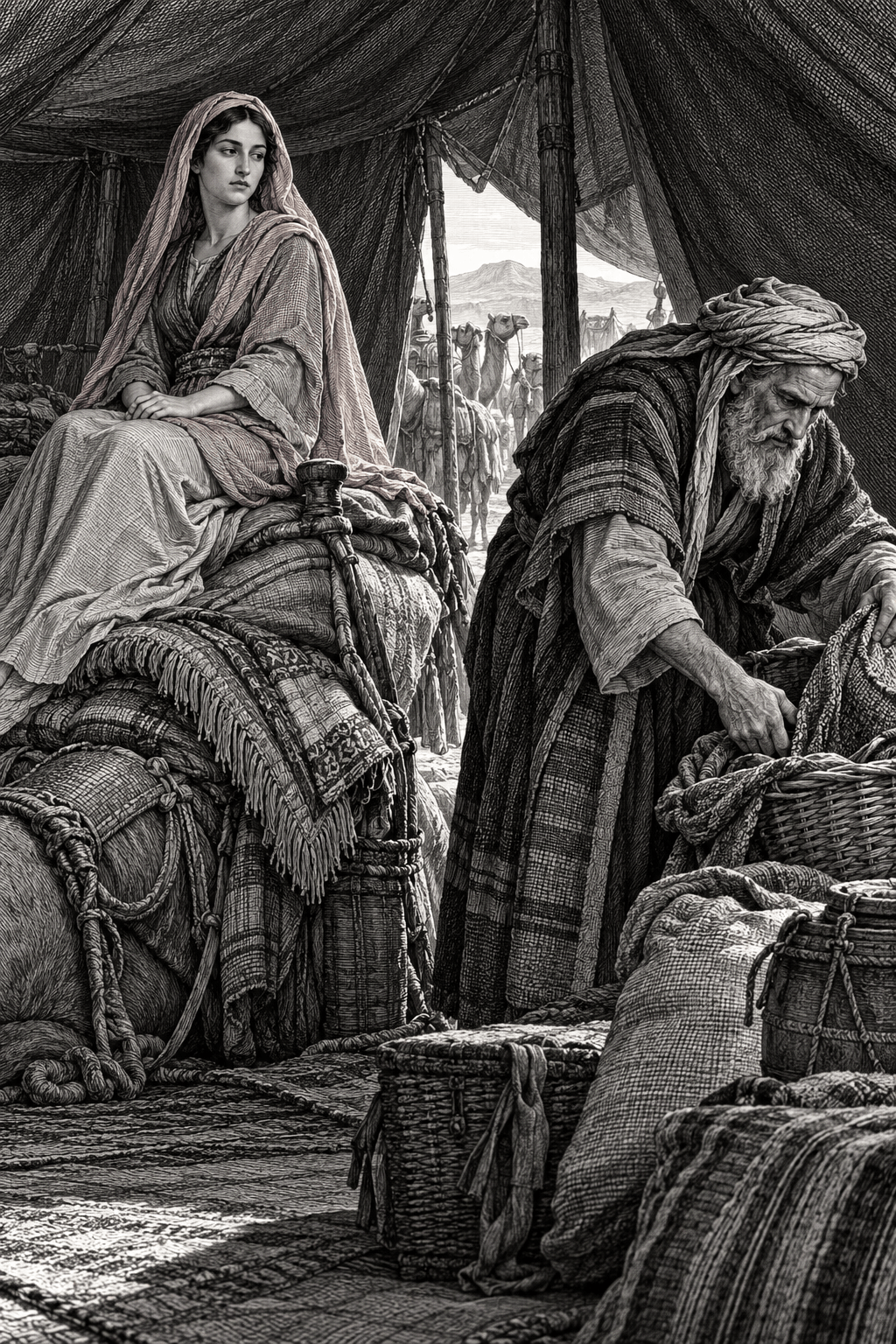
Laban reproached Jacob for taking his two daughters away as captives of war and fleeing with them, without allowing him to kiss them and their children. He accused Jacob of foolishness, claiming that he had wished to send him away with songs, tambourine, and harp. Yet it is clear that Laban would not have allowed Jacob and his family simply to depart. He might have prevented them, as Jacob himself said.
In any case, after admitting that he could not harm Jacob because God had appeared to him in a dream and warned him, his principal question was, “wherefore hast thou stolen my gods?” [30]. Jacob answered, “With whomsoever thou findest thy gods, let him not live: before our brethren discern thou what is thine with me, and take it to thee” [32].
Jacob did not know that Rachel had stolen her father’s gods. She had now placed them in the camel’s saddle and sat upon them, claiming that she could not stand because of her monthly period. As we have said, Rachel represents the Church coming from the Gentiles, from the worship of idols, having crushed the idols beneath her feet. [390]
Jacob asked Laban to search his belongings and those of his household. Whoever possessed his gods should not live; rather, Laban could take him as his slave. As Father Caesarius of Arles says:
“May God’s mercy come to us and grant that the adversary may find nothing of his in us. Then he will be unable to detain us with him or turn us away from eternal life. [387]”
Jacob protested to Laban, calling those present to witness his faithfulness throughout all twenty years of service. He declared that the ewes and she-goats had not miscarried, that he had not eaten the rams of the flock, and that he had borne the loss of animals torn by beasts. Laban had required compensation from his hand for what was stolen by day or night. The heat consumed him by day and the frost by night, and sleep fled from his eyes; yet Laban had changed his wages ten times [37–41].
Thus Jacob proclaimed his faithfulness in serving Laban for twenty years. He offers a living example for every person, especially those entrusted with caring for souls, as well as for shepherds of irrational sheep. Such a person endures the heat of the day and the frost of the night, lest a single soul be devoured or a single heart stolen!
I say that Jacob’s words remain a rebuke to every servant in the Lord’s vineyard. If irrational sheep were so precious in Jacob’s eyes, how much more precious should every soul be in ours!
Laban changed the wages ten times, that is, many times, but Jacob did not change his faithfulness. We too should not shepherd for the sake of wages, whether material reward or honor. Let us remain faithful for the salvation of every soul. How beautiful are the words Saint John Chrysostom recorded for us through his practical experience as well as his pen:
“I am a father full of tenderness.… Hear what Apostle Paul asks: “My little children, of whom I travail in birth” (Galatians 4:19). Every mother cries out when she is in labor at the hour of childbirth; so do I also. [388]”
4. Making the Covenant
KJV · Verses 43–54
43 And Laban answered and said unto Jacob, These daughters are my daughters, and these children are my children, and these cattle are my cattle, and all that thou seest is mine: and what can I do this day unto these my daughters, or unto their children which they have born? 44 Now therefore come thou, let us make a covenant, I and thou; and let it be for a witness between me and thee. 45 And Jacob took a stone, and set it up for a pillar. 46 And Jacob said unto his brethren, Gather stones; and they took stones, and made an heap: and they did eat there upon the heap. 47 And Laban called it Jegarsahadutha: but Jacob called it Galeed. 48 And Laban said, This heap is a witness between me and thee this day. Therefore was the name of it called Galeed; 49 And Mizpah; for he said, The LORD watch between me and thee, when we are absent one from another. 50 If thou shalt afflict my daughters, or if thou shalt take other wives beside my daughters, no man is with us; see, God is witness betwixt me and thee. 51 And Laban said to Jacob, Behold this heap, and behold this pillar, which I have cast betwixt me and thee: 52 This heap be witness, and this pillar be witness, that I will not pass over this heap to thee, and that thou shalt not pass over this heap and this pillar unto me, for harm. 53 The God of Abraham, and the God of Nahor, the God of their father, judge betwixt us. And Jacob sware by the fear of his father Isaac. 54 Then Jacob offered sacrifice upon the mount, and called his brethren to eat bread: and they did eat bread, and tarried all night in the mount.
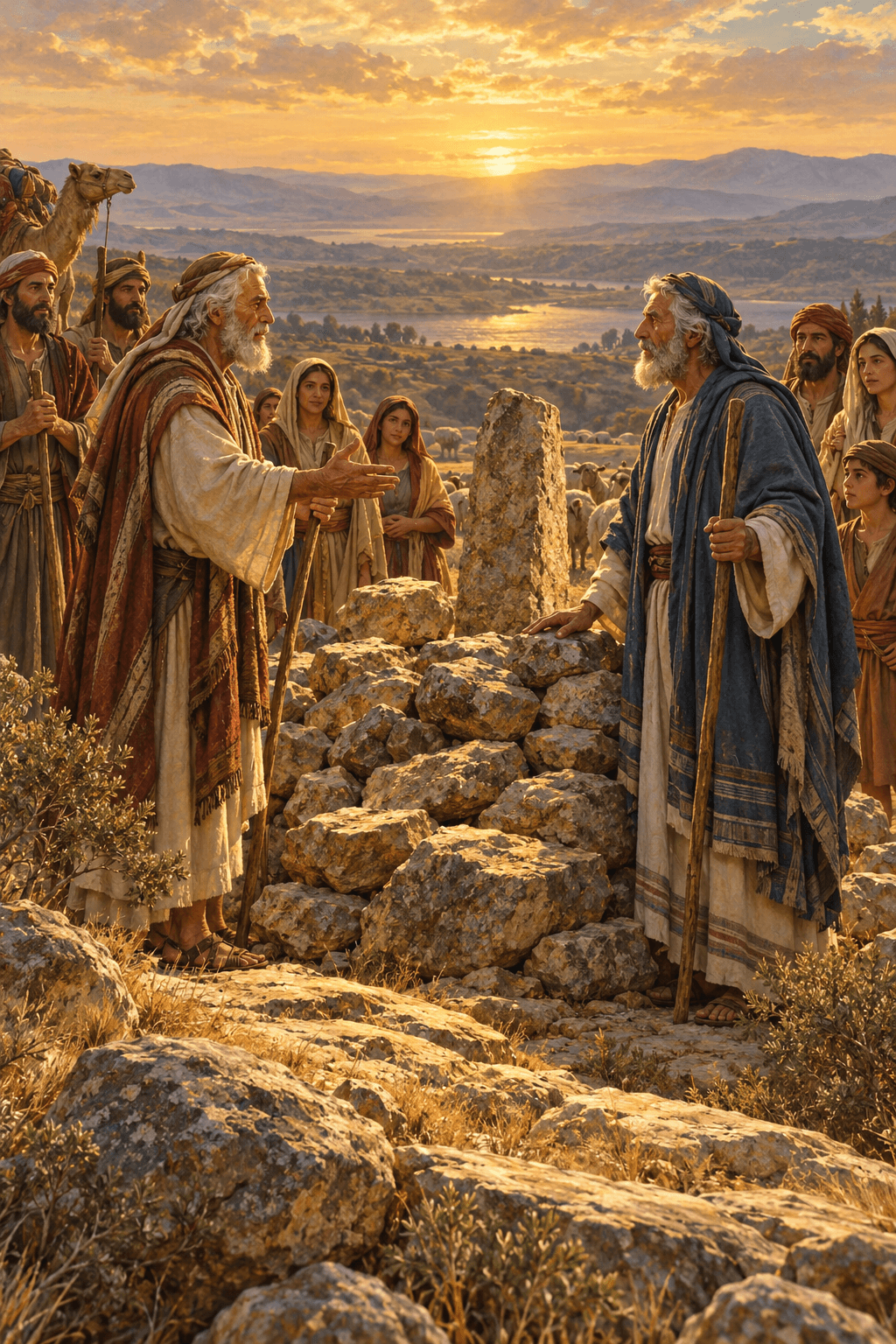
Laban thought it wise to make a covenant with Jacob, his son-in-law, so that neither would harm the other. Jacob set up a pillar, and then they made a heap of stones upon which to eat a meal of reconciliation. The pillar and the heap would be witnesses and reminders of the covenant they had made. Laban named the heap Jegar-sahadutha in Syriac, while Jacob called it Galeed in Hebrew. Both expressions mean “heap of witness.” It was also called Mizpah in Hebrew, meaning “watchtower,” as though God were watching over them both.
If Jacob and Laban set up a pillar and a heap as a witness to their reconciliation, and ate together there as a sign of peace, sharing one bread as though in one blood, then this pillar points to the cross of our Lord Jesus. It was raised upon Mount Golgotha, where He offered His body and blood as a sacrifice of love for us.
The Lord Christ reconciled us to God His Father in His body by giving Himself for us and offering us food of surpassing love. He is able to raise us into union with God the Father through abiding in Him. The cross remains, the Lord’s wounds remain, and His most holy body and blood remain a true witness to this reconciliation on an eternal level. They are the sign of the new covenant that has become ours, which we call the “New Testament” (Matthew 26:28; Luke 22:20; 1 Corinthians 11:25). [389]
We have accepted this covenant and are bound by it. As Apostle Paul says, “Of how much sorer punishment, suppose ye, shall he be thought worthy, who hath trodden under foot the Son of God, and hath counted the blood of the covenant, wherewith he was sanctified, an unholy thing, and hath done despite unto the Spirit of grace?” (Hebrews 10:29).
5. The Two Parties Depart
KJV · Verse 55
55 And early in the morning Laban rose up, and kissed his sons and his daughters, and blessed them: and Laban departed, and returned unto his place.
At the end of the encounter, Laban returned to his place, while Jacob went on his way. Laban had set his heart upon Haran, and Jacob had set his heart upon the promised land. God granted each the desire of his heart, for God shows no partiality.
The one who sets his heart upon the dust hears the divine voice, “for dust thou art, and unto dust shalt thou return” (Genesis 3:19), or, “You are earth, and to earth you shall return.” But the one who sets his heart upon heaven hears the divine voice, “You are heaven, and to heaven you shall return.” He gives us according to the heart’s desire and the direction in which we go. If we descend toward temporal things, our life becomes temporal corruption. If we rise toward heaven, our whole life becomes heavenly! [390]
Notes and References
[386] Father Caesarius of Arles, Sermon 88:4.
[387] Ibid.
[388] Saint John Chrysostom, Homilies on Hebrews, Homily 23:9. The Galatians wording within the quotation is given in KJV form; the surrounding words are translated from the Arabic quotation.
[389] By the author: Christ in the Sacrament of the Eucharist, 1973, pp. 66–84.
[390] Editorial clarification: Rachel’s destruction of the idols is the author’s spiritual interpretation; Genesis 31:34–35 records her hiding them and sitting upon them. “You are heaven, and to heaven you shall return” is a spiritual application, not the wording of Genesis 3:19. The source attributes Hebrews 10:29 to Paul; that traditional attribution is retained.