
1. God’s Dealings with Isaac (Genesis 21–27)
God revealed Himself in the life of Abraham as the father of believers and in Sarah his wife as their mother. Their son Isaac inherited this heritage, carrying his parents’ faith in his heart as a living tradition. He lived it throughout the days of his pilgrimage and handed it on to his son Jacob, Israel. In studying the preceding chapters, we have already encountered God’s dealings with Isaac, the fruit of a divine promise:
- Isaac, the son of promise, a source of joy to his parents (Genesis 21).
- Isaac, the son of obedience, a burnt offering of love to God (Genesis 22).
- God chooses Rebekah for Isaac as a holy wife to comfort him (Genesis 24).
- Isaac fathers Esau and Jacob, two nations (Genesis 25).
- Isaac sojourns in Gerar and digs wells of water (Genesis 26).
- Jacob takes his father Isaac’s blessing (Genesis 27).
When famine came upon the land, Isaac did not go down to Egypt as his father Abraham had done. Instead, at the Lord’s command, he sojourned in Gerar. Yet he followed his father’s example in calling Rebekah his sister, and Abimelech king of Gerar rebuked him. As Isaac prospered, the Philistines stopped up his wells. He moved to the valley of Gerar, and from there to Beersheba, where the Lord appeared to him and blessed him, renewing the covenant He had granted his father. God also gave him favor in the eyes of the king and the captain of his army.
2. God’s Promise During the Famine
KJV · Verses 1–6
1 And there was a famine in the land, beside the first famine that was in the days of Abraham. And Isaac went unto Abimelech king of the Philistines unto Gerar. 2 And the LORD appeared unto him, and said, Go not down into Egypt; dwell in the land which I shall tell thee of: 3 Sojourn in this land, and I will be with thee, and will bless thee; for unto thee, and unto thy seed, I will give all these countries, and I will perform the oath which I sware unto Abraham thy father; 4 And I will make thy seed to multiply as the stars of heaven, and will give unto thy seed all these countries; and in thy seed shall all the nations of the earth be blessed; 5 Because that Abraham obeyed my voice, and kept my charge, my commandments, my statutes, and my laws. 6 And Isaac dwelt in Gerar:
Isaac passed through the same trial as his father Abraham: “And there was a famine in the land, beside the first famine that was in the days of Abraham” [1]. There was indeed a famine, but it was “in the land”; it did not fall upon Isaac himself. It touched his earth, that is, his body, without entering his depths. As we have said before, the believer undergoes trial in his body, his earth, without its touching his inward life. The unbeliever, however, falls entirely beneath the weight of distress, losing his inner peace and hope and becoming utterly broken.
When famine occurred in Abraham’s days, our father went down to Egypt without consulting God and nearly lost his wife, had God not intervened. Isaac, however, seems to have consulted God, who appeared to him and said: “Go not down into Egypt; dwell in the land which I shall tell thee of: Sojourn in this land, and I will be with thee, and will bless thee; for unto thee, and unto thy seed, I will give all these countries, and I will perform the oath which I sware unto Abraham thy father; And I will make thy seed to multiply as the stars of heaven, and will give unto thy seed all these countries; and in thy seed shall all the nations of the earth be blessed” [2–4].
If Abraham erred in going down to Egypt during the famine, God asked Isaac not to act as his father had done, but to remain in Canaan even in a time of famine, as a sign of his acceptance of God’s promises to his father. All he did was move from Beer-lahai-roi to Gerar, about six miles southeast of Gaza, at the site called Khirbet Umm Gerar. As we have seen, the name is derived from a word meaning “jar” or “earthen vessel.” [356]
Because Isaac listened to the Lord’s voice and did not set out for Egypt, but remained in Gerar, he enjoyed the renewal of the divine covenant and God’s appearance to him. Truly, when we listen to the divine voice amid distress, we enjoy His manifestation within us and the renewal of our covenant with Him!
3. Calling Rebekah His Sister
KJV · Verses 7–11
7 And the men of the place asked him of his wife; and he said, She is my sister: for he feared to say, She is my wife; lest, said he, the men of the place should kill me for Rebekah; because she was fair to look upon. 8 And it came to pass, when he had been there a long time, that Abimelech king of the Philistines looked out at a window, and saw, and, behold, Isaac was sporting with Rebekah his wife. 9 And Abimelech called Isaac, and said, Behold, of a surety she is thy wife: and how saidst thou, She is my sister? And Isaac said unto him, Because I said, Lest I die for her. 10 And Abimelech said, What is this thou hast done unto us? one of the people might lightly have lien with thy wife, and thou shouldest have brought guiltiness upon us. 11 And Abimelech charged all his people, saying, He that toucheth this man or his wife shall surely be put to death.
Isaac bore the same weakness as his father. Fearing that the men of the place would kill him because his wife Rebekah was beautiful, he called her his sister. This time Abimelech looked out through a window and saw Isaac sporting with Rebekah his wife. He summoned him and reproached him nobly. This was probably not the Abimelech of Abraham’s days, for, as we have said, “Abimelech” was the title of the king of Gerar rather than his personal name. The king gave the command: “He that toucheth this man or his wife shall surely be put to death” [11].
Scripture reveals the weaknesses of righteous people such as Isaac, showing his fear of the people of Gerar and his lie to them concerning his wife. This makes us watchful against every weakness and sin, and teaches us not to judge anyone, since every believer has weaknesses, however great his holiness. At the same time, Scripture also reveals the good qualities found even among pagans, such as Abimelech, who feared that one of his people might violate Isaac’s wife and bring guilt upon the whole people [10]. This teaches us to despise no one, even a pagan.
4. The Philistines’ Envy
KJV · Verses 12–25
12 Then Isaac sowed in that land, and received in the same year an hundredfold: and the LORD blessed him. 13 And the man waxed great, and went forward, and grew until he became very great: 14 For he had possession of flocks, and possession of herds, and great store of servants: and the Philistines envied him. 15 For all the wells which his father’s servants had digged in the days of Abraham his father, the Philistines had stopped them, and filled them with earth. 16 And Abimelech said unto Isaac, Go from us; for thou art much mightier than we. 17 And Isaac departed thence, and pitched his tent in the valley of Gerar, and dwelt there. 18 And Isaac digged again the wells of water, which they had digged in the days of Abraham his father; for the Philistines had stopped them after the death of Abraham: and he called their names after the names by which his father had called them. 19 And Isaac’s servants digged in the valley, and found there a well of springing water. 20 And the herdmen of Gerar did strive with Isaac’s herdmen, saying, The water is ours: and he called the name of the well Esek; because they strove with him. 21 And they digged another well, and strove for that also: and he called the name of it Sitnah. 22 And he removed from thence, and digged another well; and for that they strove not: and he called the name of it Rehoboth; and he said, For now the LORD hath made room for us, and we shall be fruitful in the land. 23 And he went up from thence to Beersheba. 24 And the LORD appeared unto him the same night, and said, I am the God of Abraham thy father: fear not, for I am with thee, and will bless thee, and multiply thy seed for my servant Abraham’s sake. 25 And he builded an altar there, and called upon the name of the LORD, and pitched his tent there: and there Isaac’s servants digged a well.
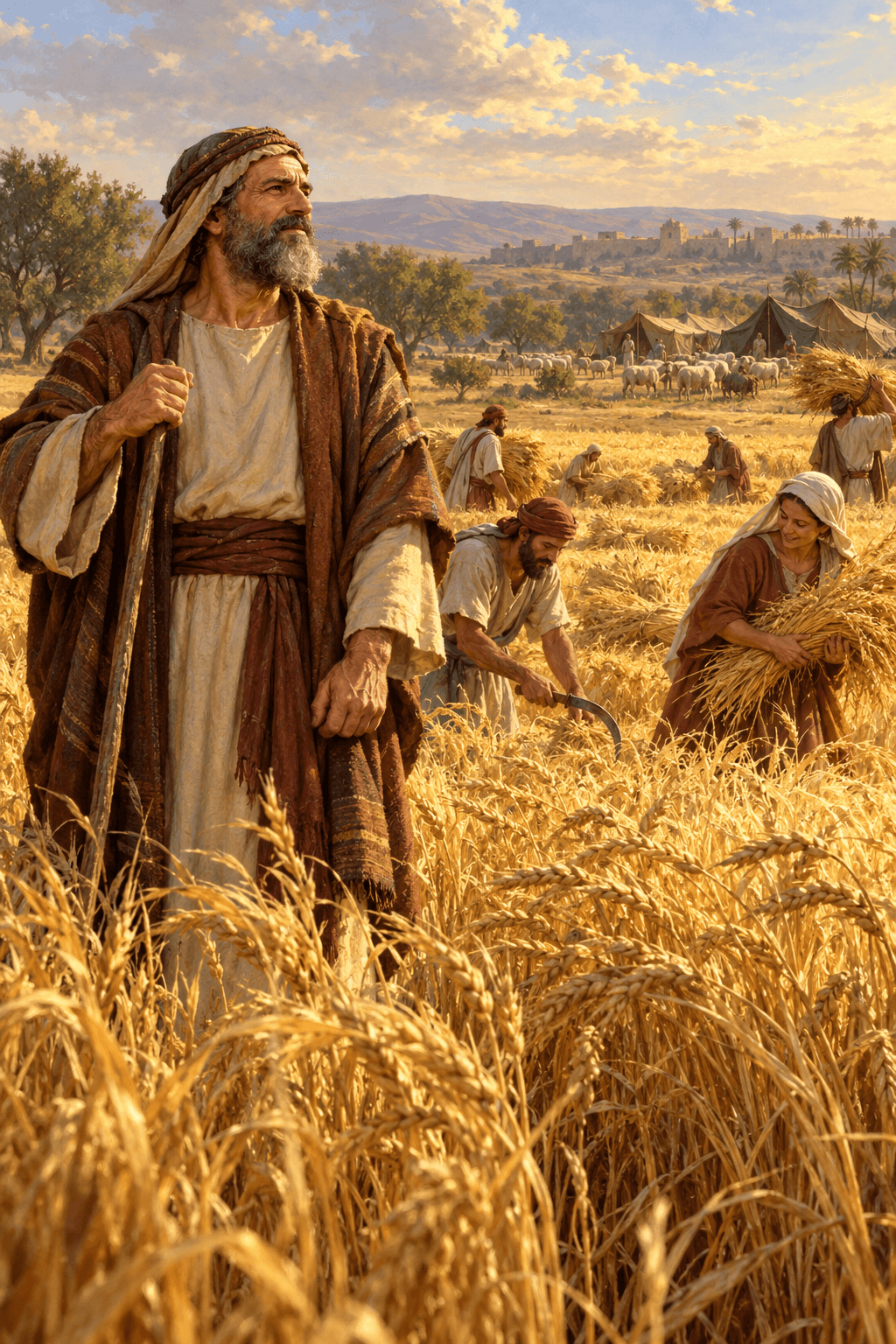
Scripture proclaims God’s blessing upon Isaac: “Then Isaac sowed in that land, and received in the same year an hundredfold: and the LORD blessed him. And the man waxed great, and went forward, and grew until he became very great: For he had possession of flocks, and possession of herds, and great store of servants: and the Philistines envied him” [12–14]. The Septuagint specifies that the crop he sowed was barley.
Although Isaac sinned through weakness, and God sent a pagan king to reproach and rebuke him, this did not prevent the Lord’s blessing or the fulfillment of His promises. When Isaac sowed barley, according to the Septuagint, he received a hundredfold, besides his many sheep, cattle, and servants. This stirred up the inhabitants of the region against him, for they feared him.
Origen comments that Isaac’s sowing of barley signifies the Law, or the simpler commandments offered to the spiritually poor, while wheat signifies the Gospel offered to the spiritual. He says:
“Why did Isaac sow barley? Why did the Lord bless him when he sowed barley? Why did he become so rich? Barley is usually the food of animals and of servants working in the countryside.… Isaac prepares wheat for the perfect and spiritual, and barley for beginners, for it is written: “O LORD, thou preservest man and beast” (Psalm 36:6).… Our Lord, who is the perfect Isaac, offers perfection, wheat, to the disciples, and simple, easy things, barley, to the multitudes. Do you want proof that He offers barley as food for beginners? The Gospel tells us that He fed the multitudes twice. The first time He gave them “barley loaves” (John 6:9), for beginners; when they had advanced in speech and teaching, He gave them wheat bread (Matthew 15:34). [357]”
Let us, then, receive wheat bread as spiritual people; otherwise, let us accept barley loaves as beginners from the hands of the true Isaac!
When Isaac sowed barley, he received a hundredfold that year, and the man became great and continued to increase until he became very great. As Origen says:
“If barley signifies the Law, the true Isaac was small under the Law, and grew greater and greater through the prophecies. Under the Law, our knowledge of Christ was as though through shadows, but the prophets revealed Him, and the Lord Christ appeared great. Now, when we remove the husk from the barley, that is, remove its literal understanding, “the law is spiritual” (Romans 7:14) appears, and Isaac becomes very great.… In other words, through barley Isaac became very great and his riches were revealed, as we acquired the Law after removing its husk, its literal meaning, and entered into its spirit and depths. [358]”
Origen offers another comment on the barley loaves that displayed Isaac’s greatness and wealth. [359] While the loaves remained unbroken, no one was satisfied by them. But when He commanded that they be broken and distributed to the multitudes, thousands were satisfied, and fragments remained. In the same way, when we offer the words of Scripture to the whole world, breaking open the letter so that people may enjoy their depths, everyone is satisfied, and something still remains for us to gather, that nothing may be lost (John 6:12).
Faced with this wealth and greatness revealed through the sowing of barley, the enemy stands in envy and fills with earth the wells that Abraham had dug. Abimelech asks Isaac to leave the place, saying: “Go from us; for thou art much mightier than we” [16].
Origen comments on the filling of the wells with earth and on Isaac’s return to reopen the wells dug in the days of his father Abraham, which the Philistines had stopped after his father’s death [18]:
“The Philistines despise water and love the earth, but Isaac loves water, searches for wells, frees the old wells, and digs new ones. Let us contemplate Isaac, who “hath given himself for us” (Ephesians 5:2). He came to the valley of Gerar, which means a wall or barrier (Ephesians 2:14). He came to break down the middle wall of partition, that is, the sin separating us from God. He breaks down the barrier between us and spiritual virtues, and thus “hath made both one” (Ephesians 2:14), carrying the lost sheep on His shoulders upon the mountains, to join them to the ninety-nine that were not lost (Luke 15:5–6; Matthew 18:12). This Isaac, our Savior, when He is in the valley of Gerar, wishes first of all to dig the wells that were dug in His Father’s days: to uncover the wells of the Law and the prophets which the Philistines had stopped.… But who are those who fill the wells with earth? Surely they are those who present the Law with an earthly mind, neither drinking themselves nor allowing others to drink. Hear what Isaac our Savior, Jesus Christ, says in the Gospel: “Woe unto you, lawyers! for ye have taken away the key of knowledge: ye entered not in yourselves, and them that were entering in ye hindered” (Luke 11:52). [360]”
Through His servants, the Lord Christ reopened the ancient wells, revealing the mysteries of the Law and the declarations of the prophets. He gave us deep spiritual understandings which lovers of the killing letter had corrupted. His work did not end there: through His apostles and disciples He also dug new wells for us, despite the opposition of the enemy of good and his attempts to fill every spiritual well. Origen says:
“Isaac and his servants dug new wells. Matthew, Mark, Luke, John, Peter, James, Jude, and the Apostle Paul dug the wells of the New Testament, although those who mind earthly things rose up against them (Philippians 3:19). [361]”
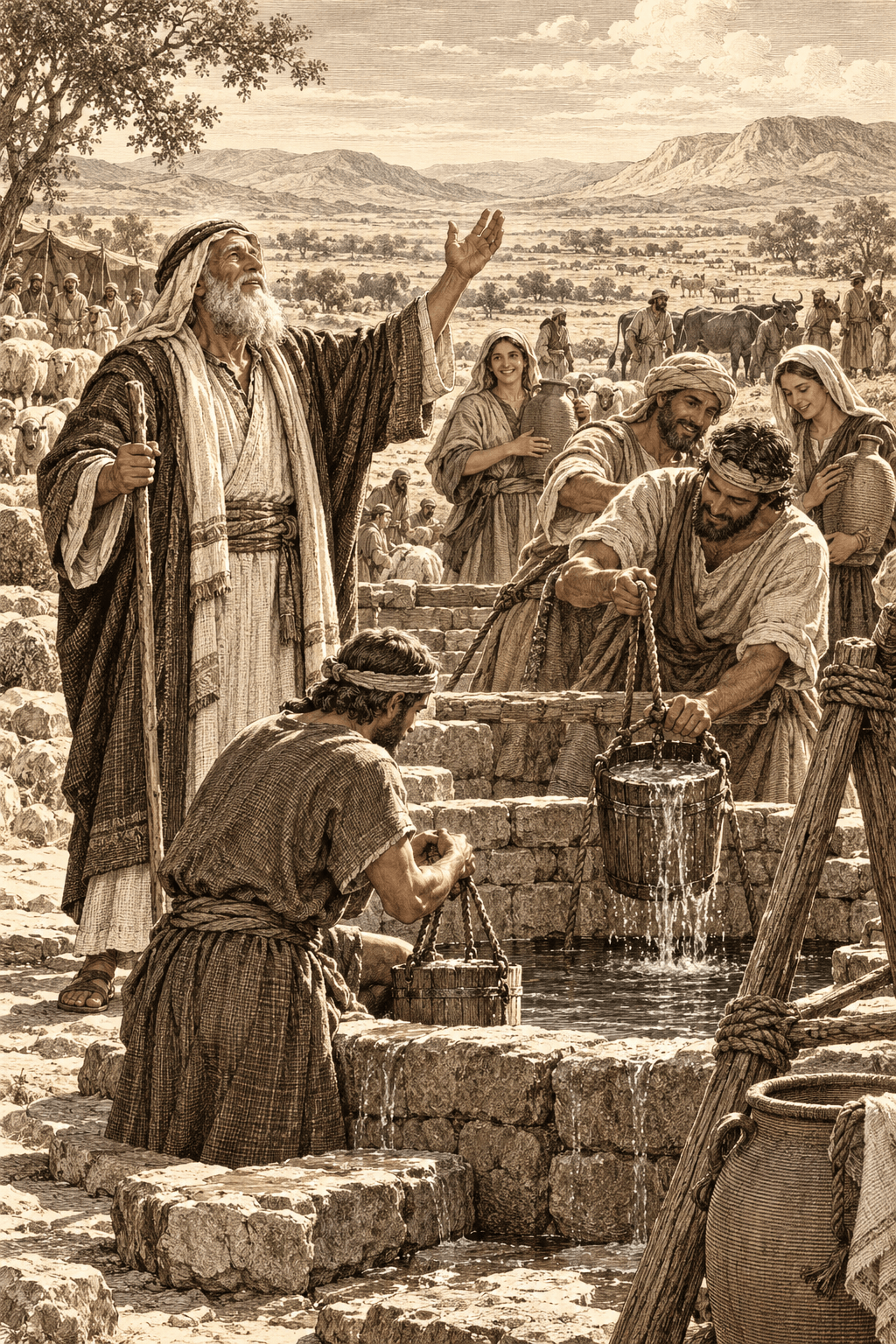
Scripture tells us of the digging of three wells. The first was called Esek, “strife,” and the second Sitnah, “contention,” because the herdsmen of Gerar disputed with Isaac’s herdsmen over them, and Isaac left them to the herdsmen of Gerar. There was no quarrel over the third, so he called it Rehoboth, “broad” or “spacious places.” It is in the region now called Wadi er-Ruheibeh, about nineteen miles southwest of Beersheba. Isaac felt that God had given him a broad, spacious place and generously bestowed blessings upon him without contention.
Origen sees in the third well a sign of faith in the mystery of the Holy Trinity, through which the kingdom’s breadth was revealed to the whole world. He says:
“After this Isaac dug a third well and called it Rehoboth, saying: “For now the LORD hath made room for us, and we shall be fruitful in the land” [22]. Truly, Isaac entered into spaciousness, and His name became great throughout the earth, when He filled us with the knowledge of the Trinity. Previously God was known only in Judah, and His name was great in Israel (Psalm 76:1); now their sound has gone out into all the earth, and His word to the ends of the world (Psalm 19:4). Isaac’s servants spread over the whole earth, digging wells and revealing the substance of life to all, for it was said: “Baptize all nations in the name of the Father, and of the Son, and of the Holy Spirit” (Matthew 28:19), for “The earth is the LORD’s, and the fulness thereof” (Psalm 24:1). [362]”
5. Making a Covenant with Abimelech
KJV · Verses 26–33
26 Then Abimelech went to him from Gerar, and Ahuzzath one of his friends, and Phichol the chief captain of his army. 27 And Isaac said unto them, Wherefore come ye to me, seeing ye hate me, and have sent me away from you? 28 And they said, We saw certainly that the LORD was with thee: and we said, Let there be now an oath betwixt us, even betwixt us and thee, and let us make a covenant with thee; 29 That thou wilt do us no hurt, as we have not touched thee, and as we have done unto thee nothing but good, and have sent thee away in peace: thou art now the blessed of the LORD. 30 And he made them a feast, and they did eat and drink. 31 And they rose up betimes in the morning, and sware one to another: and Isaac sent them away, and they departed from him in peace. 32 And it came to pass the same day, that Isaac’s servants came, and told him concerning the well which they had digged, and said unto him, We have found water. 33 And he called it Shebah: therefore the name of the city is Beersheba unto this day.
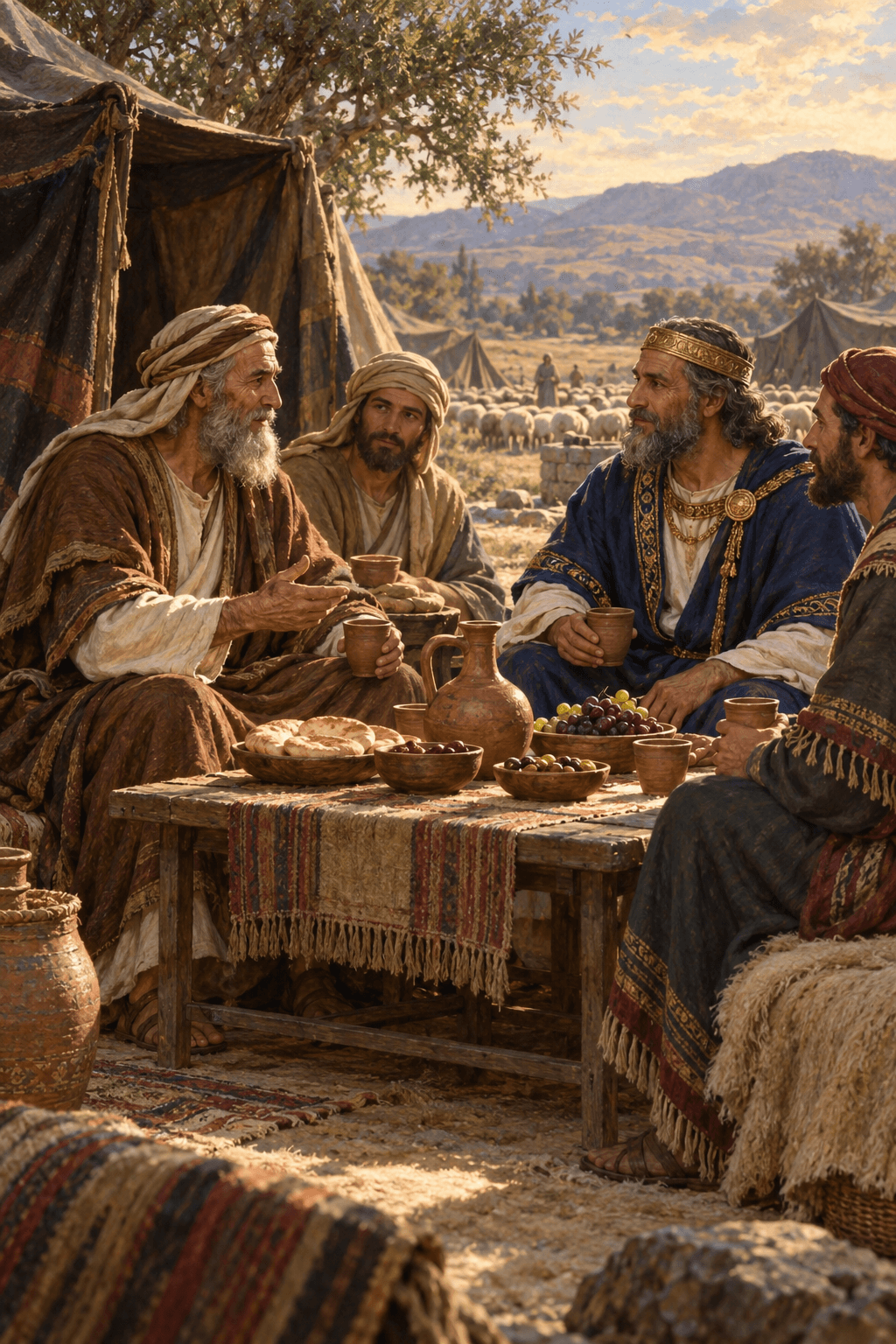
Abimelech had previously asked to make a covenant with Abraham, saying: “God is with thee in all that thou doest” (Genesis 21:22). Now Abimelech, not necessarily the same king, makes a covenant with his son Isaac. He comes with two counselors: his friend Ahuzzath, whose name means “possession,” and Phichol, the chief captain of his army. They say: “Let there be now an oath betwixt us, even betwixt us and thee, and let us make a covenant with thee; That thou wilt do us no hurt, as we have not touched thee, and as we have done unto thee nothing but good, and have sent thee away in peace: thou art now the blessed of the LORD” [28–29].
Isaac’s success had caused the inhabitants of the region to fear and had stirred up envy within them. Yet when they saw God’s work in him, they became witnesses to the truth, calling him “the blessed of the LORD” and asking him to make a covenant with them. How beautiful it is for the believer to receive a testimony from those outside, who recognize him as a man of God and sense the awe of God surrounding him!
Although a believer’s success may at first arouse envy, in the end it brings favor in everyone’s eyes!
Isaac met their fears with love. He prepared a feast for them and honored them, having established with them a covenant of reconciliation, love, and peace.
Origen sees Abimelech, who at one time hates Isaac [27] and at another seeks peace with him, as a symbol of this world’s philosophy, which sometimes contradicts faith and sometimes responds to it. Although philosophy is not always opposed to the Lord’s Law, neither can it be in complete agreement with it. [363] Origen gives examples, saying:
“Some philosophers agree with the Law and even with the Gospel when they proclaim one God, the Creator of all, who made and ordered all things through His divine Word. Yet they contradict our faith by believing that the world is eternal, without beginning or end, and so regard matter as sharing eternity with God.”
In Origen’s view, Abimelech and his two companions, his friend Ahuzzath and his army captain Phichol, signify the three branches of philosophy: logic, or philosophy based on reason alone, represented by Abimelech; philosophy based on the power of nature, represented by Ahuzzath; and moral or ethical philosophy, represented by Phichol. Despite their errors, these three branches, when sanctified, submit to faith, saying: “We saw certainly that the LORD was with thee: and we said, Let there be now an oath betwixt us, even betwixt us and thee, and let us make a covenant with thee” [28].
Origen also sees these three strangers, who came to make a covenant with Isaac and seek reconciliation, as a symbol of the three Magi who came from the East, saying: “We have seen his star in the east, and are come to worship him” (Matthew 2:2).
The hospitality Isaac offered them and the reconciliation he granted them signify the breadth of faith, which embraces every philosophy and thought for Christ’s sake. They also point to the Lord Christ’s welcome of the Magi as a symbol of the Church of the Gentiles. Perhaps his welcome of three men also signifies the Lord’s welcome of all peoples and nations descended from Shem, Ham, and Japheth: all humanity.
6. Esau’s Marriage to Hittite Women
KJV · Verses 34–35
34 And Esau was forty years old when he took to wife Judith the daughter of Beeri the Hittite, and Bashemath the daughter of Elon the Hittite: 35 Which were a grief of mind unto Isaac and to Rebekah.
Esau married two women from the children of Heth, who were a grief of mind to Isaac and Rebekah [34–35]. He did not act wisely, for he joined himself to two pagan women who damaged his relationship with his parents and deprived him and his descendants of peace.
Notes and References
[356] See the commentary on Genesis 10:19 and 20:1.
[357] Origen, Homilies on Genesis 12:5.
[358] Ibid.
[359] Ibid.
[360] Ibid., 13:2.
[361] Ibid.
[362] Ibid., 13:3.
[363] Ibid., 14:3.