
In this chapter, divine inspiration records Abraham’s departure from this world after he married Keturah and fathered many children. Although he gave gifts to each of his sons, he gave the entire inheritance to Isaac. He handed on to him his hope of salvation and his enjoyment of the divine covenant, so that Isaac in turn might hand on the same inheritance to his son Jacob.
1. Abraham’s Marriage to Keturah
KJV · Verses 1–6
1 Then again Abraham took a wife, and her name was Keturah. 2 And she bare him Zimran, and Jokshan, and Medan, and Midian, and Ishbak, and Shuah. 3 And Jokshan begat Sheba, and Dedan. And the sons of Dedan were Asshurim, and Letushim, and Leummim. 4 And the sons of Midian; Ephah, and Epher, and Hanoch, and Abidah, and Eldaah. All these were the children of Keturah. 5 And Abraham gave all that he had unto Isaac. 6 But unto the sons of the concubines, which Abraham had, Abraham gave gifts, and sent them away from Isaac his son, while he yet lived, eastward, unto the east country.
Abraham married Keturah after the death of his wife Sarah and fathered sons who became heads of nations. Yet they did not receive what Isaac received. Scripture says, “And Abraham gave all that he had unto Isaac. But unto the sons of the concubines, which Abraham had, Abraham gave gifts, and sent them away from Isaac his son, while he yet lived, eastward, unto the east country” [5–6]. Abraham did not leave his children by the concubines without gifts, but he sent them away from Isaac, who enjoyed everything his father possessed. He gave him his living faith, entrusted the promises to him, and kindled within him the spirit of hope in divine salvation. This is the Church’s Tradition, the handing on that we enjoy as a living inheritance which we put into practice.
Abraham died, yet he did not lose what he had gathered in the Lord. He deposited it in the heart of his son Isaac, that Isaac might carry the same mind and possess the same practical faith in the Lord. Thus, although Abraham died bodily, he rejoices over what his son received.
May we not be like the sons of the concubines, asking our father for material gifts. Rather, like Isaac, the son of promise, let us enjoy everything in our Father’s heart. Then we shall live our days on earth as children of God, bearing spiritual riches which no one can take from us.
Let us return to Keturah, whom Abraham married in his old age. According to Origen, the word “Keturah” means “a sweet fragrance” [344]. Abraham represents the believer whose flesh has been subdued, as though practicing the mortification of his members (Colossians 3:5). The lusts of the flesh die so that the body may go forth sanctified in the Lord, bearing the sweet fragrance of Christ. We can then say, “For we are unto God a sweet savour of Christ, in them that are saved, and in them that perish: To the one we are the savour of death unto death; and to the other the savour of life unto life. And who is sufficient for these things?” (2 Corinthians 2:15–16).
Some see Abraham’s marriage to Keturah, meaning “a sweet fragrance,” after Sarah’s death as a prophecy of the Church of the New Testament, which bears the sweet fragrance of Christ, after the Jews, represented by Sarah, lost their life through rejecting faith in the Lord Christ, the Savior of the world.
2. Abraham Gives Up the Ghost
KJV · Verses 7–11
7 And these are the days of the years of Abraham’s life which he lived, an hundred threescore and fifteen years. 8 Then Abraham gave up the ghost, and died in a good old age, an old man, and full of years; and was gathered to his people. 9 And his sons Isaac and Ishmael buried him in the cave of Machpelah, in the field of Ephron the son of Zohar the Hittite, which is before Mamre; 10 The field which Abraham purchased of the sons of Heth: there was Abraham buried, and Sarah his wife. 11 And it came to pass after the death of Abraham, that God blessed his son Isaac; and Isaac dwelt by the well Lahairoi.
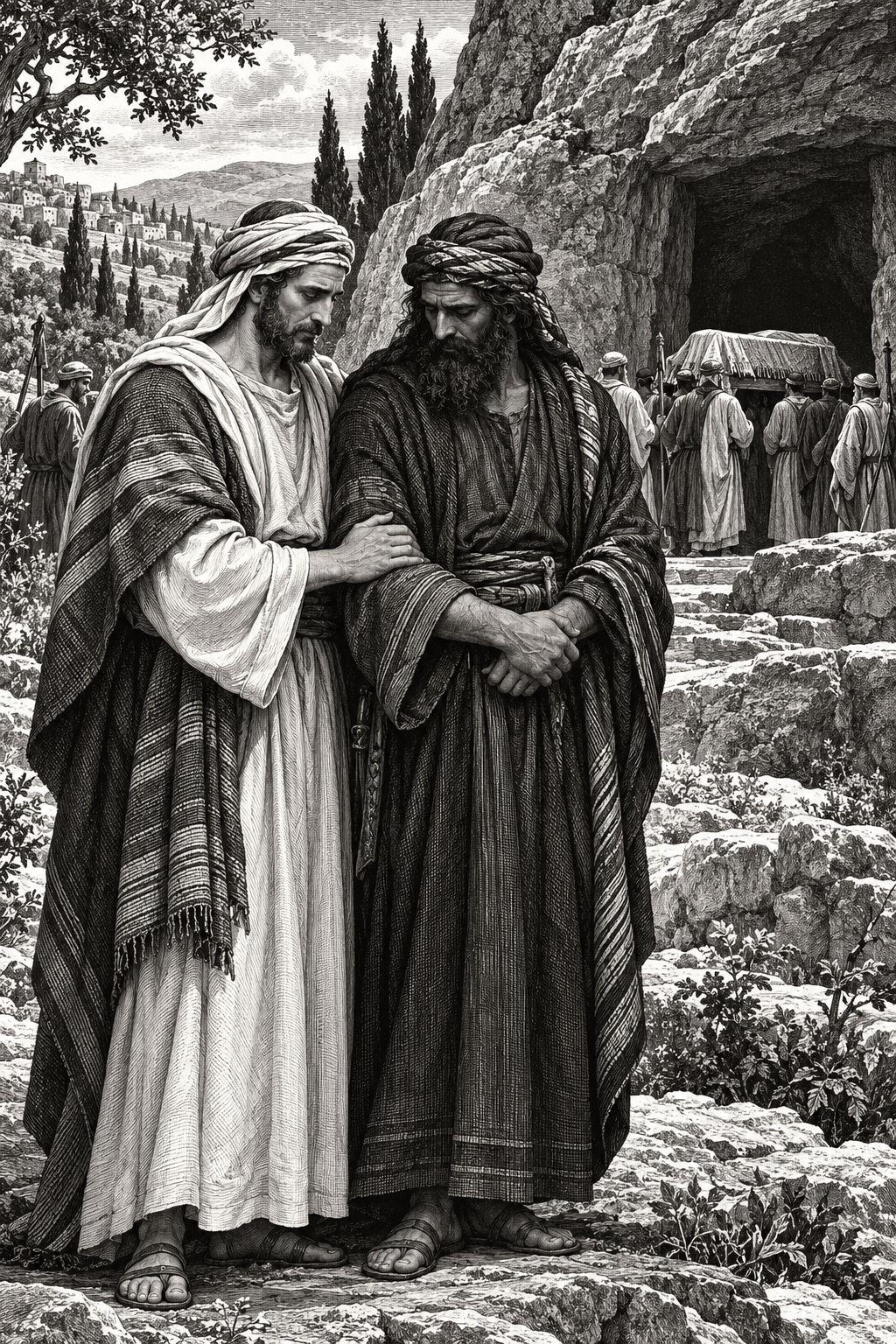
“And these are the days of the years of Abraham’s life which he lived, an hundred threescore and fifteen years. Then Abraham gave up the ghost, and died in a good old age, an old man, and full of years; and was gathered to his people” [7–8].
Although Abraham died, he lives in God. Origen says:
“Concerning Abraham’s death, we add what the Gospel contains of the Lord’s words: “And as touching the dead, that they rise: have ye not read in the book of Moses, how in the bush God spake unto him, saying, I am the God of Abraham, and the God of Isaac, and the God of Jacob? He is not the God of the dead, but the God of the living” (Mark 12:26–27), “for all live unto him” (Luke 20:38). We long for such a death, that we, “being dead to sins, should live unto righteousness” (1 Peter 2:24). We ought to understand Abraham’s death in this way: his bosom expands to embrace all the saints who come from the four corners of the world, carried by the angels into Abraham’s bosom (Luke 16:22). [345]”
In other words, death did not destroy Abraham our father. On the contrary, it made his bosom spacious enough to embrace the souls of the saints throughout the ages!
Abraham gave up the ghost and was gathered to his people, to receive in the Lord the spirits of his children in faith and enter Paradise with them in Christ Jesus our Lord. He had enjoyed a good old age and was full of days. As Saint Jerome says:
“His whole life was days without nights. [346]”
Abraham was gathered to his people: his soul departed to live with his fathers and forefathers, while his body was buried with the body of his wife Sarah in the cave of Machpelah, which he had purchased from the children of Heth.
“And it came to pass after the death of Abraham, that God blessed his son Isaac; and Isaac dwelt by the well Lahairoi” [11]. This was the blessing Isaac received: he dwelt at the well of vision. Origen says:
“Isaac deserved to remain in a state of vision and to dwell there. We too, if enlightened by the mercy of our Lord, may understand and perceive certain visions and enjoy the rays of our Lord’s vision in our minds. Then we say that we have spent a day near the well of vision. If I can acquire something from divine Scripture according to the spirit, rather than the letter, I can say that I have spent two days beside the well of vision. I cannot understand all divine Scripture, but at least I persevere in hearing it, meditating in it day and night (Psalm 1:2). I never cease searching and reflecting upon it, praying to the Lord and asking Him to grant me understanding, for He gives knowledge to man. In this way I can say that I too dwell near the well of vision. But whoever acts otherwise, failing to listen to the words of our Lord in His Church and coming to church only on feast days, neither dwells at the well of vision nor drinks from it. Make haste, then, and strive, that our Lord’s blessing may come upon you and enable you to dwell near the well of vision. May the Lord open your eyes to contemplate the well of vision and draw from it the water of life (John 4:14), a well of water springing up into everlasting life.”
“Let me show you someone who never departs from the well of vision: Paul the Apostle, who says, “But we all, with open face beholding as in a glass the glory of the Lord” (2 Corinthians 3:18). You too, if you continually enter more deeply into vision, constantly seek what benefits you, and meditate upon it without ceasing, will receive a blessing from the Lord and dwell at the well. Jesus will appear to you on the way and open the Scriptures to you, so that you say, “Did not our heart burn within us, while he talked with us by the way, and while he opened to us the scriptures?” (Luke 24:32). For God cares for those who meditate in His law day and night. [347]”
3. The Generations of Ishmael
KJV · Verses 12–18
12 Now these are the generations of Ishmael, Abraham’s son, whom Hagar the Egyptian, Sarah’s handmaid, bare unto Abraham: 13 And these are the names of the sons of Ishmael, by their names, according to their generations: the firstborn of Ishmael, Nebajoth; and Kedar, and Adbeel, and Mibsam, 14 And Mishma, and Dumah, and Massa, 15 Hadar, and Tema, Jetur, Naphish, and Kedemah: 16 These are the sons of Ishmael, and these are their names, by their towns, and by their castles; twelve princes according to their nations. 17 And these are the years of the life of Ishmael, an hundred and thirty and seven years: and he gave up the ghost and died; and was gathered unto his people. 18 And they dwelt from Havilah unto Shur, that is before Egypt, as thou goest toward Assyria: and he died in the presence of all his brethren.
Ishmael fathered twelve sons who became princes of tribes or peoples, as God had promised Abraham (Genesis 17:20). God did not forget Ishmael and his children, although Ishmael did not enjoy what Isaac received, from whose descendants the Lord Christ came incarnate. Nevertheless, Scripture records Ishmael’s descendants, for the Lord comes to gather all peoples and nations and make them one in Him.
4. The Birth of Esau and Jacob
KJV · Verses 19–26
19 And these are the generations of Isaac, Abraham’s son: Abraham begat Isaac: 20 And Isaac was forty years old when he took Rebekah to wife, the daughter of Bethuel the Syrian of Padanaram, the sister to Laban the Syrian. 21 And Isaac intreated the LORD for his wife, because she was barren: and the LORD was intreated of him, and Rebekah his wife conceived. 22 And the children struggled together within her; and she said, If it be so, why am I thus? And she went to enquire of the LORD. 23 And the LORD said unto her, Two nations are in thy womb, and two manner of people shall be separated from thy bowels; and the one people shall be stronger than the other people; and the elder shall serve the younger. 24 And when her days to be delivered were fulfilled, behold, there were twins in her womb. 25 And the first came out red, all over like an hairy garment; and they called his name Esau. 26 And after that came his brother out, and his hand took hold on Esau’s heel; and his name was called Jacob: and Isaac was threescore years old when she bare them.
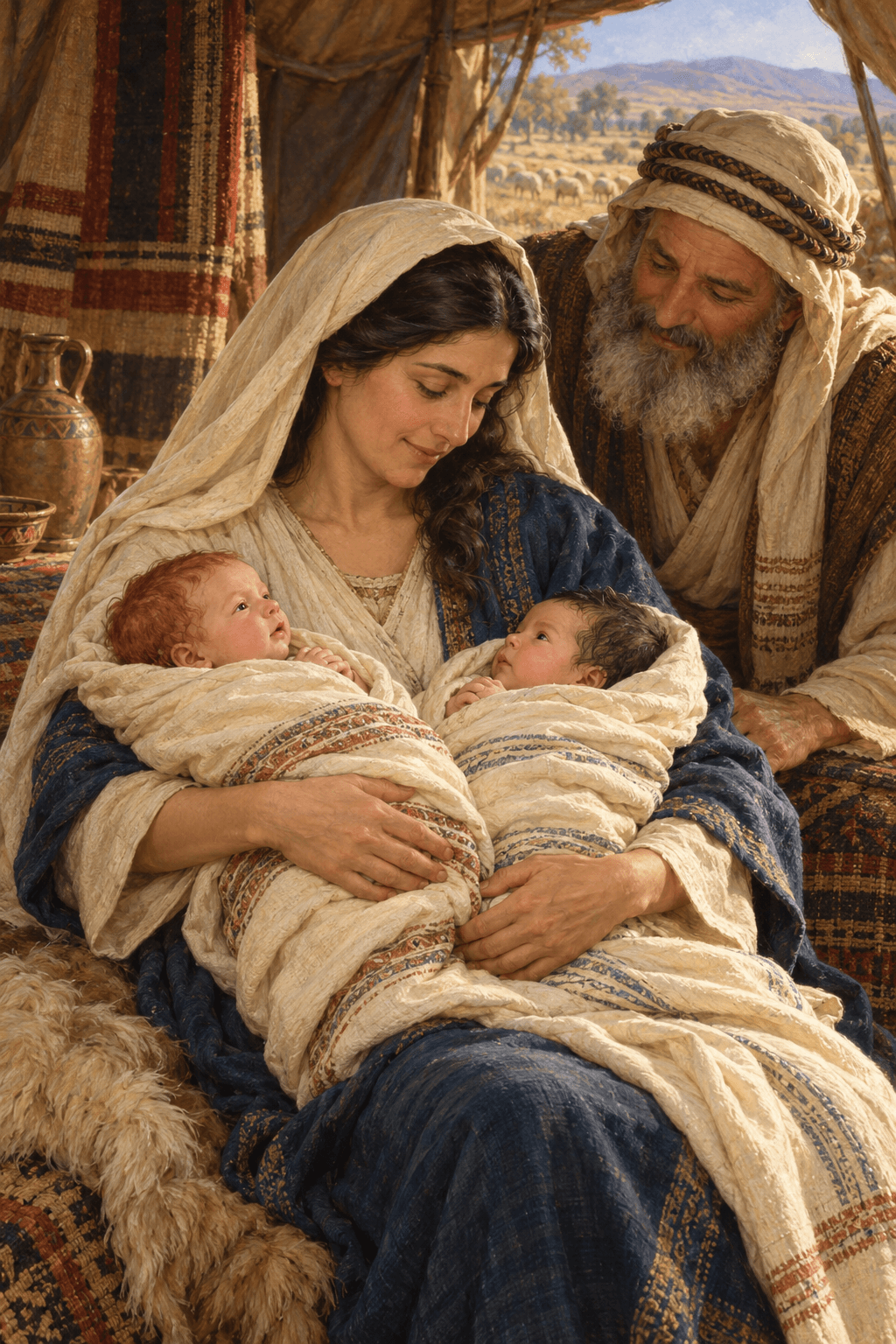
Holy Scripture tells us that Isaac married Rebekah, the daughter of Bethuel the Syrian, when he was forty years old. Since she was barren, Isaac prayed for her. The Lord answered him, and Rebekah his wife conceived after about twenty years. Two children struggled together within her, and she said, “If it be so, why am I thus?” [22]. Their struggle was violent; some translations say that they “wrestled.” It caused Rebekah such severe pain that she feared she would die or that the children would die. Hence she said, “If it be so, why am I thus?” In other words, if this is the condition of the two children, what need is there for this pregnancy? What sweetness can life still hold for me?
The conflict between Esau and Jacob appeared while they were still unborn, as though one womb could not contain them together. It became more evident after their birth and greatly increased between their descendants, Israel and Edom. Some Fathers see in this struggle an image of the continual conflict between good and evil, even within the womb of the Church. Father Caesarius of Arles says:
“Good souls wish to overcome evil, but the wicked long to destroy the righteous. The desire of the good is to reform the wicked, whereas the wicked strive to destroy the righteous. Those members within the catholic Church who belong to Esau are inclined to possess earthly things: they love the earth, desire it, and place all their hope in it. Those members who desire to serve God in order to increase in temporal honors or enjoy material advantages also belong to Esau, that is, to earthly happiness. In Esau we understand carnal souls; spiritual souls we understand in Jacob. [348]”
When Rebekah felt the pain and her soul was greatly distressed, “she went to enquire of the LORD” [22]. She devoted a longer time to prayer, perhaps in her inner chamber, asking the Lord to give her peace and reveal the matter to her. Origen understands “went” as something other than a tangible bodily movement:
“Where did Rebekah go to inquire of the Lord? Is God not everywhere? Did He not Himself say, “Do not I fill heaven and earth?” (Jeremiah 23:24). Where, then, did Rebekah go? I do not think she went to another place; rather, she passed from one life to another, from one work to another, from what is good to what is better. She advanced from what is important to what is more important, and from holiness to greater holiness. [349]”
In other words, if we want God to hear us, let us go to inquire of the Lord by advancing toward a better life and walking in a manner pleasing to Him. Then He will hear us.
The Lord answered her, “Two nations are in thy womb, and two manner of people shall be separated from thy bowels; and the one people shall be stronger than the other people; and the elder shall serve the younger” [23]. The Lord revealed the mystery of the struggle. She carried within her two peoples, one arising from the younger child, Jacob, yet spiritually stronger than the other and becoming its master. The secret of strength and dominion is the acceptance of God’s promise and the enjoyment of the divine blessing. From him the prophets would come, and from his descendants God the Word would become incarnate.
The elder is the firstborn according to the flesh, but through the corruption of his heart he loses his birthright and blessing. The younger, through his struggle and his spiritual longings in faith, enjoys the spiritual birthright and receives the blessing.
Some Fathers see in this divine declaration a reference to the Church of the New Testament. Compared with the Jews in her knowledge of God, she is considered younger, since she came to know Him in the latter times. Yet she became spiritually stronger, taking from them the firstfruits of the Spirit and drawing the prophecies, covenants, divine promises, and heavenly laws to the benefit of her children. Father Caesarius of Arles says:
“The greater and older people are the Jews, who serve the younger people, that is, the Christians. The Jews have been known as servants of the Christians, for they carried the divine law throughout the world to teach the Gentiles. [350]”
Saint Augustine says:
“You are Jacob, the younger people whom the older people serve. [351]”
“This has now been fulfilled, brethren: the Jews serve us by carrying our book case. We study, while they carry our books for us. [352]”
Origen presents the same understanding, adding another symbolic interpretation concerning our inner life. He sees each soul as Rebekah, carrying two peoples within her: the people of virtues wrestling against the people of vices in the depths of the soul. He says:
“I think it can be said that in each person there are two nations or two peoples. If there is in us a people of virtue, there is likewise a people of vice, for out of the heart proceed evil thoughts, murders, adulteries, fornications, false witness, and blasphemies (Matthew 15:19). From it also proceed reveling and such things (Galatians 5:20–21). You see how great the evil people within us are. Yet we have been made worthy to utter what the saints say: “So have we been in thy sight, O LORD. We have been with child, we have been in pain, we have as it were brought forth wind; we have not wrought any deliverance in the earth” (Isaiah 26:17–18). There is also another people, a spiritual generation, for “the fruit of the Spirit is love, joy, peace, longsuffering, gentleness, goodness, faith” (Galatians 5:22). You find this other people in us, and it is small, whereas the first is great. The wicked are always many compared with the righteous; vice exceeds virtue. But if we become like Rebekah and have Isaac, that is, the Word of God, as our bridegroom, one people will become stronger than the other and the elder will serve the younger. The flesh will serve the spirit, and vices will retreat before virtues. [353]”
Let us return to Rebekah. When her days to be delivered were fulfilled, “the first came out red, all over like an hairy garment; and they called his name Esau. And after that came his brother out, and his hand took hold on Esau’s heel; and his name was called Jacob: and Isaac was threescore years old when she bare them” [25–26].
The first was named Esau, meaning “very hairy” or “rough,” because his body was covered with hair. The younger was called Jacob because he held his brother’s heel. Throughout his life he continued to follow after him to take the birthright and blessing from him.
These two children symbolize the carnal person and the spiritual person. The first is hairy, signifying his attachment to the flesh: he loves bodily things and lives for them. He was also called “Edom,” from the word “blood,” because he was red in color. He lived as a hunter, loving bloodshed and violence. This characterized Esau, or Edom, and his descendants, the children of Edom: earthly in their thinking, harsh in their actions, and lovers of bloodshed. Jacob, however, symbolizes the spiritual person who pursues everything for the sake of acquiring eternal things. He is a wrestler, struggling for spiritual things. Saint Jerome says:
““Jacob” means “one who follows after,” that is, a person who always remains a wrestler. [354]”
Esau was a man of the wilderness, fond of hunting, whereas Jacob was a perfect man, dwelling in tents [27]. Isaac loved Esau because of the venison he brought him, while Rebekah found in Jacob a gentle person in whom she could find rest.
5. Jacob Purchases the Birthright
KJV · Verses 27–34
27 And the boys grew: and Esau was a cunning hunter, a man of the field; and Jacob was a plain man, dwelling in tents. 28 And Isaac loved Esau, because he did eat of his venison: but Rebekah loved Jacob. 29 And Jacob sod pottage: and Esau came from the field, and he was faint: 30 And Esau said to Jacob, Feed me, I pray thee, with that same red pottage; for I am faint: therefore was his name called Edom. 31 And Jacob said, Sell me this day thy birthright. 32 And Esau said, Behold, I am at the point to die: and what profit shall this birthright do to me? 33 And Jacob said, Swear to me this day; and he sware unto him: and he sold his birthright unto Jacob. 34 Then Jacob gave Esau bread and pottage of lentiles; and he did eat and drink, and rose up, and went his way: thus Esau despised his birthright.
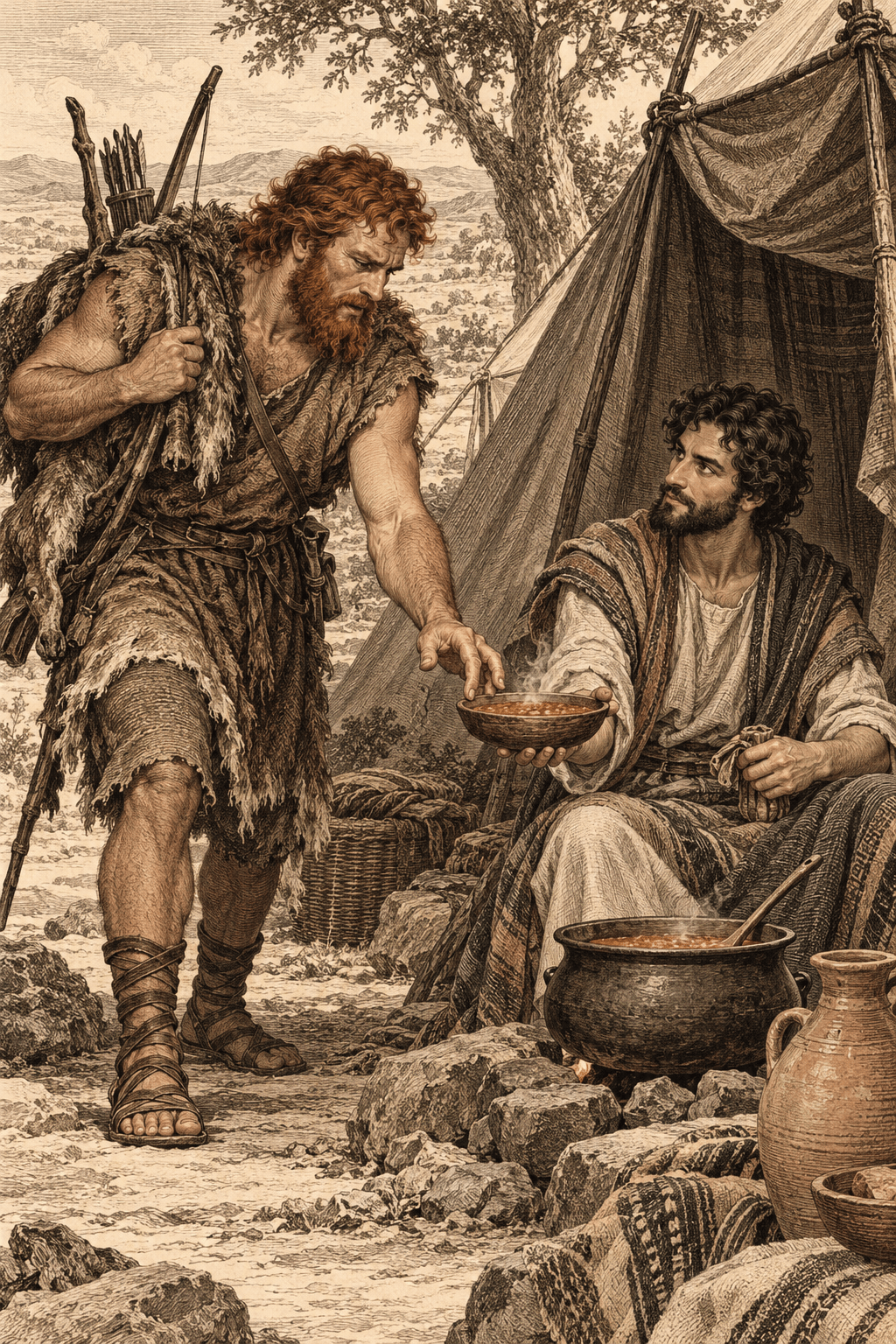
Esau revealed himself as a carnal person when he sold his birthright to his brother Jacob for a dish of red lentils; because of this he was called Edom. His carelessness appeared in his words, “Behold, I am at the point to die: and what profit shall this birthright do to me?” [32]. Scripture comments, “Thus Esau despised his birthright” [34]. Although Jacob took advantage of his brother’s weariness and bargained with him over the birthright, as a spiritual person he did not sell the dish of lentils for material gain or money, but for the acquisition of the birthright. If Esau represents the careless person who gives up spiritual blessings and eternal glories for a morsel of food and the desires of the flesh, Jacob represents the person who loves spiritual things.
The holder of the birthright represented the head of the family, inheriting from his father the right to perform priestly work, if we may use this expression. He offered sacrifices on behalf of the family. Thus from Jacob came the tribe of Levi, which fulfilled the priestly role.
Saint Augustine says that Esau’s fall came through his carelessness rather than through the dish of lentils itself:
“To make us know that the fault lies not in God’s creation but in stubborn disobedience and excessive desire, the first man met death, not in swine’s flesh, but in an apple (Genesis 3:6); and Esau lost his birthright, not through a meal of birds, but through a dish of lentils. [355]”
If we enjoy the birthright through our union with God in His firstborn Son, let us not despise it for a morsel of food or the pleasures of the flesh. Rather, let us sell everything in order to acquire the Firstborn in our lives.
Notes and References
[344] In Gen. hom 11.
[345] Ibid 11: 3.
[346] On Ps. hom 21.
[347] In Gen. 11: 3.
[348] Ser. 86: 2.
[349] In Gen. hom 12: 2.
[350] Ser. 86: 3.
[351] On Ps. 81.
[352] Ibid 41.
[353] In Gen. hom 12: 3.
[354] On Ps. hom 7.
[355] In Ioan. tr 73: 1.