
When Abraham moved to Gerar, he said of Sarah his wife that she was his sister. Abimelech king of Gerar therefore sent for her to be his wife, but the Lord prevented him from approaching her.
1. Abimelech and Sarah
KJV · Verses 1–7
1 And Abraham journeyed from thence toward the south country, and dwelled between Kadesh and Shur, and sojourned in Gerar. 2 And Abraham said of Sarah his wife, She is my sister: and Abimelech king of Gerar sent, and took Sarah. 3 But God came to Abimelech in a dream by night, and said to him, Behold, thou art but a dead man, for the woman which thou hast taken; for she is a man's wife. 4 But Abimelech had not come near her: and he said, Lord, wilt thou slay also a righteous nation? 5 Said he not unto me, She is my sister? and she, even she herself said, He is my brother: in the integrity of my heart and innocency of my hands have I done this. 6 And God said unto him in a dream, Yea, I know that thou didst this in the integrity of thy heart; for I also withheld thee from sinning against me: therefore suffered I thee not to touch her. 7 Now therefore restore the man his wife; for he is a prophet, and he shall pray for thee, and thou shalt live: and if thou restore her not, know thou that thou shalt surely die, thou, and all that are thine.
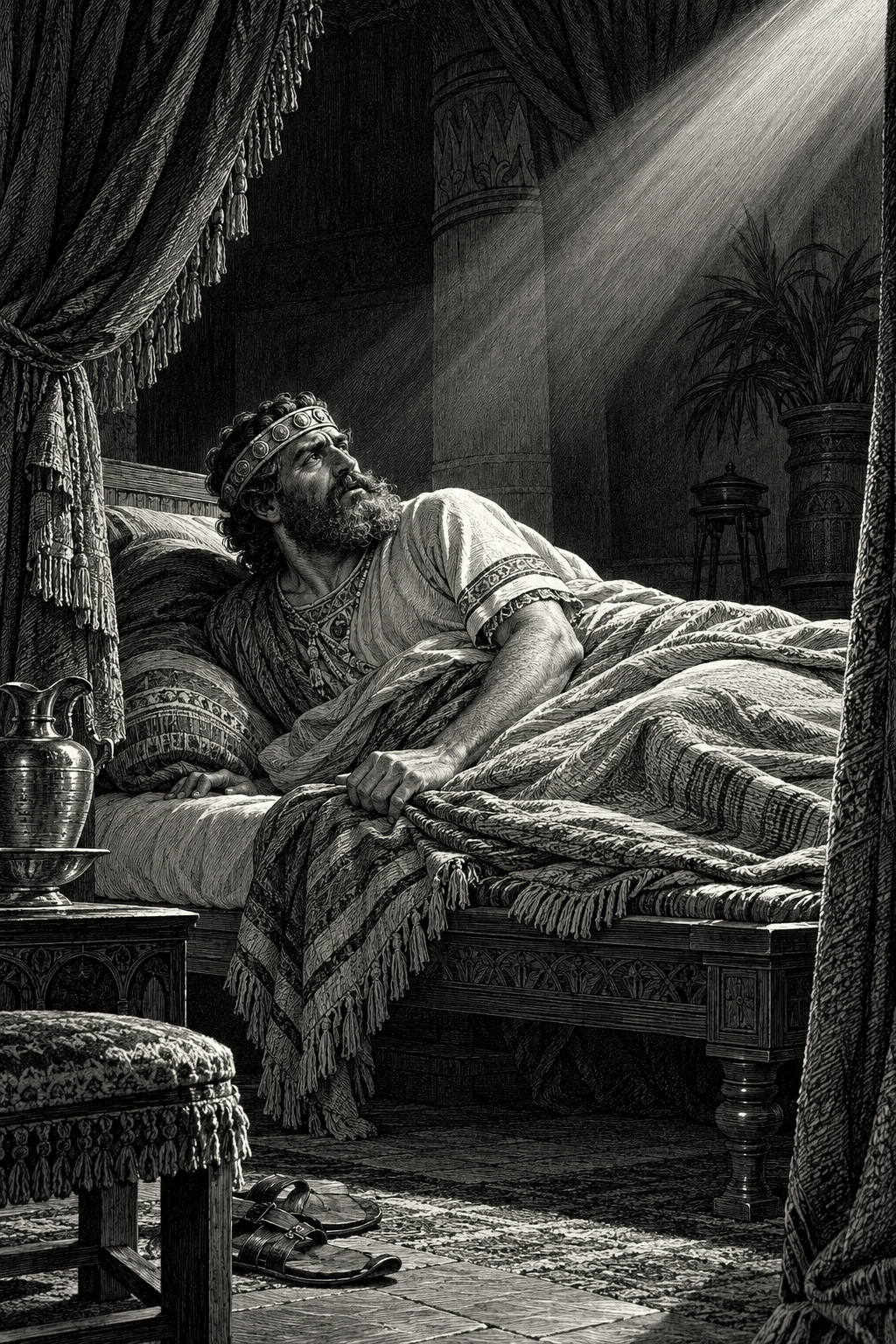
After about twenty-three years, Abraham left the oaks of Mamre and went to Gerar. Perhaps he had been affected by the sight of Sodom and Gomorrah burning and wanted to leave the whole region; or perhaps his livestock had multiplied and he sought another pasture; or a famine may have struck the area. Whatever the reason, Abraham moved to Gerar, and there he said of Sarah that she was his sister. Abimelech king of Gerar sent for her to take her as his wife, although she had by then reached ninety years of age. God, “Elohim,” came to Abimelech in a dream by night to rebuke him: “Behold, thou art but a dead man, for the woman which thou hast taken; for she is a man's wife” (Genesis 20:3). Abimelech had not approached her, and answered God: “Lord, wilt thou slay also a righteous nation? Said he not unto me, She is my sister? and she, even she herself said, He is my brother: in the integrity of my heart and innocency of my hands have I done this” (Genesis 20:4–5). God said to him in the dream: “Yea, I know that thou didst this in the integrity of thy heart; for I also withheld thee from sinning against me: therefore suffered I thee not to touch her. Now therefore restore the man his wife; for he is a prophet, and he shall pray for thee, and thou shalt live: and if thou restore her not, know thou that thou shalt surely die, thou, and all that are thine” (Genesis 20:6–7).
The word “Abimelech” means “my father is king.” Abimelech was a pagan king of the Philistines, yet he displayed fine qualities and remarkable graciousness in his conversation with God, who appeared to him in a dream, and in his dealings with Sarah and Abraham.
Abimelech sought Sarah as his wife, but did so with integrity of heart and innocence of hands. For this reason God says: “For I also withheld thee from sinning against me: therefore suffered I thee not to touch her” (Genesis 20:6). Perhaps God struck him with an illness that kept him from coming together with Sarah. This illness would have expressed God's care for him rather than divine anger against him, so that he would not sin against God Himself by having relations with Sarah, the wife of Abraham, God's friend. Abraham had previously made an agreement with his wife that she would conceal the truth of their marriage (Genesis 20:13). Many years before, when Abram went down to Egypt, Pharaoh had taken her to make her his wife (Genesis 12:14–20). The Lord struck Pharaoh and his household with great plagues so that he would not touch Sarah, and Pharaoh rebuked Abram for concealing the truth of his marriage to her. Nevertheless, Abraham remained weak in this matter, repeating it even in his old age with Abimelech. It is as though God is warning us to beware of ourselves: even if we spend decades without committing a particular fault, we may fall again in old age into something in which we had fallen before! If Abraham, the man of God, fell after all these dealings with God, should we not be watchful over ourselves?
Abraham had seen God's deliverance and care clearly when Sarah was rescued from Pharaoh's hands. God had given him the courage to rescue his nephew Lot from the hands of the kings (Genesis 14). He had received a divine promise that Sarah would bear him a son who would enjoy the inheritance and the blessing, after he had seen God and His two angels and entertained them. He ought to have been open and to have concealed nothing of his marital relationship with Sarah! In any case, Scripture did not conceal Abraham's weakness, even while presenting his life as the father of all believers, whose embrace is wide enough to include all God's children.
Returning to Abimelech king of Gerar: the word “Gerar” means “a jar” or “an earthen vessel.” It was an ancient city on the southern side of the borders of Palestine, about five or six miles from Gaza. The Philistines inhabited it at an early time (Genesis 26:1). It may have been at, or near, the place now known as Khirbet Umm Jerrar, “the sites of the jars.” Some place it thirteen miles southwest of Kadesh; others place it about nineteen miles southwest of Beit Jibrin, Eleutheropolis, and about fourteen and a half miles from Tell Jemmeh [306]. It seems that “Abimelech” was not the king's personal name, but a title borne by most kings of Gerar, like “Pharaoh” in Egypt.
Origen offers a symbolic interpretation of this event, linking it with the earlier occasion when Pharaoh took Sarah into his household. He sees Sarah as a symbol of spiritual virtue or divine wisdom, which Abraham had acquired as a wife. Neither Pharaoh nor Abimelech could possess her: the former because of his impure heart, and the latter because her husband was alive. If Abraham represents the Law, no one can acquire spiritual wisdom while the Law remains alive. As the apostle Paul says: “The law hath dominion over a man as long as he liveth. For the woman which hath an husband is bound by the law to her husband so long as he liveth; but if the husband be dead, she is loosed from the law of her husband” (Romans 7:1–2).
Among Origen's words on this subject are the following:
“I think that Sarah represents spiritual virtue. The faithful, wise man is the one who is joined to this virtue and speaks of it. He is the wise man of whom the Book of Wisdom says, “I desired to take her for my bride” (Wisdom 8:2). God also says to Abraham, “In all that Sarah hath said unto thee, hearken unto her voice” (Genesis 21:12). When spiritual virtue is within us, as our wife and bride, we can teach others once we become perfect. We offer her as our sister, and others desire her as a wife for themselves. These are the ones to whom it is said, “Say unto wisdom, Thou art my sister” (Proverbs 7:4). For this reason Abraham said of Sarah that she was his sister, as though representing the perfect person who offers virtue to whoever desires her. In former times Pharaoh wanted to take Sarah, but did not seek her with integrity of heart. Yet no one can acquire virtue in this way without purity of heart. Therefore Scripture says that the Lord plagued Pharaoh and his house with great plagues (Genesis 12:17), for virtue cannot dwell with destroyers such as Pharaoh. Abimelech, however, wanted virtue as his wife with a pure heart (Genesis 20:5). Why, then, does Scripture say that God did not allow him to touch her? It seems to me that Abimelech represents the wise people of the world and lovers of philosophy who lack piety. Abraham wished to give divine virtue, Sarah, to the wise among the nations, Abimelech, but the time had not yet come for them to receive divine grace. Virtue remained with Abraham; she remained with the people of the circumcision until the time should come for complete and perfect virtue to pass to the Church of the Gentiles. [307]”
2. Abimelech Summons Abraham
KJV · Verses 8–13
8 Therefore Abimelech rose early in the morning, and called all his servants, and told all these things in their ears: and the men were sore afraid. 9 Then Abimelech called Abraham, and said unto him, What hast thou done unto us? and what have I offended thee, that thou hast brought on me and on my kingdom a great sin? thou hast done deeds unto me that ought not to be done. 10 And Abimelech said unto Abraham, What sawest thou, that thou hast done this thing? 11 And Abraham said, Because I thought, Surely the fear of God is not in this place; and they will slay me for my wife's sake. 12 And yet indeed she is my sister; she is the daughter of my father, but not the daughter of my mother; and she became my wife. 13 And it came to pass, when God caused me to wander from my father's house, that I said unto her, This is thy kindness which thou shalt shew unto me; at every place whither we shall come, say of me, He is my brother.
Although Abimelech and his men were pagans, their hearts were ready to receive God's word. Early in the morning Abimelech summoned all his servants and told them of God's revelation to him, “and the men were sore afraid” (Genesis 20:8).
God had greatly honored Abraham in Abimelech's eyes, saying, “For he is a prophet, and he shall pray for thee, and thou shalt live” (Genesis 20:7). Yet He allowed the pagan Abimelech to rebuke His prophet and reproach him: “What hast thou done unto us? and what have I offended thee, that thou hast brought on me and on my kingdom a great sin? thou hast done deeds unto me that ought not to be done” (Genesis 20:9). It is as though he were saying: What did you intend to do to me? I had done you no wrong, yet you deceived me and brought divine anger upon me! If you had told the truth, that she was your wife, she would have remained with you, and none of this would have befallen us.
Strangely, instead of acknowledging the wrong he had committed, Abraham offered an excuse: “Surely the fear of God is not in this place; and they will slay me for my wife's sake” (Genesis 20:11). He had judged the people of the region as having no fear of God at all, and as people who would kill him. Thus he fell into the sin of condemnation and hasty judgment of others, even though the fear of God had appeared clearly in Abimelech and his men. His second reason was that he had not lied, since Sarah was his sister through his father, though not through his mother. This, however, did not justify concealing the truth of his relationship to her as her husband, so long as this concealment exposed others to the danger of sinning with her.
3. Abimelech Honors Abraham
KJV · Verses 14–18
14 And Abimelech took sheep, and oxen, and menservants, and womenservants, and gave them unto Abraham, and restored him Sarah his wife. 15 And Abimelech said, Behold, my land is before thee: dwell where it pleaseth thee. 16 And unto Sarah he said, Behold, I have given thy brother a thousand pieces of silver: behold, he is to thee a covering of the eyes, unto all that are with thee, and with all other: thus she was reproved. 17 So Abraham prayed unto God: and God healed Abimelech, and his wife, and his maidservants; and they bare children. 18 For the LORD had fast closed up all the wombs of the house of Abimelech, because of Sarah Abraham's wife.
Abimelech's honor toward Abraham was great, not only in the gifts he offered, but also in the love and esteem he expressed when he said, “Behold, my land is before thee: dwell where it pleaseth thee” (Genesis 20:15). Although he had rebuked him for endangering his life and kingdom, he showed generosity in giving, not when he took his wife from him, as Pharaoh had done (Genesis 12:16), but when he returned her, offering him his heart as well as his land! He answered the wrong done to him with practical love, something that even some believers find difficult to accomplish.
In a reproach filled with love, he said to Sarah: “Behold, I have given thy brother a thousand pieces of silver: behold, he is to thee a covering of the eyes, unto all that are with thee, and with all other: thus she was reproved” (Genesis 20:16). He called Abraham her brother as a gentle rebuke. He had given him a thousand pieces of silver to be a covering of the eyes for her, that is, an honor and a restoration of her dignity, expressing his esteem for her and her husband before everyone. Some understand “behold, he is to thee a covering of the eyes” as referring to Abraham himself rather than to the silver: he would protect and shelter her from every eye that looked upon her or thought of taking her.
Finally, when Abraham prayed for Abimelech, his wife, and his maidservants, the Lord healed them.
Notes and References
[306] New Westminster Dictionary of the Bible, p. 324.
[307] Origen, Homilies on Genesis, Homily 6.