
Abraham enjoyed the privilege of receiving God with two angels as his guests. Lot, however, received only the two angels, who rescued him from the destruction that overtook Sodom. Yet he lost his wife, and his two daughters committed a grave wrong with him.
1. Receiving the Two Angels
KJV · Verses 1–3
1 And there came two angels to Sodom at even; and Lot sat in the gate of Sodom: and Lot seeing them rose up to meet them; and he bowed himself with his face toward the ground; 2 And he said, Behold now, my lords, turn in, I pray you, into your servant's house, and tarry all night, and wash your feet, and ye shall rise up early, and go on your ways. And they said, Nay; but we will abide in the street all night. 3 And he pressed upon them greatly; and they turned in unto him, and entered into his house; and he made them a feast, and did bake unleavened bread, and they did eat.
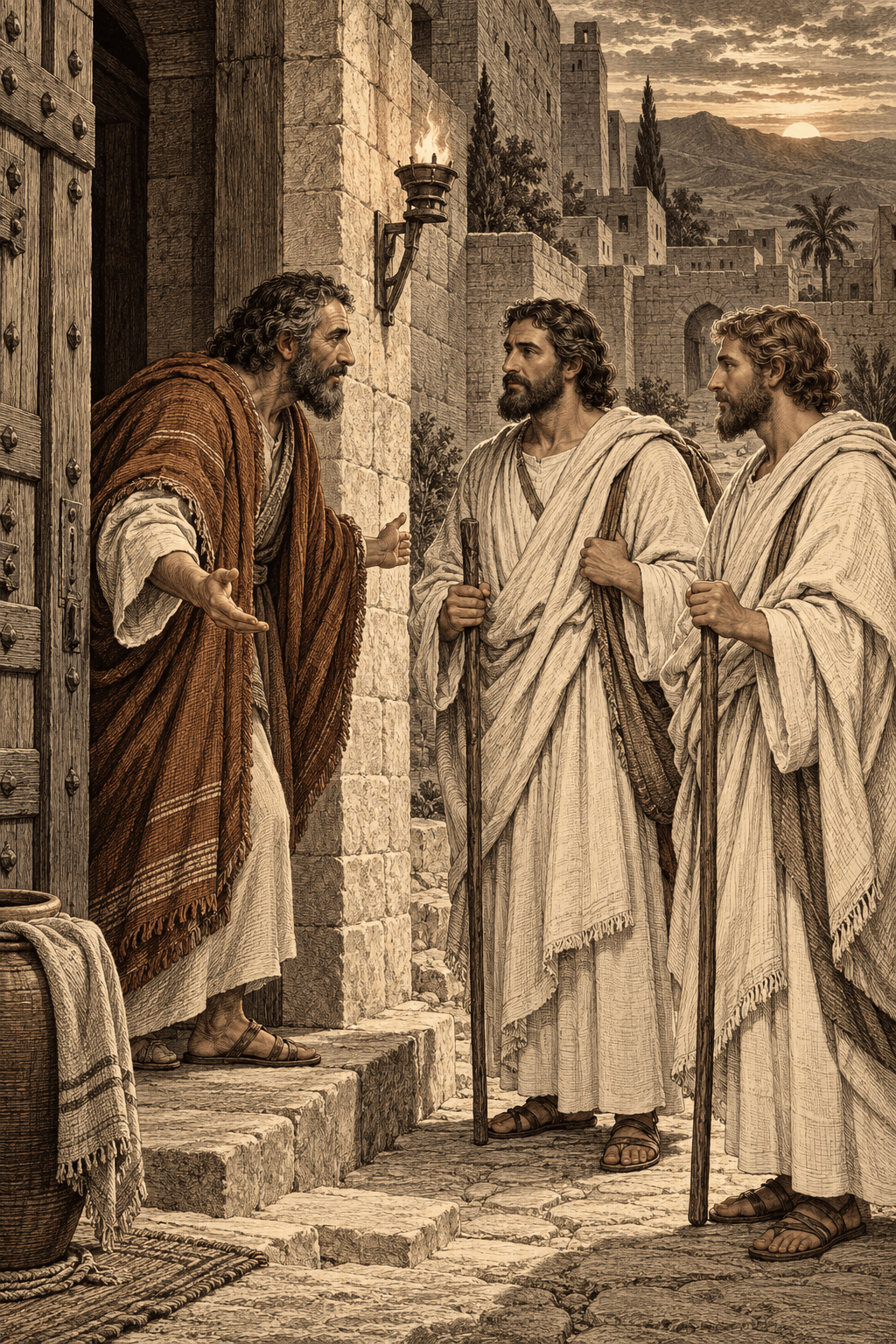
No one can overlook the life of faith and the virtues that distinguished Lot, even though he appears very small beside Abraham, the man of faith. If Lot represents the age of the law, Abraham represents the age of grace.
We should compare what the preceding chapter relates about Abraham receiving the Lord and His angels with what is related here about Lot receiving the two angels.
First: Abraham possessed a great soul. Through living faith he was made worthy to receive the Word of God and His angels at noon. He is like the people of the New Testament who met the Savior at the cross, at midday, to see heaven opened and reconciliation accomplished between those on earth and those in heaven. Lot, however, through the weakness of his faith, rather than an absence of faith, scarcely received two angels in the evening to save him from the destruction about to overtake the city he had chosen as a home for himself and his family.
Origen says:
“Three men came to Abraham in the middle of the day (Genesis 18:1-2), while two came to Lot in the evening (Genesis 19:1). Lot could not receive the fullness of the light of noon, but Abraham was able to enjoy the splendor of the light. Notice that, in Abraham’s case, the Lord came with the two angels; in Lot’s case, there were only two angels. Lot received the destroyers (Genesis 19:13), rather than the Savior, while Abraham received both the Savior and the destroyer. [295]”
As was his custom, Father Caesarius of Arles borrowed some of Origen’s expressions, saying:
“Lot could not bear the strength of the midday sun, but Abraham was able to stand in the fullness of its splendor. [296]”
The Fathers did not belittle Lot. Although he was small beside Abraham, he possessed some of his virtues. Saint Ambrose says:
“Lot, Abraham’s nephew, was close to him not only through bodily kinship, but through virtue as well. Because of his readiness to receive strangers, he and his family were saved from the punishment that overtook Sodom. [297]”
Commenting on Lot’s reception of the angels, Saint John Chrysostom says:
“He led the angels to descend to humanity, and human beings to rise to them. [298]”
Second: Comparing Abraham’s banquet with Lot’s, Father Caesarius of Arles says that three men came to Abraham and “stood by him” (Genesis 18:2); in Lot’s case, the two men came and stood in the road.
We may say that the Lord and His angels stood beside Abraham’s tent. Or we may say that the Lord of heaven and His hosts found in Abraham a heavenly life, and so made their dwelling with him. Lot, however, was met while sitting “in the gate of Sodom,” at the entrance to the city.
May we become like our father Abraham, worthy to meet the Lord and His hosts, not at the entrance to the city like Lot, but in our inner depths, as His beloved heavens.
Third: What a difference there is between Abraham and Lot! When the first asked the Lord and His angels to accept his hospitality, they immediately answered, “So do, as thou hast said” (Genesis 18:5). The second had to urge the two angels very strongly. They wished to spend the night in the square, the public open space, as strangers with no one to receive them; only then did they consent to turn aside to him and enter his house (Genesis 19:2-3).
Fourth: Abraham knew the mystery of the Holy Trinity. He did not merely meet three men; he also asked Sarah to hurry and prepare three measures of fine meal. It is as though he were asking the Church to let her children enjoy faith in the Holy Trinity, so that, as three measures of fine flour, they might become worthy to be heavenly bread.
Fifth: Abraham’s encounter ended with his receiving the blessing together with Sarah, for the Lord promised them a son. Lot’s encounter barely ended in the rescue of himself and his two daughters, without his wife. The first received a promise that his descendants would enjoy the promised land; the second left the city empty-handed, not knowing where to find shelter!
Sixth: In this encounter Abraham stood with boldness as an intercessor for others, the inhabitants of Sodom and Gomorrah. Lot, however, pleaded for himself and his two daughters, hoping that the angels would permit them to live in the city of Zoar.
2. The People Rage against the Two Angels
KJV · Verses 4–11
4 But before they lay down, the men of the city, even the men of Sodom, compassed the house round, both old and young, all the people from every quarter: 5 And they called unto Lot, and said unto him, Where are the men which came in to thee this night? bring them out unto us, that we may know them. 6 And Lot went out at the door unto them, and shut the door after him, 7 And said, I pray you, brethren, do not so wickedly. 8 Behold now, I have two daughters which have not known man; let me, I pray you, bring them out unto you, and do ye to them as is good in your eyes: only unto these men do nothing; for therefore came they under the shadow of my roof. 9 And they said, Stand back. And they said again, This one fellow came in to sojourn, and he will needs be a judge: now will we deal worse with thee, than with them. And they pressed sore upon the man, even Lot, and came near to break the door. 10 But the men put forth their hand, and pulled Lot into the house to them, and shut to the door. 11 And they smote the men that were at the door of the house with blindness, both small and great: so that they wearied themselves to find the door.
When Lot received the two men, the angels, the men of the city, young and old, surrounded the house, demanding to “know” them: that is, to commit shameful wickedness against them. This picture reveals the impurity and bitter insolence into which the whole people had fallen. Indeed, this sin came to bear their name, being called sodomy after their city, Sodom.
Lot tried to protect his guests. He offered to bring out his two daughters so that the men could do to them whatever they wished, perhaps hoping to put them to shame. When everyone insisted on bringing out the two men, the men stretched out their hands, drew Lot inside to them, and shut the door. They struck the men standing outside with blindness, so that they could not find the door.
Although Lot was marked by love of hospitality and firmly insisted that he would not surrender the two men to wickedness, he is to be blamed for offering his daughters as a ransom for his guests. In any case, God looked upon Lot’s heart, which loved strangers. He did not leave Lot to protect the strangers; rather, the strangers protected him and his household from the wicked.
We hear of no such uproar when the Lord and His angels appeared to Abraham. Abraham represents the age of grace, whereas Lot represents the fallen condition under the law. The first enjoys a joyful encounter with God in which the soul rises above all sufferings and enjoys a life on a heavenly level. The second enters a bitter struggle and distress, exposing his energies and gifts, represented by the two daughters, to corruption. Yet even in the age of the law, heaven intervened and brought the person inside his house, shutting him away from the wicked.
The first brought laughter to his body, Sarah, or spiritual joy in the Lord; the second entered into bitterness of soul.
Finally, if God sentenced Sodom and Gomorrah to destruction, He did so after saying, “I will go down now, and see” (Genesis 18:21), as though He judged with the utmost care. Perhaps He allowed Lot to live among them to provide a living, practical example and a witness against them. Now the two angels came, and the people treated them wickedly. They no longer had an excuse!
In his conversation with God, Abraham had asked, “Shall not the Judge of all the earth do right?” (Genesis 18:25). God revealed His justice and love: He sent His angels to witness the wickedness of the wicked and to rescue Lot and his family. He does not destroy the righteous with the sinner.
3. Rescuing Lot and His Family
KJV · Verses 12–22
12 And the men said unto Lot, Hast thou here any besides? son in law, and thy sons, and thy daughters, and whatsoever thou hast in the city, bring them out of this place: 13 For we will destroy this place, because the cry of them is waxen great before the face of the LORD; and the LORD hath sent us to destroy it. 14 And Lot went out, and spake unto his sons in law, which married his daughters, and said, Up, get you out of this place; for the LORD will destroy this city. But he seemed as one that mocked unto his sons in law. 15 And when the morning arose, then the angels hastened Lot, saying, Arise, take thy wife, and thy two daughters, which are here; lest thou be consumed in the iniquity of the city. 16 And while he lingered, the men laid hold upon his hand, and upon the hand of his wife, and upon the hand of his two daughters; the LORD being merciful unto him: and they brought him forth, and set him without the city. 17 And it came to pass, when they had brought them forth abroad, that he said, Escape for thy life; look not behind thee, neither stay thou in all the plain; escape to the mountain, lest thou be consumed. 18 And Lot said unto them, Oh, not so, my Lord: 19 Behold now, thy servant hath found grace in thy sight, and thou hast magnified thy mercy, which thou hast shewed unto me in saving my life; and I cannot escape to the mountain, lest some evil take me, and I die: 20 Behold now, this city is near to flee unto, and it is a little one: Oh, let me escape thither, (is it not a little one?) and my soul shall live. 21 And he said unto him, See, I have accepted thee concerning this thing also, that I will not overthrow this city, for the which thou hast spoken. 22 Haste thee, escape thither; for I cannot do anything till thou be come thither. Therefore the name of the city was called Zoar.
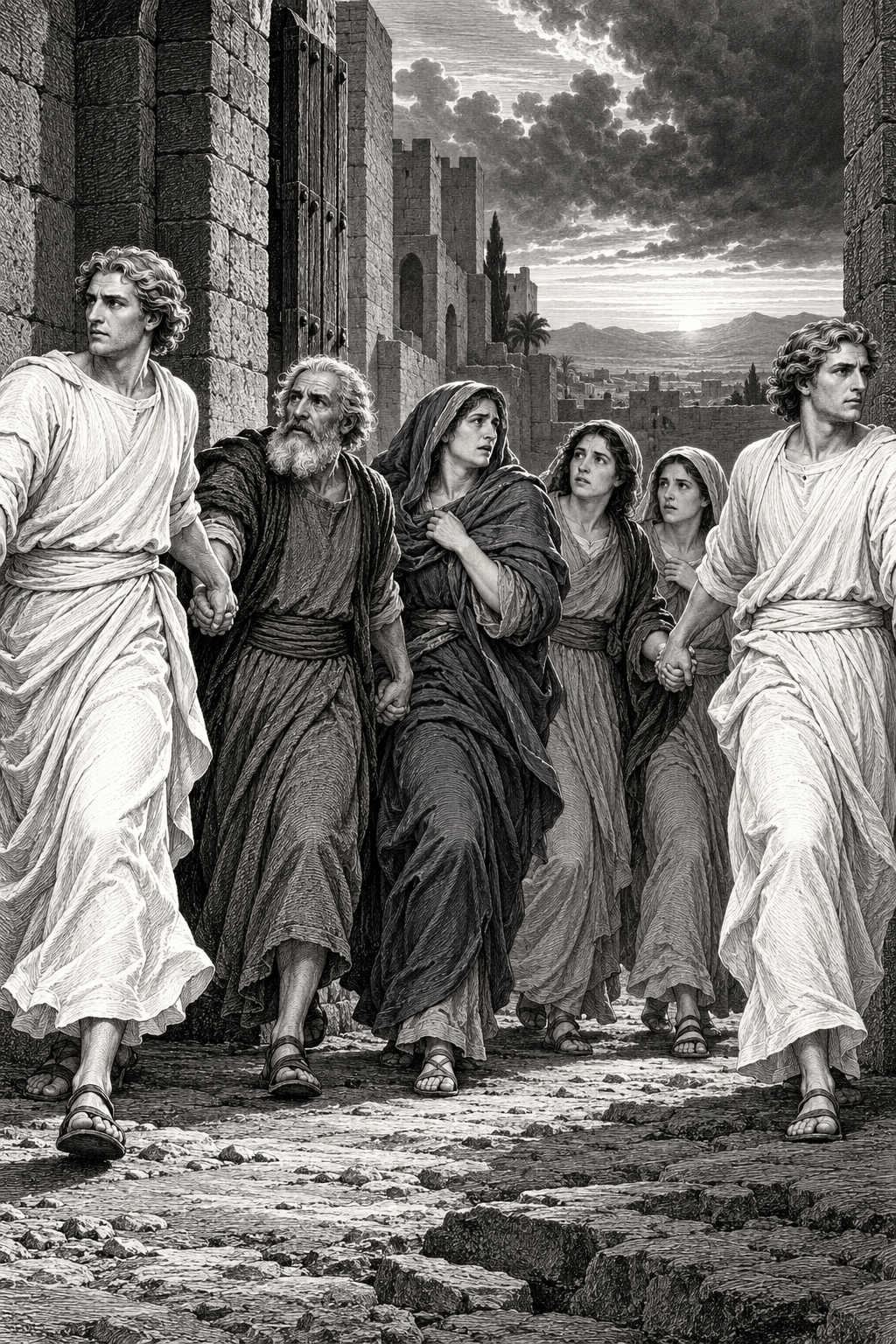
The angels revealed God’s saving plan and asked Lot to leave with his wife, his two daughters, and his sons-in-law. Yet “he seemed as one that mocked unto his sons in law” (Genesis 19:14). His sons-in-law could have been saved even at the last moment. In every generation, however, the wicked regard God’s warnings as frivolity and jest and treat them with contempt.
Finally, as dawn broke, the angels urged Lot, saying, “Arise, take thy wife, and thy two daughters, which are here; lest thou be consumed in the iniquity of the city.” The angels’ call to him at dawn, “Arise,” was like heaven’s call to us to rise with the Lord Christ, who rose from the dead at dawn on Sunday. Our souls rise, and with them our bodies, represented by his wife; our energies and gifts, represented by his two daughters, also rise through their sanctification in the Lord.
Lot lingered or delayed, perhaps because of his married daughters and their husbands, or because of his house and possessions. But the angels brought him out of the city with his wife and told them to flee for their lives.
The angels asked Lot to escape to the mountain. Yet he could not set out for the mountain, so he asked to flee to a small city nearby. It was called Zoar because it was the smallest of the cities of the plain. Previously it had been called Bela; it was probably on the eastern shore of the Dead Sea. God accepted his request and did not compel him to go to the mountain, allowing him instead to go to Zoar. Yet Lot lost much through this! God wants us to flee to the holy mountain, so that His Holy Spirit may lift us to the lofty heights; in our weakness, however, we are satisfied with Zoar!
Speaking of the Zoar Lot chose for himself, Saint Jerome says:
“It was called Zoar because of Lot’s little faith. Though he could not save the great places, he at least preserved the small ones. For the man who went far away to live in Gomorrah could not reach the land of noon attained by Abraham, the friend of God (James 2:23) and the friend of His angels (Genesis 18:1). [299]”
Perhaps Saint Jerome was influenced by Origen’s words in his fifth homily on Genesis:
“Lot was never able to dwell on the heights with Abraham.”
What is this holy mountain to which we flee for our lives, except Holy Scripture? In it we find an impregnable fortress against the assaults of the wicked enemy, the devil. For this reason, when the Lord Christ underwent temptation on the mountain on our behalf and as an example to us, He repelled every demonic attack with words from Holy Scripture. It is like the holy mountain to which He lifts us, so that the enemy cannot climb up to us by his tricks.
The mountain also points to the Word of God Himself, of whom Daniel the prophet spoke: “A stone was cut out without hands, which smote the image upon his feet that were of iron and clay, and brake them to pieces … and the stone that smote the image became a great mountain, and filled the whole earth” (Daniel 2:34-35). The Lord Christ, the Word of God, is the stone cut out without hands, for He is not of human seed. He can crush the image of evil standing within us. When He takes possession of our inner land, He fills it like a great mountain, filling the whole heart!
4. The Destruction of Sodom and Gomorrah
KJV · Verses 23–25
23 The sun was risen upon the earth when Lot entered into Zoar. 24 Then the LORD rained upon Sodom and upon Gomorrah brimstone and fire from the LORD out of heaven; 25 And he overthrew those cities, and all the plain, and all the inhabitants of the cities, and that which grew upon the ground.
“The sun was risen upon the earth when Lot entered into Zoar. Then the LORD rained upon Sodom and upon Gomorrah brimstone and fire from the LORD out of heaven” (Genesis 19:23-24).
As soon as the sun rose upon the earth, Lot entered Zoar. Since Zoar means “small,” we cannot enjoy a spirit of humility and recognize our own smallness, as one of the little ones, unless the Sun of Righteousness rises upon our inner land and proclaims within us the kingdom of His humility and love.
How wonderful that God did not rain brimstone and fire from Himself upon Sodom and Gomorrah until Lot had entered Zoar! He was most carefully watching over Lot as a righteous man.
The mystery of the Trinity appears here in the words, “The LORD rained … from the LORD,” as though the Son, the Word, rained from the Father.
5. The Destruction of Lot’s Wife
KJV · Verse 26
26 But his wife looked back from behind him, and she became a pillar of salt.
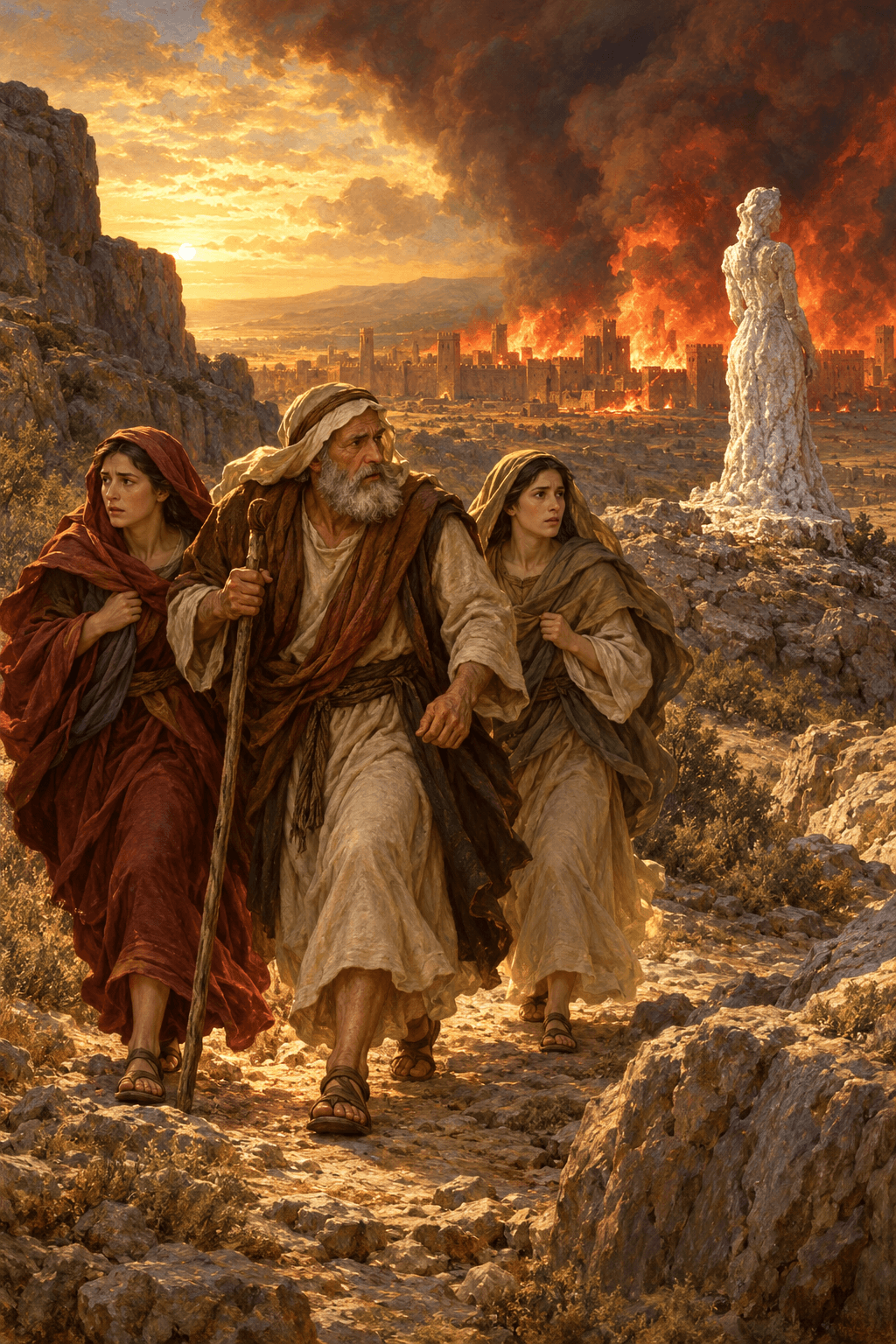
Some have explained her becoming salt as a literal transformation. Others suggest that she suffocated from the brimstone and smoke and that salt then covered her body, becoming her tomb. Some think earthquakes hurled rocks of salt, some of which fell upon Lot’s wife, so that she became a pillar of salt. Thus she became, as the Book of Wisdom says, a “monument of an unbelieving soul” (Wisdom 10:7). The Lord Christ likewise told His disciples, “Remember Lot’s wife” (Luke 17:32).
The following are some of the Fathers’ comments about Lot’s wife:
“By looking back, she became a memorial monument of an unbelieving soul. — Saint Jerome [300]”
“Lot’s wife lost her very nature because she looked back. She gazed at what was unclean, even if with pure eyes. — Saint Ambrose [301]”
“Lot’s wife was saved from Sodom, but on the way she looked back. At the place where she looked back, there she remained. — Saint Augustine [302]”
““No man, having put his hand to the plough, and looking back, is fit for the kingdom of God” (Luke 9:62). When Lot’s wife had been rescued, she looked back in disobedience to the commandment and lost the benefit of her escape. Let us not look back, where Satan calls us to retreat, but let us look toward what lies ahead, where Christ calls us. Let us lift our eyes to heaven, lest the earth deceive us with its pleasures and temptations. — Saint Cyprian [303]”
6. Abraham Looks toward Sodom and Gomorrah
KJV · Verses 27–29
27 And Abraham gat up early in the morning to the place where he stood before the LORD: 28 And he looked toward Sodom and Gomorrah, and toward all the land of the plain, and beheld, and, lo, the smoke of the country went up as the smoke of a furnace. 29 And it came to pass, when God destroyed the cities of the plain, that God remembered Abraham, and sent Lot out of the midst of the overthrow, when he overthrew the cities in the which Lot dwelt.
Yesterday Abraham enjoyed receiving the Lord and His angels and obtained a promise of a son. This did not distract him from interceding for Sodom and Gomorrah. With his great, fatherly heart, he sought what concerned others rather than what concerned himself. In his intercession he was impartial: he did not plead merely for his relatives, Lot and his family, but for the whole plain.
The matter seems to have occupied his thoughts throughout the night. He therefore rose early to stand in the very place where he had met the Lord, to look toward Sodom and Gomorrah. Abraham spoke no word about Lot and his family. Yet he was speaking with his heart, his thoughts, his affections, and his feelings, which none but the Lord Himself could hear. God answered him, for it says, “God remembered Abraham, and sent Lot out of the midst of the overthrow.” It is as though everything Lot enjoyed was for Abraham’s sake!
The soul that is great in God’s eyes overshadows smaller souls with love, prayer, and the hidden sighs of the heart, becoming a source of blessing to them. We may recall, for example, the soul of Joseph, the young slave. It was great and blessed in God’s eyes, and because of it He blessed even the house of Potiphar the Egyptian: “And the blessing of the LORD was upon all that he had in the house, and in the field” (Genesis 39:5). This is no blessing belonging to Abraham in himself, or to Joseph in himself; it is the Lord’s blessing filling the heart!
7. The Sin of Lot’s Two Daughters with Their Father
KJV · Verses 30–38
30 And Lot went up out of Zoar, and dwelt in the mountain, and his two daughters with him; for he feared to dwell in Zoar: and he dwelt in a cave, he and his two daughters. 31 And the firstborn said unto the younger, Our father is old, and there is not a man in the earth to come in unto us after the manner of all the earth: 32 Come, let us make our father drink wine, and we will lie with him, that we may preserve seed of our father. 33 And they made their father drink wine that night: and the firstborn went in, and lay with her father; and he perceived not when she lay down, nor when she arose. 34 And it came to pass on the morrow, that the firstborn said unto the younger, Behold, I lay yesternight with my father: let us make him drink wine this night also; and go thou in, and lie with him, that we may preserve seed of our father. 35 And they made their father drink wine that night also: and the younger arose, and lay with him; and he perceived not when she lay down, nor when she arose. 36 Thus were both the daughters of Lot with child by their father. 37 And the first born bare a son, and called his name Moab: the same is the father of the Moabites unto this day. 38 And the younger, she also bare a son, and called his name Benammi: the same is the father of the children of Ammon unto this day.
Holy Scripture closes the last chapter of Lot’s life with a deeply painful event, the natural fruit of the seed he had sown. He had chosen Sodom as his home, and his daughters absorbed the spirit of wickedness from its people.
If Canaan fell under the curse because he mocked Noah when he became drunk and uncovered himself, Lot’s daughters made their father drunk not merely to uncover himself, but to obtain offspring from him. Some interpreters have tried to offer excuses for these two daughters. Among these is that, as they saw it, the entire world was burning and their mother had become a pillar of salt. They therefore saw no solution except to bear children by their father, saving the world from extinction. It is as though they joined themselves to their father not out of bodily desire but to repopulate the earth.
Origen says:
“Many women do not restrain themselves with their husbands even during pregnancy. These two young women, however, did not seek pleasure.”
Saint Didymus the Blind also tries to find an excuse for them, saying:
“They did not seek the relationship with a lustful intention. This is shown by the elder daughter asking the younger, on the second day, to go in to her father, and by their not seeking to join themselves to their father again after becoming pregnant.”
Many Fathers rejected this view. The daughters ought not to have used a human means to solve the problem while ignoring the work of God, who can raise up children from stones. In their lack of faith they fell into a most dreadful sin, becoming a symbol of the corruption of Israel and Judah when they rejected the Lord. They were regarded as Oholah and her sister Oholibah, of whom the Book of Ezekiel speaks (Ezekiel 23).
Saint Augustine sees these two daughters as a bitter image of those who misuse the law, represented by the father, attaching themselves to it in a fleshly or literal way rather than spiritually, and producing fruit outside the Lord. Thus these daughters bore Moab and Ammon by their father, as the heads of two wicked nations. We have previously discussed them and what they symbolize in our commentary on Ezekiel 25. Saint Jerome places blame upon Lot even though he committed the deed against his will.
“It is better for us to remain unfruitful than to become mothers in such a way! This was a symbol of those who corrupt the law … those who misuse it, bringing forth Moabites, who symbolize evil deeds. — Saint Augustine [304]”
“Lot indeed did not know what he was doing, nor was his sin voluntary. Yet his error was great, for it made him the father of Moab and Ammon, the two enemies of Israel. — Saint Jerome [305]”
Finally, we may say that Lot represents the mature mind fleeing from evil, but with a kind of reluctance. His wife points to the body turning back because of its desires, while the two daughters point to vainglory and conceit.
Notes and References
[295] In Gen. hom. 4:1.
[296] Ser. 83:2.
[297] Duties of the Clergy 2:21 (105).
[298] In Col. hom. 3.
[299] Ep. 122:1.
[300] Ibid.
[301] Conc. Virgins 2:4 (29).
[302] On Ps. 76.
[303] Ep. 7:7.
[304] On Ps. 60.
[305] Ep. 22:8.