
Divine inspiration opens the Holy Bible by proclaiming God as Creator. He prepared everything for the human being and led him through love, so that in the end He might bring him into His eternal kingdom to enjoy everlasting glory.
Introduction
In our study I wish to remain faithful to the spirit of the Church, which looks upon the Holy Bible as a mystery of life with God, to be enjoyed and lived, rather than as a scientific or philosophical textbook. Thus, when Saint Basil the Great wrote his discourses on the six days of creation, the Hexaemeron, he explained that the Church’s task is to study the work and benefit of created things rather than investigate their nature. Saint Augustine declares:
“It is too much for you to comprehend how God made these things. He made you also, so that you might obey Him as a servant and then understand as His friend. [19]”
As God’s creatures we joyfully accept His work as servants; when He grants us understanding, wisdom, and insight into His mysteries, we live with Him as His friends and beloved ones.
We may briefly offer the following observations concerning the account of creation in Genesis.
A. The simplicity of the account
The book presents the events of creation simply and truthfully. An ordinary person understands and rejoices in them, while a learned person also discovers their depths.
B. Creation and scientific study
Many Western scholars have sought to show that the account in Genesis does not conflict with scientific facts as understood in modern thought. Some have considered its sequence of creation to correspond very closely to ideas about the development of living things. Many studies have appeared on this subject, some written by devout scientists [*]. I do not wish, however, to enter details that would take us away from interpreting the word of God. The Church of the Martyr Saint George in Sporting previously published a simple study by Professor Youssef Riad of the Faculty of Science, Alexandria University, entitled The Harmony between Modern Science and the Holy Bible. It discussed this subject simply and concisely. The Youth Bishopric also published The Six Days of Creation by Dr. Fawzi Elias.
C. The meaning of “day”
The word “day” in the first chapter of Genesis does not mean a period confined to twenty-four hours, but an age that may extend over millions of years. The sun, moon, and other heavenly bodies had not been created until the fourth age. Before that, time as we now experience it did not exist, nor did the world have day and night in their tangible, physical sense. Many Fathers, including Saint Jerome, affirmed this [20]. Even after creation, Scripture often uses “day” in a wider sense: “For a day in thy courts is better than a thousand” (Psalm 84:10; see Psalm 90:4; 2 Peter 3:8).
“Day” has many meanings in Scripture. Sometimes it refers to eternity without beginning, as in the Father’s words to the Son: “Thou art my Son; this day have I begotten thee” (Psalm 2:7; Acts 13:33; Hebrews 1:5). God is also called the “Ancient of days” (Daniel 7:9), meaning the Eternal One. It can signify eternity beyond time, as in “the day of the Lord” (Acts 2:20), His final coming when time ends. Of the Lord Jesus Christ it is said: “To him be glory both now and for ever” (2 Peter 3:18).
D. The first human being
Some may object to the account of the first human being, saying that fossil discoveries establish the existence of human bones more than a million years old and that ancient inscriptions predate Adam. How are we to explain this?
First: By a simple mathematical calculation, the world’s present population could not, according to the author’s argument, represent the increase of more than six thousand years, assuming about three children per family and deducting a high proportion for natural deaths, disasters, and wars. If human history extended a million years, the descendants of a single person would, on this calculation, require thousands of times the earth’s area to contain them.
Second: As we have said, each age could span several million years. These bones may therefore, in the author’s interpretation, belong to mammals resembling human beings and possessing certain abilities, but lacking the breath from God’s mouth that distinguished Adam and Eve. Despite similarities, these creatures would not be counted as human beings.
E. God’s continuing work
Although this book gives a very brief account of God’s work at the beginning of creation, the God who prepared the world to serve us continues His creative work in our lives without ceasing. His former work has not ended. He continues working in the human being, making the depths of his being a new heaven and a new earth in which righteousness dwells. The Lord Christ says: “My Father worketh hitherto, and I work” (John 5:17).
In this interpretation, therefore, we wish to discern God’s continuing work in our inner life, as He creates within us and renews our depths without ceasing. I hope, in Christ Jesus our Lord, to present the spiritual interpretation alongside the historical or literal interpretation.
1. God the Creator
KJV · Verse 1
1 In the beginning God created the heaven and the earth.
Genesis begins with this simple opening: “In the beginning God created the heaven and the earth.” The expression “in the beginning” does not designate a particular time, for time had not yet come into being and the heavenly bodies with their precise arrangements did not yet exist. It means that the material world has a beginning. It is not eternal, sharing God’s eternity, as some philosophers claimed.
Saint Basil affirms this in the Hexaemeron, or The Six Days of Creation. He explains that “in the beginning” does not mean a stretch of time, otherwise the beginning would have a beginning and an end, and that beginning would have another beginning, leading to an infinite series. Here “beginning” means an initial movement rather than a quantity of time, as in “The fear of the LORD is the beginning of wisdom” (Proverbs 9:10) [21]. He also says:
“Do not suppose, O man, that the visible world has no beginning merely because the heavenly bodies move in a circle and our senses find it difficult to identify where that circular movement begins, imagining that it therefore has no beginning by nature. [22]”
“That which began in time also ends in time. [23]”
He is not asserting the existence of time before the first movement of creation, but removing the idea of an eternal world. Even without time, there was a beginning before which the world did not exist. Science too has affirmed that matter is not eternal [24].
Alongside this literal or historical explanation of “in the beginning,” many Fathers offer a symbolic or spiritual interpretation: heaven and earth were created “in Christ Jesus,” or “in the Word of God.” Here are some of their words.
“The Son Himself is the Beginning. When the Jews asked Him, “Who art thou?” He answered them, “I am from the beginning” (John 8:25, as cited in the source). Thus in the Beginning God created heaven and earth. — Saint Augustine [25]”
“Who is the beginning of all things except our Lord and the Saviour of all men (1 Timothy 4:10), Jesus Christ, “the firstborn of every creature” (Colossians 1:15)? In this Beginning, that is, in His Word, “God created the heaven and the earth.” As John the Evangelist says at the opening of his Gospel: “In the beginning was the Word, and the Word was with God, and the Word was God. The same was in the beginning with God. All things were made by him; and without him was not any thing made that was made” (John 1:1-3). Scripture speaks of the Beginning who is the Saviour, through whom heaven and earth were made, rather than of a beginning in time. — Origen [26]”
“Some think “beginning” means time. But whoever examines the word deeply discovers that it has more than one meaning. Sometimes it means the cause, so that heaven and earth exist in their cause.… Truly, the Word made all things. In Christ Jesus everything on earth and in heaven, visible and invisible, was created. — Saint Didymus the Blind [27]”
In brief, God created the world with a definite beginning; the world did not share His eternity. At the same time, the Word of God is the Beginning without beginning, the Creator of all.
“In the beginning Elohim created the heaven and the earth.” “Elohim” is plural, while the verb “created” is singular. The Creator is the Holy Trinity, one in essence, nature, and divinity.
Moses affirmed God as Creator, removing from his people the many creation myths that filled the world of his time, as well as the idea, held by some philosophers, that the world produced itself by mere chance. Professor Youssef Riad discussed this subject [28].
Finally, he says that Elohim created heaven and earth: He created the heavenly beings first, with all their ranks, and afterward the earth and everything belonging to it.
If heaven signifies the human soul that God receives as His dwelling, or His heaven, and the body becomes holy ground through sanctification, then in Christ Jesus we enjoy this heaven and earth: a soul that is the Lord’s temple and a body sanctified for His kingdom.
2. The Spirit of God and the Waters
KJV · Verse 2
2 And the earth was without form, and void; and darkness was upon the face of the deep. And the Spirit of God moved upon the face of the waters.
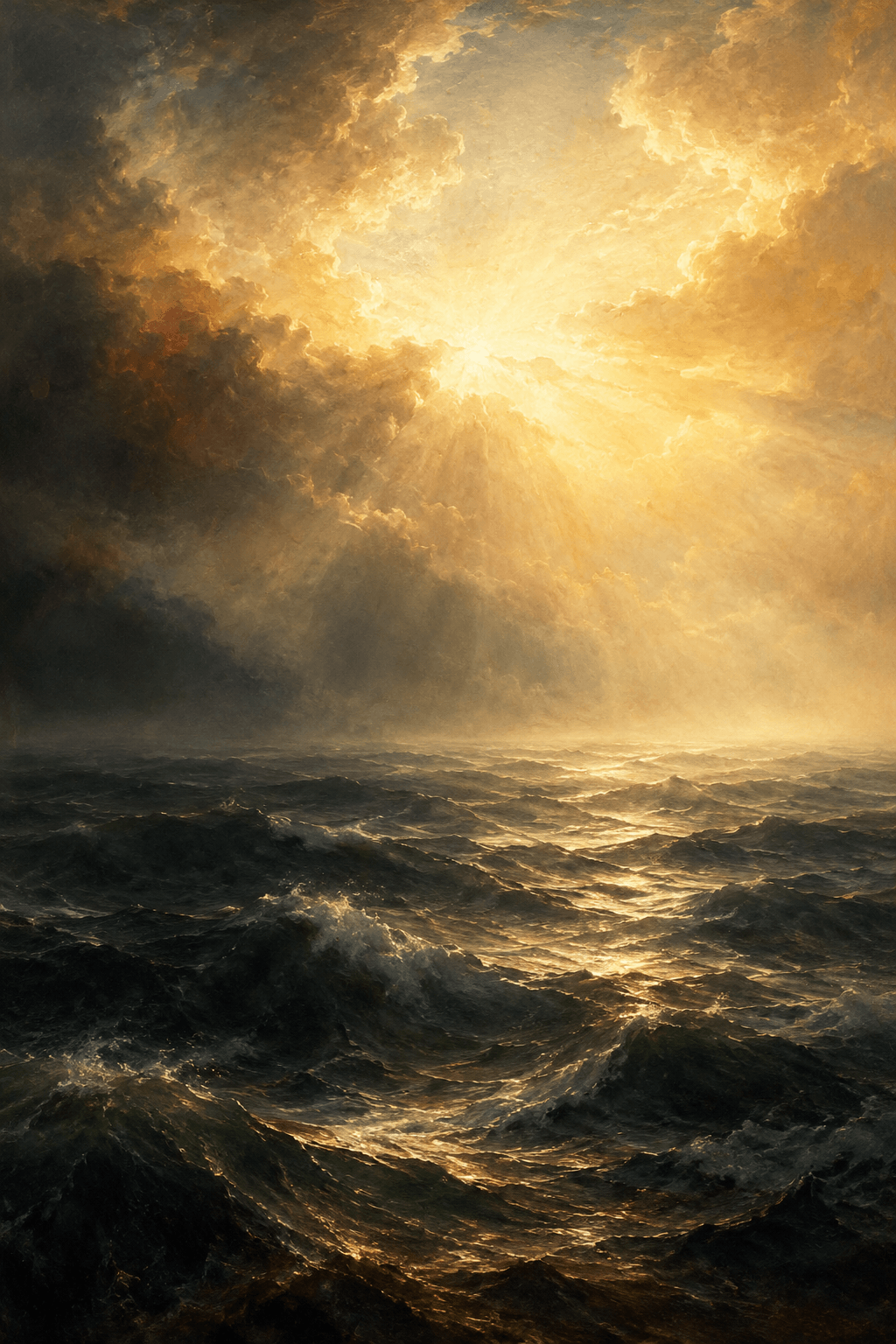
The earth is described as “without form, and void.” The Septuagint calls it “invisible and unformed.” Saint Basil explains that it was invisible because no human being had yet been created to see it, because the waters covered it completely, or because light had not yet shone upon it and the atmosphere was obscure. It was “unformed” because it could not yet produce vegetation [30].
Divine inspiration has revealed that the Father created heaven and earth through His Word. Here it discloses the Holy Spirit’s role: He moved upon the waters to create a good and beautiful world from the earth that was without form and void. To this day the Holy Spirit descends upon the baptismal waters to sanctify them. From the human being whom sin has corrupted and made a formless, empty earth, invisible through deprivation of divine illumination and unformed, He brings forth a new heaven and a new earth. He grants us new birth, in which we enjoy a soul sanctified in the image of God our Creator and a sanctified body whose members are instruments of righteousness [29].
We quote some words of the Fathers on this subject.
“The first waters brought forth life; let no one be surprised, then, if the waters of baptism can also give life.… The Spirit of God was borne upon the waters, He who re-creates the baptized. The Holy One was borne upon holy waters, or rather upon waters receiving holiness from Him. Thus the waters were sanctified and received the power to sanctify. Because water was the first element involved in creation, it received the mystery of sanctification through invocation. — Tertullian [31]”
“The new creation is accomplished through water and the Spirit, just as in the creation of the world, when the Spirit of God moved upon the waters. — Saint Clement of Alexandria [32]”
“Water is the beginning of the world, and the Jordan is the beginning of the Gospel. — Saint Cyril of Jerusalem [33]”
“If baptism was already foreshadowed on that day, there certainly was no true baptism without the Spirit. — Saint Jerome [34]”
Concerning “moved,” or “hovered,” Saint Basil says:
“A Syrian considers the Syriac word capable of expressing more than the Hebrew: it is translated as “broods,” as though the Spirit were likened to a bird brooding over its eggs to give them life through its own warmth. [35]”
Saint Ambrose sees the Spirit’s movement upon the waters as a continuing movement of love, accomplishing creative work in human life:
“How could He who moved before the earth was created cease His movement after He brought it into being? [36]”
3. The First Day: The Coming Forth of Light
KJV · Verses 3-5
3 And God said, Let there be light: and there was light. 4 And God saw the light, that it was good: and God divided the light from the darkness. 5 And God called the light Day, and the darkness he called Night. And the evening and the morning were the first day.
The first work God presents is the coming forth of light. “And God said, Let there be light: and there was light.” He saw that the light was good, divided it from darkness, called the light day and darkness night, and evening and morning were the first day.
We observe the following in this passage.
First: Light before the sun
Until a few years ago, some scientists stumbled over this statement, asking how light could appear in the first age before the sun existed. The prevailing scientific view held that the sun was the source of light. Modern research, however, affirmed that the material from which light comes preceded the sun. Thus the author sees the Bible’s excellence and divine inspiration revealed in its recording light in the first age, before the sun’s creation, something no one would have expected.
Briefly, the scientific explanation presented here is that our solar system originated from a dark spiral nebula widely spread through cosmic space. A nebula is a cloud of gases between the stars. Its material is extremely diffuse, with widely separated atoms continually moving around a gravitational center. Continued movement causes contraction and increasing density toward the center. Collisions between its atoms become more rapid, raising its temperature. As the temperature continues to rise, its radiation becomes visible and the first faint lights appear. Thus light first appeared before the sun took its present form in the fourth age, or fourth day. Light appeared while the sun was still in its first nebulous condition, before its full formation.
The remarkable thing is that Saint John Chrysostom’s fourth-century words correspond, in the author’s view, to twentieth-century discoveries:
“The light of the sun, which on the first day was without form, received its form on the fourth day of creation. [37]”
Saint Augustine may have expressed a similar idea when he said that the first day’s light did not come from the sun, but might be a physical light issuing from regions above our sight [38].
Second: The light of the heavenly city
Symbolically, Saint Augustine understands this light as belonging to the holy heavenly city, which includes the holy angels and in which believers enjoy eternity [39]. The apostle calls it Jerusalem above, our eternal mother in heaven (Galatians 4:26). We have a share in it, for “Ye are all the children of light, and the children of the day: we are not of the night, nor of darkness” (1 Thessalonians 5:5).
He considers the heavenly beings to have enjoyed the light that came forth on the first day, beholding God’s wonderful works throughout all the ages. Yet their knowledge of creation, compared with God’s knowledge, is counted as evening.
We may say that God’s works began with light so that the angels might see His works and glorify Him. In the same way, at the beginning of the new creation the Lord shone upon us with His divine light from the holy tomb at His resurrection, so that, rising in Him, we might have His glory revealed in us. In our new creation in the baptismal waters, we enjoy divine light, the light of His resurrection working within us, as God’s first work in our lives. This is why baptism is called the mystery of illumination.
Third: Dividing light from darkness
God divided light from darkness so that we might receive light as children of light and day, and reject darkness, escaping the night of destructive ignorance.
The Lord grants us inward light to dispel the old darkness. As the apostle says: “For ye were sometimes darkness” (Ephesians 5:8). He also grants the spirit of discernment, so that through God’s Spirit we distinguish light from darkness and escape the prophetic woe: “Woe unto them that call evil good, and good evil; that put darkness for light, and light for darkness; that put bitter for sweet, and sweet for bitter!” (Isaiah 5:20).
Fourth: The nature of darkness
Darkness is not a created substance brought into being by God; it is deprivation of light. With light’s appearance, darkness was exposed and recognized. Nevertheless, as Saint Augustine says:
“God commands the light He created and the darkness He did not create, and they obey Him. [40]”
Fifth: The divine command
Saint Hippolytus of Rome says:
“On the first day God created things from nothing. On the remaining days He made the other things from what He had created on the first day, shaping them according to His good pleasure. [41]”
Many Fathers, commenting on “He spoke, and it was done,” explain that all creation throughout its six stages came into being through God’s command. Saint Ambrose says:
“God did not create things by tools and craftsmanship, but spoke and it was done (Psalm 33:9), for the power to accomplish the work lies in the divine command. [42]”
Saint Basil the Great says:
“The command itself is the work. [43]”
Sixth: The goodness of creation
Saint Basil comments on “God saw … that it was good” (Genesis 1:4, 12, 18, 21):
“God does not judge a thing good because His eye is captivated by it, or because His mind tastes its beauty as ours does. He sees it as good when it is complete, suited to its purpose, and useful to the end. [44]”
Many Fathers speak about creation’s goodness. God saw that it was good, but humanity’s corruption spoiled the use of good creation. When the Lord Christ came to renew our fallen nature, as though creating it anew, we no longer saw anything in the world as evil in itself. Speaking of things that appear defiled, such as those used in pagan worship, Saint John Chrysostom says:
“God’s creation is not unclean. If it has become so, you have the remedy: seal it with the sign of the cross, offer thanksgiving and glory, and its uncleanness will depart. [45]”
Seventh: Evening and morning
The account of the first day, or first age, concludes: “And the evening and the morning were the first day.” It begins with evening and ends with morning. In Jewish tradition, the day begins in the evening, followed by daylight. Saint Augustine says:
“Evening signifies the mortal body, and morning the service of righteousness or light. Evening precedes morning so that the body may serve righteousness, rather than righteousness serve the body’s desires. [46]”
If we have begun our lives with evening, let us move through the Holy Spirit toward morning, living henceforth as spiritual rather than carnal people.
Eighth: Light and the angels
To conclude our discussion of light’s coming forth, we mention Saint Augustine’s interpretation that it may signify the creation of the heavenly beings, the angels in their ranks, who were created first. Dividing light from darkness would then signify the fall through pride of a company of angels who became darkness. He considers this separation to have occurred before their fall through God’s foreknowledge [47]. The author does not favor this last opinion, since God separates only after the fall.
4. The Second Day: The Firmament
KJV · Verses 6-8
6 And God said, Let there be a firmament in the midst of the waters, and let it divide the waters from the waters. 7 And God made the firmament, and divided the waters which were under the firmament from the waters which were above the firmament: and it was so. 8 And God called the firmament Heaven. And the evening and the morning were the second day.
The firmament may mean the region immediately above the earth, where birds fly, rather than the space containing the heavenly bodies. One explanation of how God’s command was fulfilled begins with the earth in a state of continual boiling and vaporization, surrounded by a dense envelope of vapor. Between the first and second ages its temperature fell, the vapor subsided, and the atmosphere began to clear. Calling the firmament “heaven” reflects the use of that word for what is high and elevated above the earth [48].
This firmament divides the waters above, the clouds, from those below, the seas and oceans. Alongside its literal fulfillment, this separation carries a spiritual meaning for human life. Having first received the divine light in his inner depths, the spiritual person should possess a firmament dividing waters from waters. He receives the life-giving upper waters of the Holy Spirit (John 4:14) and rises above the lower waters, the depths inhabited by Leviathan, the ancient serpent and sea monster that slays the human soul (Revelation 12:7; 20:3). Whoever enjoys ascent into the firmament distinguishes the Spirit’s grace from the evil one’s deceptions.
Origen says:
“When the believer is joined to the upper waters in heaven, he becomes heavenly and seeks exalted things above. His thought is heavenly rather than earthly; he seeks the things above, where Christ sits at God’s right hand (Colossians 3:1). Thus he becomes worthy of God’s praise: “God saw that it was good.” [49]”
Saint Augustine opposed Origen’s statement in On First Principles that the upper waters are good spirits created by God, which remained good through attachment to Him, but became degraded through separation from Him, and were punished by being sent into the world and clothed in bodies [50]. This would make our world a punishment imposed upon fallen angels, with bodies as their discipline. Saint Epiphanius and the Church Fathers also rejected this theory: it distorts our view of the world, defiles the body, diminishes human dignity, and suggests the transmigration of souls.
5. The Third Day: The Earth Brings Forth Vegetation
KJV · Verses 9-13
9 And God said, Let the waters under the heaven be gathered together unto one place, and let the dry land appear: and it was so. 10 And God called the dry land Earth; and the gathering together of the waters called he Seas: and God saw that it was good. 11 And God said, Let the earth bring forth grass, the herb yielding seed, and the fruit tree yielding fruit after his kind, whose seed is in itself, upon the earth: and it was so. 12 And the earth brought forth grass, and herb yielding seed after his kind, and the tree yielding fruit, whose seed was in itself, after his kind: and God saw that it was good. 13 And the evening and the morning were the third day.
We quote Professor Youssef Riad’s words concerning creation:
“At the beginning of Genesis, Moses divides God’s works into six periods of time, ending with the creation of the human being. He says that plants first appeared as simple vegetation, grass; life then advanced to the more complex herbs and trees, and afterward animals appeared. Aquatic animals clearly appeared before birds, and these before the human being. This is the same order that the biological sciences assign to living creatures. Did Moses possess our twentieth-century knowledge of living things? No. Some may say the order is coincidental, but in truth God guided him to this knowledge.”
“Moses also writes in Genesis 1:9-10 that God gathered the waters under heaven into one place, made the dry land appear, called the dry land Earth, and the gathering of the waters Seas, and saw that it was good. Examining a world map, one observes, according to this explanation, that the seven oceans share one connected bed. Yet Moses carefully refers to separate seas, using the plural “Seas.” In his time the Red Sea, Mediterranean, and perhaps parts of the Atlantic were known, while the seven oceans now known to us were discovered only many centuries later, when people built large ships. How did Moses know that the seas, though separate, have one common bed? [51]”
Some consider that in this age God commanded the earth’s temperature to fall further, causing its crust to contract and crack. Deep channels formed, and rivers, lakes, and seas came into being. Seas and oceans gathered in one place, while the seas now isolated resulted from various natural processes.
Turning from the literal or historical interpretation to the symbolic or spiritual, Origen distinguishes “dry land” from “earth.” Dry land covered by water signifies a person overwhelmed by sin and vice, like submerged ground unable to bear fruit. When sin recedes, barren dry land becomes fruitful earth, producing grass, herbs, and trees: spiritual fruit thirtyfold, sixtyfold, and a hundredfold (Matthew 13:8). Origen says:
“Unless we separate ourselves from the waters under heaven, the sins and vices of our bodies, the earth cannot appear in our lives, nor can we grow in the light. “For every one that doeth evil hateth the light, neither cometh to the light, lest his deeds should be reproved. But he that doeth truth cometh to the light, that his deeds may be made manifest, that they are wrought in God” (John 3:20-21). This confidence is not given us unless we separate from such waters and remove the bodily vices underlying our sins. Otherwise our dry part remains dry. [52]”
Let us receive God’s work within us, transforming our inward dry land into holy earth that offers the Spirit’s fruit to delight Him, rather than bearing a curse and producing thorns and thistles. Origen says:
“If some remain dry and fruitless, bearing thorns and thistles (Genesis 3:18), they bear the curse whose end is burning (Isaiah 9:17-18; Hebrews 6:8). But through diligence and perseverance, separating from the waters of the abyss that are the devil’s way, they become fertile earth. Then they should hope in the Lord who brings them into a land flowing with milk and honey.”
“Let us return to ourselves, for we are earth, no longer dry land! Let us offer the Lord many different fruits, that we may receive His blessing: “The smell of my son is as the smell of a field which the LORD hath blessed” (Genesis 27:27). May the apostle’s words be fulfilled in us: “For the earth which drinketh in the rain that cometh oft upon it, and bringeth forth herbs meet for them by whom it is dressed, receiveth blessing from God: But that which beareth thorns and briers is rejected, and is nigh unto cursing; whose end is to be burned” (Hebrews 6:7-8). [53]”
Saint Ambrose sees the earth’s bringing forth vegetation as a sign of the body’s resurrection from death [54]. As the earth brings forth life at the Lord’s command, so at His command He restores life to our mortal bodies. Nature obeys Him, and dry bones also obey Him on the Lord’s great day.
6. The Fourth Day: The Creation of the Lights
KJV · Verses 14-19
14 And God said, Let there be lights in the firmament of the heaven to divide the day from the night; and let them be for signs, and for seasons, and for days, and years: 15 And let them be for lights in the firmament of the heaven to give light upon the earth: and it was so. 16 And God made two great lights; the greater light to rule the day, and the lesser light to rule the night: he made the stars also. 17 And God set them in the firmament of the heaven to give light upon the earth, 18 And to rule over the day and over the night, and to divide the light from the darkness: and God saw that it was good. 19 And the evening and the morning were the fourth day.

God created the heavenly systems in their marvelous, precise order for humanity, to serve us and proclaim His love for us, rather than to make astronomers of us.
If God created the sun to give humanity daylight and assistance throughout life, He also offers us His living Word, the Sun of Righteousness, who transforms our darkness into unending day and grants us a new inner life. He shines upon the Church, making her a moon that illumines the world. He works in every member, making each a star with its own appointed place and orbit, pouring light and splendor upon the earth. Origen says:
“Christ is the Light of the world, illumining the Church with His light. As the moon receives light from the sun and lights the darkness, so the Church receives light from Christ to shine upon those in the darkness of ignorance. [55]”
“Moses is one of these stars: he shines within us, and his works enlighten us. So also Abraham, Isaiah, Jacob, Jeremiah, Ezekiel, and all whom Scripture testifies to have pleased God (Hebrews 11:5).”
“The higher we rise, the more we contemplate the Dayspring from on high, and the greater its brightness and warmth. As our thought ascends and rises toward Christ, it draws nearer His radiant splendor, and we are illumined by His light in greater wonder and beauty. He Himself says, “Turn ye unto me, saith the LORD of hosts, and I will turn unto you” (Zechariah 1:3).… If we can ascend with Him to the mountaintop, like Peter, James, and John, we are enlightened by Christ’s light and by the Father’s own voice. [56]”
The creation of heavenly bodies of different kinds, sizes, and widely separated positions awakens an inward longing for Christ in the Church’s heaven. The soul rises from glory to glory (2 Corinthians 3:18), becoming a greater star in Christ Jesus.
Scripture says: “And God set them in the firmament of the heaven to give light upon the earth.” Every spiritual star wishing to preserve its nature as a star and its work of lighting the earth must remain in the firmament, retaining its heavenly nature. A star falling to earth loses its character as a star and damages the earth instead of lighting it. So a soul that indulges others by falling with them into love of earthly things and temporal thinking loses its heavenly nature. The Lord’s light grows dark within it, and it destroys many others with itself.
Let us therefore love the earth while remaining in heaven’s firmament. With love, free from pride and hypocrisy, let us reflect the Sun of Righteousness upon others, knowing that the secret of illumination lies in Him who freely shines upon all, rather than in ourselves.
If earth signifies the body, then a soul bearing its new heavenly nature and soaring like a star in the firmament reflects the Lord’s light upon the body, and the body is illumined. Our earth, the body, then carries the Saviour’s light within it instead of obstructing salvation. Body and soul move in harmony, fulfilling the saying: “And God set them in the firmament of the heaven to give light upon the earth.”
Saint Theophilus, the second-century bishop of Antioch, comments on the fourth day’s lights. He considers the first three days to signify God, His Word, and His Wisdom, perhaps meaning the Holy Trinity. The fourth day signifies humanity, whom God created as lights subject to His commandment. There are two kinds: bright, fixed stars that do not descend, such as the prophets and their imitators; and wandering stars that change position, signifying those who have strayed from God and abandoned His commandment [57].
7. The Fifth Day: Fish and Birds
KJV · Verses 20-23
20 And God said, Let the waters bring forth abundantly the moving creature that hath life, and fowl that may fly above the earth in the open firmament of heaven. 21 And God created great whales, and every living creature that moveth, which the waters brought forth abundantly, after their kind, and every winged fowl after his kind: and God saw that it was good. 22 And God blessed them, saying, Be fruitful, and multiply, and fill the waters in the seas, and let fowl multiply in the earth. 23 And the evening and the morning were the fifth day.
When everything was ready for the creation of fish, God said: “Let the waters bring forth abundantly the moving creature that hath life.” Creatures possessing living souls first appeared in the waters. Saint Ambrose says that as the waters naturally brought forth living beings by God’s word, so now the sanctified waters bring forth living beings by grace through His word. We live like fish, imitating Christ, the true Fish.
Saint Augustine sees the waters’ bringing forth moving creatures with living souls as an image of the ancient people coming forth from the Red Sea, moving with life within them, as though emerging from baptismal waters [58]. What happened symbolically to them is accomplished in reality in us:
“Look, you whom the waters have brought forth, moving with living souls within you. [59]”
Origen sees creeping creatures as evil thoughts that make us crawl upon the earth with our hearts bound to dust, while birds signify good thoughts that carry us heavenward:
“As for the better things, the birds, let us allow them to fly in heaven’s firmament instead of crawling upon the earth.… Let us recognize the creeping things that harm us. If we look upon a woman to desire her, we are like a crawling serpent. But if we possess self-control and sobriety, even if the Egyptian woman desires us, we are like a bird: we leave our Egyptian garments in her hands and fly on our wings away from her deceitful snares (Genesis 39:7). If we surrender to thoughts of theft, we do the serpent’s works; if we give alms to others, we become like a bird rising above earthly things and soaring in heaven’s firmament. [60]”
Origen asks: If creeping creatures signify devilish thoughts, why does Scripture say God saw everything as good? He answers that even through the devil’s resistance we gain victory and a crown, and so it becomes good for us [61].
Saint Theophilus of Antioch sees good fish as those who enjoy the blessings of the baptismal font and seek nothing for themselves, possessing no private property. Evil fish signify people among whom the great devour the small and the strong consume the weak. Birds too may signify either good or evil:
“Those who turn from wickedness and live righteously in the Spirit fly upward and please God’s will. Those who neither know nor worship God are like birds that possess wings but cannot fly, and so cannot soar into the lofty things of God. [62]”
8. The Sixth Day: Animals and the Human Being
KJV · Verses 24-31
24 And God said, Let the earth bring forth the living creature after his kind, cattle, and creeping thing, and beast of the earth after his kind: and it was so. 25 And God made the beast of the earth after his kind, and cattle after their kind, and every thing that creepeth upon the earth after his kind: and God saw that it was good. 26 And God said, Let us make man in our image, after our likeness: and let them have dominion over the fish of the sea, and over the fowl of the air, and over the cattle, and over all the earth, and over every creeping thing that creepeth upon the earth. 27 So God created man in his own image, in the image of God created he him; male and female created he them. 28 And God blessed them, and God said unto them, Be fruitful, and multiply, and replenish the earth, and subdue it: and have dominion over the fish of the sea, and over the fowl of the air, and over every living thing that moveth upon the earth. 29 And God said, Behold, I have given you every herb bearing seed, which is upon the face of all the earth, and every tree, in the which is the fruit of a tree yielding seed; to you it shall be for meat. 30 And to every beast of the earth, and to every fowl of the air, and to every thing that creepeth upon the earth, wherein there is life, I have given every green herb for meat: and it was so. 31 And God saw every thing that he had made, and, behold, it was very good. And the evening and the morning were the sixth day.

God prepared everything for the animals’ creation and then for the creation of humanity, offering them visible and invisible things. Saint Theophilus of Antioch considers that wild animals acquired their ferocity only after humanity’s fall. The corruption humanity brought upon itself through disobedience was reflected in the ground, which produced thorns and thistles, and in the animals, some becoming savage. This ferocity disappears toward many righteous people:
“When the human being returns to his natural condition and no longer does evil, these animals also return to their original gentleness. [63]”
Church history provides countless examples of saints living among wild beasts. In recent years we have seen a monk such as Father Abd al-Masih the Ethiopian living among them without being harmed.
Finally, God crowned His earthly creation by creating humanity. He made the human being in His image and likeness and established him as master over earthly creation, rather than merely one creature among innumerable others. We observe the following.
First: The image of God and human dignity
What draws our attention is God’s saying: “Let us make man in our image, after our likeness,” followed by the affirmation: “So God created man in his own image, in the image of God created he him.” We hear this of no other creature. He brought the soul into being bearing the Holy Trinity’s image and marked by likeness to God.
Before presenting the early Fathers’ comments, I wish briefly to mention contemporary atheistic philosophies. They arise, in the author’s view, from failure to understand humanity’s true relationship with God and its creation in His image.
The author describes contemporary atheism as rejection of God more than denial of His existence [site-1]. Contemporary atheists, in this description, disregard Him or seek freedom from Him because they consider Him to enslave humanity and rob it of its humanity. Thus the German Heinrich Heine said, “Let us leave heaven to the angels and the sparrows,” and the French poet Prévert wrote, “Our Father who art in heaven, stay there.” Marx’s atheism was influenced partly by the philosopher Feuerbach (1804-1872), who said that history’s great turning point would be the moment when humanity understood that the only god of man is man himself: Homo homini deus.
Feuerbach thus wanted humanity to be its own god, with no greater being stifling it. Marx denied God in order to affirm humanity. He mistakenly regarded religion as alienation from humanity through escape to what is called “God.” I do not wish to discuss these ideas here; the reader may consult Costi Bendaly’s engaging scholarly study [64]. What I wish to explain is that these philosophers failed to understand God’s esteem for humanity.
God is not the enemy of human freedom, as Marxists repeatedly claimed, nor does His existence depend upon human weakness and humiliation. He created humanity in His image to receive its Creator as a friend, responding in freedom, love, and friendship. Throughout Scripture we shall see this continuous theme: humanity is established in God’s image and likeness to become His heir, a joint-heir with Christ, sharing His eternal glory. God pursues humanity to embrace it and raise it above temporal life, rather than destroy it. Even after the fall, we hear Christ, God’s Word, say: “Henceforth I call you not servants; for the servant knoweth not what his lord doeth: but I have called you friends; for all things that I have heard of my Father I have made known unto you” (John 15:15).
God’s existence does not depend upon wasting human life and dignity. He came down to us to raise us to Himself. Early Eastern theology is summarized in the famous saying repeated in different forms by many Fathers: “God became man so that man might become god.” Contemporary atheists’ longing for divinity is an inward thirst for eternity, arising from the image granted to humanity above other earthly creatures. As Costi Bendaly says:
“Humanity’s unlimited aspirations are, within the human being, the image of the infinite God who calls him to share His life. [65]”
Marx thought that by denying God he could make himself his own god. He did not realize that his inward longing for divinity was the fruit of being created in God’s image, though misdirected. He faced the problem of death helplessly and, according to this discussion, avoided it in his vast writings except once, bewildered by the realization that death would destroy the divinity he had established for himself. This appeared in his words:
“My son’s death hurt me so deeply that I still feel the bitterness of his loss as on the first day. [66]”
Here his hope collapses and life loses its meaning. Marxists therefore began raising the problem of “the meaning of life and death” at their conferences, standing perplexed before it.
If contemporary atheists think that breaking the relationship with God establishes human existence, we affirm union with the God who created us in His image and likeness, died to save us, and grants us participation in His nature and enjoyment of His glory beyond time and place. We bear His image as His own coin, which no other may seize. It is drawn to Him so that the image may be with its Original. The Lord says: “Render therefore unto Caesar the things which are Caesar’s; and unto God the things that are God’s” (Matthew 22:21). Bearing His image, we long to return to Him and enjoy His embrace.
Here are some Fathers’ comments on humanity’s creation in God’s image and likeness.
“Observe how something very exalted appears in humanity’s creation that we do not find in any other creation. God created the human being in His image and likeness, something we find neither in heaven nor earth, sun nor moon. The one made in God’s image is our invisible inward person, incorporeal, immortal, and incorruptible. These are the true characteristics by which God’s image is described and recognized. — Origen [67]”
“I mean what the Lord said when He saw Caesar’s coin: “Render therefore unto Caesar the things which are Caesar’s; and unto God the things that are God’s” (Matthew 22:21). It is as though He said: As Caesar requires the stamp of his image from you, so does God. Return the coin to Caesar, and return the soul to God, illumined and sealed with the light of His countenance. [68]”
“You have impressed Your features upon us! You brought us into being in Your image and likeness! You made us Your coin. But Your image should not remain in darkness. Send the ray of Your wisdom to scatter our darkness, that Your image may shine within us. [69]”
“Do not seek how to repay Him.… Return His image to Him; He asks nothing else. He seeks His coin.… Do not give Him a repayment from yourself. God does not seek what is yours, for when you offer what is your own, you offer sin. — Saint Augustine [70]”
Second: The soul’s likeness to the Trinity
God created the human soul in His image and likeness, in the likeness of the Holy Trinity. It is a living, rational being. Although it is one essence in its being and nature, its existence, reason, and life are distinct. With the necessary distinction between Creator and creature, the Father is self-existent Being, the Word is God’s utterance, and the Holy Spirit is Life. God is one in essence: self-existent, rational through the Son, and living through the Holy Spirit.
Third: “Let us make”
Only in creating humanity does God say “Let us make” in the plural. The Holy Trinity delights to work together joyfully for this beloved creature.
Fourth: Humanity’s dominion
God created humanity last to crown it as king over creation. As we say in the Liturgy of Saint Gregory, He left us in need of none of the works of His honor. “Replenish the earth, and subdue it: and have dominion over the fish of the sea, and over the fowl of the air, and over every living thing that moveth upon the earth.” He did not create humanity as a humiliated, submissive creature; He intended it to have authority over itself and the rest of creation. Origen says:
“These signify what arises from the soul and the thoughts of the heart, or what proceeds from bodily desires and movements of the flesh. The saints and all who faithfully preserve our Lord’s blessing exercise authority over these things, governing the whole person according to the spirit’s will. Sinners, on the contrary, fall under the power of what arises from bodily vices and desires. [71]”
The true Christian, as Father Isaac the Syrian says, is a king possessing authority: he tells one thought to depart and it departs, and another to come and it comes.
Fifth: The sixth day and renewal in Christ
Humanity was created on the sixth day, or sixth age. When creation was complete, God saw all He had made as “very good,” not merely good. He rested on the seventh day, rejoicing and delighting in humanity, the object of His love. As humanity was created on the sixth day, so Christ offered His life as a ransom upon the cross to re-create or spiritually renew it on the sixth day, at the sixth hour.
Saint Augustine sees Christ as coming to humanity in the sixth age to renew it and restore God’s image [72]. He divides salvation history into these periods: first, Adam to Noah; second, Noah to Abraham; third, Abraham to David; fourth, David to the Babylonian captivity; fifth, the captivity to John’s preaching. We now live in the sixth period or sixth day, when Christ came to renew our creation, until the world ends and we enter His rest on the Lord’s day, the seventh day.
Sixth: Male and female
In this general account of creation Scripture speaks of humanity’s creation and leaves the detailed account of Adam and then Eve for later. From the beginning, however, it affirms “male and female created he them,” showing that we have one father and one mother and that all humanity is bound by one blood. It also sanctifies the mystery of marriage between man and woman as the mystery of their unity. Origen says:
“All the Lord’s works are accomplished through a company united together, such as heaven and earth, sun and moon. Thus Scripture wished to show that humanity, as the Lord’s work, is not complete without the fullness and unity appropriate to it. [73]”
God created humanity male and female so that each might move in love toward the other. This is something greater than fleshly desire: love as the sign of inward life, giving without awaiting repayment. If the Holy Trinity is a Trinity of love, eternally active in mutual love, God desires humanity also to bear a movement of sincere love arising from love’s inward nature rather than expectation of reward. This may be called the first purpose of human life, and also the purpose of married life.
Scripture says: “And God blessed them, and God said unto them, Be fruitful, and multiply, and replenish the earth, and subdue it.” Saint Augustine says:
“Increase and growth to fill the earth are a gift of God’s blessing. They are the gift of marriage, which God established from the beginning, before humanity’s fall, when He created them male and female, that is, two distinct sexes. [74]”
Origen says:
“A man cannot be fruitful and multiply without a woman. He was given the woman so that he might not doubt the possibility of the blessing. [75]”
God created humanity male and female so that they might bear children even had they not fallen into disobedience. Childbearing was not, as some supposed, a fruit of sin. Saint Augustine therefore affirms that procreation belongs to the glory of marriage established by God Himself, rather than being the fruit of lust [76]. He also rejects the claim that our first parents’ sin was bodily desire that stripped them of purity; rather, lust came as a fruit of sin.
Finally, Origen offers a symbolic interpretation, seeing the man as signifying the mind and the woman the spirit [77]. Mind and spirit must unite in a holy life, as two harmonious elements, bringing forth children who have authority over the earth, that is, over the body and all its powers. Spiritual life requires both mind and spirit, working harmoniously under the Holy Spirit’s guidance to bear fruit that delights God’s heart.
In the New Testament, as God raises us to the heavenly, angelic life, some desire virginity to devote themselves to worship or service for God’s kingdom. This involves neither contempt for marriage nor forbidding it. The apostle Paul says: “For I would that all men were even as I myself.… I would have you without carefulness. He that is unmarried careth for the things that belong to the Lord, how he may please the Lord: But he that is married careth for the things that are of the world, how he may please his wife” (1 Corinthians 7:7, 32-33). The apostle honors virginity without despising marriage. Saint Jerome says:
“While we permit marriage, we prefer the virginity that springs from it.… Is a tree insulted if its apples are preferred to its roots and leaves? [78]”
Notes and References
[*] Website clarification: “Devout” translates an Arabic word meaning piety, righteousness, and fear of God.
[site-1] Website comment: This does not mean that there is an atheism which believes in a god’s existence but rejects him. Atheism means, fundamentally, lack of belief in a supreme divine power. The intended meaning may be that some atheists reject the idea of a god who lays down laws or principles for human conduct, considering this a restriction upon human freedom.
[19] On Ps. 102.
[20] Hom. 1.
[21] Hexaemeron 1:6.
[22] Ibid., 1:3.
[23] Ibid.
[24] See Dr. Fawzi Elias, The Six Days of Creation, pp. 11-14.
[25] PL 46:821.
[26] In Gen. hom. 1:1.
[27] In Gen. hom. 1.
[28] The Harmony between Modern Science and the Holy Bible, pp. 8-19.
[29] By the author: The Holy Spirit between the New Birth and Continual Renewal, 1981, p. 27.
[30] Hexaem. 2:1.
[31] De Baptismo 2.
[32] Ecol. Proph. 7.
[33] Cat. Lect. 3:5. Website clarification: The Lord Christ’s baptism marked the beginning of preaching the Gospel, the joyful good news.
[34] On Ps. hom. 10.
[35] Hexaem. 2:6.
[36] Of the Holy Spirit 2:5.
[37] Dr. Fawzi Elias, pp. 18-19.
[38] City of God 11:7.
[39] Ibid.
[40] On Ps. 10.
[41] In Gen. 1:6.
[42] Of the Holy Spirit 2:148.
[43] Hexaem. 2:6.
[44] Ibid., 3:10.
[45] In 1 Tim. hom. 12.
[46] On Ps. 71.
[47] City of God 11:23.
[48] See Studies in the Book of Genesis by Dr. Ragheb Abd al-Nour, Sunday School Magazine, years 1-2.
[49] In Gen. hom. 1:2.
[50] City of God 11:23.
[51] The Harmony between Modern Science and the Holy Bible, pp. 21-22.
[52] In Gen. hom. 1:3.
[53] Ibid.
[54] On Belief of Resur. 2:74.
[55] In Gen. 1:5.
[56] Ibid.
[57] To Autolycus 2:15.
[58] On Ps. 81.
[59] Ibid.
[60] In Gen. hom. 1:8.
[61] Ibid., 1:10.
[62] To Autolycus 2:16-17.
[63] Ibid.
[64] God and Contemporary Atheism, Beirut, 1986.
[65] Ibid., p. 19.
[66] Ibid., p. 51.
[67] In Gen. hom. 1:13.
[68] On Ps. 67.
[69] Ibid.
[70] Ibid., 103.
[71] In Gen. hom. 1:16. Website addition: The Arabic wording was corrected by adding “and” after “the saints” to agree with the cited English text: “I mean, either the things which proceed from the inclination of the soul and the thought of the heart, or those which are brought forth from bodily desires and the impulses of the flesh. The saints and all who preserve the blessing of God in themselves exercise dominion over these things guiding the total man by the will of the spirit. But on the other hand, the same things which are brought forth by the vices of the flesh and pleasures of the body hold dominion over sinners.” Ronald E. Heine, The Fathers of the Church: A New Translation, Volume 71, The Catholic University of America Press, Washington, D.C., 1982, Origen, Genesis, Homily 1, p. 69.
[72] On Ps. 93.
[73] In Gen. hom. 1:14.
[74] City of God 14:22.
[75] In Gen. hom. 1:14.
[76] City of God 14:21.
[77] In Gen. hom. 1:14.
[78] Ep. 48:2.