
Abram entered into friendship with God Himself, who confirmed to him the promise that his seed coming forth from his own loins would inherit the land to which He had brought him. When years passed without change, Sarai thought she could have children through Hagar her maid, so she gave her to her husband; and Abram accepted the matter, thinking that God would fulfill His promises through his seed from Hagar… But since Sarai acted by purely human reasoning outside the circle of faith, she reaped bitterness and loss.
1. Sarai Gives Hagar to Her Husband
KJV · Verses 1–5
1 Now Sarai Abram's wife bare him no children: and she had an handmaid, an Egyptian, whose name was Hagar. 2 And Sarai said unto Abram, Behold now, the Lord hath restrained me from bearing: I pray thee, go in unto my maid; it may be that I may obtain children by her. And Abram hearkened to the voice of Sarai. 3 And Sarai Abram's wife took Hagar her maid the Egyptian, after Abram had dwelt ten years in the land of Canaan, and gave her to her husband Abram to be his wife. 4 And he went in unto Hagar, and she conceived: and when she saw that she had conceived, her mistress was despised in her eyes. 5 And Sarai said unto Abram, My wrong be upon thee: I have given my maid into thy bosom; and when she saw that she had conceived, I was despised in her eyes: the Lord judge between me and thee.
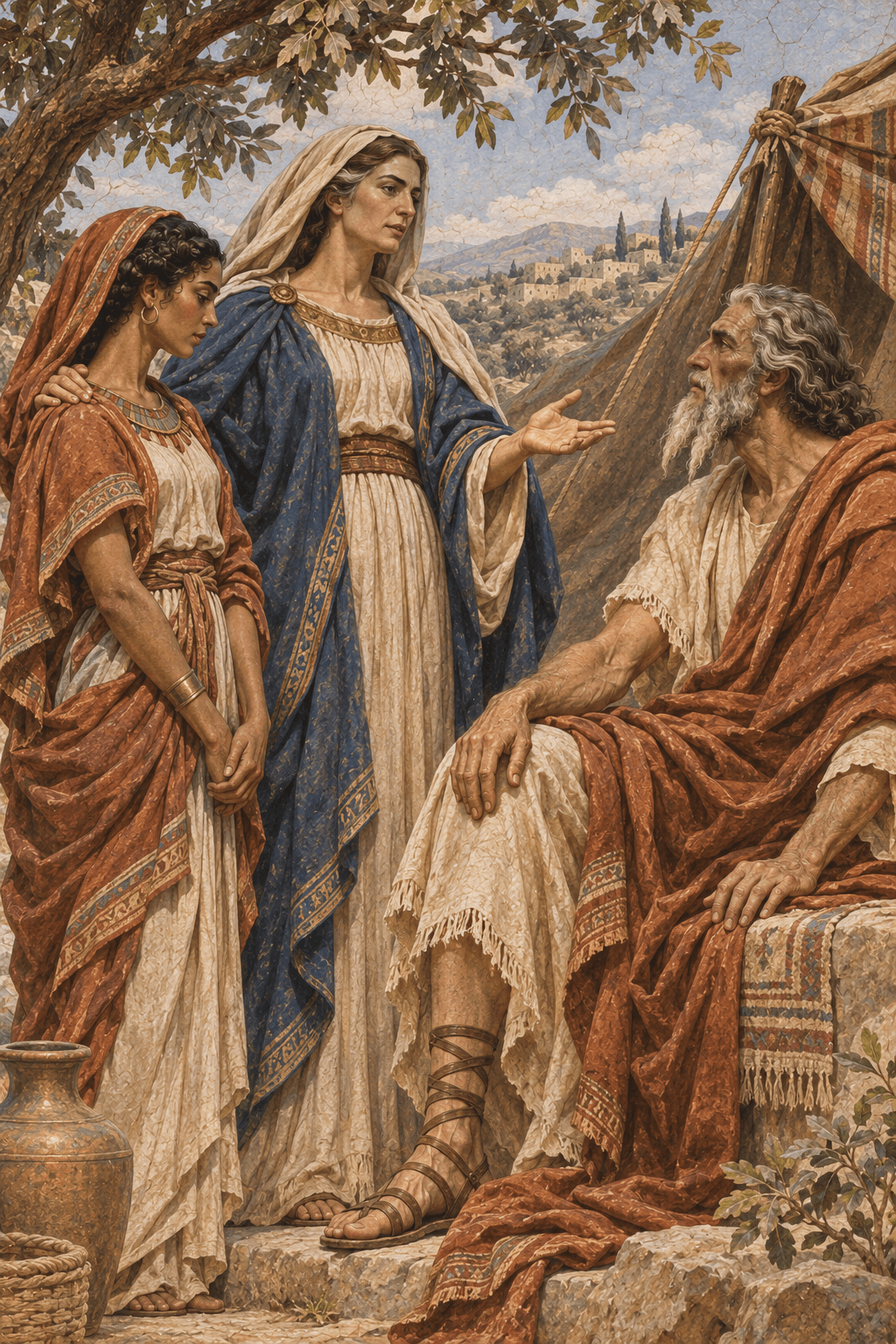
When Sarai had remained ten years with Abram in the land of Canaan without bearing children, being barren, she used purely human reasoning to fulfill God’s promises: she asked her husband to go in to her Egyptian maid Hagar. When Hagar conceived, her mistress was despised in her eyes, and Sarai laid the blame on Abram, who delivered Hagar into her hands; and she afflicted her until she fled. This act represents man’s reliance on himself, planning for himself without returning to God and seeking His counsel.
Saint John Chrysostom sees that Sarai thought the childlessness was due to her husband, so she gave him the maid to test the matter; and when she saw that Hagar had conceived, she was greatly grieved, for she realized that the secret of the barrenness lay in herself…
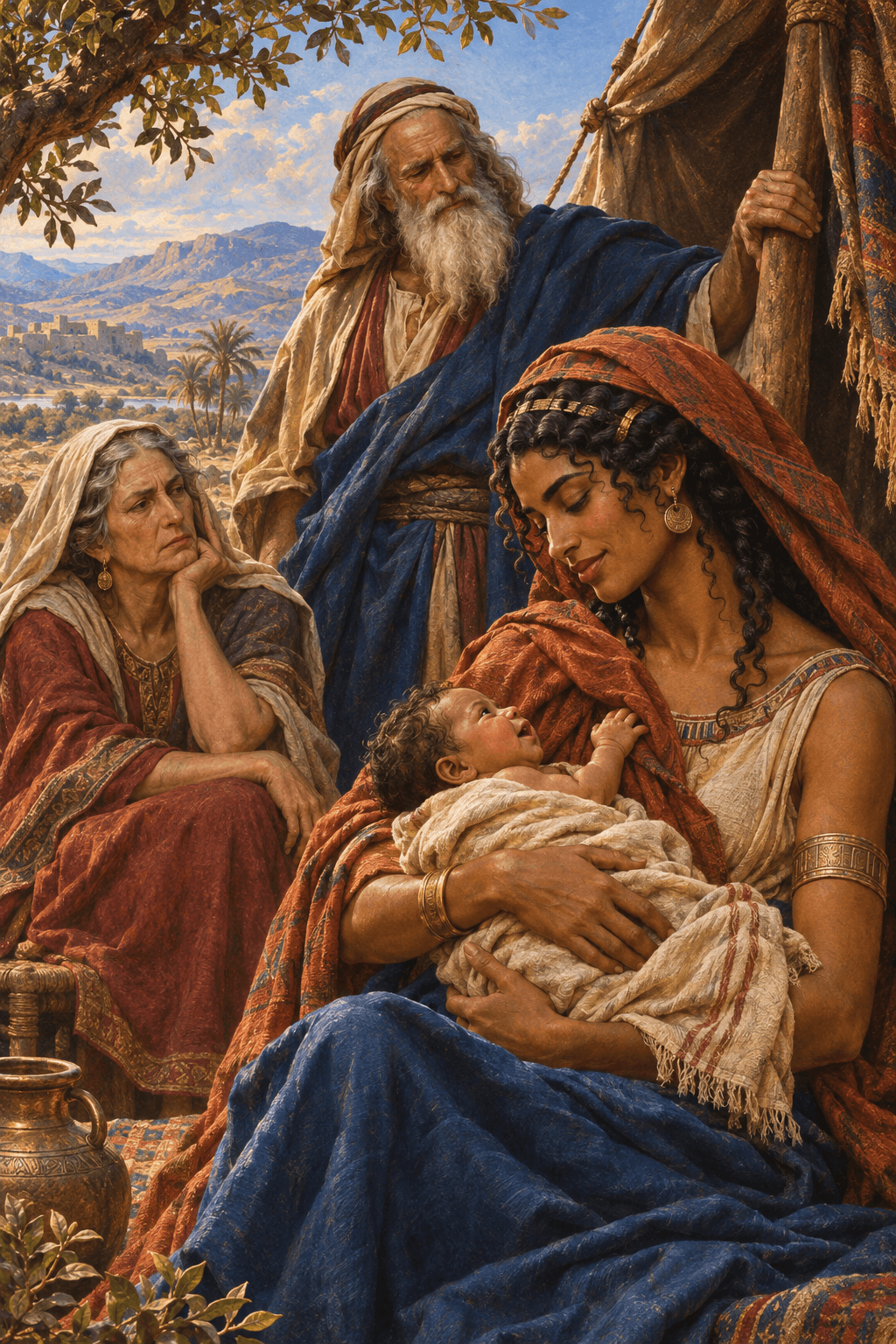
In any case, since Abram and Sarai walked by faith, God used even their weakness for the glory of His name. Sarai came to represent the Church of the Gentiles (the New Covenant), which before was barren, bearing no children to God; and Hagar points to the Jews, who bore slaves by rejecting sonship to God in Christ Jesus… In the fullness of time Sarai bore Isaac, as she brought forth many children to God. Sarai bore her son not according to nature, for she was barren, but according to God’s promise, so he came as a blessed son; whereas Hagar bore according to nature, and he came as a slave. The Apostle Paul declared this idea clearly when he said to the Christians who wanted to return to Jewish thinking (the Judaizing movement): “Tell me, ye that desire to be under the law, do ye not hear the law? For it is written, that Abraham had two sons, the one by a bondmaid, the other by a freewoman. But he who was of the bondwoman was born after the flesh; but he of the freewoman was by promise. Which things are an allegory: for these are the two covenants; the one from the mount Sinai, which gendereth to bondage, which is Agar. For this Agar is mount Sinai in Arabia, and answereth to Jerusalem which now is, and is in bondage with her children. But Jerusalem which is above is free, which is the mother of us all. For it is written, Rejoice, thou barren that bearest not; break forth and cry, thou that travailest not: for the desolate hath many more children than she which hath an husband. Now we, brethren, as Isaac was, are the children of promise. But as then he that was born after the flesh persecuted him that was born after the Spirit, even so it is now. Nevertheless what saith the scripture? Cast out the bondwoman and her son: for the son of the bondwoman shall not be heir with the son of the freewoman. So then, brethren, we are not children of the bondwoman, but of the free” (Galatians 4:21–31).
Sarai, or Sarah, being barren, represents the Gentiles who were unable to present children to God. But she bore Isaac, not as the fruit of the law of nature nor through lawful marriage alone, for in her barrenness she was as one under the sentence of death; rather she bore a son through God’s promise to her with her husband Abraham, and so bore a son in the Lord. As Saint John Chrysostom says:
Isaac was born not according to the law of nature, nor by lawful marriage, nor by the strength of the flesh, and yet he was truly his son. He came from two bodies that were dead, from a dead womb; his conception was not according to the flesh, nor was his birth from seed (alone), for the womb was dead through old age and barrenness, but the word of God (the divine promise) formed him (through the union of Abraham and Sarah as the fruit of the promise, being their son from their seed). It was not so with the son of the bondwoman, for he came as the fruit of the laws of nature and through intercourse. And yet he who was not according to the flesh was more honorable than he who was born according to the flesh. [262]
Among his words also:
The Church was not only barren like Sarah, but also became like her a mother of many children, and she conceived them in the same way as happened with Sarah; for she did not conceive through nature but through the promise of God, who made Sarah a mother.
Who is she that was barren and desolate? It is the Church of the Gentiles, which was deprived of the knowledge of God. And who is she that has a husband? It is the synagogue of the Jews. But the barren one surpassed her in the number of children, for she gathered Greeks and barbarians, on sea and land and in every part of the inhabited world.
As long as we are children of the barren one, we are free. But what kind of freedom is this, if the Jews seize the believers and persecute them? Let us not be troubled by this, for from the beginning the son of the bondwoman persecuted the son of the freewoman. [263]
Saint Clement of Alexandria sees that Hagar represents worldly wisdom and Sarai represents divine wisdom, or the knowledge of God; and that Sarai’s giving Hagar to her husband signifies the knowledge of God handing over worldly wisdom, or culture, as a maid or servant serving man, while we honor the wisdom of God as wife and companion. Sarai drove Hagar out for a time to discipline her until she submitted to her — a sign of the man who rejects the wisdom of the world if it is not in the Lord.
Finally, Saint Augustine offers us a justification of Abraham’s conduct with Hagar, saying:
Abraham was not guilty in regard to the concubine, for he used her not to gratify lust but only for the sake of offspring; not to wrong his wife but in obedience to her, who thought by this conduct to remove her barrenness by using her maid’s fruitful womb in place of her own (barren) nature. By the law the Apostle says: “And likewise also the husband hath not power of his own body, but the wife” (1 Corinthians 7:4). So, as a wife, she used her husband to bear children through another when she herself was unable to do so. Here there is no room for lust or base defilement. The maid was given to the husband by the wife for the sake of conception; neither of them wished to commit sin, but they sought increasing fruit. Therefore, when the pregnant maid despised her barren mistress, and Sarah in her womanly jealousy laid the blame on her husband, Abraham did not show a selfish love, but showed that he sought a child while being free (from lust). So, though he had joined himself to Hagar, it was not at the expense of Sarah his wife, but fulfilling her will… Therefore he said to her: “Behold, thy maid is in thy hand; do to her as it pleaseth thee” (6). [264]
Thus Saint Augustine justifies the conduct of Abraham the patriarch: that he did not seek union with Hagar out of bodily lust but to seek offspring, and at his wife’s request; and he showed the fullness of his love for his wife by leaving the maid in her hands to do with her as she pleased. But we cannot accept such conduct, especially under divine grace. If Abraham and Sarah acted thus for the sake of offspring, awaiting the coming of the Savior from their seed, we now do not seek seed or children according to the flesh. On the other hand, if the husband has no power over his own body but his wife, it is not her right to hand over her husband’s body to another, whatever the motive; for she received her husband from the Lord, just as the husband receives his wife from the Lord, that the two may live as one flesh in the Lord, with no strange body entering between them!
2. Hagar Flees from Sarai
KJV · Verses 6–7
6 But Abram said unto Sarai, Behold, thy maid is in thine hand; do to her as it pleaseth thee. And when Sarai dealt hardly with her, she fled from her face. 7 And the angel of the Lord found her by a fountain of water in the wilderness, by the fountain in the way to Shur.
Saint Augustine [265] sees that “Hagar,” or “stranger,” points to the strange soul that is not a citizen among the people of God, and represents every thought foreign to the faith. Hagar conceived and despised her mistress, so she deserved discipline, until, submitting to her in heart, she might return to her.
How many Hagars there are in our inner life — that is, how many thoughts foreign to the faith that despise their mistress (the thought of faith), or (the knowledge of God)… Let us drive Hagar away from us, that is, every strange thought, and humble it until it is disciplined and returns, submissive to the godly life of faith.
Hagar fled, “And the angel of the LORD found her by a fountain of water in the wilderness, by the fountain in the way to Shur” (7). Perhaps she was heading to Egypt, her original homeland, and went down into the wilderness of Paran, where the angel of the Lord met her at a spring of water — perhaps “the Springs of Moses” near Suez — on the way to Shur, that is, “wall,” a caravan route in the wilderness…
It was not possible for Hagar to return to Sarai and Abram and bear a son unless she met the angel of the Lord at a spring of water on the way to Shur. If the angel of the Lord points to the Lord Christ, He came down to us in our barren wilderness to meet us at the waters of baptism and to be for us a wall (“Shur”), turning us back from heading toward Egypt, that is, the love of the world, to the heavenly Canaan. We were driven out of Canaan, that is, paradise, because of our sins, and we came into bitterness and isolation in the wilderness of this world; but the Lord does not leave us, but brings us back to Him by renewing us in baptism. As Saint Jacob of Serugh says in his homily on baptism:
Baptism is a door that brings us back to paradise; in it man enters to God to be with Him. Baptism is a new ship carrying the dead; by it they rise and cross over to the land of the immortals. Baptism was set in the new world; in it man crosses over from among the dead to the land of life. [266]
3. Hagar Returns to Sarai
KJV · Verses 8–14
8 And he said, Hagar, Sarai's maid, whence camest thou? and whither wilt thou go? And she said, I flee from the face of my mistress Sarai. 9 And the angel of the Lord said unto her, Return to thy mistress, and submit thyself under her hands. 10 And the angel of the Lord said unto her, I will multiply thy seed exceedingly, that it shall not be numbered for multitude. 11 And the angel of the Lord said unto her, Behold, thou art with child and shalt bear a son, and shalt call his name Ishmael; because the Lord hath heard thy affliction. 12 And he will be a wild man; his hand will be against every man, and every man's hand against him; and he shall dwell in the presence of all his brethren. 13 And she called the name of the Lord that spake unto her, Thou God seest me: for she said, Have I also here looked after him that seeth me? 14 Wherefore the well was called Beerlahairoi; behold, it is between Kadesh and Bered.
The angel of the Lord asked Hagar to return to her mistress Sarai; as though she points to worldly wisdom, which, if sanctified, serves the faith by submitting to it. She represents worldly philosophies which, if the believer accepts them in a spirit of godliness and with a mind of faith, become his servant in the Lord and not destroyers of his faith through a spirit of pride and arrogance…
Perhaps Hagar also points to the carnal man: if he despises the spirit (Sarai), he destroys himself; but if he is sanctified in the waters of baptism, accepts the work of the Holy Spirit in him, and returns to Sarai submitting to the spirit, he becomes a servant of the Lord. In this Saint Augustine says:
“Return to thy mistress,” O carnal soul, like an arrogant maid. If you have endured some hardship, it was for discipline; so why do you rebel? Return to your mistress and enjoy the peace of the Church. [267]
The angel of the Lord asked her to submit and obey her mistress (9), who it seems had not wronged her in driving her out; rather Hagar had been harsh in her contempt for her mistress. In return for this submission he promised her many descendants, but that her son would be a wild man who would not cease resisting his brothers, and they too would resist him.
Hagar saw “the angel of the LORD,” and as many interpreters hold, this was one of the appearances of the Son of God. Hagar called Him “Thou God seest me” (“El Roi”), that is, “God of seeing, God who sees,” meaning He is the Lord who appeared to her and saw her affliction. And the well where she stopped she called “Beer-lahai-roi,” which means the well where the living God was seen.
4. The Birth of Ishmael
KJV · Verses 15–16
15 And Hagar bare Abram a son: and Abram called his son's name, which Hagar bare, Ishmael. 16 And Abram was fourscore and six years old, when Hagar bare Ishmael to Abram.
Hagar bore her son and called him “Ishmael,” as the angel of the Lord had said; it means “God hears.” Abram called him by the same name, reckoning that God had heard him and given him a son to inherit from him (Genesis 17:18)… for he did not think that Sarah would bear him a son.
Abram was eighty-six years old when Hagar bore Ishmael, and he was a hundred years old when Isaac was born; so Ishmael was about fourteen years older than Isaac.
Notes and References
[262] Chrysostom, In Gal. hom., on Galatians 4:23.
[263] Church of the Virgin, El-Faggala: commentary on the Epistle to the Galatians, chapter 4.
[264] Augustine, City of God 16:25.
[265] Augustine, On Ps. 83.
[266] Manuscript at the Monastery of St. Anthony, copied A.M. 1488.
[267] Augustine, On the Epistle of St. John, hom. 10:10.