
After the renewal of the earth by the waters of the flood, God populated it with the descendants of Noah; but despite the renewal that had taken place, man returned and held fast to evil, so that it spread in the world.
In this chapter divine revelation presents to us the line of Noah’s descendants, revealing the origin of the ancient nations. As Professor Kautzsch of Halle says: “It is a record without any equal for showing the origin and rise of the nations, and all the past archaeological discoveries have supported it.” [206] In the past some thought there was confusion or error in this line concerning the origin of the peoples, but modern discoveries have come in agreement with what is in this chapter.
This book does not aim to present the rise of the nations, but wanted to give us a preparation for the rise of the old people from whom the Lord Christ would come forth as the Savior of the peoples.
1. The Sons of Japheth
KJV · Verses 1–5
1 Now these are the generations of the sons of Noah, Shem, Ham, and Japheth: and unto them were sons born after the flood. 2 The sons of Japheth; Gomer, and Magog, and Madai, and Javan, and Tubal, and Meshech, and Tiras. 3 And the sons of Gomer; Ashkenaz, and Riphath, and Togarmah. 4 And the sons of Javan; Elishah, and Tarshish, Kittim, and Dodanim. 5 By these were the isles of the Gentiles divided in their lands; every one after his tongue, after their families, in their nations.
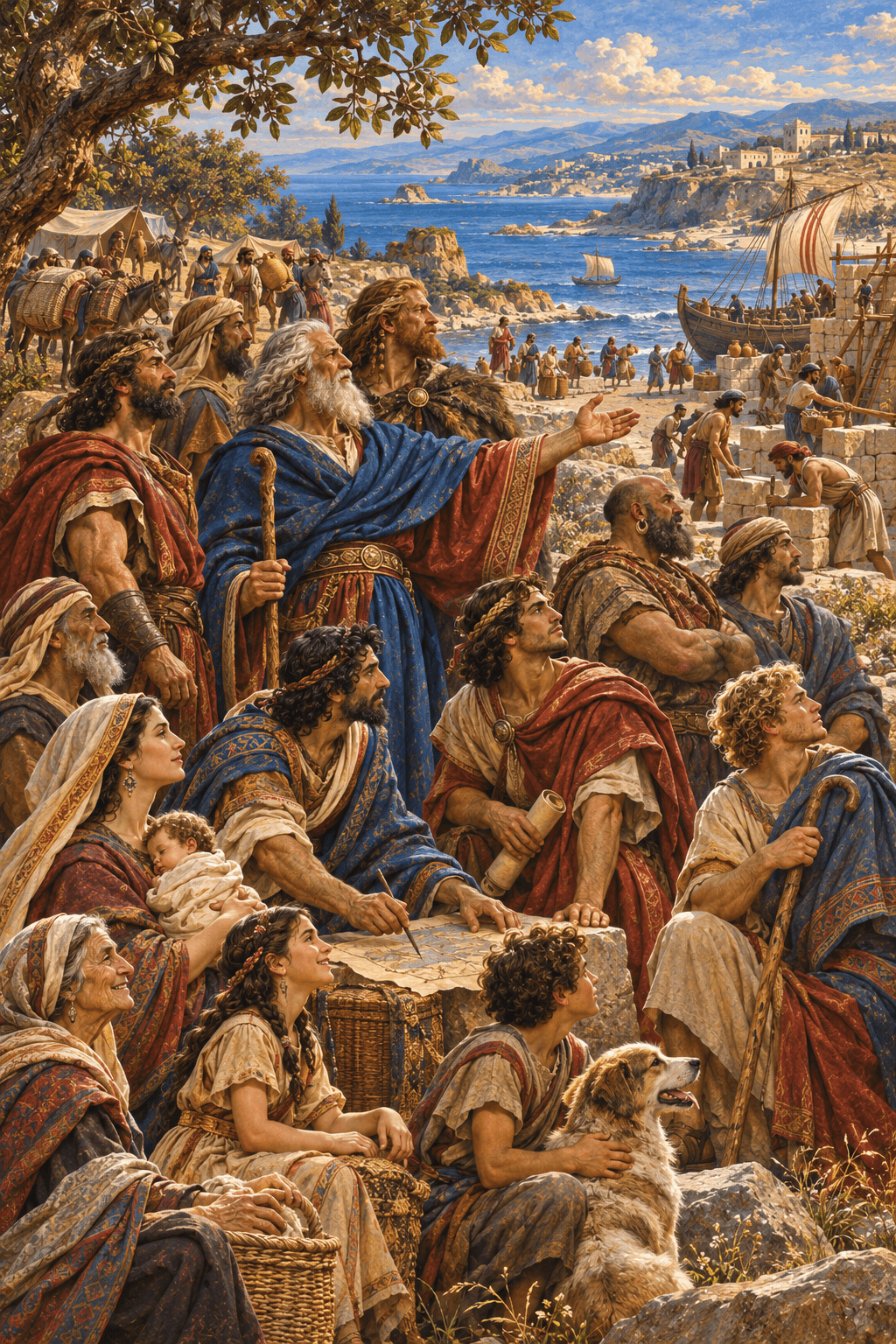
“Japheth” is a Semitic name meaning “may he be spacious, or broad.” [207] He was born after Noah reached about 500 years (Genesis 5:32; 6:10). When his father was uncovered through drunkenness, he acted with his brother Shem with wisdom and dignity, and received a blessing that seems obscure (Genesis 9:27), declaring the movement of the non-Semitic peoples (of the seed of Japheth) to dwell in the tents of Shem. Some see that it points to the movements that happened more than once of some nations and peoples into the bosom of the Lord Christ, or to His Church, He who came incarnate from the seed of Shem and opened the doors of His Church to all peoples and nations. Japheth represents the Indo-European people in general. [208]
Seven sons of Japheth are mentioned here, after whose names several peoples were called, and from his seven sons other peoples branched out, of whom there is no room to speak here. His seven sons are:
First, Gomer: The word “Gomer” in Hebrew means “the end of completion,” especially the completion of failure; [209] the wife of Hosea the prophet bore the same name: “Gomer the daughter of Diblaim.” The descendants of Gomer dwelt in the north, so that Homer the Greek called them “the people of the far north,” [210] and Herodotus mentioned that they came to Asia from the regions beyond the Caucasus, [211] settled in Cappadocia, and threatened the Assyrian empire, but Esarhaddon defeated them. Turning west, they occupied Asia Minor and entered more than one battle with Gyges king of Lydia, which ended with his death; perhaps he is the one called in Holy Scripture by the name Gog. [212] They were later driven out of Asia (Lydia) by Alyattes. [213]
Second, Magog: The word “Magog” is Hebrew, meaning “the land of Gog.” The name Magog was coupled with the name Gog, and the two names became a symbol of resistance to the Christian faith (Revelation 20:7–9). In the Middle Ages the Syrians called the land of the Tatars Magog, and the Arabs named the land between the Caspian Sea and the Black Sea Magog; but the majority counted the Scythians as the people of Magog.
Third, Madai: From his descendants was formed the empire of Media, which united with Persia; their land was known as Madai or Media. They lived south and southwest of the Caspian Sea, in an area of about 150,000 square miles.
Fourth, Javan: He is the father of the Greeks; so the word Javan in Holy Scripture, as in Zechariah 9:13, means the Greek or Macedonian people. Their land was also called “Ionia.”
Fifth, Tubal: He is mentioned with Javan (Isaiah 66:19) and with Meshech in the slave trade (Ezekiel 27:13). Gog was the chief of Meshech and Tubal, for the two peoples were bound together; they appear in the Assyrian histories under the names Mushki and Tabali as stubborn opponents of Assyria in the twelfth century B.C. It is likely that the descendants of Tubal lived in the lands east of Asia Minor.
Sixth, Meshech: It is thought that his descendants dwelt in the lands near the sources of the Euphrates and the Tigris (Psalm 120:5; Ezekiel 32:26), and then moved to the region of the Black Sea and the Caspian Sea. His descendants traded with Tyre (Ezekiel 27:13).
Seventh, Tiras: From his descendants came the Tyrsenian people, who lived on the islands and coasts of the Aegean Sea; perhaps they are the Turusha pirates who invaded Egypt and Syria in the thirteenth century B.C. and are mentioned in the records of Ramesses III. [214]
From these seven sons came descendants who give us other nations and peoples, of whom there is no room to speak now.
2. The Sons of Ham
KJV · Verses 6–20
6 And the sons of Ham; Cush, and Mizraim, and Phut, and Canaan. 7 And the sons of Cush; Seba, and Havilah, and Sabtah, and Raamah, and Sabtechah: and the sons of Raamah; Sheba, and Dedan. 8 And Cush begat Nimrod: he began to be a mighty one in the earth. 9 He was a mighty hunter before the Lord: wherefore it is said, Even as Nimrod the mighty hunter before the Lord. 10 And the beginning of his kingdom was Babel, and Erech, and Accad, and Calneh, in the land of Shinar. 11 Out of that land went forth Asshur, and builded Nineveh, and the city Rehoboth, and Calah, 12 And Resen between Nineveh and Calah: the same is a great city. 13 And Mizraim begat Ludim, and Anamim, and Lehabim, and Naphtuhim, 14 And Pathrusim, and Casluhim, (out of whom came Philistim,) and Caphtorim. 15 And Canaan begat Sidon his first born, and Heth, 16 And the Jebusite, and the Amorite, and the Girgasite, 17 And the Hivite, and the Arkite, and the Sinite, 18 And the Arvadite, and the Zemarite, and the Hamathite: and afterward were the families of the Canaanites spread abroad. 19 And the border of the Canaanites was from Sidon, as thou comest to Gerar, unto Gaza; as thou goest, unto Sodom, and Gomorrah, and Admah, and Zeboim, even unto Lasha. 20 These are the sons of Ham, after their families, after their tongues, in their countries, and in their nations.
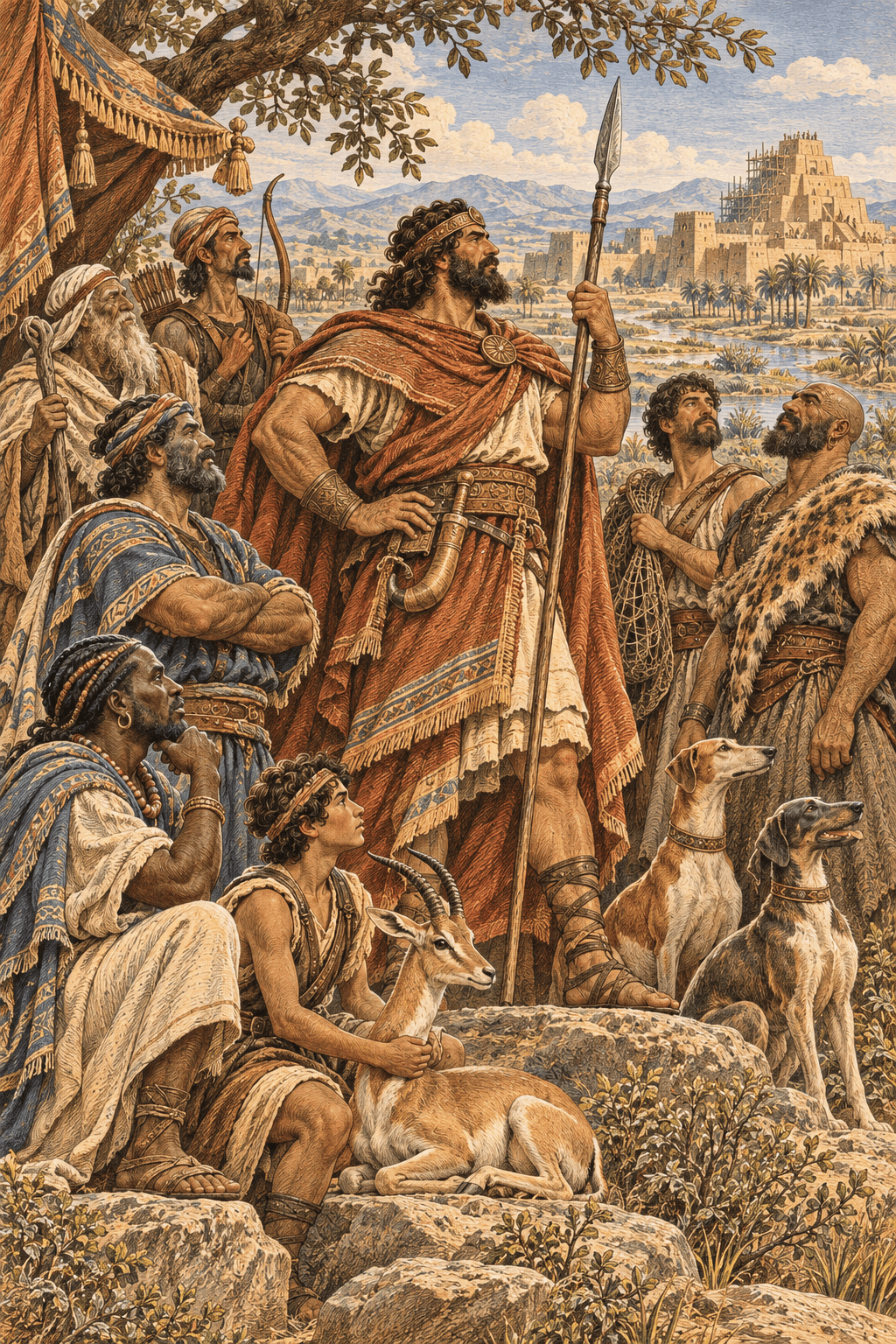
The word “Ham” means “hot” or “warm”; so the sun god was called “Hammu,” because of the heat and warmth of the sun. Ham was born after Noah reached 500 years (Genesis 5:32; 6:10; 9:24–25). He and his younger son Canaan acted unwisely with Noah, so Canaan fell under the curse (Genesis 9:22–27). Through his sons Ham gave us the peoples who inhabited southern Arabia, Nubia, Ethiopia, Egypt, and the land of Canaan; and the name Ham is sometimes used for Egypt in poetic passages (Psalm 78:51; 105:23, 27; 106:22).
First, Cush: The word “Cush” means in Hebrew “black.” Cush, the firstborn of Ham, begot five sons who gave five peoples: Seba (“man”), Havilah (“circle” or “district”), Sabtah (“striker”), Raamah (“trembling”), and Sabtecha (“striker”). [215] These peoples lived in central and southern Arabia, but Seba moved to Africa (Ethiopia); so Cush in the Old Testament usually means Ethiopia and Nubia (south of Egypt), and sometimes southern and central Arabia… In many Bible dictionaries Cush is counted as Ethiopia only.
The descendants of Ham in general gave peoples and nations that resisted the work of God and His people in the Old Testament; so the Old Testament declared divine punishment on these peoples as bearing symbols of evil: Cush pointed to the darkness of ignorance, Egypt to the love of the world that enslaves the soul, Canaan to satanic work, and so on… But the prophecies of the Old Testament did not leave these peoples without hope; they declared the rejection of the faith by God’s people and the entry of these nations into the divine covenant. So the nations that were under the curse because of their paganism and abominations became the holy bride preparing for eternal life in the bosom of the heavenly Father.
If Holy Scripture revealed God’s work through the seed of Shem, from whom the Word of God would come incarnate of the seed of Abraham… it also reveals the work of the enemy of good, especially through the seed of Cush, which gave Nimrod, and the seed of Canaan, which gave the Canaanite peoples resisting the work of God. As for Nimrod, “he began to be a mighty one in the earth. He was a mighty hunter before the Lord” (8–9). He was a mighty hunter who founded the ruling dynasty in Babel, Shinar, and Accad; perhaps he was the same as the Akkadian or Babylonian Gilgamesh. In any case, Babel later became a symbol of opposition to God and of pride, as well as of spiritual adultery (Revelation 14:8; 16:19; 17:1–5). Babel came to point to the company of the wicked, as Saint Augustine says, [216] as well as to the kingdom of the Antichrist. [217]
The word “Nimrod” means “mighty” or “rebel.” As for the saying, “a mighty hunter before the Lord,” perhaps it means that he was stubborn and rebellious, proud of himself in his ability to hunt and in his resistance to the Lord. Wonderfully, many of those who resisted the Lord were hunters of wild beasts, such as Esau. For this reason Saint Jerome says:
Esau too was a hunter, and he was a sinner. In all Holy Scripture we do not find a hunter who was a faithful servant; but we find fishermen faithful. [218]
The kingdom of Nimrod was in the land of Shinar, which means “two rivers,” perhaps because it lies between the Tigris and the Euphrates, the plains of Babylonia. This kingdom contained four principal cities at that time: Babel, meaning “the gate of God” (Bab-ilu); Erech, meaning “lasting”; Accad, meaning “upright”; and Calneh, meaning “fortress.”
Nimrod, or his tribe afterward, was not content with this region, but went out into Assyria, to Nineveh (the dwelling of the god Nin), Rehoboth-Ir (the broad city), Calah (old age), and Resen (head of a spring).
Second, Mizraim: The word “Mizraim” in Hebrew is a dual, so some thought it was so called because of Lower and Upper Egypt, or because the Nile divides it into an east bank and a west bank; but the more likely opinion is that it was called “Misr” in Arabic, from the Hebrew, after Mizraim, since he and his sons dwelt in it, though his descendants extended to the neighboring lands. His sons are:
- Ludim: from him came the people of Lud, or the Ludim, who are not the people of Lud of the seed of Shem (22). These, of the seed of Mizraim, lived west of the Nile toward Libya.
- Anamim: it seems that the tribe that came from him lived in Libya.
- Lehabim: it seems that the tribe of Lehabim is the same as the tribe of Lubim, or “the Libyans,” who are Africans who originated in Egypt.
- Naphtuhim: his descendants were inhabitants of Middle Egypt, near Memphis, the center of the god Ptah; perhaps some of them migrated to Ethiopia.
- Pathrusim: they lived in Pathros in Upper Egypt. The word “Pathros” means “the land of the south.”
- Casluhim: meaning “fortified”; his descendants probably lived in “Casiotis,” a mountainous region east of Pelusium, on the border of Egypt toward Palestine. From Casluhim came Philistim, whose descendants migrated to Palestine, where the ancient Philistine people arose; perhaps the word Palestine derives from “Philistim,” meaning “stranger” or “emigrant.” From Casluhim also came Caphtorim, meaning “crowns”; his descendants lived in Caphtor, which some think was in Cappadocia in Asia Minor, others Cyprus or the island of Crete, and others in the Egyptian Delta near Memphis, where there was a city called “Kaft-hor,” most likely “Caphtor.”
Third, Canaan: the youngest son of Ham; from his descendants appeared the Canaanite tribes. We have spoken briefly of some of these tribes in the introduction to the Book of Joshua. [219]
3. The Sons of Shem
KJV · Verses 21–32
21 Unto Shem also, the father of all the children of Eber, the brother of Japheth the elder, even to him were children born. 22 The children of Shem; Elam, and Asshur, and Arphaxad, and Lud, and Aram. 23 And the children of Aram; Uz, and Hul, and Gether, and Mash. 24 And Arphaxad begat Salah; and Salah begat Eber. 25 And unto Eber were born two sons: the name of one was Peleg; for in his days was the earth divided; and his brother's name was Joktan. 26 And Joktan begat Almodad, and Sheleph, and Hazarmaveth, and Jerah, 27 And Hadoram, and Uzal, and Diklah, 28 And Obal, and Abimael, and Sheba, 29 And Ophir, and Havilah, and Jobab: all these were the sons of Joktan. 30 And their dwelling was from Mesha, as thou goest unto Sephar a mount of the east. 31 These are the sons of Shem, after their families, after their tongues, in their lands, after their nations. 32 These are the families of the sons of Noah, after their generations, in their nations: and by these were the nations divided in the earth after the flood.
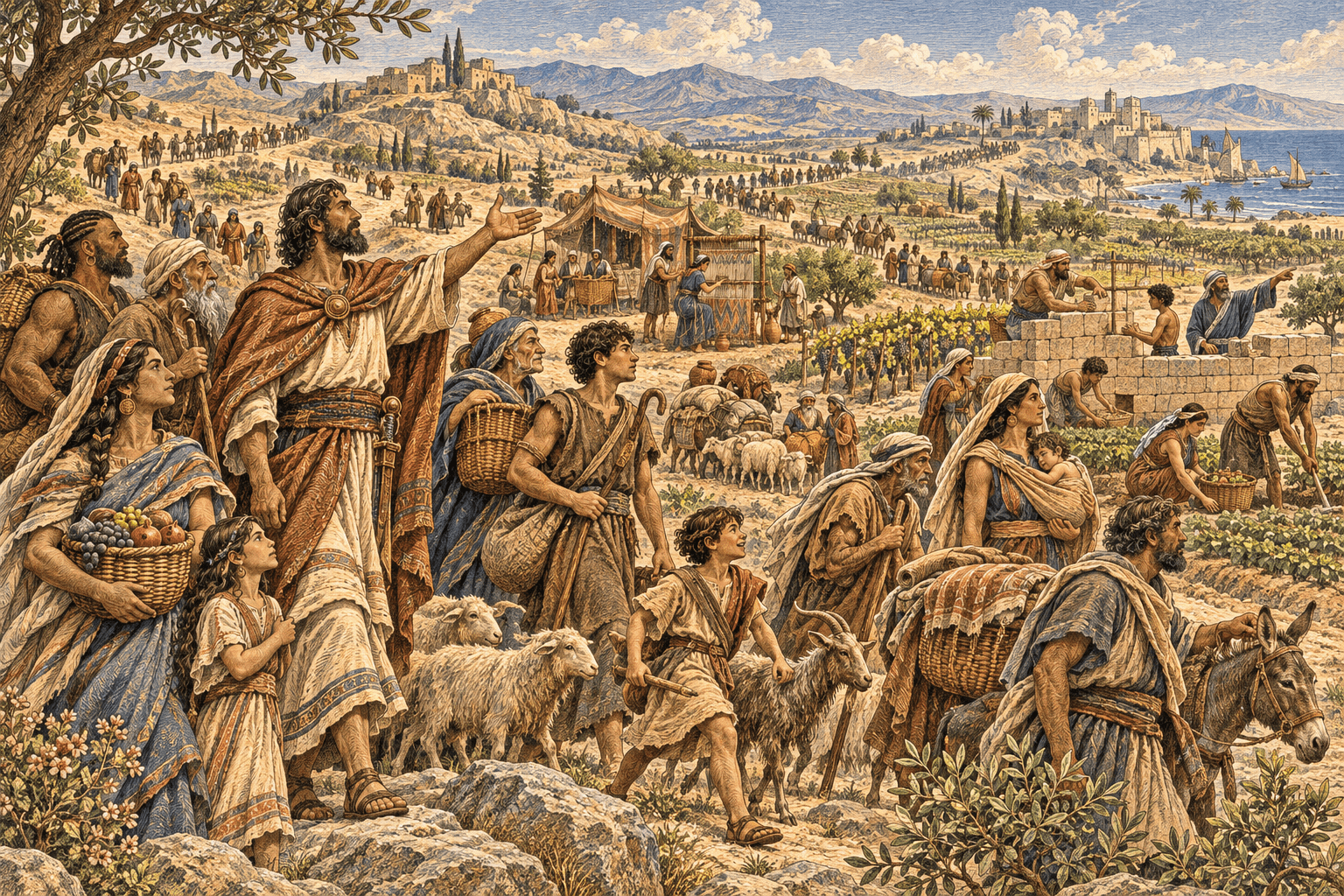
“Shem” is a Hebrew name meaning “high” (or “name”). Since Shem acted wisely with Japheth when their father Noah was drunk and uncovered, Shem received a blessing from his father’s mouth. His five sons dwelt in the land stretching from Elam in western Asia to the east of the Mediterranean. From his descendants came the Jews, the Arameans, the Assyrians, and the Arabs; so the languages spoken by the descendants of Shem are called Semitic languages, such as Arabic and Hebrew. The five sons of Shem are:
- Elam: the word “Elam” in Akkadian means “highlands.” To him the Elamites and Persians are attributed. The land of Elam extends beyond the Tigris, east of the kingdom of Babylon, south of Assyria and Media, north of the Persian Gulf, and southwest of the kingdom of Persia. The capital of the kingdom was Shushan, so the Elamites were called Shushanites. Elam was the center of an ancient empire with an effective political role in the history of the ancient Eastern empires. Though Elam contributed to the fall of Babylon (Isaiah 21:2), the Medes annexed it to their empire (Persia and Media) and made it a province subject to them, and they made Shushan their capital (Daniel 8:2). We hear of some Elamites on the day of Pentecost (Acts 2:9); it is now part of Iran, called the province of Khuzestan.
- Asshur: he is the father of the Assyrians. The land of Assyria lies on the upper part of the Tigris… The capital of the kingdom was Asshur, today called “Qal‘at Sherqat,” on the west bank of the Tigris; afterward they took Nineveh as their capital… Assyria was in continual conflict with the Babylonians in the south and against the Hittites in the northwest. Israel, as well as Judah, was subject to Assyria, its kings paying tribute. Israel fell into the captivity of Assyria, as Amos (Amos 5:27; 6:14) and Hosea (Hosea 10:6; 11:5) prophesied. God fought for Hezekiah king of Judah when Sennacherib king of Assyria attacked him (Isaiah 36–37). Finally the Medes and Babylonians fought them and triumphed over them with the rise of the kingdom of Babylon.
- Arphaxad: the ancestor of the Joktanite Arab tribes; and Josephus holds that he was the ancestor of the Chaldeans too. The homeland of the Chaldeans is the southern region of Mesopotamia.
- Lud: the ancestor of the Lydians, not the people of Lud, or the Ludim, of the seed of Mizraim. The latter lived west of the Nile in North Africa, while those of the seed of Shem probably lived in the region of Lydia in western Asia Minor.
- Aram: meaning “the highland”; the Aramaic language is the ancient Syriac language. Aram was a group of small states or provinces, among them Aram of the two rivers (Genesis 24:10), Aram of Damascus, Aram of Zobah (1 Samuel 14:47), Aram of Maachah (Joshua 12:5), Aram of Beth-rehob (Joshua 19:28), and so on…
Moses took care to mention the sons of Arphaxad, for he begot Salah, and Salah begot Eber, and Eber begot Peleg, and Peleg Reu, and Reu Serug, and Serug Nahor, and Nahor Terah, who begot Abram, who married Sarai. So the first setting out of the people began with the appearance of Abram (Abraham), the father of the fathers. Moses the prophet also made clear Lot’s kinship to Abram, as his nephew, the son of Haran son of Terah.
Saint Augustine interprets the statement, “the name of one was Peleg; for in his days was the earth divided” (25), to mean that this division points to the multiplicity of languages: in the days of Peleg more than one language began to appear on the earth, after all had spoken what was later called Hebrew. [220]
Notes and References
[206] Archdeacon Naguib Guirguis, The Book of Genesis, 1973, p. 161.
[207] New Westminster Dictionary of the Bible, p. 446; McKenzie, Dictionary of the Bible, p. 413.
[208] New Westminster Dictionary of the Bible, p. 446.
[209] Fr. Tadros Yacoub Malaty, Hosea, p. 20.
[210] Homer, Odyssey 11:14.
[211] Herodotus, Histories 4:11–12.
[212] See Fr. Tadros Yacoub Malaty, Ezekiel, 1981, pp. 260–261.
[213] Herodotus, Histories 1:16.
[214] New Westminster Dictionary of the Bible, p. 951.
[215] Archdeacon Naguib Guirguis, The Book of Genesis, 1973, pp. 166–167.
[216] Saint Augustine, On the Psalms 26.
[217] See Fr. Tadros Yacoub Malaty, The Revelation of John the Theologian, 1979, pp. 163–164.
[218] Saint Jerome, Homilies on the Psalms 20.
[219] Fr. Tadros Yacoub Malaty, Joshua, 1982, pp. 23–30.
[220] Saint Augustine, The City of God 16:10–11.