
God’s Dealings with Jacob (Genesis 25–50)
God was manifested in the life of Abraham and Sarah; their son Isaac received the Lord’s blessing upon them and enjoyed their hope in salvation, and the Lord Himself came to confirm to him His promises with his father… Now Jacob receives the blessing of his parents Isaac and Rebekah — or rather the Lord’s blessing that rested upon them — to live bearing their faith and enjoying their hope in Him, striving all the days of his sojourning for the Lord’s sake.
1. Jacob the wrestler in his mother’s womb (Genesis 25).
2. Jacob takes his father’s blessing (Genesis 27).
3. Jacob enjoys the open heaven (Genesis 28).
4. Jacob labors for his uncle (Genesis 29–30).
5. God supports him against his uncle (Genesis 31).
6. Jacob wrestles with the angel (Genesis 32).
7. Jacob overcomes Esau by love (Genesis 33).
8. Shechem’s assault on Dinah, Jacob’s daughter (Genesis 34).
9. Jacob journeys to Bethel (Genesis 35).
10. Jacob and his beloved son Joseph (Genesis 37–50).
Jacob and the Open Heaven
When Isaac had blessed his son Jacob, he charged him — at Rebekah’s request — to set out to his uncle Laban to take a wife of his daughters, one who could support him in the way of his faith, and not to bind himself, as his brother had, to the pagan daughters of Heth… On the way the heavens opened, and Jacob saw a ladder whose top reached to heaven, with the angels of God ascending and descending on it, and the Lord standing above it… When he awoke from his sleep he anointed the stone he had leaned on, to be a pillar in the house of God.
1. Isaac’s Charge to Jacob
KJV · Verses 1–5
1 And Isaac called Jacob, and blessed him, and charged him, and said unto him, Thou shalt not take a wife of the daughters of Canaan. 2 Arise, go to Padanaram, to the house of Bethuel thy mother's father; and take thee a wife from thence of the daughers of Laban thy mother's brother. 3 And God Almighty bless thee, and make thee fruitful, and multiply thee, that thou mayest be a multitude of people; 4 And give thee the blessing of Abraham, to thee, and to thy seed with thee; that thou mayest inherit the land wherein thou art a stranger, which God gave unto Abraham. 5 And Isaac sent away Jacob: and he went to Padanaram unto Laban, son of Bethuel the Syrian, the brother of Rebekah, Jacob's and Esau's mother.
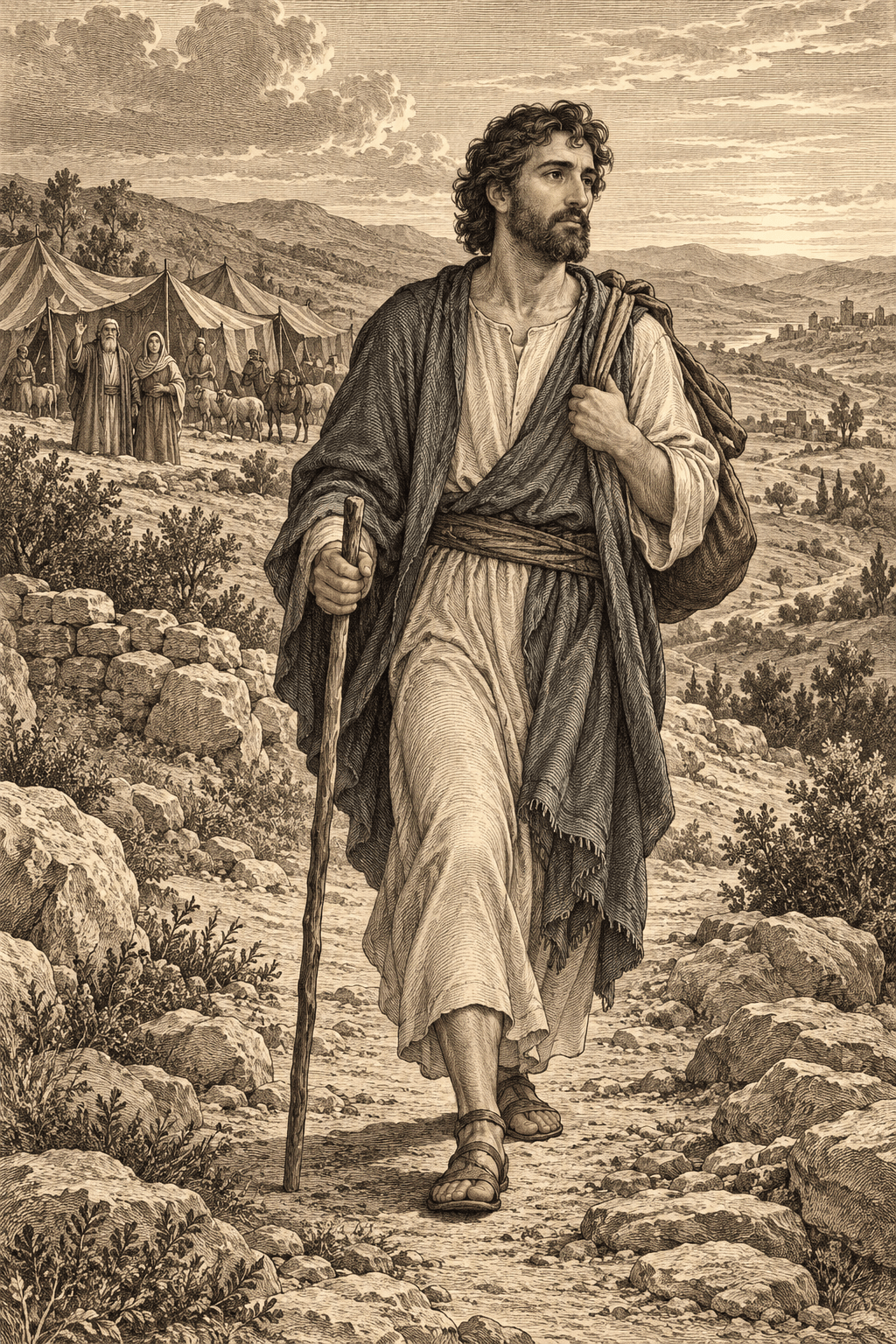
Though Rebekah had asked Jacob to flee from the face of his brother Esau until his anger subsided, she and her husband Isaac were certain that Jacob was the heir of the blessing and that in him the promises would be fulfilled. Therefore in her conversation with him she was sure of his return to the land of Canaan (Genesis 27:44–45) to inherit the land of promise… which Isaac also made clear by saying to him: “And give thee the blessing of Abraham, to thee, and to thy seed with thee; that thou mayest inherit the land wherein thou art a stranger, which God gave unto Abraham” (4). Isaac could indeed have sent a servant to bring a wife for Jacob, as Abraham did at Isaac’s marriage; but because of Esau’s grudge Isaac and Rebekah preferred that their son set out to his uncle and stay with him “a few days.” These few days stretched to about twenty years… during which Rebekah died without seeing her son Jacob.
Isaac blessed his son Jacob before his departure to Laban his uncle, whom Scripture describes thus: “the brother of Rebekah, Jacob’s and Esau’s mother” (5). Here Rebekah is called the mother of Jacob first, for he was counted the firstborn who enjoyed the blessing of Abraham.
2. Esau Marries the Daughter of Ishmael
KJV · Verses 6–9
6 When Esau saw that Isaac had blessed Jacob, and sent him away to Padanaram, to take him a wife from thence; and that as he blessed him he gave him a charge, saying, Thou shalt not take a wife of the daughers of Canaan; 7 And that Jacob obeyed his father and his mother, and was gone to Padanaram; 8 And Esau seeing that the daughters of Canaan pleased not Isaac his father; 9 Then went Esau unto Ishmael, and took unto the wives which he had Mahalath the daughter of Ishmael Abraham's son, the sister of Nebajoth, to be his wife.
Esau saw that his brother had received the birthright and then the blessing, confirmed by his being sent to Padan-aram to marry from his uncle’s daughters. He also felt that his marriage to the pagan daughters of Heth had deprived him of much; so he resolved to marry from the seed of Abraham to please his parents, and took to himself a third wife, Mahalath the daughter of Ishmael, Abraham’s son, the sister of Nebajoth.
3. The Heavenly Ladder
KJV · Verses 10–15
10 And Jacob went out from Beersheba, and went toward Haran. 11 And he lighted upon a certain place, and tarried there all night, because the sun was set; and he took of the stones of that place, and put them for his pillows, and lay down in that place to sleep. 12 And he dreamed, and behold a ladder set up on the earth, and the top of it reached to heaven: and behold the angels of God ascending and descending on it. 13 And, behold, the Lord stood above it, and said, I am the Lord God of Abraham thy father, and the God of Isaac: the land whereon thou liest, to thee will I give it, and to thy seed; 14 And thy seed shall be as the dust of the earth, and thou shalt spread abroad to the west, and to the east, and to the north, and to the south: and in thee and in thy seed shall all the families of the earth be blessed. 15 And, behold, I am with thee, and will keep thee in all places whither thou goest, and will bring thee again into this land; for I will not leave thee, until I have done that which I have spoken to thee of.
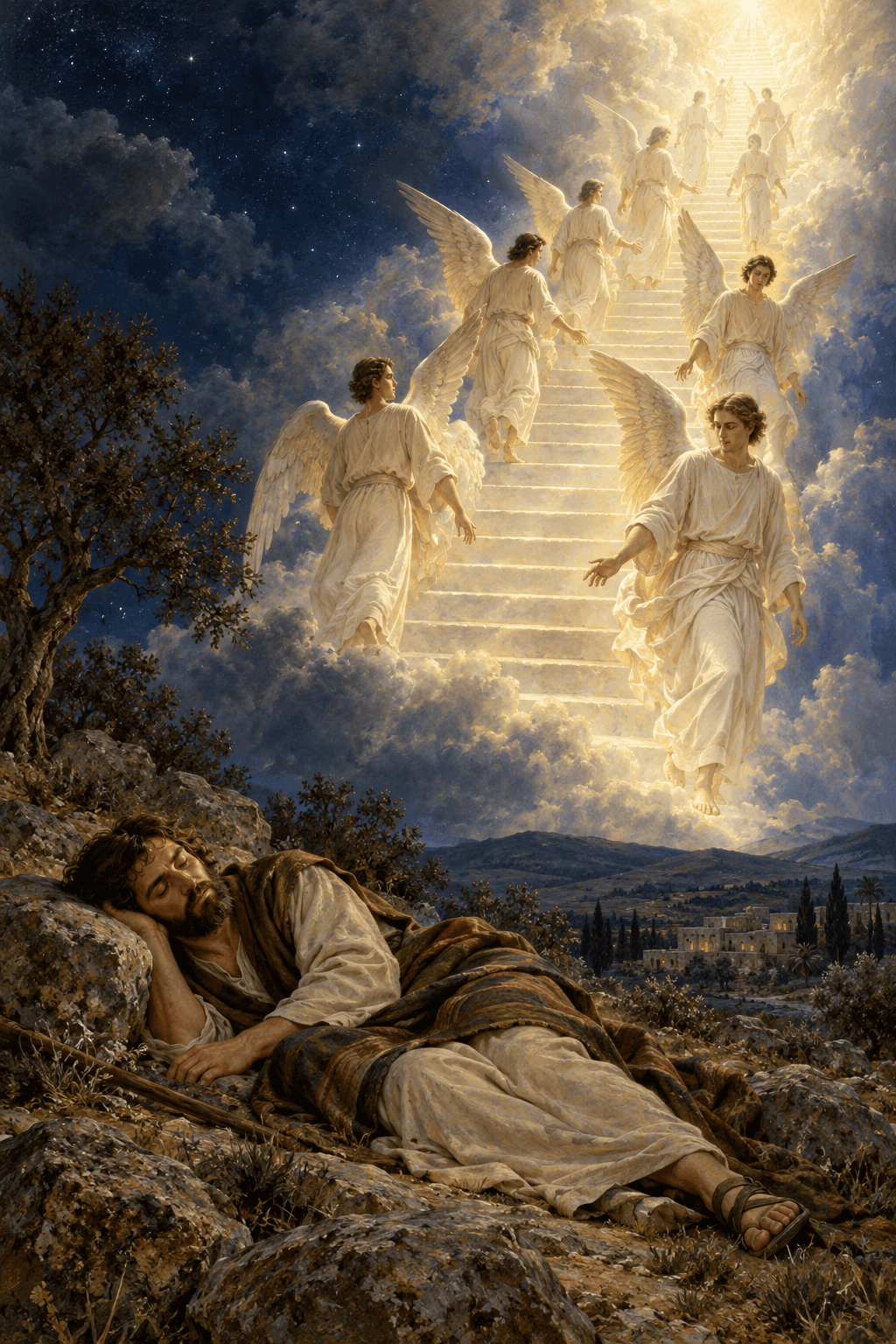
Now Jacob set out fleeing from the face of his brother Esau, deprived of the affection and care of his parents. He was on the road at sunset, alone, exposed to many dangers… In the midst of this distress Jacob put his head on a stone and lay down in that place, to see the heavens open and a heavenly ladder set up on the earth, whose top touched heaven — something he could not have seen when he was pampered in the tent, with his mother caring for him and placing soft pillows under his head! In the midst of distress and deprivation God manifests Himself to fill every need and give abundantly, above all that we ask or think. As Saint Jerome says:
The stone under his head is Christ. He had no stone under his head before, but he had one at the time he fled from his persecutor. When he was in his father’s house, at rest according to the flesh, he did not enjoy a stone under his head. He left his home as a poor man and became as one alone, having nothing but a staff, and that very night he found a stone to place under his head. Having a pillow of this kind, his head found rest through the vision he beheld. [370]
If the stone is the Lord Christ, we do not enjoy Him in our lives — supporting our head with heavenly visions and surpassing divine knowledge — as long as we live pampered, seeking to lean on others…
Father Caesarius of Arles sees that Jacob points to the Lord Christ, [371] and that his father Isaac, who asked him to leave the daughters of the region, points to the Father, who asked Him to leave the Jewish synagogue and go to a distant place where He would acquire the Church of the Gentiles as His bride. This was fulfilled when the two apostles said to the Jews: “It was necessary that the word of God should first have been spoken to you: but seeing ye put it from you, and judge yourselves unworthy of everlasting life, lo, we turn to the Gentiles” (Acts 13:46).
Caesarius also sees in the stone a symbol of the Lord Christ, on whom the Church stands, and whom the Father anointed for the work of salvation. While the Lord Christ appeared on the ladder at the top of heaven as the Heavenly One, behold He is under Jacob’s head as the cornerstone on which the Church is founded by His Incarnation. Saint Augustine speaks of this stone, saying:
In this stone we understand Christ… He placed it at his head, since Christ is the head of the man (1 Corinthians 11:3). And the stone was anointed, because “Christ” is so called because He is “anointed.” [372]
As for the ladder Jacob saw, it is the cross of our Lord Jesus Christ, through which by faith we rise to enjoy heaven itself, while through denying it the Jews went down to the abyss. As Saint Jerome says:
I think the cross of the Savior is the ladder that Jacob saw. On this ladder angels were descending and ascending. On this ladder, that is, on the cross, the Jews were descending and the Gentiles ascending. [373]
He also says:
He saw angels ascending, for he saw Paul ascending; and he saw angels descending, for he saw Judas the traitor falling utterly. He saw angels ascending, for he saw saints rising from earth to heaven; and he saw angels descending, that is, Satan and all his host falling from heaven. [374]
When we see the ladder we do not find the ascent through it hard, for the Lord stands above it, supporting us and lifting us up to Him. As Saint Jerome says:
Do not look at the steps, but look up to where the Lord is. [375]
Saint Jerome encourages us to continue ascending without stopping, saying:
If one of us is standing on the first step, let him not despair of reaching the second; and whoever is on the second, let him not lose hope of reaching the third. Blessed are the martyrs, for many of them were made worthy to ascend to the final steps, to the very summit. We who live in the world cannot climb all the steps at once from bottom to top; but let us not be content to stand on the first step — we ought to strive, climbing higher steps. [376]
He also says:
The lesson we learn from the ladder is that the sinner ought not to despair of salvation, nor the righteous rest secure in his virtue. [377]
Father Caesarius of Arles explains the timing of this vision on the road, saying:
Why did this happen on the road before Jacob acquired his wife? Because our Lord — the true Jacob — first bowed upon the ladder, that is, the cross, and after that formed the Church for Himself, at the time when He offered her His blood as the dowry for His kingdom! [378]
4. Jacob and the House of God
KJV · Verses 16–22
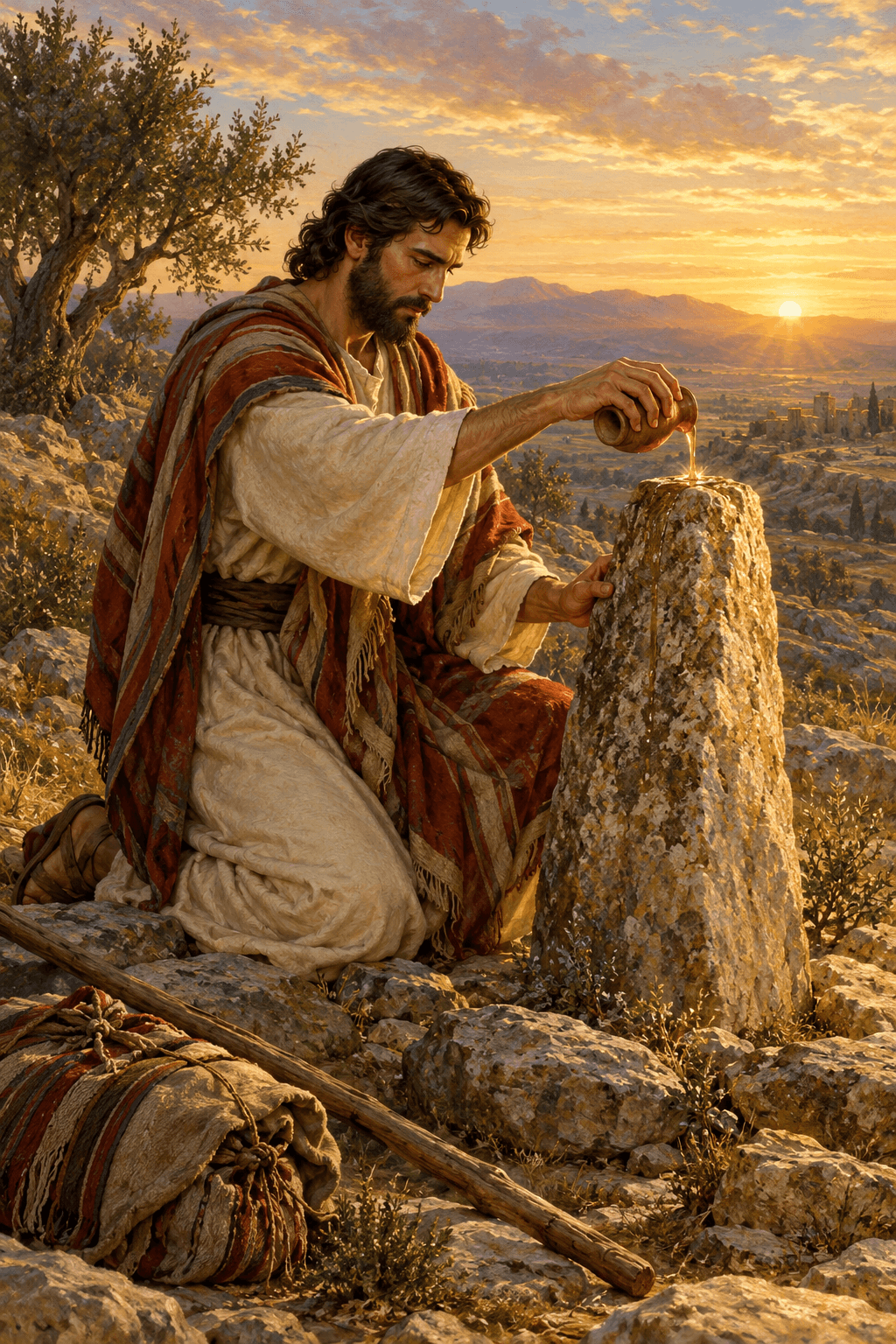
16 And Jacob awaked out of his sleep, and he said, Surely the Lord is in this place; and I knew it not. 17 And he was afraid, and said, How dreadful is this place! this is none other but the house of God, and this is the gate of heaven. 18 And Jacob rose up early in the morning, and took the stone that he had put for his pillows, and set it up for a pillar, and poured oil upon the top of it. 19 And he called the name of that place Bethel: but the name of that city was called Luz at the first. 20 And Jacob vowed a vow, saying, If God will be with me, and will keep me in this way that I go, and will give me bread to eat, and raiment to put on, 21 So that I come again to my father's house in peace; then shall the Lord be my God: 22 And this stone, which I have set for a pillar, shall be God's house: and of all that thou shalt give me I will surely give the tenth unto thee.
In our study of the Church as the house of God we spoke of Bethel [379] as the first house of God that man established after enjoying the open heaven and seeing the ladder set up on the earth, its top touching heaven, with the angels ascending and descending on it, and hearing the Lord standing above it say to him: “Behold, I am with thee.” Jacob rose early and said: “Surely the LORD is in this place…! How dreadful is this place…! this is none other but the house of God, and this is the gate of heaven!” Then he took the stone and set it up for a pillar, poured oil upon it, and called the place “Bethel,” that is, “house of God.”
God wished to present to the holy community, through their father Jacob, two truths of faith: His being with them, and the opening of heaven to those on earth. As for His being with His people, we find the Lord’s assurance, “Behold, I am with thee,” at the time when Jacob found no one who could support him… And as for the opening of heaven to those on earth, reconciliation was accomplished through the true ladder, and the Church became the house of God and the dwelling of His angels. As Saint John Chrysostom says:
God sends the angels to men; then He leads men to heavenly things. Behold, heaven is set up on earth, so that heaven is bound to receive those on earth. [380]
We have already spoken of the Church (Bethel) and its bond with the holy community and with heaven. [381]
Notes and References
[370] Jerome, On Ps. hom. 46.
[371] Caesarius of Arles, Serm. 83:2.
[372] Augustine, On Ps. 45.
[373] Jerome, On Ps. hom. 21.
[374] Ibid. 41.
[375] Ibid.
[376] Ibid.
[377] Jerome, Ep. 132:5.
[378] Caesarius of Arles, Serm. 87:3.
[379] See the author’s The Church, House of God, pp. 20–22.
[380] Sunday Sermons of the Great Fathers, vol. 1, p. 113.
[381] See the author’s The Church, House of God (Arabic, 1982), part two.