
Divine revelation links the lighting of the golden candlestick with the ordination, or cleansing, of the Levites, as though it wanted to declare that His ministers are a heavenly candlestick shining in the world.
1. The Lighting of the Golden Candlestick
KJV · Verses 1–4
1 And the Lord spake unto Moses, saying, 2 Speak unto Aaron and say unto him, When thou lightest the lamps, the seven lamps shall give light over against the candlestick. 3 And Aaron did so; he lighted the lamps thereof over against the candlestick, as the Lord commanded Moses. 4 And this work of the candlestick was of beaten gold, unto the shaft thereof, unto the flowers thereof, was beaten work: according unto the pattern which the Lord had shewed Moses, so he made the candlestick.
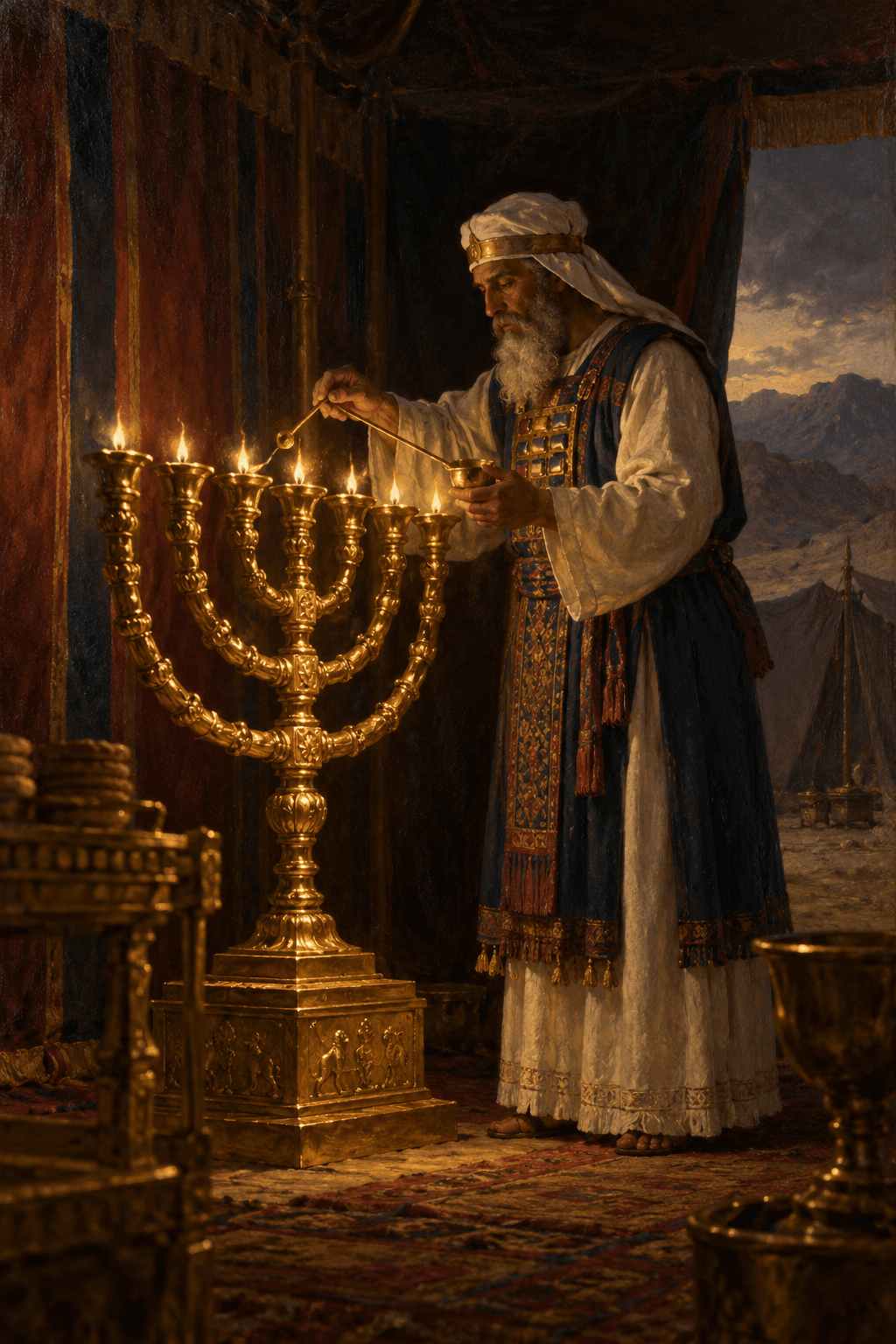
For the first time Aaron the high priest himself lifted up the lamps and lit them, as the Lord commanded. This rite came immediately before the ordination of the Levites, to affirm the true nature of their work: it is not merely carrying the tabernacle and helping the priests in outward tasks, but being enlightened by Christ the Lord, the great High Priest, so that they may shine among their brethren (Matthew 5:15).
The candlestick with its seven lamps points to the perfect work of the Holy Spirit in the life of the Church (Revelation 4:5), especially through the seven sacraments. It is as though God’s ministers, when Christ the Lord enlightens them by His fiery Holy Spirit, become a heavenly lamp filled with the oil of grace, burning continually night and day, consuming evil and enlightening souls.
In this candlestick the work of Holy Scripture is bound up with the crucified Christ and with the Holy Spirit in the ministers. It is said that the custom among the Jews was for the priest to light the lamp in the middle from the fire of the altar, and from this lamp the other lamps were lit. These lamps (their wicks) were made from the old garments of the priests. If the golden candlestick points to Holy Scripture, the shining lamp for souls, then the true minister hides himself in Holy Scripture, or the divine commandment: he does not shine himself; rather, the word of God lights the way in the life of the minister as in the life of those he serves. The priest lights the lamp in the middle from the fire of the altar; as though this enlightenment in the life of those served is accomplished by Christ Jesus, the great High Priest, who kindles our inner hearts with the fire of His Holy Spirit through the fire of the cross, or the altar, for the Spirit “shall receive of mine, and shall shew it unto you” (John 16:14). He carries in our midst the fire of the cross, which burns up evil and gives unceasing enlightenment; and so the surrounding lamps are lit from this lamp that is in the middle.
The fire burning in our heart, as in the lamp in the middle, is the fire of the Holy Spirit, which declares the glory of Christ and His work as the centre of Holy Scripture in both its Testaments, and so He grants us the divine mysteries in Christ Jesus.
Finally, the wicks of the lamps were made from the old garments of the priests. If garments point to the body, these lamps represent the labours which the priests and ministers live through until their bodies are torn and worn out… Yet in themselves they are worth nothing, like an old, worthless garment. But when the priest kindles them with the fire of the Spirit, sent forth to us through the sacrifice, these worn-out garments become the secret of enlightenment for many.
2. The Ordination of the Levites
KJV · Verses 5–22
5 And the Lord spake unto Moses, saying, 6 Take the Levites from among the children of Israel, and cleanse them. 7 And thus shalt thou do unto them, to cleanse them: Sprinkle water of purifying upon them, and let them shave all their flesh, and let them wash their clothes, and so make themselves clean. 8 Then let them take a young bullock with his meat offering, even fine flour mingled with oil, and another young bullock shalt thou take for a sin offering. 9 And thou shalt bring the Levites before the tabernacle of the congregation: and thou shalt gather the whole assembly of the children of Israel together: 10 And thou shalt bring the Levites before the Lord: and the children of Israel shall put their hands upon the Levites: 11 And Aaron shall offer the Levites before the Lord for an offering of the children of Israel, that they may execute the service of the Lord. 12 And the Levites shall lay their hands upon the heads of the bullocks: and thou shalt offer the one for a sin offering, and the other for a burnt offering, unto the Lord, to make an atonement for the Levites. 13 And thou shalt set the Levites before Aaron, and before his sons, and offer them for an offering unto the Lord. 14 Thus shalt thou separate the Levites from among the children of Israel: and the Levites shall be mine. 15 And after that shall the Levites go in to do the service of the tabernacle of the congregation: and thou shalt cleanse them, and offer them for an offering. 16 For they are wholly given unto me from among the children of Israel; instead of such as open every womb, even instead of the firstborn of all the children of Israel, have I taken them unto me. 17 For all the firstborn of the children of Israel are mine, both man and beast: on the day that I smote every firstborn in the land of Egypt I sanctified them for myself. 18 And I have taken the Levites for all the firstborn of the children of Israel. 19 And I have given the Levites as a gift to Aaron and to his sons from among the children of Israel, to do the service of the children of Israel in the tabernacle of the congregation, and to make an atonement for the children of Israel: that there be no plague among the children of Israel, when the children of Israel come nigh unto the sanctuary. 20 And Moses, and Aaron, and all the congregation of the children of Israel, did to the Levites according unto all that the Lord commanded Moses concerning the Levites, so did the children of Israel unto them. 21 And the Levites were purified, and they washed their clothes; and Aaron offered them as an offering before the Lord; and Aaron made an atonement for them to cleanse them. 22 And after that went the Levites in to do their service in the tabernacle of the congregation before Aaron, and before his sons: as the Lord had commanded Moses concerning the Levites, so did they unto them.
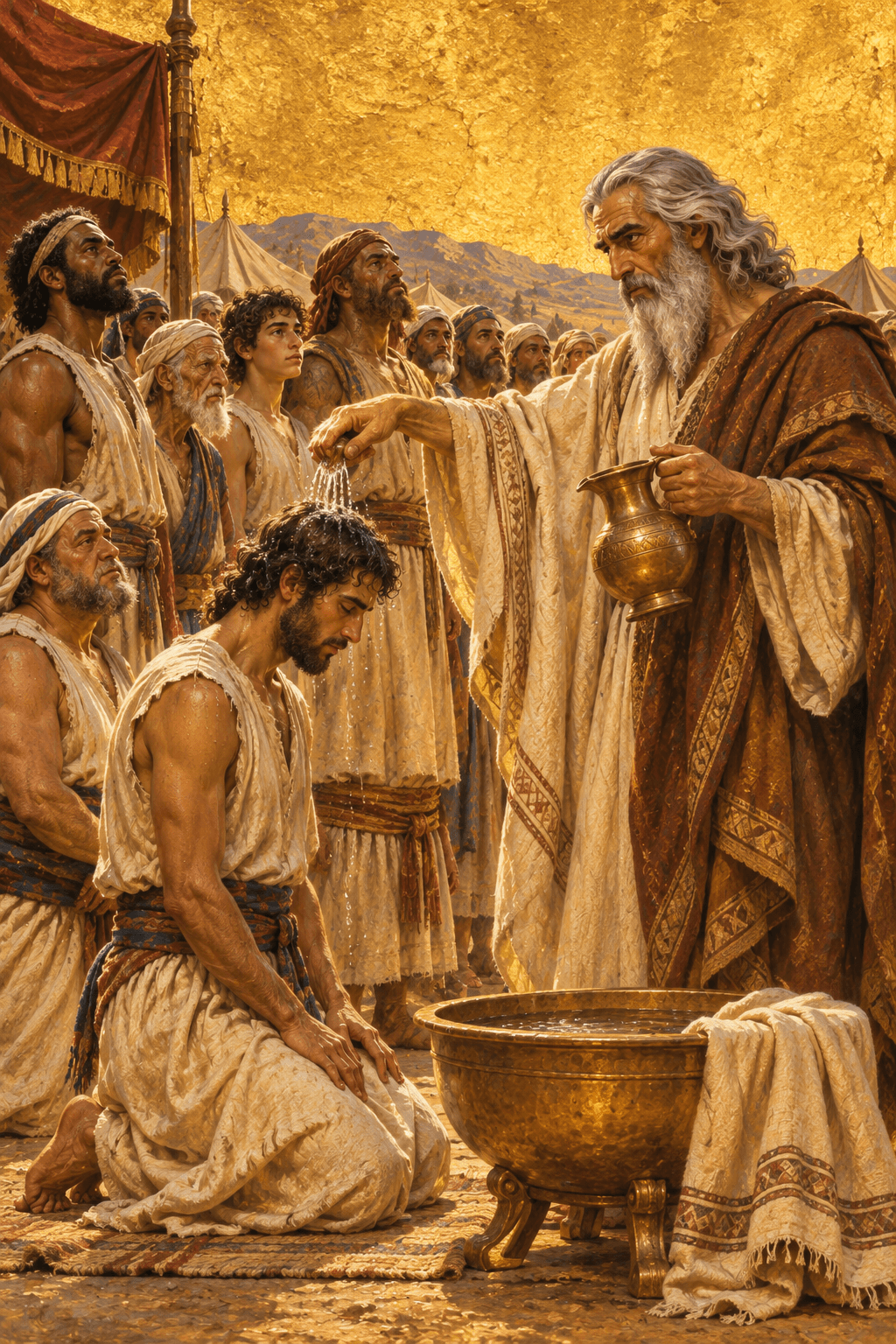
In the Book of Leviticus (Leviticus 8) the rite of the ordination of the priests was given; here the rite of the ordination of the Levites is set forth. In this rite the work of God Himself appears in sanctifying these souls so that they may be made fit for His holy service. Therefore a sin offering and a burnt offering are offered for them to the Lord to make atonement for them (12), and Aaron and his sons offer them for a wave offering unto the Lord (13). It is God who accepts them as a gift from the people, and He Himself prepares them for work in His house.
In this rite the Levites themselves, Moses the prophet, Aaron the priest and the whole congregation (that is, the lay princes) all take part. Each has his role, his work and his responsibility in this rite. On the side of the Levites, they shave all their flesh and wash their clothes (7), a sign of their commitment to a holy, pure and clean life. Passing the razor over their flesh points to removing every defilement attached to the flesh, and washing the clothes, which are a symbol of the body, is a sign of purity. Moses the prophet, the receiver of the Law and the representative of the divine commandment, sprinkles on them the water of purifying, or water of sin offering (7). It is as though the secret of the cleansing of the ministers is their bond with the word of God, which exposes their sin and supports them in repentance. Aaron plays a principal role in the rite, for he and his sons receive these Levites as the people’s gift to God, and at the same time God appoints them as helpers to the priests (19). The people, or rather the princes of the people, put their hands upon the Levites (10). It is as though what the people do, the ministers bear responsibility for before God; and on the other hand, it is as though they present the Levites with their own hands as a gift from the people to God, as a son presents a gift with his hands to his father.
The Book of Numbers has tried to affirm that God’s ministers are not only God’s gift for the service and care of His people, but also the people’s gift to God, who accepts them as the firstborn of the people, so that all are blessed because of them. Therefore no patriarch, bishop, priest or deacon may be ordained without the people… For the people must come forward to God themselves, offering him as a gift of love to God, so as to receive him from the hands of God as His gift to His people.
I see in this a symbolic picture of the true Minister, Christ the Lord, who is the Father’s gift to mankind for its salvation, and at the same time a sacrifice of love offered to the Father in the name of mankind, which He accepts as a sign of His good pleasure toward us. In the sacrament of the Eucharist God accepts the offerings of His people through the cross, and the people receive from the Father the Body and Blood of His Son, a mystery of union with Him and of sanctification for them. It is the sign of shared love, in which the Father meets mankind, and He is the offering of each side to the other.
3. The Period of Service
KJV · Verses 23–26
23 And the Lord spake unto Moses, saying, 24 This is it that belongeth unto the Levites: from twenty and five years old and upward they shall go in to wait upon the service of the tabernacle of the congregation: 25 And from the age of fifty years they shall cease waiting upon the service thereof, and shall serve no more: 26 But shall minister with their brethren in the tabernacle of the congregation, to keep the charge, and shall do no service. Thus shalt thou do unto the Levites touching their charge.
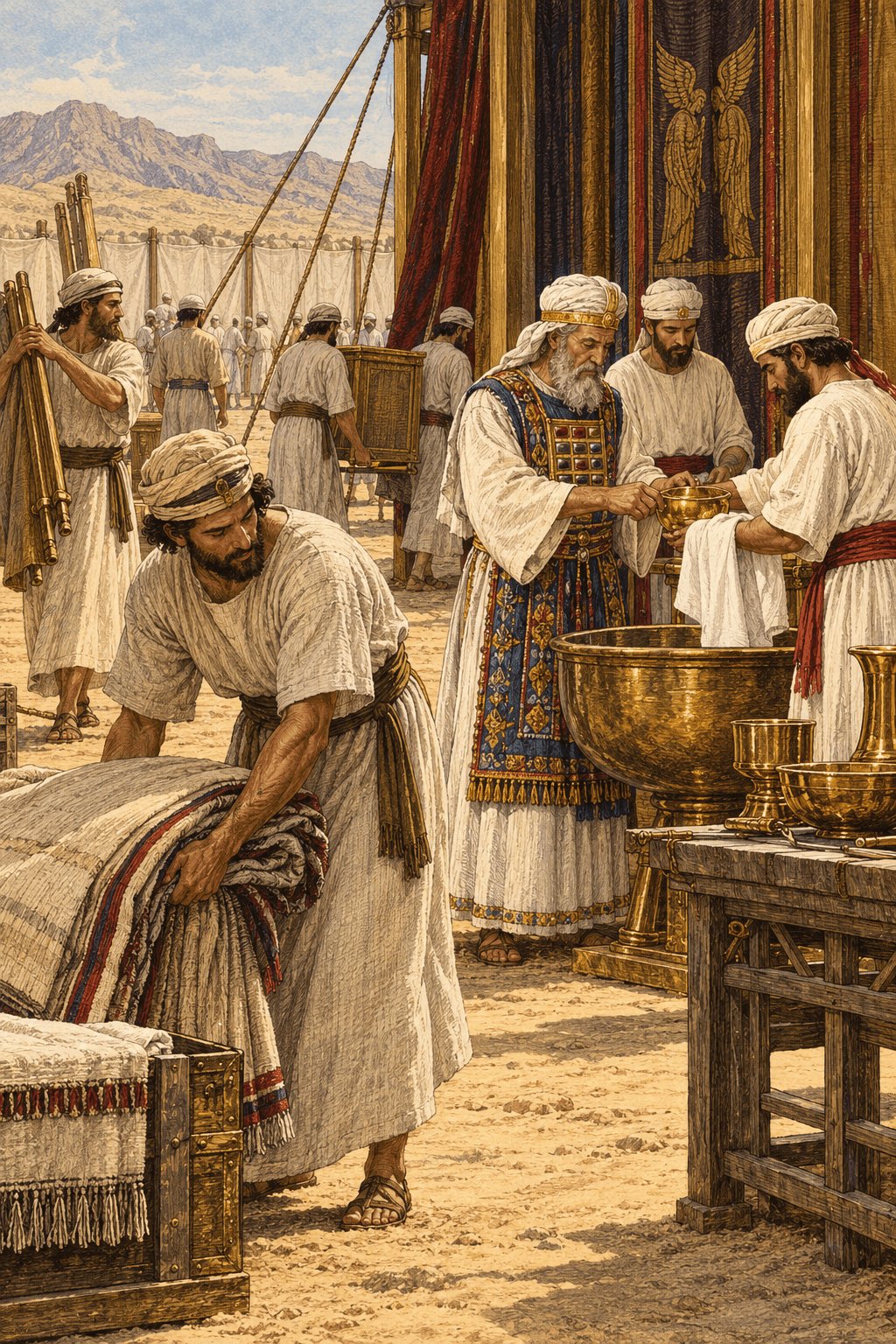
We have already spoken of the period of service and its symbolic meaning in our discussion of chapter 4.