
In the burnt offering God smells a savour of delight in His Church, aflame with the fire of love, through the Slain One, our Head Jesus Christ, who offered His whole life as a burnt offering of obedience to the Father. In the meat offering the Church rejoices in her crucified Bridegroom as the source of her spiritual fullness. In the peace offering the Father rejoices together with the Church, in all her ranks of priests and people, through fellowship together. The Father declares His good pleasure through the sacrifice, and the Church declares her joy and thanksgiving. That is why in this sacrifice a part is offered on the altar while the rest is shared among the priests, the offerers, and the invited guests.
Introduction to the Peace Offering
A) Origen observed that the peace offering is not offered of birds, as the burnt offering is, nor of flour or unleavened bread, as the meat offering is; rather, “a great and perfect offering must be offered, and of this the Apostle says: ‘But strong meat belongeth to them that are of full age’ (Hebrews 5:14).” [61] If the burnt offering is the offering of the spiritual man and the meat offering the offering of the soulish man, the peace offering, in Origen’s view, is the offering of the spiritually mature or perfect man, who enjoys the perfect peace of God in his inner life and in his relationships, since it is an overflow of peace and thanksgiving springing through the Lord Christ Himself, the Giver of peace.
The source of peace is the Lord Christ, who by His blood reconciled us to the Father and restored to us our peace with the Father, our peace with ourselves, and with our brethren, the peace we had lost because of sin. Saint Augustine holds that the Lord Christ is not only the source of peace but is Himself our true peace. He says:
Peace is Christ, “for he is our peace, who hath made both one, and hath broken down the middle wall of partition” (Ephesians 2:14)… Christ the Son of God is peace. He came to gather His own and separate them from evil. [62]
B) The peace offering is the sacrifice that most expresses inner joy and the life of thanksgiving, so it was called “the offering of completeness.” The congregation, or one of its members, offered it voluntarily on certain joyful occasions as a sacrifice of thanksgiving to God for His care and love. Families used to choose a day or days in the year to offer it in their name (1 Samuel 20:6). This sacrifice was also offered as an obligation, such as the sacrifice of the consecration offered at the ordination of priests (Exodus 29:19–28; Leviticus 8:22–32), and the peace offering offered at the feast of Pentecost (Leviticus 23:19–20).
C) The Eucharist is the sacrifice of peace and thanksgiving that the Church of the New Testament offers, for the word “Eucharist” in Greek means “thanksgiving.” In the liturgy of the Divine Liturgy, as we enjoy the body and blood of the Lord given for us, we enjoy abiding in Him and receive the inner nature of thanksgiving. So our thanksgiving is not mere words in praise and prayers but an inner nature that touches our inmost depths wholly.
To this day our fathers the bishops, on reaching any city, before entering any place, offer “the Prayer of Thanksgiving” as a peace offering for God’s care for them on the way.
1. A Peace Offering from the Herd
KJV · Verses 1–5
1 And if his oblation be a sacrifice of peace offering, if he offer it of the herd; whether it be a male or female, he shall offer it without blemish before the Lord. 2 And he shall lay his hand upon the head of his offering, and kill it at the door of the tabernacle of the congregation: and Aaron's sons the priests shall sprinkle the blood upon the altar round about. 3 And he shall offer of the sacrifice of the peace offering an offering made by fire unto the Lord; the fat that covereth the inwards, and all the fat that is upon the inwards, 4 And the two kidneys, and the fat that is on them, which is by the flanks, and the caul above the liver, with the kidneys, it shall he take away. 5 And Aaron's sons shall burn it on the altar upon the burnt sacrifice, which is upon the wood that is on the fire: it is an offering made by fire, of a sweet savour unto the Lord.
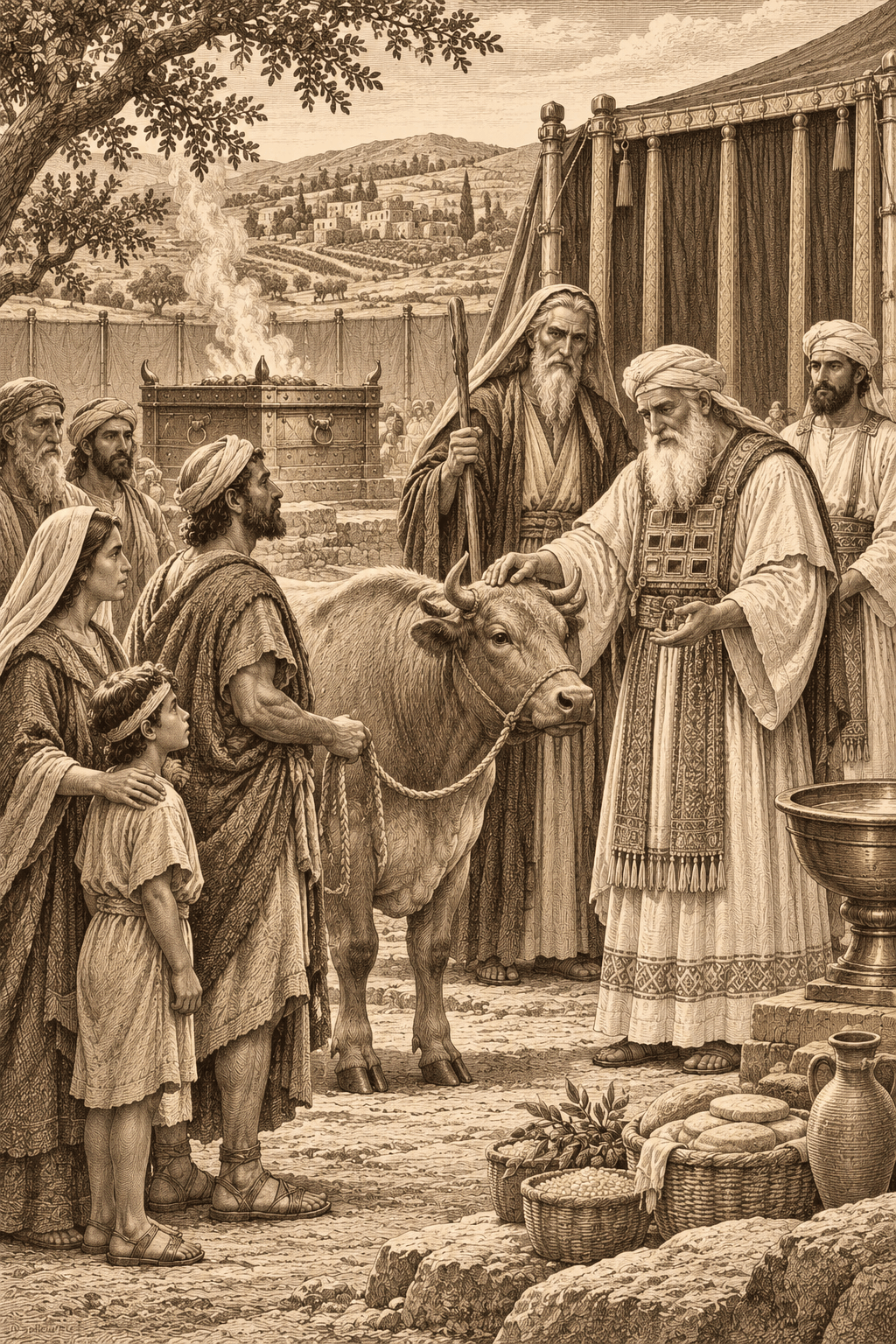
As we look closely and carefully at the peace offering, we discover wonderful sides of the sacrifice of Christ other than those revealed by the burnt offering. Leaving aside the common sides which I explained in the first chapter, I will mention here only some other sides:
A) In the burnt offering it was required that it be a male without blemish, but in the peace offering a male or a female could be offered, provided it was without blemish (1, 6). Perhaps the reason is that the burnt offering is offered wholly to the Lord on the altar, pointing to the Lord Christ’s offering of His life in its fullness in obedience to the Father; while this sacrifice, though it points to the sacrifice of the Lord Christ, the Giver of reconciliation and peace, represents the fellowship between God and men through reconciliation and peace. Perhaps accepting females in this sacrifice points to the Church entering as a bride into union with her Bridegroom, to enjoy union with Him and His surpassing peace. It is the sacrifice of the whole Church, which rejoices and delights in the cross and offers her life as a sacrifice of thanksgiving to God.
B) No one ate of the burnt offering; it was burned wholly to God after being flayed, cut up, washed with water, and laid on the altar, pointing to its being offered wholly to the Father, who alone knows the inward parts of His Son, which are without blemish. But here man shares with the altar in enjoying the sacrifice, and we hear nothing of flaying, cutting up, or washing. It is the sacrifice of true fellowship! God smells it as a sweet savour, and at the same time gives it as a delightful table to man, so that he says: “Thou preparest a table before me in the presence of mine enemies” (Psalm 23:5). And Isaiah the prophet says: “And in this mountain shall the LORD of hosts make unto all people a feast of fat things” (Isaiah 25:6). The Lord Christ also says: “Behold, I have prepared my dinner: my oxen and my fatlings are killed, and all things are ready” (Matthew 22:4).
C) Laying the hand on the head here was usually for thanksgiving and joy. A person did not speak words confessing his sins but declared his thanks for God’s benefits to him. As Saint Augustine says:
Confession has two complementary parts: the confession of our sins and the confession of God’s benefits to us; so God is glorified in us through our weakness as in the declaration of His works with us. If it was said of the disobedient: “We have piped unto you, and ye have not danced; we have mourned to you, and ye have not wept” (Luke 7:32), it befits us through the cross to hear the pipe of the Gospel and dance spiritually, rejoicing in His saving works, as we hear the mourning and weep over our sins. So joy in hope mingles with the sorrow of repentance without contradiction. [63]
2. A Peace Offering from the Flock
KJV · Verses 6–11
6 And if his offering for a sacrifice of peace offering unto the Lord be of the flock; male or female, he shall offer it without blemish. 7 If he offer a lamb for his offering, then shall he offer it before the Lord. 8 And he shall lay his hand upon the head of his offering, and kill it before the tabernacle of the congregation: and Aaron's sons shall sprinkle the blood thereof round about upon the altar. 9 And he shall offer of the sacrifice of the peace offering an offering made by fire unto the Lord; the fat thereof, and the whole rump, it shall he take off hard by the backbone; and the fat that covereth the inwards, and all the fat that is upon the inwards, 10 And the two kidneys, and the fat that is upon them, which is by the flanks, and the caul above the liver, with the kidneys, it shall he take away. 11 And the priest shall burn it upon the altar: it is the food of the offering made by fire unto the Lord.
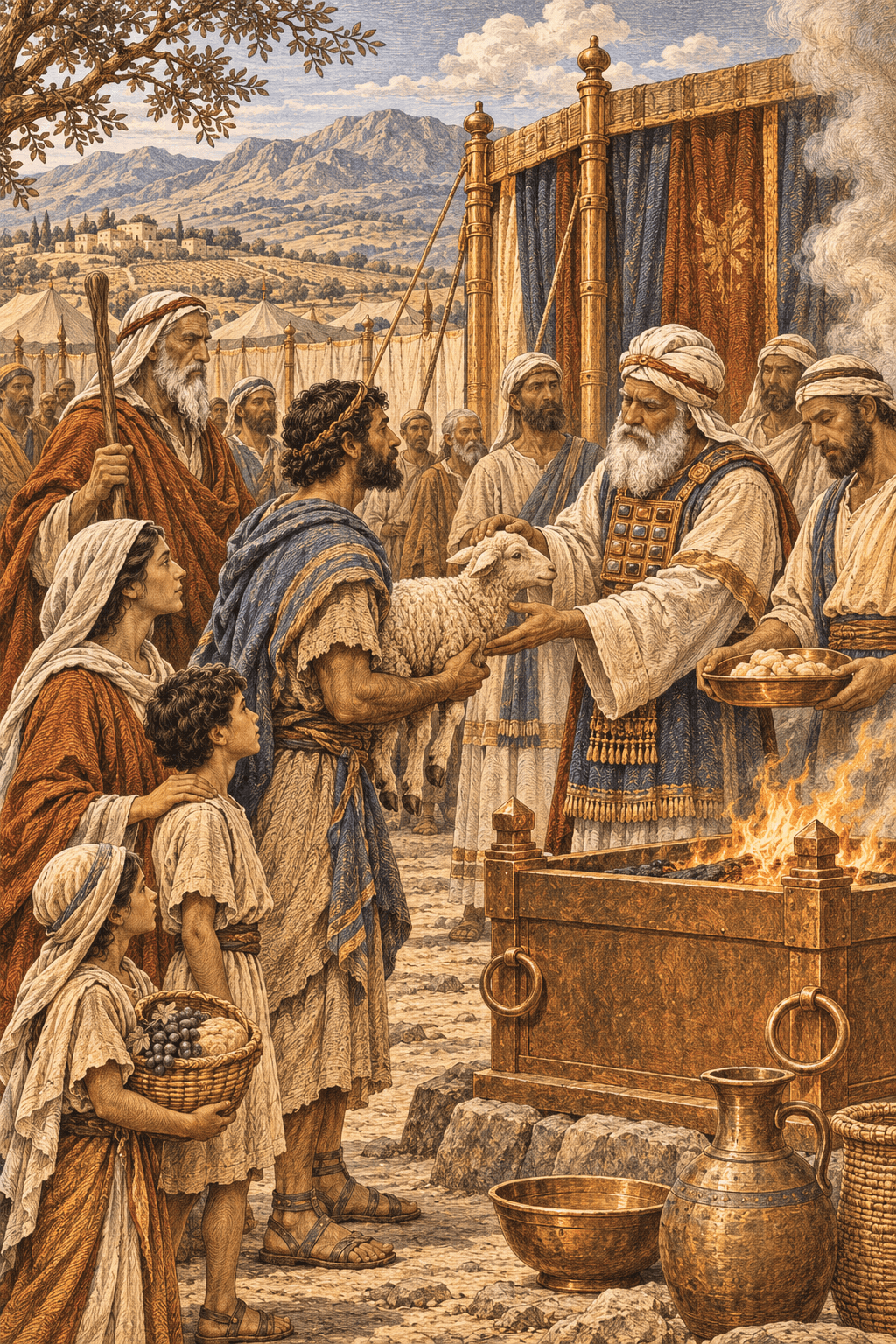
It does not differ much in all its rites from the peace offering of the herd, except for the addition of offering the whole rump on the altar, the fat part in the tail of the sheep, especially in Eastern countries, which he took off hard by the backbone, that is, at the last vertebra of the spine.
3. A Peace Offering of the Goats
KJV · Verses 12–17
12 And if his offering be a goat, then he shall offer it before the Lord. 13 And he shall lay his hand upon the head of it, and kill it before the tabernacle of the congregation: and the sons of Aaron shall sprinkle the blood thereof upon the altar round about. 14 And he shall offer thereof his offering, even an offering made by fire unto the Lord; the fat that covereth the inwards, and all the fat that is upon the inwards, 15 And the two kidneys, and the fat that is upon them, which is by the flanks, and the caul above the liver, with the kidneys, it shall he take away. 16 And the priest shall burn them upon the altar: it is the food of the offering made by fire for a sweet savour: all the fat is the Lord's. 17 It shall be a perpetual statute for your generations throughout all your dwellings, that ye eat neither fat nor blood.
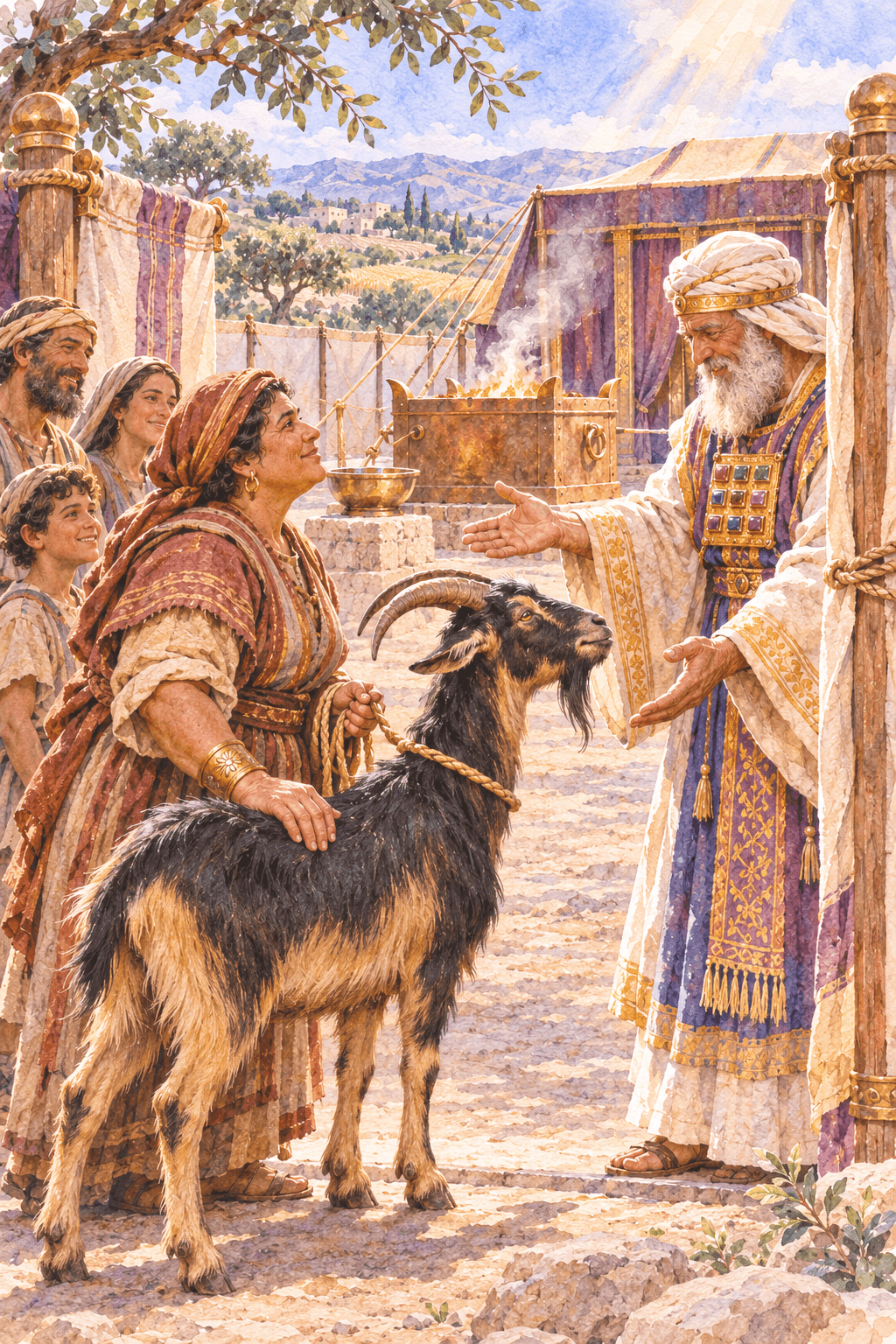
It is almost an identical picture of the sacrifice of the herd in all its rites.
Finally he closes his discussion of the peace offering by affirming that the fat and the blood are not to be eaten, for he says: “It shall be a perpetual statute for your generations throughout all your dwellings, that ye eat neither fat nor blood” (17). He does not mean here the fat that runs through the meat, but the fat that covers the inwards and is joined to them, and that which is on the two kidneys, by the flanks (4). Perhaps the reasons for forbidding the fat and the blood are these:
A) As for the fat, from the standpoint of health fat is rich in cholesterol, an excess of which in a person’s food causes many diseases, such as high blood pressure and blocked arteries… So the Law allowed man in the Old Testament to eat the fat within the meat, but not to eat the pieces of thick fat. [64]
B) Also from the standpoint of health, some physicians hold that certain infectious diseases and germs are passed on quickly by drinking blood.
C) The Law forbade the Jewish people to drink blood because it represents the life, and it is offered to God alone in the sacrifice for reconciliation, where a life is offered in place of a life. Besides this, drinking blood suggests ferocity and vindictiveness; He feared they would grow used to it, so that a man would walk in hardness of heart even toward his brother.
As Saint John Chrysostom says:
The reason for forbidding the eating of blood is that it is consecrated to be offered to God alone; or perhaps the prohibition was because God wanted to hold people back from rushing to shed human blood, so He forbade them to eat the blood of animals, lest this lead them to fall little by little into the sin of shedding human blood. I said that we have often heard one enemy threaten another, saying: “I will kill you and drink your blood.” [65]
When the first council of the apostles and the elders met, it decided that those of the Gentiles coming to the faith should abstain from things strangled and from blood (Acts 15:28–29). The Apostolic Canons affirmed that a cleric who eats an animal with its blood (Genesis 9:4), or the flesh of an animal killed by a beast, or one that died of itself, is deposed, and a layman is excommunicated. [66] Abstaining from blood and things strangled was observed for several centuries in the East and in the West too, but its observance gradually weakened until it was forgotten, if not in every church, at least in the West. Some hold that the Western Church followed in this the opinion of Saint Augustine, who says:
This command was observed by the Christians before the Church of the Gentiles was organized. [67]
Notes and References
[61] Origen, In Lev. hom. 2:2.
[62] St. Augustine, On Ps. 126.
[63] Fr. Tadros Yacoub Malaty, Pastoral Love, 1965, p. 363.
[64] Archdeacon Naguib Guirguis, The Book of Leviticus, 1980, pp. 43–44.
[65] Al-Nour Publications, Collection of Church Canon Law, 1975, p. 865.
[66] ANF, vol. 7, p. 504 (canon 63).
[67] Collection of Church Canon Law, p. 590.