
Chapters 1–7: The Sacrifices and Offerings
The Book of Leviticus is the book of the life of the congregation sanctified by the Holy God. It rests above all on the sacrifice which the priest offers. There is no approach to God and no acceptance of worship except through the reconciliation by the blood which the priest offers in the name of the congregation. It is as if there is no entry into the embrace of the Holy Father and no eternal rest except by the blood of our Lord Jesus Christ, which cleanses us from all sin (1 John 1:7), since He is at once the unique sacrifice of the cross and the great High Priest.
Since the sacrifice of the cross is unique in its nature and its power, no single kind of sacrifice or offering could reveal it. So the Book of Leviticus presents five kinds of sacrifices and offerings, each declaring a certain side or sides of the cross. Even so, we can say that all these kinds, with their long, exact, and varied rites, could not reveal all the mysteries of the cross. That is why the Old Testament gave us many symbols, figures, and events through the generations, to bring us into new depths of this surpassing mystery: the mystery of the cross and the sacrifice.
The sacrifices and offerings mentioned here are:
- The burnt offering (Leviticus 1).
- The meat offering (Leviticus 2).
- The peace offering (Leviticus 3).
- The sin offering (Leviticus 4; 5:1–13).
- The trespass offering (Leviticus 5:14–6:7).
Some scholars see Leviticus 1:1–6:7 as a guide to the sacrifices addressed to the congregation of worshippers together with the priests, while the last part (Leviticus 6:8–7:38) is a guide for the priests on the rite of the sacrifices and offerings. [5]
The Order of the Sacrifices and Their Connection
The order of the sacrifices and offerings is wonderful. It begins with the burnt offering and ends with the trespass offering, which suits the Father’s view of the sacrifice, not man’s. In his meeting with the cross, the believer first sees it as a trespass offering and a sin offering, for he sees in it the incarnate Word of God bearing his pains and his iniquity to take away the Father’s wrath from him. Through this view he finds in the cross a peace offering and a thank offering, and he offers his life in Christ Jesus the Crucified as a thankful life, instead of the ungrateful nature that crept into him through the fall. He also sees in the cross a meat offering, in which he enjoys the life of fellowship in Christ Jesus the Crucified. Finally he understands the cross as a burnt offering, for he discovers in it the obedience of the only Son to the Father unto death, even the death of the cross, and he too offers his life as a sacrifice of obedience and a burnt offering of love to God in His Son.
This is the order of the sacrifices and offerings as we benefit from them as believers. But the Father looks at the cross first, if one may say so, as a burnt offering of obedience, in which He smells the savour of His beloved Son, a burnt offering of perfect love; and He ends by looking at it as bearing our sins and iniquities, paying our debt and bearing the divine wrath for us. We do not separate one side from another, in the eyes of God the Father or of the believer, for they are complementary sides that are never separated. But we want to make clear that, in the eyes of the Father, the cross is revealed with greater splendor not so much in taking away our iniquities and sins as in our bearing the nature of the Crucified, so that through Him we become a burnt offering of obedience and love, an unceasing flame of fire, bearing the Son’s obedience unto death (Philippians 2:8) and love without end. That is why the Apostle says: “Let this mind be in you, which was also in Christ Jesus: Who, being in the form of God, thought it not robbery to be equal with God: But made himself of no reputation, and took upon him the form of a servant, and was made in the likeness of men: And being found in fashion as a man, he humbled himself, and became obedient unto death” (Philippians 2:5–8).
In short, we can say that God the Father smells the savour of Christ in us through the cross in this way:
- A burnt offering of perfect love and obedience to Him in His Son (the burnt offering).
- The fellowship of life with Him in His only begotten Son (the meat offering).
- A life of inner peace and continual thanksgiving (the peace offering).
- The enjoyment of continual washing from our general daily sins and our unceasing weaknesses (the sin offering).
- Salvation from every iniquity we commit and return from by repentance (the trespass offering).
Blood Sacrifices and Food Offerings
As a general rule the sacrifices centered on the blood, since it stands for the life of the animal. It is as if man, his own life wholly corrupted, needed an innocent life to bear the wages of his iniquity and redeem him from death after paying his debt. This work was only a symbol of the shedding of the blood of the Lord Christ the Saviour, who alone is able to redeem humanity and pay its debt to the Father in full. The Jews believed in the idea of redeeming a life with a life; we mention some sayings of Jewish interpreters: [6]
- The life of every creature is bound to its blood; therefore the blood was offered to atone for the life of a man, so that one life takes the place of the other and atones for it (Rashi). [7]
- One life takes the place of another (Ibn Ezra).
- I offer you the life on the altar, so that the life of an animal atones for the life of a man (Moses ben Nachman).
Many Jews expressed their sense that the blood of animals could not pay man’s debt before God. For this reason hearts in the Old Testament looked forward with longing to the coming of the Messiah as their true Saviour.
Three kinds of animals and two kinds of birds were used for the blood sacrifices: cattle, sheep, goats, turtledoves, and pigeons. Beside these blood sacrifices there were food offerings, such as flour, unleavened cakes, and drink offerings of wine. These offerings were not separate from the blood sacrifices; to confirm this, their quantity differed according to the kind of sacrifice they accompanied (Numbers 15:1–12; 28:1–12; 29:1, etc.).
The Sacrifices and the Priesthood
The work of sacrifice was joined to the priesthood. If man after his fall needed a sacrifice to redeem him and bear his death, there was a pressing need for a priest to intercede with God by this sacrifice for the sinner. The Lord Christ came to us as the true sacrifice, to offer it Himself as the great High Priest, who alone is able to intercede for sinners by His blood before the Father, for He is alive, seated at His right hand, working for us and in our name. And as the Lord gave His Church the right to offer His body given for us, not as a repetition of the sacrifice but as its extension, the very same sacrifice in a mystical way, so He, the great heavenly High Priest, gave His Church the holy priesthood, for He works in His priests and is hidden in them. They work in His name, for His sake, and by His power, not by their own human abilities, however exalted!
In the Old Testament the people had a positive role in the sacrifice. Some rabbis hold that the people could present the sacrifice and lay their hands on it, confessing their sins or their trespasses, or confessing their thanks to God. Besides this, they were sometimes allowed to slay it, flay it, cut it in pieces, and wash its inwards. But there were priestly works that no one but the priest could do, such as pouring out the blood of the sacrifice, sprinkling it, and kindling the fire on the altar.
The Variety of the Sacrifices and Their Purpose
Saint John Chrysostom comments on the variety of the sacrifices and their purpose: with all their many kinds, he finds not a single sacrifice offered against an enemy for revenge; all of them aim at the building up of man through the forgiveness of sins. He says:
Consider how many sacrifices are mentioned in the Law: a sacrifice of praise, a sacrifice of knowledge, a peace offering, sacrifices for purifications, and many other kinds. Yet we do not find a single sacrifice against enemies; all are offered for taking away sins and for man’s progress. [8]
In the second century, when the Christians were accused of refusing to offer sacrifices to the gods, the philosopher Athenagoras (133–190) wrote in their defense:
It befits us to offer a bloodless sacrifice, the service of our minds. [9]
The Burnt Offering
The guide to the sacrifices and offerings begins with the burnt offering in its three kinds, whether of cattle, of sheep, or of birds. In its rites it reveals to us the sacrifice of the Son in His perfect obedience to His Father, offering His whole life as a burning offering of love, which the Father smelled as a savour of delight and good pleasure in the name of the Church and for her sake. Through this sacrifice the heart of the believer burns with the love that he has in Christ Jesus, longing, through union with the Crucified, to rise with Him to the cross as onto the altar of burnt offering, to receive gladly the burning fire of sufferings and offer his whole life as a burnt offering to the Lord.
1. Introduction
KJV · Verses 1
1 And the Lord called unto Moses, and spake unto him out of the tabernacle of the congregation, saying,
At the beginning of the ministry God called Moses to receive the pastoral work through the bush burning with fire. After the exodus He called him again to receive the Ten Commandments on the mountain, where the congregation could not go up to Him amid the lightnings, thunders, and smoke… It is as if God wanted to assure us of our inability to meet Him, since He is a consuming fire. He longed to give us His commandments, that perhaps we might draw near to Him through them; but in our weakness we were counted breakers of the commandment and fell further under the curse of the Law, so there is no reconciliation except through the sacrifice and the blood.
This is why Moses was called this time into the tabernacle, not amid lightnings, thunders, and fearful darkness, but from the mercy seat on the cover of the ark of the covenant (Exodus 25:22). It is as if this time He presents to him the mystery of the sacrifice of the cross, by which we meet God as in the tabernacle of the congregation, in stillness and quiet, through the surpassing divine love, in which the Word of God comes down to us bearing our nature and draws us into Himself, so that we enjoy fellowship with the Father by His Holy Spirit through the merits of the precious blood.
The burnt offering was truly “the sacrifice of consecration and service” (sacrificium latreuticum). In time it became an inseparable part of the morning and evening service in the temple, and additional burnt offerings were offered on the feasts, such as the Sabbaths, the new moons, and the other feasts, after the service. It represents the sacrifice of the covenant, offered by the people who had entered into a covenant with God. [10]
The burnt offering had a special sanctity among the Jews: it was the only sacrifice that one who was not of Israel was not allowed to offer. [11]
2. A Burnt Offering from the Herd
KJV · Verses 2–9
2 Speak unto the children of Israel, and say unto them, If any man of you bring an offering unto the Lord, ye shall bring your offering of the cattle, even of the herd, and of the flock. 3 If his offering be a burnt sacrifice of the herd, let him offer a male without blemish: he shall offer it of his own voluntary will at the door of the tabernacle of the congregation before the Lord. 4 And he shall put his hand upon the head of the burnt offering; and it shall be accepted for him to make atonement for him. 5 And he shall kill the bullock before the Lord: and the priests, Aaron's sons, shall bring the blood, and sprinkle the blood round about upon the altar that is by the door of the tabernacle of the congregation. 6 And he shall flay the burnt offering, and cut it into his pieces. 7 And the sons of Aaron the priest shall put fire upon the altar, and lay the wood in order upon the fire: 8 And the priests, Aaron's sons, shall lay the parts, the head, and the fat, in order upon the wood that is on the fire which is upon the altar: 9 But his inwards and his legs shall he wash in water: and the priest shall burn all on the altar, to be a burnt sacrifice, an offering made by fire, of a sweet savour unto the Lord.
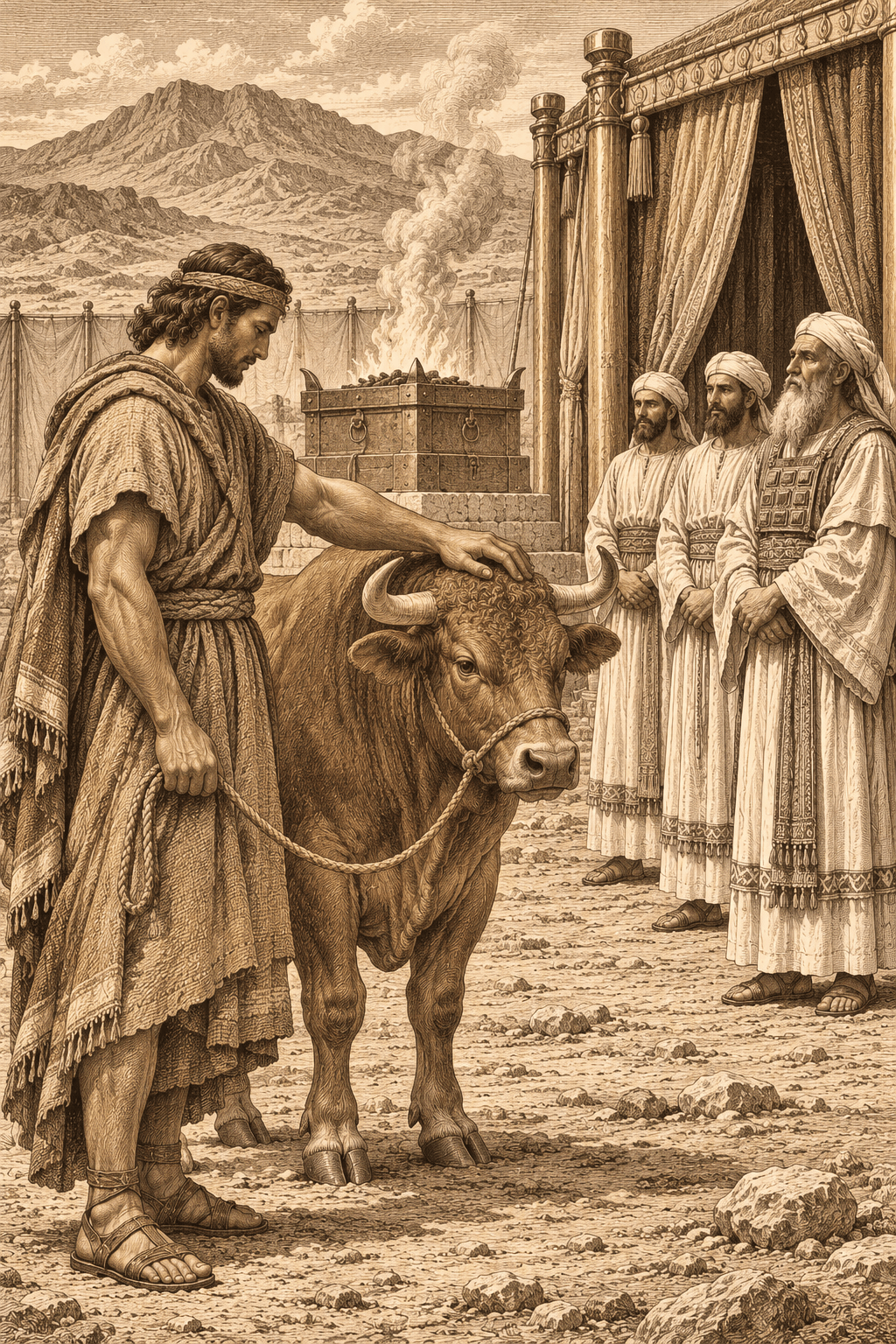
What Is the Burnt Offering?
Saint Augustine explains the word “burnt offering” (holocaust):
What is a holocaust? It means burning wholly with fire, for causis means “burning” and holon means “whole”; so a holocaust is the whole burnt with fire. There is a certain fire, the burning charity, by which the mind is set aflame with love, so that it passes from the mind to the rest of the members… and the whole man is set aflame with the fire of divine love, offering a holocaust to God. [12]
In other words, the burnt offering means that a person offers his whole inner life and outward conduct as a burning sacrifice of love for God. Saint Augustine says:
When the whole animal is laid on the altar and wholly burned with fire, it is called a holocaust. May the divine fire take us up wholly, and that flame lay hold of us completely. [13]
A sacrifice is called a holocaust when it is wholly burned… So every holocaust is truly a sacrifice, but not every sacrifice is a holocaust. [14]
Saint John Chrysostom urges us to offer our lives as a burnt offering to the Lord:
Since man is higher than the flock, when you offer yourself as a sacrifice you are higher than those sacrifices… There are other sacrifices that are truly burnt offerings: the bodies of the martyrs, for the martyrs offer their souls and their bodies too (a burnt offering to the Lord). These sacrifices have a sweet savour. You too can offer a sacrifice if you will. Though you cannot offer your body as a burnt offering by fire, you can offer it by another fire, such as voluntary poverty… A man could spend his days in luxury and extravagance, but he chooses a bitter and hard life and the mortification of the body; is not this a burnt offering?! Put to death the (lusts of) your body and crucify it, and you will receive the crown of martyrdom. The martyrs receive martyrdom by the sword; here you receive it by the mind, by a strong will. [15]
Saint Gregory of Nazianzus says:
Let us offer to God all our members which are upon the earth (Colossians 3:5). Let us consecrate them all, and not offer only the caul above the liver (Leviticus 3:4), or the rump with the fat, or some members of our body now and others at another time. Let us offer all the members of the body, and be counted a reasonable burnt offering (Romans 12:1), a whole sacrifice… offering it wholly to God, that we may receive it back from Him wholly. [16]
For Whom Is the Sacrifice Offered?
Having learned the meaning of the burnt offering, we speak of those for whom it is offered, for the Lord says to Moses: “Speak unto the children of Israel, and say unto them, If any man of you bring an offering unto the LORD” (2). Origen sees that it is not without purpose that He did not say “if any of you,” but “if any man of you.” [17] This book distinguishes between an offering for a man and another for “a soul” (Leviticus 4:2), or for the whole congregation (Leviticus 4:13), or for a ruler (Leviticus 4:22), or for a priest, and so on. The word “man” comes at the head of the list so that divine revelation declares that the burnt offering is offered for the whole human race as “man.”
If the burnt offering is the sacrifice of perfect obedience which the Son offers to the Father, He offers it for all humanity as though it were one man… for the Father wishes to smell in all a savour of delight and good pleasure.
The Offering Itself
If he wished to offer a burnt offering of the herd, he chose a male (a bullock) “without blemish.” As Saint Augustine says:
Truly He is a Lamb without blemish, wholly and always without blemish. [18]
Origen comments on this sacrifice:
What is the burnt offering of the herd without blemish but the fatted calf which the Father killed when the son who had been prodigal returned, having lost all his goods?! He made a feast and there was joy (Luke 15:23), for it is said: “There is joy in the presence of the angels of God over one sinner that repenteth” (Luke 15:10). This man who was lost and was found had no righteousness of his own to offer, for he “wasted his substance with riotous living” (Luke 15:13). So he found this calf, which was sent from heaven yet came of the seed of Abraham. That is why the Law did not say only “a burnt offering of the herd,” as though it were any cow, but “a burnt offering of oxen from the herd” (Septuagint), for He came of the seed of the patriarchs (the herd). [19]
It was specified that the burnt offering here be a male. Origen holds that the distinction between male and female in the spiritual sense does not mean a distinction between the sexes, men and women, but points to a spiritual distinction between mature, earnest manliness and the softness of pampering and luxury. So he often says that on the day of the Lord we will find many women here counted as strong men in the eyes of the Lord, and many men here will appear on the day of the Lord as women, because they lived their lives in pampering and in the enjoyment of bodily pleasures.
The One Who Offers It
“And he shall kill the bullock before the LORD: and the priests, Aaron’s sons, shall bring the blood” (5).
In the Old Testament the priests alone had the right to offer the sacrifices. The Lord Christ came in the New Testament not after the order of Aaron but after the order of Melchizedek, offering the surpassing sacrifice of the cross. In the Epistle to the Hebrews the Apostle Paul made clear the difference between the priesthood of Levi and the priesthood of the Lord Christ, especially in two respects. First, the priesthood of Levi was marked by weakness, so the priests themselves needed to offer sacrifices for themselves before offering sacrifices for the people; but the Lord Christ, being without blemish, offers the sacrifice for the people. Second, the priests offered animal blood sacrifices, the blood of bulls and goats, which could not cleanse the inner conscience; but the Lord Christ offered His own blood (Hebrews 9:12). The Priest and the Sacrifice are one, so His sacrifice is effective and gives life. As Saint John Chrysostom says:
Great is the difference! He is the ransom, the Priest, and the sacrifice! Were it otherwise, there would be need to offer many sacrifices, and He would be crucified many times. [20]
And Saint Augustine says:
You are the Priest and You are the sacrifice; You are the Offerer and You are the offering. [21]
The One who offers the sacrifice is our Priest, the Lord Christ. The fathers of the Church declared this clearly. Saint John Chrysostom says:
We fill the place of servants; but it is He Himself who blesses, and He who changes the offerings. [22]
This great High Priest, who works in His priests, offers us His one atoning sacrifice itself, without repetition, for he says:
Though it is offered in many places, it is one body and not many bodies, and one sacrifice. He is our High Priest, who offered the sacrifice that cleanses us, so that we now also offer what He offered, which is not repeated… It is not another sacrifice; we always offer the same sacrifice. [23]
The Rite of the Offering
A) “He shall offer it of his own voluntary will at the door of the tabernacle of the congregation before the LORD” (3).
Some translate this phrase to mean that the offerer presents the sacrifice of his own will, that is, in complete freedom, since it represents the sacrifice of the cross which the Lord Christ offered of His own will and in complete freedom as a ransom for humanity. But the expression rather declares the offerer’s desire to enjoy the Lord’s good pleasure toward him, for the sacrifice of the cross was offered as a sacrifice of delight to the Father and of acceptance for all the believers united with the Crucified. In any case, for God’s acceptance of man to be fulfilled, he must go with the offering to the door of the tabernacle of the congregation. As Origen says:
To the door, and not inside, but outside the entrance. Truly Jesus was outside the door, for “He came unto his own, and his own received him not” (John 1:11). He did not come inside the tabernacle (the Jewish nation), through which He came to the door to offer His burnt offering, but suffered outside the camp (Leviticus 4:12). When the son of the lord of the vineyard came, the wicked husbandmen took him, cast him out of the vineyard, and slew him (Matthew 21:39). This, then, is the offering which is offered “at the door of the tabernacle of the congregation… before the LORD” for acceptance; for is there anyone more acceptable to Him than Christ, “who… offered himself without spot to God” (Hebrews 9:14)? [24]
The Lord Christ was slain on the cross outside the camp so that we might go forth to Him bearing His reproach outside the camp (Hebrews 13:13). As Saint John Chrysostom says:
He was crucified outside as one condemned, so let us not be ashamed to be cast outside. [25]
B) “And he shall put his hand upon the head of the burnt offering; and it shall be accepted for him to make atonement for him. And he shall kill the bullock before the LORD: and the priests, Aaron’s sons, shall bring the blood, and sprinkle the blood round about upon the altar that is by the door of the tabernacle of the congregation” (4–5).
A person laid his hand on the head of the burnt offering to become one with it, whether in confessing God’s benefits to him when offering the sacrifice for thanksgiving, or in confessing his sins and iniquities, as in the sin offering or the trespass offering, so that the sin passed to the sacrifice, which atoned for him and paid his debt. We too, as we lay our hands on the head of our sacrifice, the Lord of glory Jesus, declare our oneness with Him. As Scripture says, we are “complete in him” (Colossians 2:10), and “we are members of his body, of his flesh, and of his bones” (Ephesians 5:30); “he that is joined unto the Lord is one spirit” (1 Corinthians 6:17). We have become one with Him, who offers His life as a burnt offering of love in our name and for our sake, and as a sacrifice to atone for our sins which He bore on His shoulders, as the prophet says: “Yet it pleased the LORD to bruise him; he hath put him to grief: when thou shalt make his soul an offering for sin” (Isaiah 53:10).
Origen comments on laying the hand on the head of the burnt offering:
He laid upon His body the sins of the human race, for He is the head of the body, the Church (Ephesians 1:22–23). [26]
And Saint John Chrysostom says:
How did He make Himself a reconciler…? He bore the punishment that was upon us, submitting to the chastisements we deserved, condescending to what we are. Do you want to know how He bore all this? The Apostle says: “Christ hath redeemed us from the curse of the law, being made a curse for us” (Galatians 3:13). [27]
If the curse of the Law came upon us because we broke the divine commandment, He bowed down to bear the curse for us and lift us from the curse to His blessed place.
As for the rite of laying hands on the head of the sacrifice among the Jews, it was not practiced by women, children, the blind, the deaf, or non-Israelites. [28] The one or ones offering the sacrifice laid their hands between the horns of the sacrifice, with their faces toward the west, where the Holy of Holies was, to realize the holiness and awe of this act, for it touched their relationship with the Lord Himself. Opinion was not settled as to whether a person laid one hand or both hands, but it was settled that he pressed with his hand with all his strength, as one throwing his burdens upon it. [29] As he laid his hand he made this confession (usually in the sin and trespass offerings): “I beseech You, O God, for I have sinned, rebelled, and transgressed, committing… (he names the sin); but I have returned in repentance; let this be for my atonement.” [30]
He says: “He shall kill the bullock before the LORD” (5). It was slain outside the camp, yet in truth it was slain before the Lord, pointing to the sacrifice of the cross which the Son offered in obedience to the Father. Though He was crucified outside the earthly Jerusalem, He “now… appear[s] in the presence of God for us” (Hebrews 9:24). He comes forward as the slain One while seated at the right hand of the Father, interceding by His blood to atone for us, as the Apostle says: “He ever liveth to make intercession for them” (Hebrews 7:25).
Through this unique atoning intercession He opened for us a new way to pass with Him and through Him along His road, the way of the cross, to enter into His Father’s embrace. Saint John Chrysostom says:
Since we have such a High Priest, let us imitate Him and walk in His steps. [31]
And Saint Augustine says:
As our Advocate He helps us in temptations, not only by giving aid but by becoming an example for us. [32]
He says: “And the priests, Aaron’s sons, shall bring the blood, and sprinkle the blood round about upon the altar that is by the door of the tabernacle of the congregation” (5).
The holy blood is the secret of the power of the sacrifice; by it we are cleansed from all sin (1 John 1:7). As Saint Paul says: “For if the blood of bulls and of goats, and the ashes of an heifer sprinkling the unclean, sanctifieth to the purifying of the flesh: How much more shall the blood of Christ, who through the eternal Spirit offered himself without spot to God, purge your conscience from dead works to serve the living God?… And almost all things are by the law purged with blood; and without shedding of blood is no remission” (Hebrews 9:13–14, 22). And the Apostle Peter says: “Forasmuch as ye know that ye were not redeemed with corruptible things, as silver and gold, from your vain conversation received by tradition from your fathers; But with the precious blood of Christ, as of a lamb without blemish and without spot” (1 Peter 1:18–19). The Book of Revelation says of the redeemed that they “have washed their robes, and made them white in the blood of the Lamb” (Revelation 7:14), and that they overcame the devil by this precious blood (Revelation 12:11).
Through this precious blood, by which we gain the victory (Revelation 12:11), the cross is counted glory and triumph. As Saint John Chrysostom says:
It appears that the cross is glory and honour, as the Lord always called it: “that the Son of man should be glorified” (John 12:23). If He calls the sufferings of His servants glory, how much more the sufferings of the Lord? [33]
As for sprinkling the blood round about upon the altar, we know that the circle points to eternity, for it has no point of beginning and no point of end. [34] It is as if this blood works in us eternally, carrying us to heaven itself to bring us into the embrace of the heavenly Father, so that we live above the limits of time, as those in the circle of eternity who practice the heavenly life itself.
Here we gather some sayings of the fathers on the power of the blood of the cross and the heavenly life:
When He stretched out His hands on the cross, He cast down the prince of the power of the air, that worketh in the children of disobedience (Ephesians 2:2), preparing for us the way to the heavens… When His body was lifted up on high, the things in heaven were revealed. (Saint Athanasius) [35]
It is a heavenly sacrifice more than an earthly one! (Origen) [36]
Is not the altar also heavenly? How? There is nothing carnal on it; all becomes spiritual sacrifices. The sacrifice does not turn into ashes and smoke… what is on it is splendid and exalted… The Church is heavenly; indeed, it is nothing but heaven!… If we are heavenly and have such a sacrifice, let us fear. Let us no longer stay on earth, for whoever wills can no longer stay on earth. Whether you count yourself on earth or not is a matter of a person’s own choice. For example, it is said of God that He is in heaven. Why? Not because He is bounded by a place, God forbid! Nor in the sense that He left the earth deprived of His presence, but to declare His close relationship with His angels (the heavenly ones). So what does it mean that I am in heaven, if I behold the Lord of heaven, and have myself become a heaven? For He says: “We will come unto him, and make our abode with him” (John 14:23). So let our souls be heaven! (Saint John Chrysostom) [37]
C) Cutting up and arranging the burnt offering: “And he shall flay the burnt offering, and cut it into his pieces. And the sons of Aaron the priest shall put fire upon the altar, and lay the wood in order upon the fire: And the priests, Aaron’s sons, shall lay the parts, the head, and the fat, in order upon the wood that is on the fire which is upon the altar: But his inwards and his legs shall he wash in water: and the priest shall burn all on the altar, to be a burnt sacrifice, an offering made by fire, of a sweet savour unto the LORD” (6–9).
Since the burnt offering reveals the Son’s perfect obedience toward the Father, its flaying, cutting up, and washing even to the depths of the inwards declares that Christ Jesus our Lord passed before the Father, who found Him without blemish even in His inmost depths. It was said of Him: “Because he had done no violence, neither was any deceit in his mouth” (Isaiah 53:9); “Why, what evil hath he done? I have found no cause of death in him” (Luke 23:22); and He Himself said: “Which of you convinceth me of sin?” (John 8:46). The Son offered perfect obedience without blemish, as by the fire of His divine love toward the Father and toward humanity, and the Father smelled His sacrifice as a sweet savour! Laying the wood in order on the fire symbolizes the wood of the cross, which bore the fiery Word of God crucified according to the flesh! Laying the head in order with the other parts points to the cross, the cross of the Lord Christ, the Head of the Church, which also bears the Church as His suffering body, sharing His obedience to the Father and His love!
Origen gives another interpretation. He sees in flaying the burnt offering, that is, removing the skin from the flesh, a symbol of removing the letter from the interpretation of the word of God, so that the deep, inner, spiritual interpretation appears. Cutting up the parts and arranging them on the altar points to the advance from touching the hem of the Lord Christ’s garment (Matthew 9:20) to the joy of washing His feet with our tears and wiping them with the hair of our head (Luke 7:44), then to anointing His feet with ointment, and finally to leaning on His breast as Saint John the Beloved did, so that our mind rests and we are made fit to grasp His divine mysteries and are counted worthy to receive His mother as our mother, as Saint John enjoyed at the time of the crucifixion. In other words, Origen sees in the rite of the burnt offering continual growth in the spiritual life, and the advance from drinking the milk of children or of the weak (touching the hem of the garment) to enjoying the strong meat of the mature (leaning on His breast). He says:
I think that the priest who brings out the flesh of the calf offered as a burnt offering by flaying off its skin is the one who removes the letter from the word of God (2 Corinthians 3:6), laying bare its inner members, that is, gaining the spiritual understanding and inner knowledge of the word. This is done on the altar, in a high and holy place, not in a low place. For the divine mysteries are usually not unveiled to unworthy people who walk in low and earthly things and go from earth to earth; they are unveiled to those who are counted as an altar of the Lord, who kindle the divine fire without ceasing and put the (lusts of the) flesh to death without interruption. On such people we lay the calf of the burnt offering and cut its members in pieces, explaining the order and harmony of the members: like touching the hem of Christ’s garment, washing His feet with tears and wiping them with the hair of the head; and what is better, anointing His feet with ointment; and greater than this, leaning on the breast of Christ (John 13:25; 21:20). What progress this is, as each of us enjoys spiritual understanding according to his stature and what suits him! Some enjoy the first things, others advance further in faith in Christ, and others are counted perfect in His knowledge and love… This is the cutting of the calf limb by limb. [38]
Through the burnt offering of love, then, let us receive Christ Himself and enjoy the unveiling of the mysteries of His word. If we cannot lean on His breast with boldness to carry all His mysteries, let us anoint His feet with ointment to have a share in some of the mysteries of His love; and if we have no ointment, let us wash them with our tears and wipe them with the hair of our head; and if not, let us strive to touch even the hem of His garment, that we may be healed of the issue of blood of literalism, legalism, and formalism!
D) Washing with water: “But his inwards and his legs shall he wash in water” (9).
If this sacrifice points to the sacrifice of the Lord Christ, who offered His life as a burnt offering for our sake, it is also our sacrifice through our union with Him. So Origen and many of the fathers see in washing it with water, even to the inwards, a reference to the work of baptism, by which our inner nature is washed through the blood of the sacrifice and the water, and is renewed by the crucifixion of the old man and the enjoyment of the new man.
In this sacrifice the blood is joined with the water, the cross with the waters of baptism, so that we receive the new man in the image of the Lord Christ. That is why blood and water flowed from the Lord’s side at His crucifixion (John 19:34). As Saint John Chrysostom says:
This flowed not by chance or without purpose, but because by these two the Church stands. The baptized know this: by the water regeneration is accomplished, and by the blood and the body they are nourished. [39]
The blood and the water point to the same thing, for baptism is His passion. [40]
When we plunge our heads in the water, the old man is buried as in a tomb below, wholly sunk. And as we rise again, the new man rises in his place. As it is easy for us to plunge our heads and raise them again, so it is easy for God to bury the old man and show forth the new. This is done three times, that we may learn that the power of the Father, the Son, and the Holy Spirit fulfills all this. [41]
E) Burning it wholly: “And the priest shall burn all on the altar, to be a burnt sacrifice, an offering made by fire, of a sweet savour unto the LORD” (9).
As the water was joined to the blood, a sign of the bond between baptism and the cross, so the water was joined to the fire, a sign of the bond between baptism and the Holy Spirit, the fire, who gives us adoption to God the Father through the merits of the cross.
This fire that consumes the sacrifice is the fire of the Holy Spirit, by whom we offer the sacrifice of the Eucharist, the sacrifice of the Lord Christ, not to consume the sacrifice but to burn every evil in us and establish us in Christ the Slain. Saint Ambrose speaks of this fire:
This fire was hidden in the days of the captivity, when sin reigned, and appeared again in the days of freedom. [42]
It is as if we did not enjoy this fire while we were in captivity; but when the cross freed us from the captivity of sin and we enjoyed spiritual freedom, the fire of the Holy Spirit was kindled in us anew!
Saint John Chrysostom speaks of the power of this heavenly fire:
Let us stretch our minds toward heaven and hold fast to this desire, wrapped in the spiritual fire and girded with its flame. No one who carries a flame fears whoever meets him, whether beast or man or countless snares; for armed with the (spiritual) fire, no one stands in his way, but all draw back before him, for the flame is unbearable and the fire scatters everything. Let us seek this fire, then, giving glory to our Lord Jesus Christ with His Father and the Holy Spirit. [43]
The Power of the Burnt Offering
In the burnt offering we look to the Crucified not as the bearer of our sins, but as the Son who obeyed the Father unto death, offering His life given for us as a delight to the Father. So we hear the phrase: “a burnt sacrifice, an offering made by fire, of a sweet savour unto the LORD” (9).
The Symbolic Interpretation
We close our discussion of the burnt offering of the herd by gathering some sayings of Origen in his symbolic interpretation of it:
You too have a calf which you must offer. This wanton calf is your body. If you want to offer it to the Lord as an offering, keep it chaste and pure; lead it to the door of the tabernacle of the congregation, where you can hear the reading of the Holy Scriptures. Let your offering be a male… with nothing of pampering or slackness in it. Lay your hand on the burnt offering, that it may be acceptable to the Lord, and slay it before the Lord; that is, set restraints of chastity and do not give up subduing the body, but be like the one who laid his hand on his body when he said: “But I keep under my body, and bring it into subjection: lest that by any means, when I have preached to others, I myself should be a castaway” (1 Corinthians 9:27). Slay it before the Lord and do not hesitate to mortify your members (Colossians 3:5)… Let there be within you a priest and his sons, that is, the spirit that is in you and its senses, for through them there is understanding of the Lord and perception of divine knowledge. So offer your body to the Lord in self-denial, but with spiritual understanding, as the Apostle says: “a living sacrifice, holy, acceptable unto God, which is your reasonable service” (Romans 12:1)… For some offer their bodies as a burnt offering, but as without a priest, that is, without fullness of knowledge… These are put to shame because they seek human glory (in their self-denial), or are defiled by the lust of covetousness, or commit the sin of envy or malice, or are troubled by the frenzy of hatred or the harshness of anger. These practice self-denial of the body but offer a burnt offering without a priest, that is, without understanding or perception, and are counted with the five foolish virgins, who were truly chaste in body as virgins but did not know how to put oil in their vessels: the oil of love and peace with the other virtues. That is why they were shut out of the bridegroom’s chamber (Matthew 25)… But it befits us, with the self-denial of the body, to be pure in spirit… so that we are made fit to be conformed to Christ the Slain. [44]
3. A Burnt Offering from the Flock
KJV · Verses 10–13
10 And if his offering be of the flocks, namely, of the sheep, or of the goats, for a burnt sacrifice; he shall bring it a male without blemish. 11 And he shall kill it on the side of the altar northward before the Lord: and the priests, Aaron's sons, shall sprinkle his blood round about upon the altar. 12 And he shall cut it into his pieces, with his head and his fat: and the priest shall lay them in order on the wood that is on the fire which is upon the altar: 13 But he shall wash the inwards and the legs with water: and the priest shall bring it all, and burn it upon the altar: it is a burnt sacrifice, an offering made by fire, of a sweet savour unto the Lord.
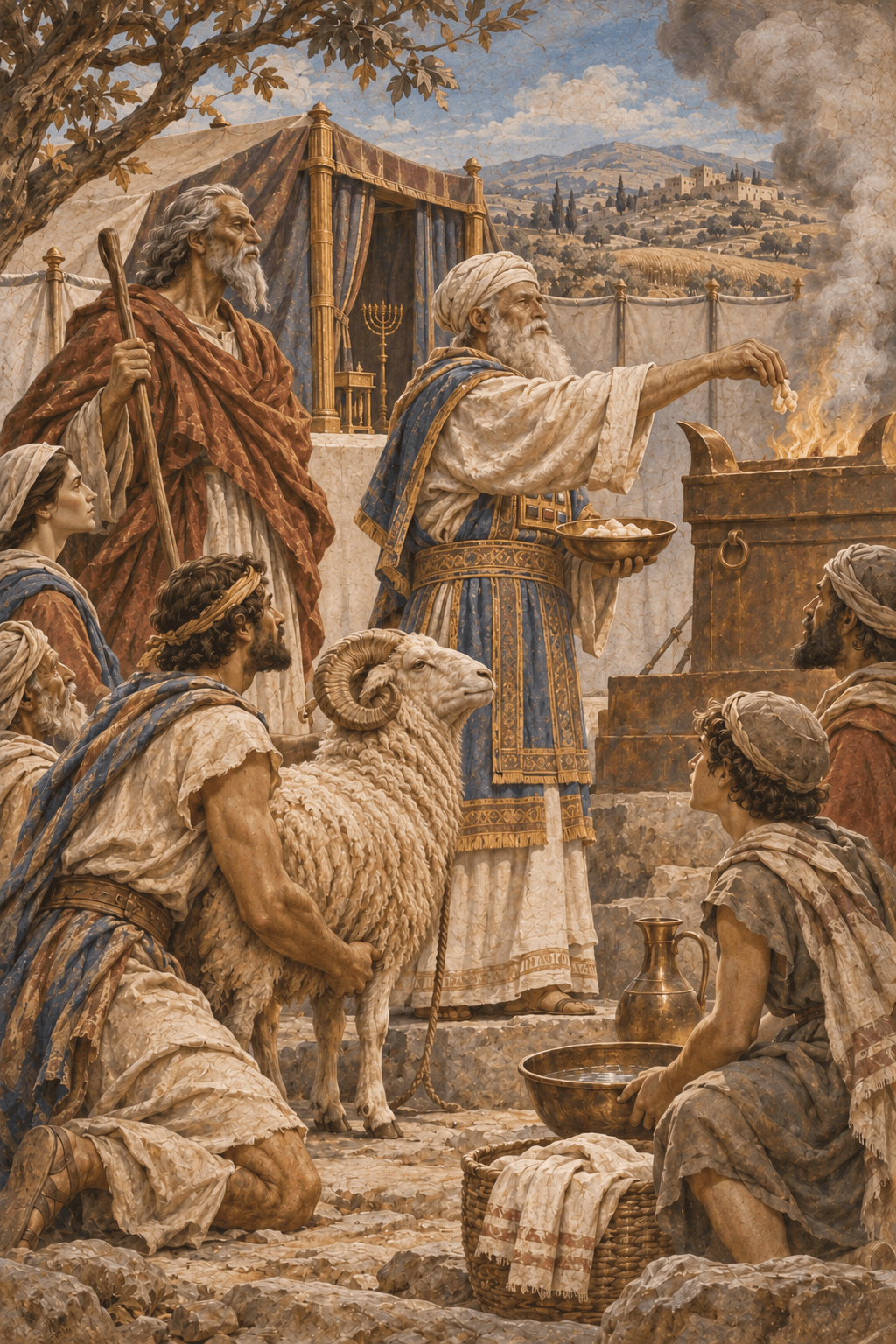
If a person was not able to offer a bullock without blemish, let him offer of the flock, of the sheep or of the goats… The rite of this burnt offering does not differ much from the previous rite; it is almost identical to it and carries the same meanings.
4. A Burnt Offering of Birds
KJV · Verses 14–17
14 And if the burnt sacrifice for his offering to the Lord be of fowls, then he shall bring his offering of turtledoves, or of young pigeons. 15 And the priest shall bring it unto the altar, and wring off his head, and burn it on the altar; and the blood thereof shall be wrung out at the side of the altar: 16 And he shall pluck away his crop with his feathers, and cast it beside the altar on the east part, by the place of the ashes: 17 And he shall cleave it with the wings thereof, but shall not divide it asunder: and the priest shall burn it upon the altar, upon the wood that is upon the fire: it is a burnt sacrifice, an offering made by fire, of a sweet savour unto the Lord.
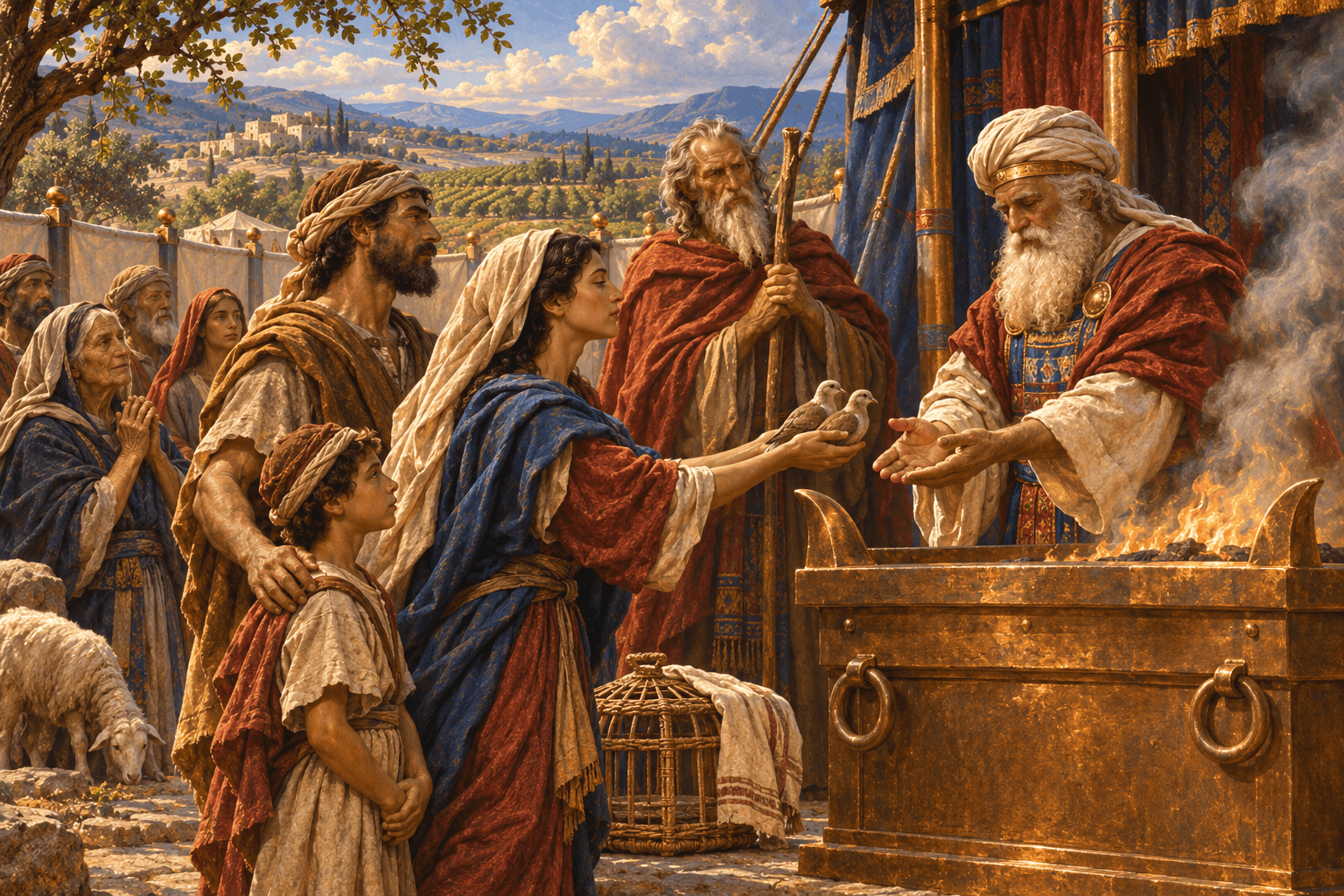
Whoever could not offer a bullock, a sheep, or a goat was to offer two turtledoves or two young pigeons, which was easy for the poor to offer, for the great majority, even the poor, raised birds in their houses.
God does not care about the material value of the offering; He seeks the heart. He wants us not to appear empty before Him. Let us offer Him a little, even two mites like the widow, for He seeks the fruit of the heart, not the gift. As Saint Paul, who bore the spirit of his Master, wrote: “Not because I desire a gift: but I desire fruit that may abound to your account” (Philippians 4:17).
Among the birds God accepts only the offering of turtledoves and pigeons. Saint Clement of Alexandria sees that the turtledoves point to the fear of sin, and the young pigeons to meekness and harmlessness. [45]
Origen holds that some turtledoves accept only one mate and approach no other, even if she dies; so it is a symbol of purity. The pigeon points to the Church, the fair dove that bears the Holy Spirit of God, who appeared in the form of a dove at the baptism of the Lord Christ; the pigeon also points to the life of simplicity. It is as if this offering is the offering of the Church, which appears poor in this world, owning nothing but turtledoves and pigeons, yet rich in her purity and the simplicity of her heart through the work of the Holy Spirit in her.
Notes and References
[5] J. Hastings, A Dictionary of the Bible, vol. 3, p. 103.
[6] Alfred Edersheim, The Temple, 1976, pp. 118–119.
[7] On Leviticus 17:11.
[8] St. John Chrysostom, In 2 Cor. hom. 5:5.
[9] Athenagoras, A Plea for the Christians 13.
[10] Edersheim, The Temple, pp. 126–127.
[11] Ibid., p. 127.
[12] St. Augustine, On Ps. 50.
[13] St. Augustine, On Ps. 52.
[14] St. Augustine, On Ps. 66.
[15] St. John Chrysostom, In Hebr. hom. 11:5–6.
[16] St. Gregory of Nazianzus, Orat. on Holy Baptism 40.
[17] Origen, In Lev. hom. 1:2.
[18] St. Augustine, On Ps. 64.
[19] Origen, In Lev. hom. 1:3.
[20] St. John Chrysostom, In Hebr. hom. 16:5.
[21] St. Augustine, On Ps. 65.
[22] St. John Chrysostom, In Matt. hom. 82.
[23] St. John Chrysostom, In Hebr. hom. 17:6.
[24] Origen, In Lev. hom. 1:2.
[25] St. John Chrysostom, In Hebr. hom. 33:4.
[26] Origen, In Lev. hom. 1:2.
[27] St. John Chrysostom, PG 50, In Ascensione.
[28] Edersheim, The Temple, p. 113.
[29] Ibid., pp. 113–114.
[30] Ibid., p. 114.
[31] St. John Chrysostom, In Hebr. hom. 13:9.
[32] St. Augustine, The Trinity 4:13.
[33] St. John Chrysostom, In Hebr. hom. 4:3.
[34] By the author: The Church, the House of God, 1979, p. 83.
[35] St. Athanasius, Ep. to Adelphius 8; De Incarn. 25.
[36] Origen, In Lev. hom. 1:3.
[37] St. John Chrysostom, In Lev. hom. 14:3; 16:17 (as printed).
[38] Origen, In Lev. hom. 1:4.
[39] St. John Chrysostom, In Ioan. hom. 35:3.
[40] St. John Chrysostom, In Hebr. hom. 16:3.
[41] St. John Chrysostom, In Ioan. hom. 25:2.
[42] St. Ambrose, Duties of the Clergy.
[43] St. John Chrysostom, In Hebr. hom. 1:5.
[44] Origen, In Lev. hom. 1:5.
[45] St. Clement of Alexandria, Instructor 1:5.