
After Benjamin had received his portion by lot, the lot determined the turn of the remaining tribes; and finally Joshua the son of Nun received his portion in the midst of Israel.
1. The portions of the remaining tribes (1–48).
2. The portion of Joshua the son of Nun (49–51).
1. The Portions of the Remaining Tribes
KJV · Verses 1–48
1 And the second lot came forth to Simeon, even for the tribe of the children of Simeon according to their families: and their inheritance was within the inheritance of the children of Judah. 2 And they had in their inheritance Beersheba, and Sheba, and Moladah, 3 And Hazarshual, and Balah, and Azem, 4 And Eltolad, and Bethul, and Hormah, 5 And Ziklag, and Bethmarcaboth, and Hazarsusah, 6 And Bethlebaoth, and Sharuhen; thirteen cities and their villages: 7 Ain, Remmon, and Ether, and Ashan; four cities and their villages: 8 And all the villages that were round about these cities to Baalathbeer, Ramath of the south. This is the inheritance of the tribe of the children of Simeon according to their families. 9 Out of the portion of the children of Judah was the inheritance of the children of Simeon: for the part of the children of Judah was too much for them: therefore the children of Simeon had their inheritance within the inheritance of them. 10 And the third lot came up for the children of Zebulun according to their families: and the border of their inheritance was unto Sarid: 11 And their border went up toward the sea, and Maralah, and reached to Dabbasheth, and reached to the river that is before Jokneam; 12 And turned from Sarid eastward toward the sunrising unto the border of Chislothtabor, and then goeth out to Daberath, and goeth up to Japhia, 13 And from thence passeth on along on the east to Gittahhepher, to Ittahkazin, and goeth out to Remmonmethoar to Neah; 14 And the border compasseth it on the north side to Hannathon: and the outgoings thereof are in the valley of Jiphthahel: 15 And Kattath, and Nahallal, and Shimron, and Idalah, and Bethlehem: twelve cities with their villages. 16 This is the inheritance of the children of Zebulun according to their families, these cities with their villages. 17 And the fourth lot came out to Issachar, for the children of Issachar according to their families. 18 And their border was toward Jezreel, and Chesulloth, and Shunem, 19 And Haphraim, and Shihon, and Anaharath, 20 And Rabbith, and Kishion, and Abez, 21 And Remeth, and Engannim, and Enhaddah, and Bethpazzez; 22 And the coast reacheth to Tabor, and Shahazimah, and Bethshemesh; and the outgoings of their border were at Jordan: sixteen cities with their villages. 23 This is the inheritance of the tribe of the children of Issachar according to their families, the cities and their villages. 24 And the fifth lot came out for the tribe of the children of Asher according to their families. 25 And their border was Helkath, and Hali, and Beten, and Achshaph, 26 And Alammelech, and Amad, and Misheal; and reacheth to Carmel westward, and to Shihorlibnath; 27 And turneth toward the sunrising to Bethdagon, and reacheth to Zebulun, and to the valley of Jiphthahel toward the north side of Bethemek, and Neiel, and goeth out to Cabul on the left hand, 28 And Hebron, and Rehob, and Hammon, and Kanah, even unto great Zidon; 29 And then the coast turneth to Ramah, and to the strong city Tyre; and the coast turneth to Hosah; and the outgoings thereof are at the sea from the coast to Achzib: 30 Ummah also, and Aphek, and Rehob: twenty and two cities with their villages. 31 This is the inheritance of the tribe of the children of Asher according to their families, these cities with their villages. 32 The sixth lot came out to the children of Naphtali, even for the children of Naphtali according to their families. 33 And their coast was from Heleph, from Allon to Zaanannim, and Adami, Nekeb, and Jabneel, unto Lakum; and the outgoings thereof were at Jordan: 34 And then the coast turneth westward to Aznothtabor, and goeth out from thence to Hukkok, and reacheth to Zebulun on the south side, and reacheth to Asher on the west side, and to Judah upon Jordan toward the sunrising. 35 And the fenced cities are Ziddim, Zer, and Hammath, Rakkath, and Chinnereth, 36 And Adamah, and Ramah, and Hazor, 37 And Kedesh, and Edrei, and Enhazor, 38 And Iron, and Migdalel, Horem, and Bethanath, and Bethshemesh; nineteen cities with their villages. 39 This is the inheritance of the tribe of the children of Naphtali according to their families, the cities and their villages. 40 And the seventh lot came out for the tribe of the children of Dan according to their families. 41 And the coast of their inheritance was Zorah, and Eshtaol, and Irshemesh, 42 And Shaalabbin, and Ajalon, and Jethlah, 43 And Elon, and Thimnathah, and Ekron, 44 And Eltekeh, and Gibbethon, and Baalath, 45 And Jehud, and Beneberak, and Gathrimmon, 46 And Mejarkon, and Rakkon, with the border before Japho. 47 And the coast of the children of Dan went out too little for them: therefore the children of Dan went up to fight against Leshem, and took it, and smote it with the edge of the sword, and possessed it, and dwelt therein, and called Leshem, Dan, after the name of Dan their father. 48 This is the inheritance of the tribe of the children of Dan according to their families, these cities with their villages.
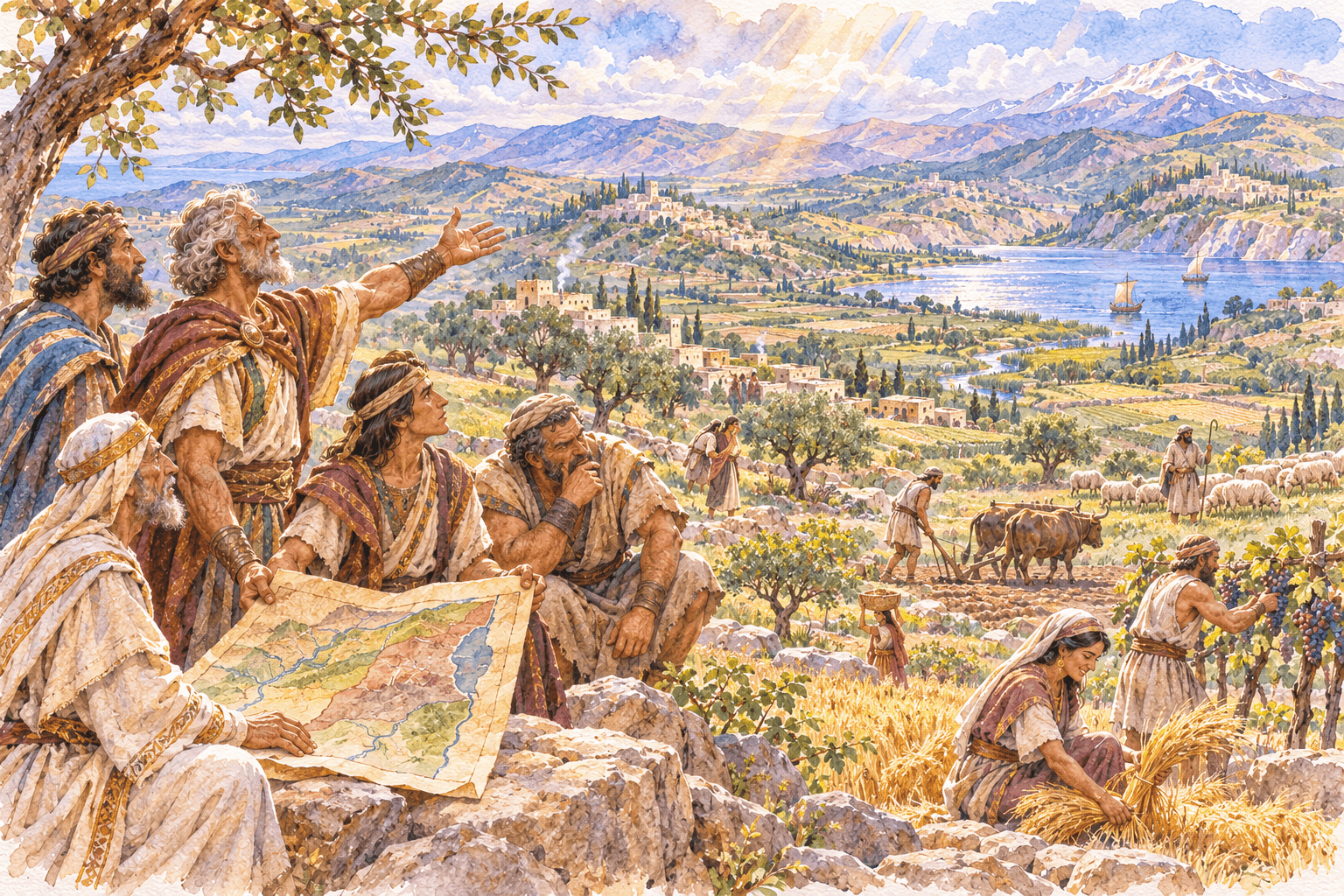
We have said that Origen sees in everything that happened in the land of promise a symbol relating to the heavenly life, even if we do not perceive it now. In any case, the rest of the land was divided among the remaining six tribes in order: the tribe of Simeon, the tribe of Zebulun, the tribe of Issachar, the tribe of Asher, the tribe of Naphtali, and finally the tribe of Dan.
If you have not found a place for yourself in the previous tribes, ask to belong to one of these tribes. “Simeon,” which means “one who hears,” includes the company of those who listen to the commandment and obey God. The tribe of “Zebulun,” which means “dwelling,” includes those whose hearts open to God as a dwelling for Him. The tribe of “Issachar,” that is, “reward,” points to those who seek the heavenly reward. The tribe of “Asher,” that is, “happy,” contains those who are blessed in the Lord and filled with the joy of the Holy Spirit. And finally “Dan,” that is, “he judges,” includes those who judge themselves and not others. [241]
2. The Portion of Joshua the Son of Nun
KJV · Verses 49–51
49 When they had made an end of dividing the land for inheritance by their coasts, the children of Israel gave an inheritance to Joshua the son of Nun among them: 50 According to the word of the Lord they gave him the city which he asked, even Timnathserah in mount Ephraim: and he built the city, and dwelt therein. 51 These are the inheritances, which Eleazar the priest, and Joshua the son of Nun, and the heads of the fathers of the tribes of the children of Israel, divided for an inheritance by lot in Shiloh before the Lord, at the door of the tabernacle of the congregation. So they made an end of dividing the country.
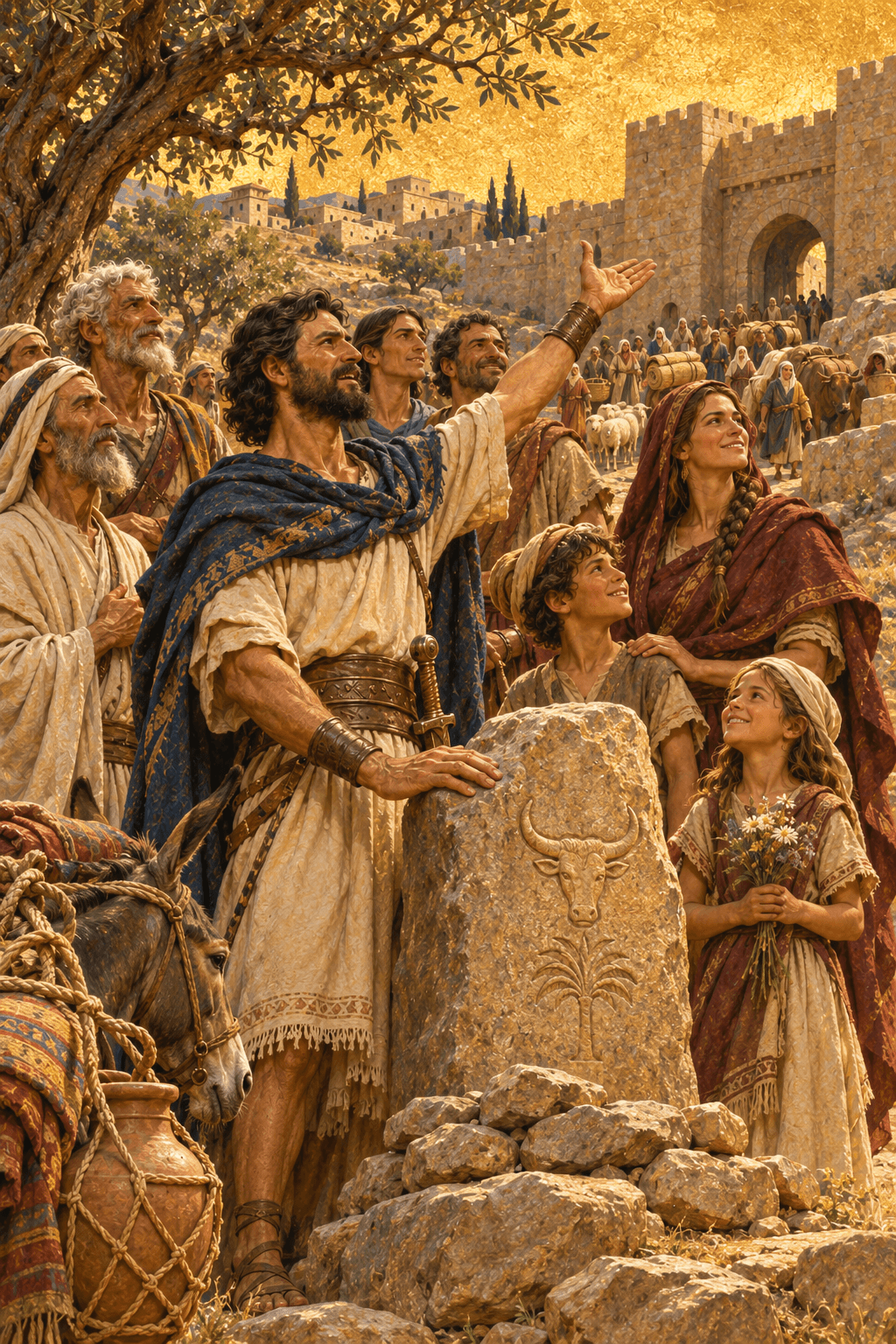
“When they had made an end of dividing the land for inheritance by their coasts, the children of Israel gave an inheritance to Joshua the son of Nun among them” [49]. It is not strange that Joshua should wait to receive his portion in the midst of God’s people until after they had enjoyed their portions. This was not from disregard for the inheritance; rather, he counts what each of them receives as received by himself, and waits to take his portion among them, so that the people themselves are his portion.
This is a living picture of the mind of Christ Himself, who counts all we possess as possessed by Him, being our Head, glorified in His honored body … He remains as the last of all, so that He may rejoice in all His elect, His partners in the eternal inheritance. On this Origen says:
“What beauty and what humility this phrase shows concerning Joshua! He was truly worthy to bear the name of Jesus our Lord and Savior. Scripture says: ‘The children of Israel gave an inheritance to Joshua the son of Nun among them: according to the word of the Lord they gave him the city which he asked, even Timnath-serah in mount Ephraim: and he built the city, and dwelt therein’ [49–50]. It was he who gave the inheritance to all the children of Judah, to Ephraim and to the half tribe of Manasseh; he who gave the inheritance to the noble Caleb the son of Jephunneh; he who sent three men from every tribe to go through the whole country, make the plan and present it to him on their return. He determined the lot of all, and left himself the last place! Why did he want to be the last of all? To affirm that it is he who becomes the first of all (Matthew 19:30). He did not take his share of the inheritance by himself, but received it from the people, for Scripture says: ‘The children of Israel gave an inheritance to Joshua the son of Nun among them’ [49]. But ‘all these things happened unto them for ensamples’ (1 Corinthians 10:11). They were set before us as a picture, so that we in turn may observe the principles that Joshua fulfilled in these works: ‘If thou be made the master, lift not thyself up, but be among them as one of the rest’ (Sirach 32:1). See in what manner he was the leader of the people! He brought them into the holy land, the land of promise, and was the successor of Moses; and yet he did not allow himself to take his portion of the land, but waited to receive his piece of land from the people. He is the leader of the people; yet when Joshua, worthy of this name, received it, he built the land given to him and raised buildings on it, so that it might be worthy of the gift of God and of the spiritual inheritance. [242]”
If Joshua is a symbol of the Lord Christ, would that we might do what the children of Israel did: offer our Joshua a land or a portion among us, offering Him our heart, the center of our life, as the Lord’s portion. He receives it as land and builds His holy city in it and dwells there [50]. If we cannot build Him a city within us — for the Most High dwells not in temples made with hands — then by His Holy Spirit He builds His spiritual, fortified city to dwell in, turning our heart into His holy heaven. This is what the Lord Himself affirmed when He said:
“If a man love me, he will keep my words: and my Father will love him, and we will come unto him, and make our abode with him” (John 14:23).
Notes and References
[241] Commentary on Numbers (Arabic), 1981, p. 15.
[242] Origen, Homilies on Joshua 24:2.