
We said that the first meeting pointed to our enjoyment of fellowship in the sufferings of the Lord Christ and His crucifixion, and the second meeting pointed to burial with the Lord Christ; but this meeting points to our resurrection with the Lord Christ, who revealed Himself to us as the Giver of life and the Conqueror of death.
1. Joseph Reveals Himself
KJV · Verses 1–15
1 Then Joseph could not refrain himself before all them that stood by him; and he cried, Cause every man to go out from me. And there stood no man with him, while Joseph made himself known unto his brethren. 2 And he wept aloud: and the Egyptians and the house of Pharaoh heard. 3 And Joseph said unto his brethren, I am Joseph; doth my father yet live? And his brethren could not answer him; for they were troubled at his presence. 4 And Joseph said unto his brethren, Come near to me, I pray you. And they came near. And he said, I am Joseph your brother, whom ye sold into Egypt. 5 Now therefore be not grieved, nor angry with yourselves, that ye sold me hither: for God did send me before you to preserve life. 6 For these two years hath the famine been in the land: and yet there are five years, in the which there shall neither be earing nor harvest. 7 And God sent me before you to preserve you a posterity in the earth, and to save your lives by a great deliverance. 8 So now it was not you that sent me hither, but God: and he hath made me a father to Pharaoh, and lord of all his house, and a ruler throughout all the land of Egypt. 9 Haste ye, and go up to my father, and say unto him, Thus saith thy son Joseph, God hath made me lord of all Egypt: come down unto me, tarry not: 10 And thou shalt dwell in the land of Goshen, and thou shalt be near unto me, thou, and thy children, and thy children's children, and thy flocks, and thy herds, and all that thou hast: 11 And there will I nourish thee; for yet there are five years of famine; lest thou, and thy household, and all that thou hast, come to poverty. 12 And, behold, your eyes see, and the eyes of my brother Benjamin, that it is my mouth that speaketh unto you. 13 And ye shall tell my father of all my glory in Egypt, and of all that ye have seen; and ye shall haste and bring down my father hither. 14 And he fell upon his brother Benjamin's neck, and wept; and Benjamin wept upon his neck. 15 Moreover he kissed all his brethren, and wept upon them: and after that his brethren talked with him.
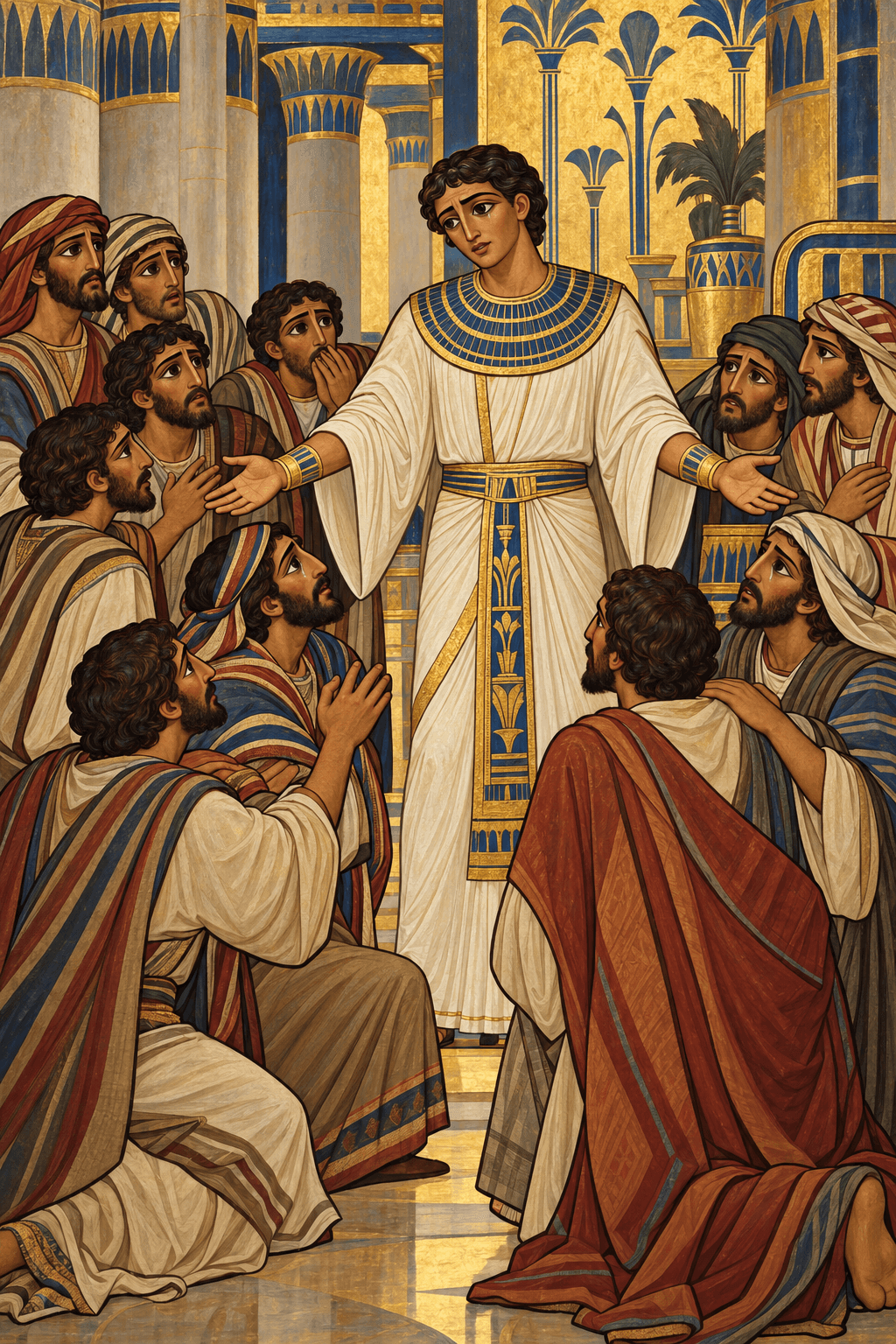
“Then Joseph could not refrain himself before all them that stood by him; and he cried, Cause every man to go out from me. And there stood no man with him, while Joseph made himself known unto his brethren. And he wept aloud: and the Egyptians and the house of Pharaoh heard. And Joseph said unto his brethren, I am Joseph; doth my father yet live? And his brethren could not answer him; for they were troubled at his presence” (1–3).
When Judah related the conversation between himself and his father Israel, Joseph discerned through it how his absence had left a deep mark on his father’s soul that could not be removed, and that Israel’s soul had become bound to Benjamin, so that Judah offered himself as a ransom in place of Benjamin so as not to see his father struck by evil because of Benjamin’s not returning… Before these feelings, together with the burning longing in Joseph’s heart toward his father, he could not bear the situation, so that he cried out: Cause every man to go out from me. Here Joseph reveals himself to his brothers, his eyes bursting with tears, weeping with a loud voice that the Egyptians outside heard!
Joseph had restrained himself in the two previous meetings; his heart burned with love and longing, and he wept behind his brothers’ backs… But now he could not hide his feelings, and could only reveal himself after sending out the strangers.
The first meeting was in the presence of many, and the second also; but in the third, Joseph did not reveal himself until he had sent out the strangers. So the first meeting with the Lord Christ took place at the cross before all, who witnessed all the events of the crucifixion; and also at the burial, for the soldiers were around the tomb. But in the resurrection He revealed Himself only to His beloved, who long for the risen life. In other words, the crucifixion and also the burial took place openly, declaring God to all people; but the mystery of the resurrection is enjoyed only by those who desire to know His mysteries and enjoy His risen life. For the resurrection of the Lord Christ is the mystery of the manifestation of Christ, the Conqueror of death, and His revelation of Himself in His Church, which enjoys life with Him and abides in Him.
Scripture says: “and the Egyptians and the house of Pharaoh heard”… They heard the sound of weeping with Joseph’s cry, but they did not understand what was happening inside: was it the weeping of joy, of amazement, or of grief?! They were like the guards at the tomb, who saw an intense splendor and felt the earthquake but could not know the mystery of the Lord Christ’s resurrection nor receive it within them, for they were outside! I say they were like the companions of Saul of Tarsus, who saw an intense light and a voice from heaven but did not enjoy understanding the voice of the Risen One nor see Him… the meeting was with Saul alone.
“And Joseph said unto his brethren, I am Joseph”… as though he symbolizes the Lord Christ, who said from heaven: “I am Jesus whom thou persecutest: it is hard for thee to kick against the pricks” (Acts 9:5). And as Joseph’s brothers were troubled at this meeting, Saul too was troubled and perplexed!
May we hear the voice of our Joseph whom we sold by our sins: I am Joseph your brother, who loved you and offered you every tenderness, and you sold me for counterfeit silver! I am Joseph whom you pushed into humiliation… “Now therefore be not grieved, nor angry with yourselves, that ye sold me hither: for God did send me before you to preserve life” (5). We sold Him for counterfeit silver, and behold, He is crucified to give us eternal life.
I say, may we not be afraid of meeting our Lord Jesus, risen from the dead, for He is gentle to the utmost, even in His reproach of us!
When he revealed himself to them he said: “doth my father yet live?” (3). He had already learned from them that he was alive, but he asks in amazement, as though saying: How has my father endured the trial?! Is he perhaps waiting in hope to see me? — to reveal to us that what occupies the mind of our new Joseph when we meet Him through the resurrection is the offering of His atoning sacrifice in obedience to the Father, who is “living” and longs to give life to every person.
“And his brethren could not answer him; for they were troubled at his presence” (3). What is the secret of their fear? They saw Joseph as one who had died and risen! They did not expect to see their brother again, especially in this great glory. Perhaps they remembered Joseph’s dreams, which they had despised and mocked, and which today were fulfilled in the most splendid form! Or perhaps they counted themselves fallen into the lion’s mouth: the one they had mercilessly cast into death had suddenly risen bearing authority!
With wonderful gentleness Joseph wished to remove all fear from them, saying to them: “Come near to me, I pray you” (4). Perhaps from the horror of the situation and their great agitation they had drawn back… but the sweet Joseph tenderly calls them: “Come near to me.” By sin we become far from our Joseph; but when we hear His voice and accept the work of His resurrection in us, we draw near to Him, as the Apostle Paul says: “But now in Christ Jesus ye who sometimes were far off are made nigh by the blood of Christ” (Ephesians 2:13).
To move them to draw near to him not only with their bodies but with all their hearts, he said to them: “Now therefore be not grieved, nor angry with yourselves, that ye sold me hither: for God did send me before you to preserve life… So now it was not you that sent me hither, but God” (5–8).
Though he revealed their iniquity by saying, “I am Joseph your brother, whom ye sold into Egypt” (4), he quickly offered them the remedy: God had used even this evil for his good and theirs. Two years of the famine had passed, and five years remained; now God had sent him to save them through all these harsh years so that they would not die. With the same thought the Lord Christ declares to His own that, though they sold Him and delivered Him to death, two years of famine have passed for the world, and the world remains hungry five years until the end of the age comes. The Word of God sustained the world in the Old Testament, and now sustains them in the New Testament, until the famine of temporal life passes and we enter into the fullness of eternal satisfaction.
How beautiful it is to sense God’s plan and dispensation, as He turns all things to good, even if our brothers wanted to be rid of us by selling us into Egypt.
He also says: “and he hath made me a father to Pharaoh, and lord of all his house, and a ruler throughout all the land of Egypt” (8). In ancient times Pharaoh called the chief minister his father, for he left him the management of all the affairs of the state, as a son commits his life into his father’s hands. And if Pharaoh represents the Gentile world of that time, the Lord Christ became a father to the Gentiles, Lord over all their life, and ruler over their bodies (all the land) as over their spirits. Thus the true Joseph cares for the community of the strange Gentiles, joining them to Himself as members of His body.
Now, having removed fear from them, he asked them to hasten to him with his father: “Haste ye, and go up to my father, and say unto him, Thus saith thy son Joseph, God hath made me lord of all Egypt: come down unto me, tarry not: and thou shalt dwell in the land of Goshen, and thou shalt be near unto me, thou, and thy children, and thy children’s children, and thy flocks, and thy herds, and all that thou hast: and there will I nourish thee; for yet there are five years of famine; lest thou, and thy household, and all that thou hast, come to poverty… And ye shall tell my father of all my glory in Egypt” (9–13).
Joseph did not think of the past through a sickly human lens, but with spiritual insight, which is in truth a divine gift. Instead of rebuking his brothers for the wrong they had done him and the troubles they had caused him through the past years, he saw God’s mighty hand and His surpassing plan for his salvation and the salvation of his father, his brothers, and their children from death. He found no time for talk, but wished to honor all by earnest action, saying: “Haste ye, and go up to my father,” and asked them to tell his father: “come down unto me, tarry not!” It is no time for words but for action and salvation from a death to which the world would be exposed for the coming five years!
As for the land of Goshen, which Joseph chose for his father, his brothers, and all their children, it lies in the northeast of the Delta, where the governorate of Sharqia is now; it is also called the land of Rameses (Genesis 47:11). It was among the best lands, a land for grazing; Israel dwelt there in Joseph’s days, shepherding Pharaoh’s flocks and their own, and Israel remained there until the time of affliction.
Finally, he counted the glory that was his as belonging to his father and brothers, saying to them: “And ye shall tell my father of all my glory in Egypt” (13). He is the opposite of many who, when they grow rich or obtain honor, ignore their families and become arrogant toward them. Joseph felt that what he had attained was not his own merit, but God’s work for the sake of his father and brothers, that they might be glorified and live. In this he became an image of the Lord Christ, who left His glory for our sake and was glorified again with the glory He had before the world was (John 17:5), to lift us up with Him in His glory as heirs of the inheritance.
2. The Invitation to Enter Egypt
KJV · Verses 16–24
16 And the fame thereof was heard in Pharaoh's house, saying, Joseph's brethren are come: and it pleased Pharaoh well, and his servants. 17 And Pharaoh said unto Joseph, Say unto thy brethren, This do ye; lade your beasts, and go, get you unto the land of Canaan; 18 And take your father and your households, and come unto me: and I will give you the good of the land of Egypt, and ye shall eat the fat of the land. 19 Now thou art commanded, this do ye; take you wagons out of the land of Egypt for your little ones, and for your wives, and bring your father, and come. 20 Also regard not your stuff; for the good of all the land of Egypt is your's. 21 And the children of Israel did so: and Joseph gave them wagons, according to the commandment of Pharaoh, and gave them provision for the way. 22 To all of them he gave each man changes of raiment; but to Benjamin he gave three hundred pieces of silver, and five changes of raiment. 23 And to his father he sent after this manner; ten asses laden with the good things of Egypt, and ten she asses laden with corn and bread and meat for his father by the way. 24 So he sent his brethren away, and they departed: and he said unto them, See that ye fall not out by the way.
When Pharaoh and his servants heard of Joseph’s meeting with his brothers, they were very glad (16), for all loved Joseph. And Pharaoh was exceedingly generous, for he asked Joseph: “Say unto thy brethren, This do ye; lade your beasts, and go, get you unto the land of Canaan; and take your father and your households, and come unto me: and I will give you the good of the land of Egypt, and ye shall eat the fat of the land. Now thou art commanded, this do ye; take you wagons out of the land of Egypt for your little ones, and for your wives, and bring your father, and come. Also regard not your stuff; for the good of all the land of Egypt is yours” (17–20).
What are the good things of the land of Egypt and the fat of the land of Egypt which Pharaoh longed to offer to Joseph’s brothers out of love for their brother, beloved to him, but a sign of the mysteries of God’s kingdom and the overflowing riches of heaven which have become ours from God through the new Joseph, beloved of the Father? He asked them to take wagons for themselves, their children, and their wives, and come to enjoy the good things of all the land of Egypt, which would be theirs. What are these wagons that carry us but God’s saving works and the means of salvation — the enjoyment of the word of God and the sacraments of the Church, with prayers and prostrations — things that kindle the heart to set out by the Holy Spirit, not to enjoy the good things of the land of Egypt but the good things of heaven itself. Among these divine wagons is the sacrament of baptism, for example. We hear Saint Gregory of Nazianzus say:
Illumination is baptism. Illumination is a vehicle moving toward God, a going along with Christ, the foundation of faith, the perfecting of the mind. Illumination is the key of the kingdom of heaven, the restoration of life, the release from slavery, the loosing of bonds. [435]
The second wagon that sets out with us to glory is the sacrifice of the Eucharist, for it is said in the Syriac Liturgy of Addai and Mari: “This offering of Thy servants… let it be for the forgiveness of our transgressions and the blotting out of our sins, and a great light for the resurrection from the dead, and new life in the kingdom of heaven”… Thus we say that the works of the Holy Spirit in the life of the Church are like divine wagons able to lift us to the Father’s bosom through our being established in Christ Jesus our Lord.
Returning to Pharaoh, we find him saying, “Now thou art commanded,” though it is clear from the context that Pharaoh had not heard that Joseph had commanded his family to be brought. But Pharaoh counts what comes from him on behalf of Joseph and his family as though it came from Joseph himself, and what Joseph commands for the good of Egypt as though it came from Pharaoh. I say, with the difference, that what the Father gives us by His command is in Christ, and what Christ gives us is through the Father!
How sweet are the words Pharaoh spoke: “Also regard not your stuff; for the good of all the land of Egypt is yours” (20). It was not an easy matter for aged Israel, his sons, grandsons, and servants to leave their land, despite what had befallen them because of the famine, unless they looked to the promise, “for the good of all the land of Egypt is yours.” We too cannot give up what is ours in the land of our sojourning unless the Lord opens our insight to see the eternal glory prepared for us if our hearts depart thither… When the spiritual eyes of Paul the Apostle were opened to behold this glory, he said: “But what things were gain to me, those I counted loss for Christ. Yea doubtless, and I count all things but loss for the excellency of the knowledge of Christ Jesus my Lord: for whom I have suffered the loss of all things, and do count them but dung, that I may win Christ” (Philippians 3:7–8). Saint Paul found in the Lord Christ the pearl of great price, for which he sold everything with joy and gladness. He discovered the overflowing riches in Him, so he left everything, setting out with his heart, mind, and all his feelings, and found in Him all true fullness.
Returning to Joseph: with wonderful love he wished to assure them of his forgiveness of the past, for he gave them wagons and changes of raiment as a sign of honor, and gave his brother Benjamin three hundred pieces of silver with five changes of raiment. He sent ten asses laden with good things and ten she-asses laden with corn, bread, and meat for his father for the way from Canaan to Egypt… He also charged them: “See that ye fall not out by the way” (24), for he feared lest one of them blame another for what they had done to him before. It is no time for blame, but for hastening to return to him with their father, wives, children, and all they had.
What are these garments Joseph gave his brothers but union with the Lord Christ, so that we are with Him and in Him, hidden in Him, and He becomes to us as a garment covering us eternally, and by Him we have the right to enter into His Father’s bosom.
As for the silver he gave his youngest brother, it is the word of the Gospel, which the Lord Christ delivered to His Church, or to mankind as the youngest brother. As we saw earlier in our commentary on the Book of Judges, [436] the number 300 in Greek is represented by the letter tau “T,” that is, the cross; as though the three hundred pieces of silver Benjamin received are the acceptance of fellowship in the crucifixion and suffering with the Lord Christ through preaching the joyful word of the Gospel. And the five changes of raiment he gave Benjamin are the sanctification of our five senses, that they may bear the marks of the Lord Christ and be sanctified for Him by His Holy Spirit.
All that the true Joseph has given us is “meat for… the way” (23); what lies beyond this food is the enjoyment of things unspeakable, or as the Apostle says: “Eye hath not seen, nor ear heard, neither have entered into the heart of man, the things which God hath prepared for them that love him” (1 Corinthians 2:9). What we receive here is an earnest and provision for the way until we reach the glory, to enjoy the fullness of the divine gift.
3. Israel Hears about Joseph
KJV · Verses 25–28
25 And they went up out of Egypt, and came into the land of Canaan unto Jacob their father, 26 And told him, saying, Joseph is yet alive, and he is governor over all the land of Egypt. And Jacob's heart fainted, for he believed them not. 27 And they told him all the words of Joseph, which he had said unto them: and when he saw the wagons which Joseph had sent to carry him, the spirit of Jacob their father revived: 28 And Israel said, It is enough; Joseph my son is yet alive: I will go and see him before I die.
The men went up out of Egypt and came to their father, who heard the news of his son, and all his feelings and emotions froze from the shock of the situation. It was greater than old Jacob could bear, so that it seemed to him his heart had stopped beating. When he came to himself little by little and was sure of the truth of the news by seeing the wagons, his spirit revived anew, and he counted it the greatest divine gift to see Joseph his son and die… The wagons did not occupy him, nor the glory his son had reached, but he said: “I will go and see him” (28) — as though declaring what the psalmist said: “Whom have I in heaven but thee? and there is none upon earth that I desire beside thee” (Psalm 73:25).
Origen the scholar has a long comment on this text, of which we take a little, with a comment on our part:
First: He comments on the phrase, “And they went up out of Egypt, and came into the land of Canaan” (25), explaining that Scripture does not speak of going down to holy places but of going up to them, and the reverse also. [437] If Egypt was blessed by Joseph’s presence in it and became a source of fullness, yet in the Old Testament it was a symbol of the world or of the love of it; therefore it is said, “they went up out of Egypt,” for one rises above the world toward the heavenly Canaan. And we can say that Egypt became a blessing not by Joseph’s dwelling in it but by the coming of the Lord Christ Himself into it, with His mother and Saint Joseph.
Second: Origen sees that the word “revived” in the phrase, “the spirit of Jacob their father revived: And Israel said, It is enough; Joseph my son is yet alive” (27–28), came in the Latin with the meaning “shone” or “was enlightened.” It is as though Jacob, far from Joseph, was like a lamp going out, and was enlightened with life, for it is said, “and the life was the light of men” (John 1:4). [438] We can say that our souls, like Jacob, when they are far from the true Joseph, the spirit is quenched in them (1 Thessalonians 5:19); and when we come to know that He is alive, that is, risen from the dead, our souls are enlightened within us by the joy of His resurrection at work in us.
If Jacob longed to end his life by seeing Joseph alive, he represents mankind, which longed to enjoy seeing the Lord Christ risen from the dead so as to fall asleep in hope.
Third: Origen says that Israel marveled when he heard that Joseph was “governor over all the land of Egypt” (26), that is, conqueror of every sin of lusts, fornication, and defilement. [439]
May we be united with our true Joseph, so that we bear every victory in Him and are truly rulers over one city, or two, or three — indeed over our whole body (our symbolic Egypt). By Him we discipline the mind, by Him we live holy in our senses and emotions, and by Him we walk with dignity!
Notes and References
[435] See the author’s Divine Love (Arabic), pp. 855–856.
[436] See the commentary on Judges 7.
[437] Origen, In Gen. hom. 15:1.
[438] Ibid. 15:2.
[439] Ibid. 15:3.