
These four chapters (7–10) speak of the first nine plagues, while chapters 11–12 speak of the last plague, which was bound up with the Passover lamb. The commentary on chapters 7–12 is arranged as follows:
- An introduction to the plagues (7:1–13).
- The water turned to blood (7:14–25).
- The plague of frogs (8:1–15).
- The plague of lice (8:16–19).
- The plague of flies (8:20–32).
- The plague on the cattle (9:1–7).
- The plague of boils (9:8–12).
- The plague of hail and fire (9:13–35).
- The plague of locusts (10:1–20).
- The plague of darkness (10:21–29).
- The plague of the firstborn (chapters 11–12).
1. An Introduction to the Plagues
KJV · Verses 1–13
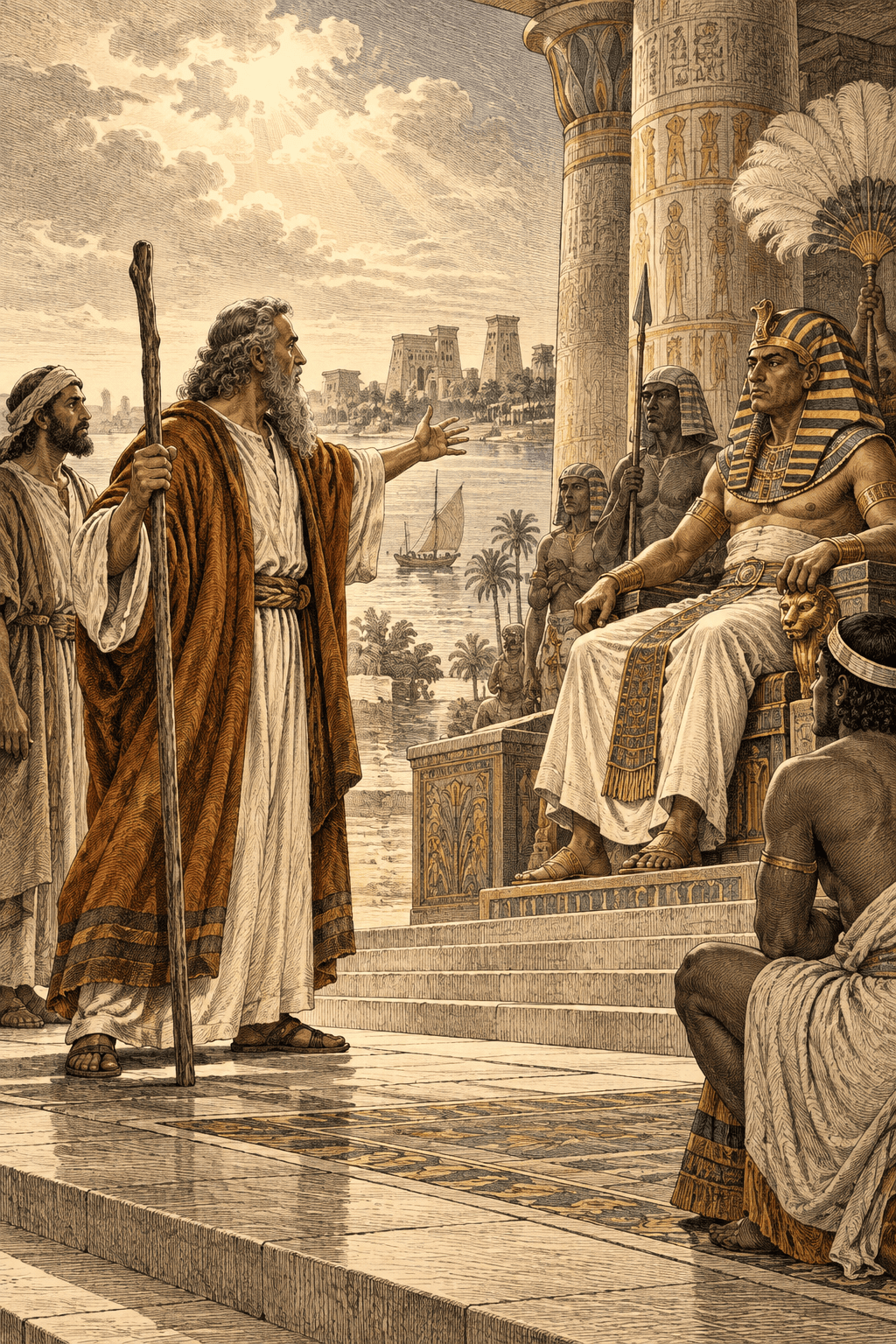
1 And the Lord said unto Moses, See, I have made thee a god to Pharaoh: and Aaron thy brother shall be thy prophet. 2 Thou shalt speak all that I command thee: and Aaron thy brother shall speak unto Pharaoh, that he send the children of Israel out of his land. 3 And I will harden Pharaoh's heart, and multiply my signs and my wonders in the land of Egypt. 4 But Pharaoh shall not hearken unto you, that I may lay my hand upon Egypt, and bring forth mine armies, and my people the children of Israel, out of the land of Egypt by great judgments. 5 And the Egyptians shall know that I am the Lord, when I stretch forth mine hand upon Egypt, and bring out the children of Israel from among them. 6 And Moses and Aaron did as the Lord commanded them, so did they. 7 And Moses was fourscore years old, and Aaron fourscore and three years old, when they spake unto Pharaoh. 8 And the Lord spake unto Moses and unto Aaron, saying, 9 When Pharaoh shall speak unto you, saying, Shew a miracle for you: then thou shalt say unto Aaron, Take thy rod, and cast it before Pharaoh, and it shall become a serpent. 10 And Moses and Aaron went in unto Pharaoh, and they did so as the Lord had commanded: and Aaron cast down his rod before Pharaoh, and before his servants, and it became a serpent. 11 Then Pharaoh also called the wise men and the sorcerers: now the magicians of Egypt, they also did in like manner with their enchantments. 12 For they cast down every man his rod, and they became serpents: but Aaron's rod swallowed up their rods. 13 And he hardened Pharaoh's heart, that he hearkened not unto them; as the Lordhad said.
Before God began the plagues, He assured Moses of several truths:
A) “See, I have made thee a god to Pharaoh” (1), that is, I have made you a lord over him; so do not fear him or dread the hardness of his heart. As Saint Basil the Great says:
This title offers proof of a kind of authority in governing or in acting. [118]
The believer is wary of the devil, but he believes that he has authority over him, as the Lord said: “Behold, I give unto you power to tread on serpents and scorpions, and over all the power of the enemy: and nothing shall by any means hurt you” (Luke 10:19). And as Saint John Chrysostom affirms in more than one discourse, Satan has no authority over us; he only offers his temptations, which do not compel us, and his tricks and deceptions, so that we may fall into his snares. [119]
B) “Aaron thy brother shall be thy prophet” (1), that is, the one who speaks for you. When the commandment (Moses) was joined to the priestly work of worship (Aaron), worship became the declaration of the commandment and its revealer. This is our faith: our liturgical worship is not something separate from our Gospel, but works by it and preaches it. The unlearned and the child can grasp the mysteries of the Gospel through the simplicity and spirituality of the rite, and the learned and mature can find in it the depths of the theological concepts of the Gospel.
C) The purpose of the plagues: “And the Egyptians shall know that I am the LORD” (5), that is, to scatter the darkness of ignorance which had blinded man’s eyes in his evil. In other words, God did not intend by them to throw terror into the hearts of those present, but wanted them to be a support for salvation. As Saint Gregory of Nyssa says:
By these very miracles the enemy (Satan) is defeated and the people of God are strengthened. [120]
The Lord reminded them of these after many centuries, to bring them back to Him. In the psalm (Psalm 78:43–53) He reproaches them: He saved them with a mighty hand and struck the enemy to help them, yet they still walk in the hardness of their heart.
D) Pharaoh called two magicians. Saint Paul the Apostle mentions their names, “Jannes and Jambres” (2 Timothy 3:8), from Jewish tradition. These two magicians resisted Moses and Aaron, not by throwing terror and threats as Pharaoh did, but through a dangerous war, the war of blurring the line between truth and falsehood, between the work of God and the work of the devil. They tried to do what Moses and Aaron did, but they failed, for Scripture says:
- “But Aaron’s rod swallowed up their rods” (12).
- “And the magicians did so with their enchantments to bring forth lice, but they could not… Then the magicians said unto Pharaoh, This is the finger of God” (Exodus 8:18–19).
- “And the magicians could not stand before Moses because of the boils; for the boil was upon the magicians, and upon all the Egyptians” (Exodus 9:11).
In other words, though the magicians tried to deceive by producing, through sorcery, some works bearing the likeness of what Moses and Aaron did, they were weak. The two magicians fell under the plagues like the others; they could not cancel the plagues or save Pharaoh and his soldiers… and they were forced to confess the power of “the finger of God.”
In our study of the Book of Revelation we saw a similar war. As the Holy Trinity reveals His works with man, the unholy trinity, “the Antichrist, the beast from the land, and the beast from the sea,” tries to deceive people, and sometimes even presents works that seem to resemble the works of the Holy Trinity, such as working miracles by satanic power. [121]
E) The rod in the hand of Moses the prophet was called “the rod of God” (Exodus 4:20), “Aaron’s rod” (12), and “Moses’ rod” (Exodus 10:13). It is the rod of salvation that works in our life. It points to faith in the Cross, the life-giving wood, and so it is called the rod of God. It also points to the divine commandment, or the word of God preaching the Cross (the rod of Moses), and to the life of worship through which we enter into communion with the Crucified (the rod of Aaron). It is as if faith is joined to Holy Scripture and to worship without separation.
F) The rod between the Law and the Cross: The rod that Moses brought to Egypt is the Law, with which he strikes the ten plagues, that is, condemns sin and exposes it. It is also the Cross, which stripped the devil of his authority and broke his power, giving the faithful the power of victory and salvation. On this Origen says:
Moses comes to Egypt bearing the rod with which he punishes and strikes the ten plagues, that is, with the ten commandments. But the rod by which these things were done, which subdued Egypt and tamed Pharaoh, is the Cross of Christ, which overcame the world and triumphed over (the prince of this world) and over “principalities and powers” (Colossians 2:15). When it is cast on the ground, it turns into a serpent and devours the serpents of the magicians of Egypt, who had done the same thing. The Gospel has revealed to us that this serpent is wisdom, saying: “Be ye therefore wise as serpents” (Matthew 10:16); and elsewhere: “Now the serpent was more subtil than any beast of the field” (Genesis 3:1). So the Cross of Christ, the preaching of which was counted a kind of madness, was present in Moses, that is, in the Law, as the Lord said: “For he wrote of me” (John 5:46). This Cross of which Moses wrote, when it was cast on the ground, that is, when men believed in it, became a wisdom that devours all the wisdom of the Egyptians, that is, swallows up all the wisdom of this world. See how God has made foolish the wisdom of this world (1 Corinthians 1:20–21) by lifting up Christ on the Cross, who is the power of God and the wisdom of God!
G) The mystery of the ten plagues: Some fathers see in the ten plagues a symbolic picture of the work of the Cross in the heart of a person who has become a lover of the world, that is, has become like the land of Egypt, in order to bring him out into the holy life. In brief:
The first plague, turning the water of the river into blood, points to the need to turn the waters of the cold heart into a life of struggle, as the Apostle says: “Ye have not yet resisted unto blood” (Hebrews 12:4).
The second plague, the frogs, points to a life full of empty talk without work, like the croaking of frogs all night long. By the Holy Spirit we pass from much talking to the life of working faith.
The third plague, the lice, points to evil thoughts. A person does not feel the gnat on his body until it bites him; so a person often surrenders to thoughts and does not notice them until they have stirred his senses toward sin, and the word of Scripture applies to him: “which drinketh iniquity like water” (Job 15:16). By the Holy Spirit we shut the door of thought against evil, so that it opens and goes forth toward positive, constructive work.
The fourth plague, the flies, which come from filthy places and cause disease, points to the need to flee from the source of sin and its provocations, such as evil companions and places of defilement, so that we are not struck with weakness.
The fifth plague, the murrain that struck the cattle, points to sinking into carnal, animal thoughts. We must not walk according to the lusts of the flesh, but accept the desire of the Spirit.
The sixth plague, the boils and sores, points to the corruption of the body and our failure to sanctify it, since we must accept the work of the Holy Spirit even in the members of our body.
The seventh plague, the thunder, hail, and fire, points to God’s work within the heart: He thunders in us by His Holy Spirit to shake every sin that has settled and established itself within the heart; the hail falls to kill every beginning of a satanic planting (the weeds); and by His holy fire He burns the thorns that choke the soul and inflames the heart with the fire of divine love.
The eighth plague, the locusts, points to leaving no trace of sin in our life, as the locusts did not leave a green leaf in all the land.
The ninth plague, the darkness, is a person’s discovery of the blindness of his spiritual sight, so that he cries out to God to grant him inner spiritual enlightenment.
Finally, the tenth plague, the plague of the firstborn, points to the slaying of the devil and his soldiers, so that we ourselves may become members of the Church of the firstborn.
Origen gives us an interpretation of these ten plagues, saying:
Every soul in this world that lives in error and ignorance of the truth is (symbolically) in Egypt. When the Law of God [122] draws near to it, the waters are turned into blood for it, that is, the easy life full of idleness is turned into the blood of the Old and New Covenants. Then it draws the soul away from the vain talk which, in the eyes of God’s providence, is the croaking of frogs. Then it cleanses it of evil thoughts, which are like the bite of lice, and removes from it the stings of evil. It binds up in it the wounds caused by the frenzy symbolized by the flies, and destroys in it folly and animal perceptions… The Law cares for the wounds of its sins, removes from it the swelling of pride and the burns of anger, and offers it the voices of thunder, that is, the teachings of the Gospel. It uses the chastisements of the hail, that the luxuries and pleasures of the senses may be subdued in it, and offers it the fire of repentance, so that the soul repeats: “Did not our heart burn within us?” (Luke 24:32). The Law does not delay to send it the locusts, which attack the unruly, impure passions and devour them, so that the soul is disciplined by the teachings of the apostles: “Let all things be done decently and in order” (1 Corinthians 14:40). When it has received in full the chastisements for its evil habits and is committed to changing its life to the better life, it acknowledges the One who strikes, and says that it is “the finger of God.” Then it perceives the darkness of its works and confesses the darkness of its sins. When it reaches this point, God destroys within it the firstborn of Egypt (evil). [123]
2. The Water Turned to Blood
KJV · Verses 14–25
14 And the Lord said unto Moses, Pharaoh's heart is hardened, he refuseth to let the people go. 15 Get thee unto Pharaoh in the morning; lo, he goeth out unto the water; and thou shalt stand by the river's brink against he come; and the rod which was turned to a serpent shalt thou take in thine hand. 16 And thou shalt say unto him, The Lord God of the Hebrews hath sent me unto thee, saying, Let my people go, that they may serve me in the wilderness: and, behold, hitherto thou wouldest not hear. 17 Thus saith the Lord, In this thou shalt know that I am the Lord: behold, I will smite with the rod that is in mine hand upon the waters which are in the river, and they shall be turned to blood. 18 And the fish that is in the river shall die, and the river shall stink; and the Egyptians shall lothe to drink of the water of the river. 19 And the Lord spake unto Moses, Say unto Aaron, Take thy rod, and stretch out thine hand upon the waters of Egypt, upon their streams, upon their rivers, and upon their ponds, and upon all their pools of water, that they may become blood; and that there may be blood throughout all the land of Egypt, both in vessels of wood, and in vessels of stone. 20 And Moses and Aaron did so, as the Lord commanded; and he lifted up the rod, and smote the waters that were in the river, in the sight of Pharaoh, and in the sight of his servants; and all the waters that were in the river were turned to blood. 21 And the fish that was in the river died; and the river stank, and the Egyptians could not drink of the water of the river; and there was blood throughout all the land of Egypt. 22 And the magicians of Egypt did so with their enchantments: and Pharaoh's heart was hardened, neither did he hearken unto them; as the Lord had said. 23 And Pharaoh turned and went into his house, neither did he set his heart to this also. 24 And all the Egyptians digged round about the river for water to drink; for they could not drink of the water of the river. 25 And seven days were fulfilled, after that the Lord had smitten the river.
In the ten plagues we notice that God directed them against the very gods of the Egyptians, to reveal their weakness, for He says: “Against all the gods of Egypt I will execute judgment: I am the LORD” (Exodus 12:12). On the other hand, He intended by them to expose the evil life they were living. Turning the waters of the Nile into defiled blood threw the Egyptians into confusion, for they saw their object of worship become defiled! On the other hand, it revealed to them that their whole thinking was carnal: [124] they saw everything according to flesh and blood, and not through a spiritual lens.
The Nile also points to the wisdom of the Egyptians and their changing philosophies. By its being turned into blood, it became clear that there is no salvation for them by human wisdom and worldly philosophy, but by faith in the blood of the Lord Christ, which absorbs all wisdom and philosophy. Therefore the plagues began with blood and also ended with blood, when the Passover lamb was slain and the sign of the blood was put on the lintel and the two side posts; the firstborn of the Egyptians perished, and the people of God were saved.
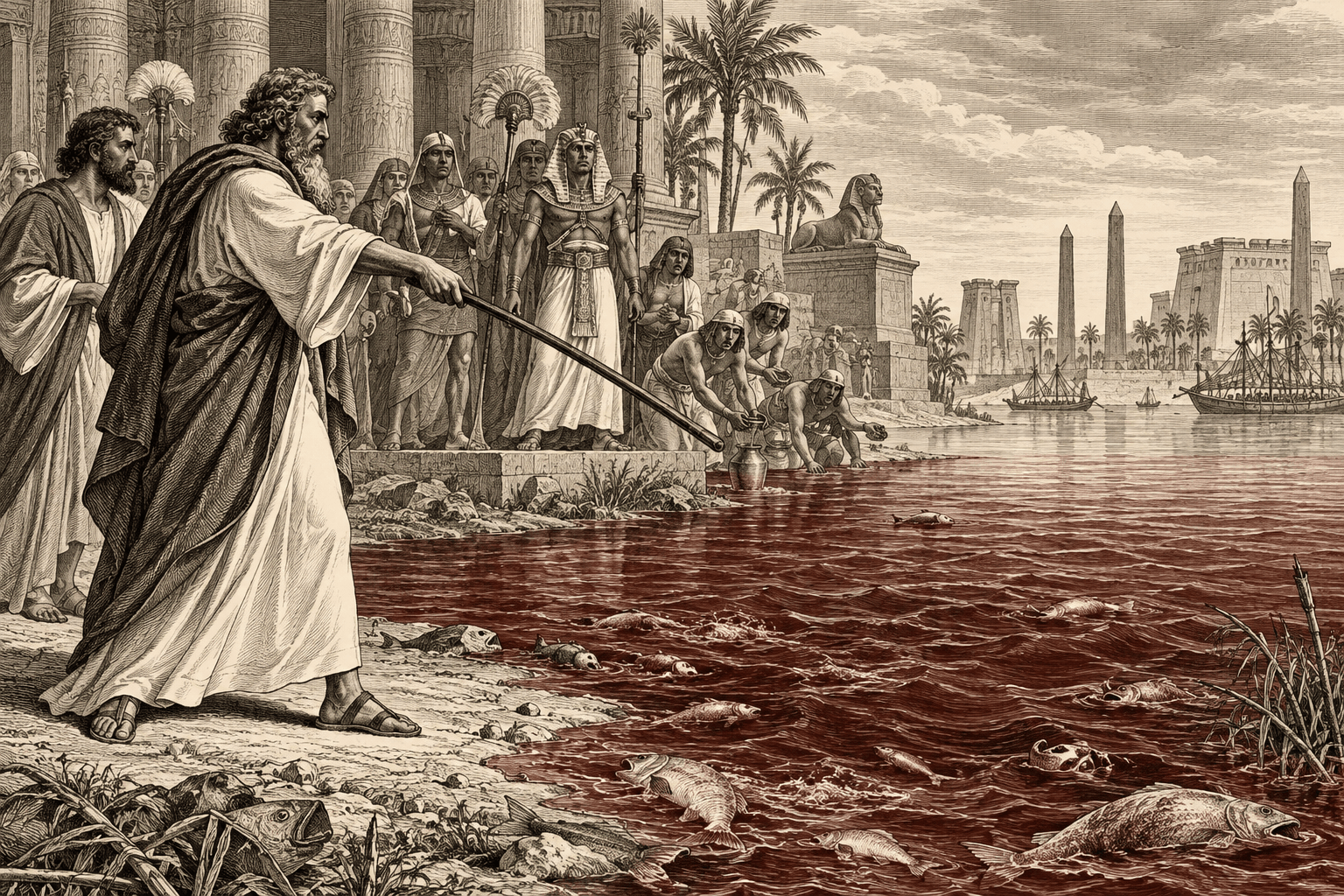
The Lord asked Moses to go to Pharaoh “in the morning” (15), for our war with the enemy of good begins with the morning of our spiritual life, at its first setting out. He also asked him to meet him by the river’s brink, going out to him at the water (15). It is as if this is a declaration to the believer that he may meet the masters of philosophy with their own philosophies; the Church does not fear the study of the philosophical sciences. And He required him to take in his hand the rod which had turned into a serpent, for there is no possibility of victory over evil without the Cross, the giver of victory.
The result is: “that there may be blood throughout all the land of Egypt, both in vessels of wood, and in vessels of stone” (19). If the earth has become “the land of Egypt,” that is, a lover of the world, the blood enters it to sanctify it. The lifeless wood in it has the blood flowing through it, so that it becomes living, fruitful trees, and the hard stones are turned into “children unto Abraham” (Matthew 3:9), as the Lord Christ Himself said: “If these should hold their peace, the stones would immediately cry out” (Luke 19:40)!
The death of the fish and their stench (18, 21) points to the perishing of what the Egyptians thought was food for them in worldly philosophies; the smell of pagan philosophies beside the faith becomes unfitting, and the soul finds no rest in it.
Note that the water did not become blood for the Hebrews. As Saint Gregory of Nyssa says:
It is no wonder that the Hebrews, living among strangers, were not affected by the evils of the Egyptians. This can be observed in crowded cities now, where people hold opposite opinions: for some, the streams of faith from which they draw the divine teachings are refreshing and clear; but for others, who live like the Egyptians according to their evil passions, the waters have become corrupt blood. [125]
Notes and References
[118] St. Basil, Epistle 189:7.
[119] Fr. Tadros Yacoub Malaty, St. John Chrysostom: Does Satan Have Authority over You? (Arabic).
[120] Gregory of Nyssa, Life of Moses 2:64.
[121] Fr. Tadros Yacoub Malaty, The Revelation of St. John the Theologian (Arabic, 1979).
[122] Here he means the divine Law in general, or the divine commandment.
[123] Origen, In Exod. hom. 4:8.
[124] St. Augustine, On Psalm 78.
[125] Gregory of Nyssa, Life of Moses 2:66.