
Having enjoyed God’s peace through the ladder, Jacob hastened toward Padan-aram, and there he met Rachel at the well of water; and serving his uncle Laban, he married his two daughters, Leah and Rachel.
1. The Meeting with Rachel
KJV · Verses 1–14
1 Then Jacob went on his journey, and came into the land of the people of the east. 2 And he looked, and behold a well in the field, and, lo, there were three flocks of sheep lying by it; for out of that well they watered the flocks: and a great stone was upon the well's mouth. 3 And thither were all the flocks gathered: and they rolled the stone from the well's mouth, and watered the sheep, and put the stone again upon the well's mouth in his place. 4 And Jacob said unto them, My brethren, whence be ye? And they said, Of Haran are we. 5 And he said unto them, Know ye Laban the son of Nahor? And they said, We know him. 6 And he said unto them, Is he well? And they said, He is well: and, behold, Rachel his daughter cometh with the sheep. 7 And he said, Lo, it is yet high day, neither is it time that the cattle should be gathered together: water ye the sheep, and go and feed them. 8 And they said, We cannot, until all the flocks be gathered together, and till they roll the stone from the well's mouth; then we water the sheep. 9 And while he yet spake with them, Rachel came with her father's sheep; for she kept them. 10 And it came to pass, when Jacob saw Rachel the daughter of Laban his mother's brother, and the sheep of Laban his mother's brother, that Jacob went near, and rolled the stone from the well's mouth, and watered the flock of Laban his mother's brother. 11 And Jacob kissed Rachel, and lifted up his voice, and wept. 12 And Jacob told Rachel that he was her father's brother, and that he was Rebekah's son: and she ran and told her father. 13 And it came to pass, when Laban heard the tidings of Jacob his sister's son, that he ran to meet him, and embraced him, and kissed him, and brought him to his house. And he told Laban all these things. 14 And Laban said to him, Surely thou art my bone and my flesh. And he abode with him the space of a month.
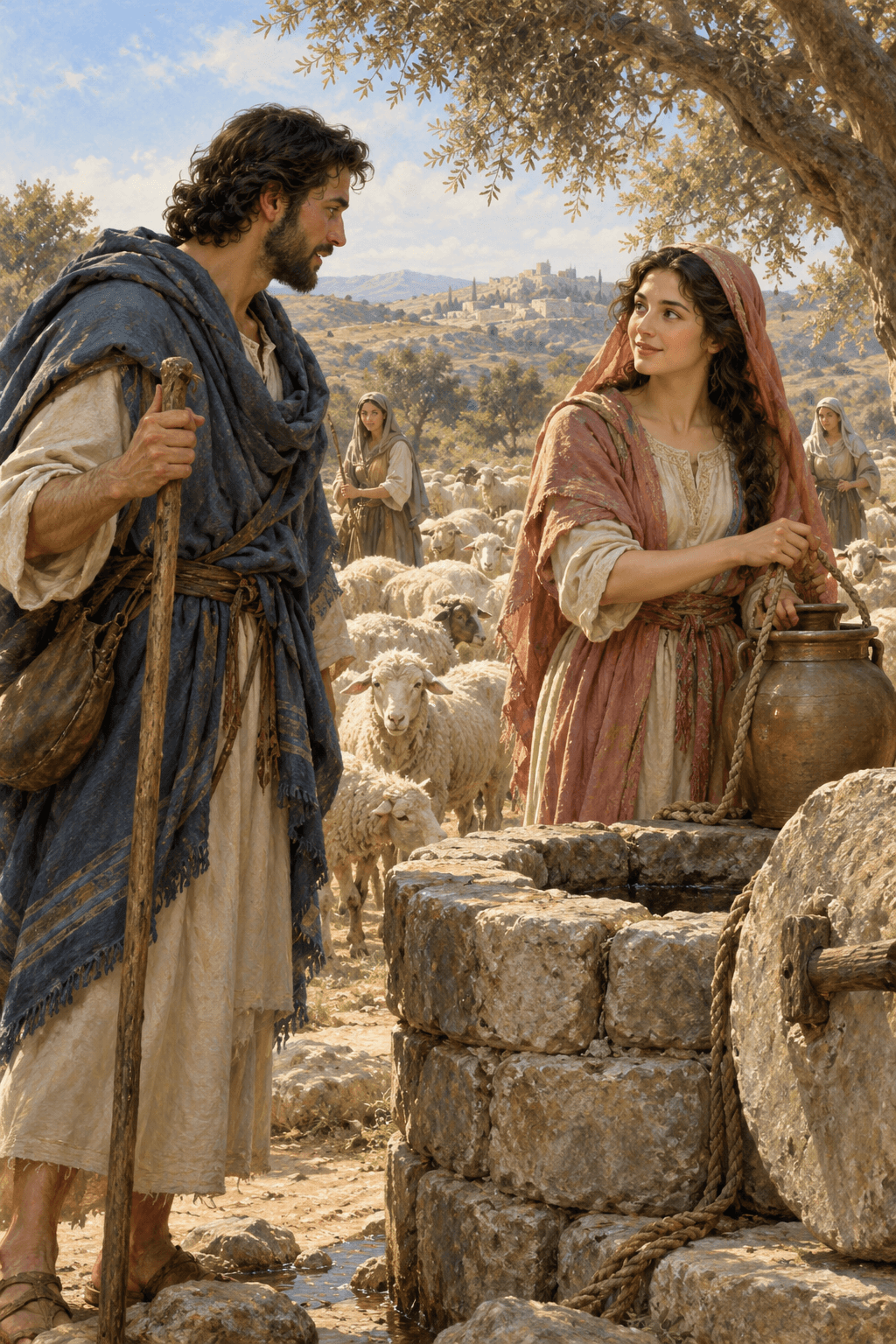
“Then Jacob went on his journey, and came into the land of the people of the east” (1). The expression “went on his journey” (literally, “lifted up his feet”) perhaps means hastening on the road, for the intimate vision moved him to set out with assurance, hurrying toward his uncle in the land of Padan-aram, east of Canaan. It is as though whenever our eyes are opened toward heavenly things and our inner ears enjoy God’s promises that He is with us, we hasten on the road — not to marry Leah or Rachel, but to union with God in our Lord Jesus Christ.
“And he looked, and behold a well in the field, and, lo, there were three flocks of sheep lying by it; for out of that well they watered the flocks: and a great stone was upon the well’s mouth” (2). Jacob drew near to Haran and saw a well in the field, and three flocks of sheep lying by it, waiting for someone to roll away the great stone covering the well so that all might drink from it. If Jacob points to the Lord Christ, who came to the world to acquire the true Rachel — the Church of the New Covenant — as His bride, He came to the field, that is, to the world; and in the field is a well, which is baptism, closed, needing Jacob to remove the great stone from it and reveal its mystery by His descending into it. The flocks lying beside the well, hoping for its water and waiting for someone to lift the stone for them, are three groups lying in the hope of salvation: the fathers before the Mosaic Law, such as Abel, Enoch, Abraham, Isaac, Jacob, and Joseph, and those who walked in their faith; the men of the Mosaic Law, who felt after the Messiah, the Savior, through the symbols and commandments; and the prophets, whose eyes were opened to see the true Jacob coming, through the spirit of prophecy. In other words, these three flocks that sat by the well awaiting the Messiah, the Savior, are the natural law, the Mosaic Law with its symbols, and the prophecies. All sat at the well, calling mankind to enjoy the waters of baptism, to receive sonship to God and enter the heavenly kingdom; but they were unable to offer it to them. They point to the kingdom with their finger, awaiting the coming of the Savior, the Desire of all nations, the heavenly Bridegroom!
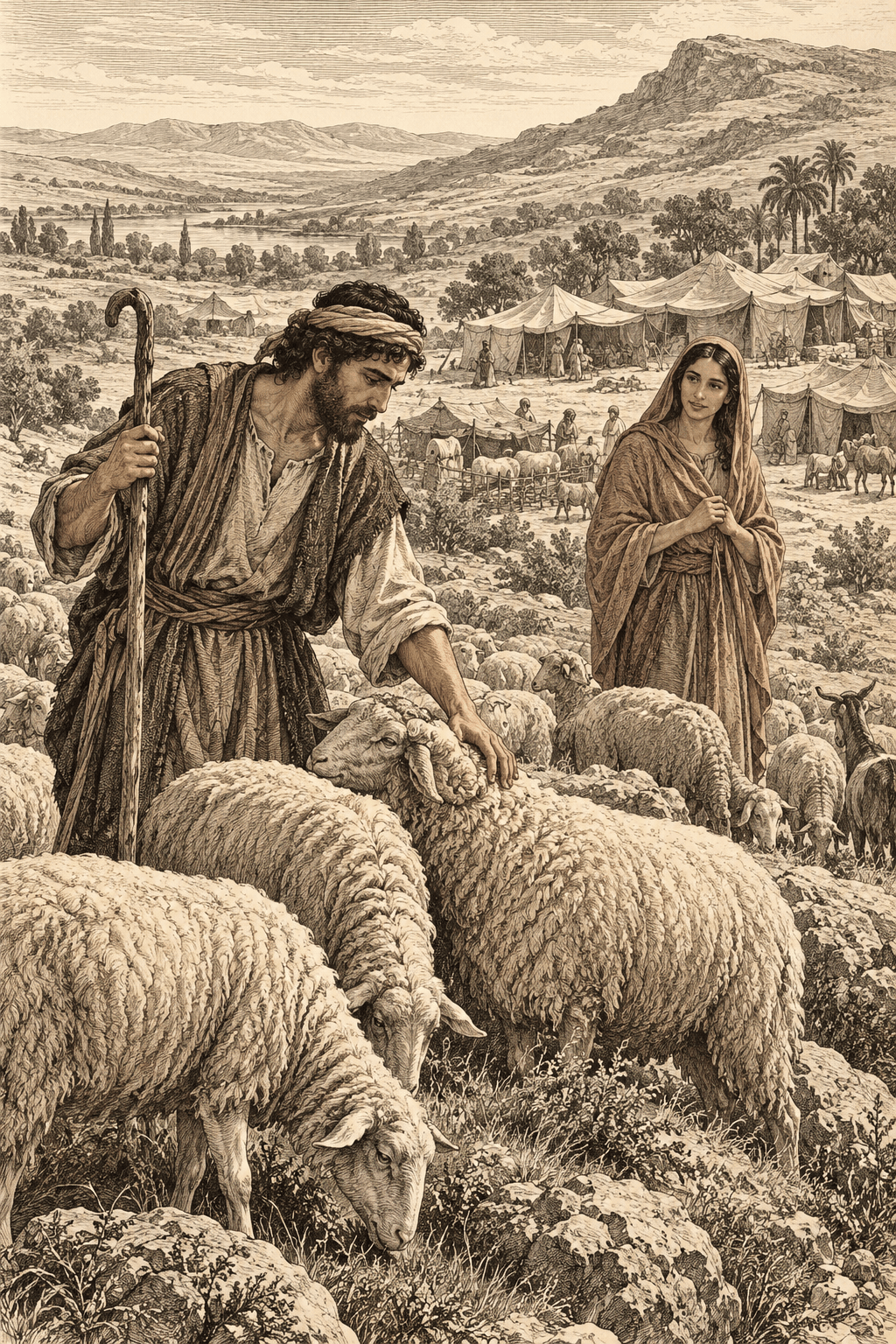
While Jacob was talking with the shepherds, he saw Rachel coming with her father Laban’s sheep. He went near and rolled the stone from the well’s mouth and watered the flock of Laban his uncle. And Jacob kissed Rachel, lifted up his voice, and wept, and told her that he was her father’s brother (kinsman) and that he was Rebekah’s son; and she ran and told her father… When Laban came he said to him, “Surely thou art my bone and my flesh,” and he abode with him a month.
Jacob’s talking with the shepherds while the stone remained on the well’s mouth points to the Word of God speaking with the men of the Old Testament in various ways, through events, symbols, and prophecies; until, seeing that the coming of the Church of the New Covenant had arrived, He went near and rolled the stone from the well’s mouth, offering the Church His holy divine mysteries. Perhaps the rolling of the stone also reminds us of what happened on the day of His resurrection: He rose while the stone was on the mouth of the tomb, but He sent His angel to roll away the stone, that we might drink of the water of the well of His resurrection, by our being buried with Him and rising with Him too, as the Apostle says: “Buried with him in baptism, wherein also ye are risen with him through the faith of the operation of God, who hath raised him from the dead” (Colossians 2:12).
Jacob kissed Rachel and lifted up his voice and wept… What kiss is this but the kiss of practical love which He declared when He cried out on the cross and gave Himself for her? This is the kiss Rachel longs for, saying: “Let him kiss me with the kisses of his mouth: for thy love is better than wine” (Song of Solomon 1:2). His telling her that he was her father’s brother points to the declaration of His kinship with us through the cross, for reconciliation was accomplished and we became children of His heavenly Father! We have entered into kinship with the Lord Christ through the grace of His cross!
Jacob stayed with Laban a month, for it was the custom that a man host others for a maximum of a month, after which the guest was treated as one of the family members. He is not treated as a guest but shares with them ordinary daily life, including work, though he receives wages for his work.
In brief, Jacob met Rachel on a level different from his meeting with the shepherds sitting beside the well, in many respects:
He met her after lifting the stone of shadows and symbols, to bring her into the fullness of truth!
He met her at the water, that she might enter with him into a relationship of kinship through the sacrament of baptism and enjoy sonship to God!
He kissed her and lifted up his voice and wept — the kiss of the cross, that is, the kiss of practical love, in which He gave up His spirit for her!
He revealed Himself to her, and she received Him and brought Him into her father’s house!
He dwelt in her father’s house a month… a sign of fellowship with Him all the days of our sojourning until He brings us into His heavens.
2. Jacob Serves His Uncle
KJV · Verses 15–20
15 And Laban said unto Jacob, Because thou art my brother, shouldest thou therefore serve me for nought? tell me, what shall thy wages be? 16 And Laban had two daughters: the name of the elder was Leah, and the name of the younger was Rachel. 17 Leah was tender eyed; but Rachel was beautiful and well favoured. 18 And Jacob loved Rachel; and said, I will serve thee seven years for Rachel thy younger daughter. 19 And Laban said, It is better that I give her to thee, than that I should give her to another man: abide with me. 20 And Jacob served seven years for Rachel; and they seemed unto him but a few days, for the love he had to her.
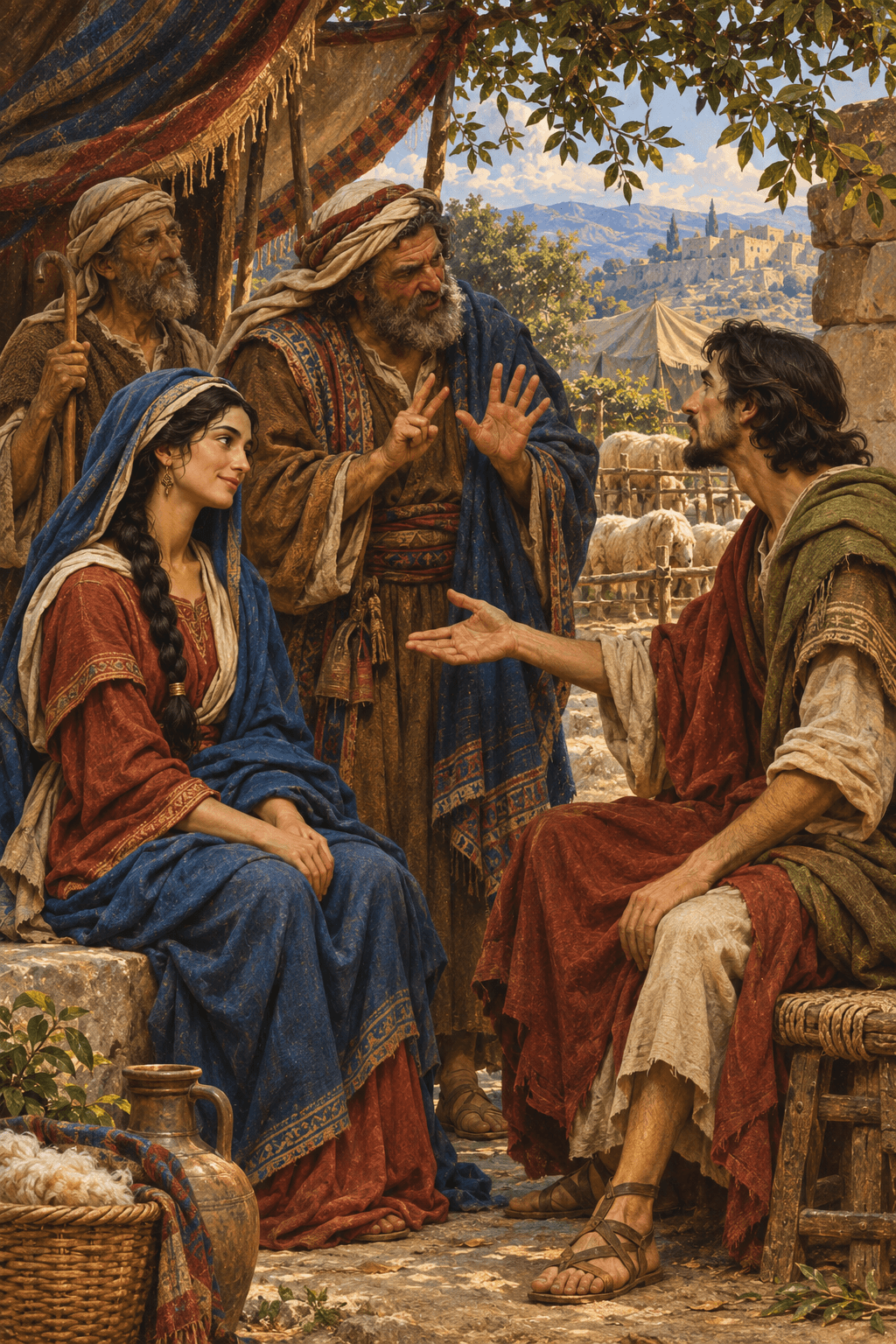
When Jacob had spent a month as a guest, working in the house of his uncle Laban, “Laban said unto Jacob, Because thou art my brother, shouldest thou therefore serve me for nought? tell me, what shall thy wages be?… And he said, I will serve thee seven years for Rachel thy younger daughter… And Jacob served seven years for Rachel; and they seemed unto him but a few days, for the love he had to her” (15–20).
Jacob could have spent the first month as a guest doing only light work; but as a man of striving he spent all his energy, until Laban felt he could not do without him and asked about his wages… and his wages were the request for his younger daughter Rachel. Jacob represents the Lord Christ, who came down to the world as a guest while He is its Creator, and who was still working in the world for the sake of the younger daughter Rachel, that is, the Church of the New Covenant, to acquire her for Himself as a bride.
Since “Leah” means “weary,” perhaps because of a disease of her eyes, and Rachel means “ewe,” the true Jacob, the Lamb of God, seeks the ewe sanctified by the blood of the Lamb. Leah, however, lost her beauty because of the weakness of her inner eyes, or the weakness of her spiritual insight.
It was said of the years of work Jacob gave that “they seemed unto him but a few days, for the love he had to her” (20). As Saint Jerome says:
Love makes nothing difficult; no labor is hard to one who longs for it. [382]
If for the sake of his marriage to Rachel Jacob endured seven years of work, and they were as a few days, and then went on to spend seven more years, how much more ought we to offer for the enjoyment of God’s kingdom through union with our Lord Jesus Christ?!
3. His Marriage to Leah and Rachel
KJV · Verses 21–30
21 And Jacob said unto Laban, Give me my wife, for my days are fulfilled, that I may go in unto her. 22 And Laban gathered together all the men of the place, and made a feast. 23 And it came to pass in the evening, that he took Leah his daughter, and brought her to him; and he went in unto her. 24 And Laban gave unto his daughter Leah Zilpah his maid for an handmaid. 25 And it came to pass, that in the morning, behold, it was Leah: and he said to Laban, What is this thou hast done unto me? did not I serve with thee for Rachel? wherefore then hast thou beguiled me? 26 And Laban said, It must not be so done in our country, to give the younger before the firstborn. 27 Fulfil her week, and we will give thee this also for the service which thou shalt serve with me yet seven other years. 28 And Jacob did so, and fulfilled her week: and he gave him Rachel his daughter to wife also. 29 And Laban gave to Rachel his daughter Bilhah his handmaid to be her maid. 30 And he went in also unto Rachel, and he loved also Rachel more than Leah, and served with him yet seven other years.
When Jacob had completed the seven years of work as a few days, he asked for Rachel as his wife according to her father’s promise. Laban made a feast, and in the evening he brought him Leah his daughter and gave her Zilpah as a maid. In the morning, when Jacob discovered his uncle’s deception, his uncle excused himself: “It must not be so done in our country, to give the younger before the firstborn. Fulfil her week, and we will give thee this also for the service which thou shalt serve with me yet seven other years” (26–27).
Though Jacob deceived his father Isaac in his old age and took the blessing from him in place of Esau — even if with good intent and a spiritual aim — with the measure he measured to his father it was measured to him… So he was deceived in his wife by his uncle, as his sons deceived him in the matter of Joseph; and Jacob spent most of the days of his life in bitterness of soul!
The deception was not difficult, for the bride was brought in at the wedding feast wearing a red veil… and at night it was not easy to recognize her in the dim light or darkness…
In any case, what took place in the matter of Jacob’s marriage carried a symbolic, prophetic work. As Father Caesarius of Arles says:
These two women whom Jacob married, that is, Leah and Rachel, signify the two peoples: Leah signifies the Jews and Rachel the Gentiles. And Christ, as the cornerstone, joined the two peoples like two walls coming from different directions… In Him they found eternal peace, as the Apostle says: “For he is our peace, who hath made both one” (Ephesians 2:14). [383]
It is also to be noted that the Lord Christ came from the tribe of Judah, whom Leah bore (35), for the Lord Christ came incarnate from the Jewish nation.
The Law had not yet been given which forbade marriage to two sisters (Leviticus 18:18); nor was Jacob seeking polygamy, but he came from his father’s house seeking one wife, and in his service to Laban he was waiting for Rachel as his one wife. His joining himself to the maids was not out of bodily lust but because of the need for children, since the world at that time had few people relative to its size.
4. The Children of Leah
KJV · Verses 31–35
31 And when the Lord saw that Leah was hated, he opened her womb: but Rachel was barren. 32 And Leah conceived, and bare a son, and she called his name Reuben: for she said, Surely the Lord hath looked upon my affliction; now therefore my husband will love me. 33 And she conceived again, and bare a son; and said, Because the Lord hath heard I was hated, he hath therefore given me this son also: and she called his name Simeon. 34 And she conceived again, and bare a son; and said, Now this time will my husband be joined unto me, because I have born him three sons: therefore was his name called Levi. 35 And she conceived again, and bare a son: and she said, Now will I praise the Lord: therefore she called his name Judah; and left bearing.
Not without purpose did the Lord open Leah’s womb, so that she bore Jacob Reuben, then Simeon and Levi, then Judah, and then left off bearing. For God looked on her affliction, since Jacob loved Rachel, and gave Leah an opportunity to draw near to her husband, that he might love her for the sake of her children. On the other hand, since Leah represents the Jews, the Jews were fruitful in the knowledge of the Lord; from them came the patriarchs, the prophets, the priesthood, and so on… while Rachel represents the Gentiles, who before were “barren,” without spiritual fruit because of paganism.
From Leah came Reuben the firstborn… for the Jews were as a firstborn in the Lord’s eyes, until the Gentiles took the spiritual birthright from them. From her came Levi, the priesthood, and also Judah, for the Lord Christ came from the Jews… And here she left off bearing, for the Jews rejected the Lord Christ who came forth from the tribe of Judah, and so there was a cessation of spiritual childbearing. It seems Jacob forsook her for a time until she later bore again — perhaps a sign of the Jews’ return from their denial of the Lord Christ and their acceptance of the Christian faith in the last times.
Notes and References
[382] Jerome, Ep. 22:40.
[383] Caesarius of Arles, Serm. 88:2.