
1. The Acceptance of Abel’s Offering
KJV · Verses 1–7
1 And Adam knew Eve his wife; and she conceived, and bare Cain, and said, I have gotten a man from the Lord. 2 And she again bare his brother Abel. And Abel was a keeper of sheep, but Cain was a tiller of the ground. 3 And in process of time it came to pass, that Cain brought of the fruit of the ground an offering unto the Lord. 4 And Abel, he also brought of the firstlings of his flock and of the fat thereof. And the Lordhad respect unto Abel and to his offering: 5 But unto Cain and to his offering he had not respect. And Cain was very wroth, and his countenance fell. 6 And the Lord said unto Cain, Why art thou wroth? and why is thy countenance fallen? 7 If thou doest well, shalt thou not be accepted? and if thou doest not well, sin lieth at the door. And unto thee shall be his desire, and thou shalt rule over him.
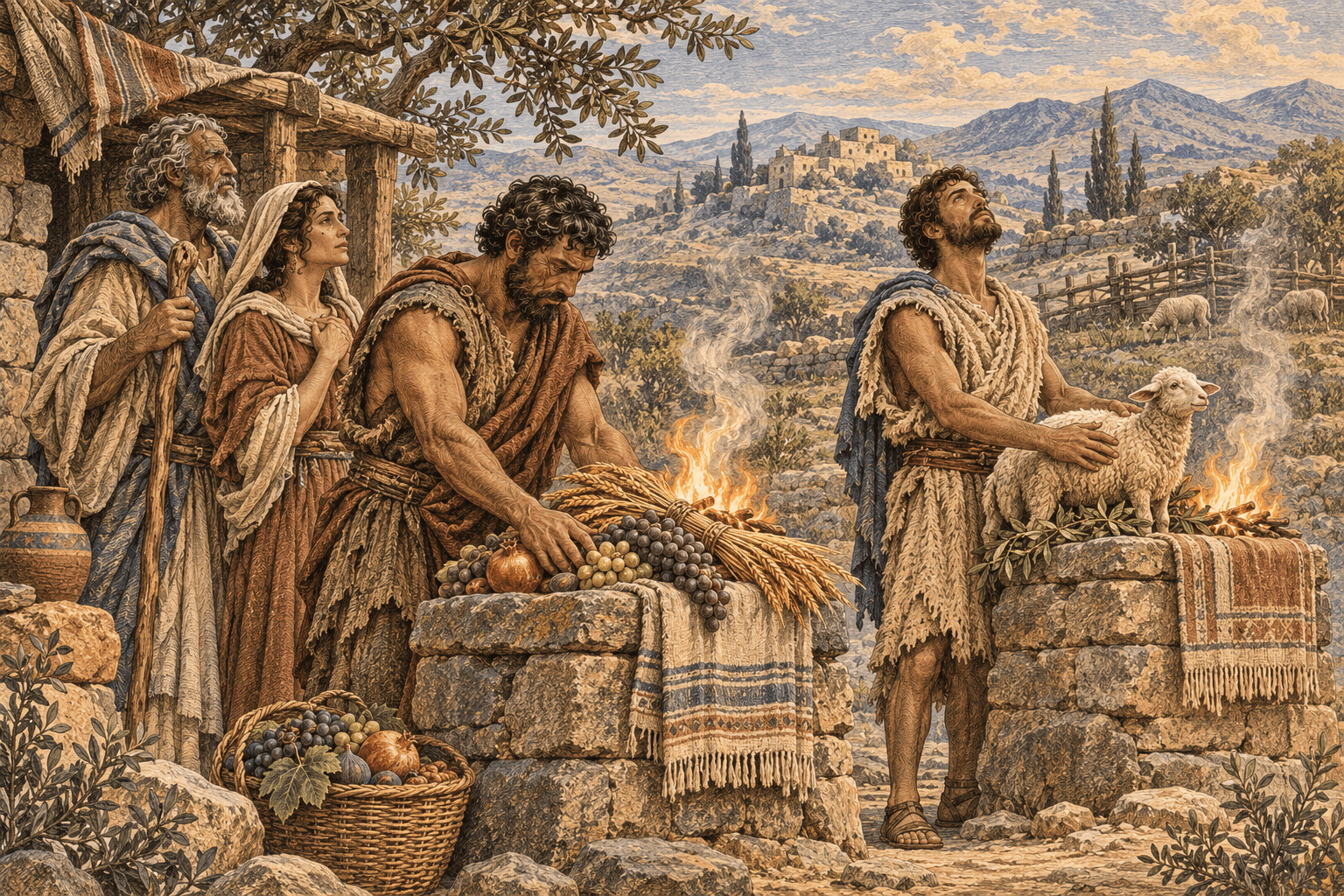
“And Adam knew Eve his wife; and she conceived, and bare Cain, and said, I have gotten a man from the Lord” (1).
Philo the Jew of Alexandria held that Cain and Abel were twins, but this opinion found no acceptance among the early Fathers of the Church.
Some Origenists relied on this text to declare that Adam knew Eve as his wife after the fall, as though in their view the bodily marital relationship were the fruit of the fall; and some went so far as to say that the fall itself was nothing but the practice of this relationship. The Church strongly rejected this extreme opinion from its appearance, and attacked it; for the Fathers of the Church affirmed that God is the founder of married life in its perfect form, and that with or without the fall the bodily relationship between our parents would have taken place and children would have been begotten, but not through evil lust, rather as the fruit of pure married love. The Fathers also rejected the idea that our parents’ fall was their bodily union, for this opinion defiles the view of married life.
In any case, Eve realized that her child was a divine gift, so she called him “Cain,” that is, “acquired,” and said: “I have gotten a man from the Lord” (1). Perhaps the secret of her joy in him was that she thought the coming of the promised Savior from her seed had drawn very near, and perhaps she expected it to be fulfilled in her days.
Eve felt that her son was acquired from the Lord. As Saint Ambrose says in his book “Cain and Abel”:
We ought to realize that God is the One who brings into being and creates; so Eve attributed the work to God. When she said, “I have gotten a man (a man child) from the Lord,” she said this so that we might imitate her in similar situations, and not count success as our own, but attribute it wholly to God. [131]
“And she again bare his brother Abel” (2). Saint Ambrose saw that Cain represents purely rational thought, or the rationalist school; perhaps he meant the Gnostics, who set intellectual knowledge alone as the way of salvation instead of faith, thinking that man is able by his mind, without divine help, to attain the knowledge of God and grasp His mysteries, creative in thought, feeling, emotions, sentiments, and passions. Abel symbolizes the school of faith, which rests on God’s grace to enjoy God’s mysteries through the faith given to man, without ignoring his mind. For faith does not contradict the mind, but lifts it through God’s revelations to it and exalts it. The two schools, despite their contradiction, are connected together, as though they were two brothers from one womb, though they cannot dwell together for long.
The story of Abel and Cain presents a living picture of the story of the birthright of the spirit and the birthright of the flesh. Cain was the firstborn of Adam and Eve according to the flesh, but he lost his birthright through his wickedness, and Abel’s spiritual birthright appeared in the acceptance of his sacrifice, indeed of his whole life, as the object of God’s pleasure rather than his brother. So Saint Augustine sees in Cain a symbol of the first Adam, the firstborn of humanity in the flesh, who lost his birthright so that the true Abel might appear, the Lord Christ, the second Adam, truly the firstborn of humanity, in whom the Father accepts us as a sweet savor of pleasure and favor. Among his words:
Of these two first parents of the human race, Cain was the firstborn, belonging to the city of men, and after him was born Abel, belonging to the city of God, so that he became truly the firstborn too. And as in the case of the individual (so it is on the level of the human race), it is said in the Apostle’s statement, distinguishing the truth: “Howbeit that was not first which is spiritual, but that which is natural; and afterward that which is spiritual” (1 Corinthians 15:46). So it happens that every person who is taken from his condemned origin is born first of Adam, carnal and evil, and afterward becomes good and spiritual when he is grafted into Christ by regeneration (by baptism); so it is with the human race as a whole… for we find that the inhabitants of this world are born first, and afterward the strangers to it, that is, the citizens of the city of God, who by grace were predestined, by grace chosen, by grace lived as strangers here below, and by grace lived as citizens on high… God as a potter made from the same lump one vessel unto honor and another unto dishonor (Romans 9:21); but He made the vessel of dishonor first, and afterward the vessel of honor. [132]
For as we first took the image of the earthy, afterward we bore also the image of the heavenly, that is, Christ, so that in Him we became a new creation, worthy to be a vessel of honor.
Wonderfully, the story of the birthright of the flesh and the birthright of the spirit extended through the ages. We find God choosing Abraham as the father of all nations, though he was not the firstborn among his brothers according to the flesh; He chose Isaac, who was younger in the flesh than Ishmael, and Jacob, who was younger than his brother Esau. The Lord Christ came from the seed of Pharez, whom Tamar bore, and Pharez broke out before his brother Zarah while still in his mother’s womb, to take the birthright from him (Genesis 38:27–30). And the genealogy of the Lord Christ presents a large group of fathers who were not firstborn according to the flesh… We have spoken before of the meaning of the birthright and its connection with the person of the Lord Christ, the Firstborn, in our study of the Book of Numbers. [133]
Saint Ambrose sees in Cain a symbol of the community of the Jews, who bore the birthright of the knowledge of God but denied faith in the Savior, and whose synagogue was stained with the shedding of innocent blood; and Abel comes representing the Church of the New Testament, which includes members from the Gentiles, so that she takes the spiritual birthright and is counted the church of the firstborn (Hebrews 12:23) through her cleaving to, or union with, the Lord, the Firstborn. He says:
We see in Cain the Jewish people, stained with the blood of their Lord, their Creator, and also their Brother; and in Abel we understand the Christian man cleaving to God, as David says: “But it is good for me to draw near to God” (Psalm 73:28), that is, his soul is bound to heavenly things and avoids earthly things. In another place he says: “My soul fainteth for thy salvation” (Psalm 119:81), which shows that the law of his life was directed to meditating on the Word (Christ) and not on the pleasures of the world. [134]
When the Scripture spoke of the bodily birth, it began with Cain, the firstborn in the flesh, and then Abel; but when each received the work he loved, Abel took first place, as though seizing the birthright from Cain, for it is said: “And Abel was a keeper of sheep, but Cain was a tiller of the ground” (2). As Saint Ambrose says, the Holy Scripture did not mention Abel first without purpose, despite his birth after Cain, but:
It mentioned the younger first when it pointed to the work, competence, and talent, so that we might realize the difference between their two professions. According to our experience, cultivating and ploughing the land comes first, but it is lower in rank than shepherding sheep. [135]
Perhaps work on the land points to the carnal man, who fixes his eyes and all his energies on the earth and temporal things; and shepherding sheep points to the person concerned with shepherding, managing, and leading the body with all its energies (the sheep). So we ought not to be workers of the land for the sake of the body and its lusts, but shepherds who manage the body and tend it spiritually for the sake of God’s kingdom.
Saint Didymus the Blind distinguishes between the work of Abel and Cain. He sees in Abel, as a keeper of sheep, one who manages and controls the senses of his body; but Cain was a worker of the land, not a husbandman like Noah (Genesis 9:20), distinguishing between the worker of the land and the husbandman. The husbandman is the one who manages agricultural work, knowing when to plough, when to sow, and when to reap, with wisdom and good management; but the worker of the land works without wisdom or management (doing bodily work, not managerial work). He says:
The Scripture did not say of Cain that he was a husbandman, but a worker of the land. For he had no leading role, as Noah had, who was called a husbandman and not a worker of the land (Genesis 9:20)… Abel was a keeper of sheep, that is, a manager of the senses he leads. This is the excellent shepherd, who subjects his knowledge to his rod and controls his anger and lust, and bears understanding as a leader and manager. But Cain went about the earth and earthly things, not as a husbandman but as a worker of the land, as a friend of the body, walking without reason or management… The saying may apply to him: “let us eat and drink; for to morrow we shall die” (Isaiah 22:13; 1 Corinthians 15:32). But whoever does these things with divine management applies the principle: “Whether therefore ye eat, or drink, or whatsoever ye do, do all to the glory of God” (1 Corinthians 10:31). [136]
Cain brought of the fruit of the ground, and Abel of the firstlings of his flock; the Lord had respect unto Abel and his offering, but not unto Cain and his offering, and Cain was very wroth (see verses 3–5 above).
Why Did God Not Have Respect to Cain and His Offering?
First: Saint Didymus the Blind and Saint Ambrose see that the expression “in process of time” (literally, “after days”) points to Cain’s slackness in his offering, or practicing it from a motive other than love. The first says:
Cain offered his offering negligently, but Abel offered it sincerely. [137]
And the second says:
Cain’s offering came after days… not quickly and with longing; so the commandment came: “When thou shalt vow a vow unto the Lord thy God, thou shalt not slack to pay it” (Deuteronomy 23:21); “When thou vowest a vow unto God, defer not to pay it.” [138]
Second: Perhaps God rejected Cain’s offering because it was of the fruit of the ground, and it was not said “of the firstfruits”; he did not offer the best he had. But Abel offered “of the firstlings of his flock and of the fat thereof”… He gave God the first place!
Third: Cain’s offering was of the fruits of the ground, unable to reconcile God and man; but Abel’s offering was a bloody sacrifice, bearing a symbol of the sacrifice of the Lord Christ, who alone is able to reconcile us with the Father through the shedding of His blood for us.
Fourth: Saint Jerome sees in the Lord’s word to Cain (in the Septuagint), “If thou hast not divided rightly,” that Cain offered God the fruits of the earth but did not offer his heart; that is, he offered an outward offering without the inward, so the division was not right.
As for how Cain knew that God accepted Abel’s offering and not his, as Saint Didymus the Blind says:
Perhaps fire came down and consumed the offering, as happened with Aaron and his sons, for “there came a fire out from before the Lord, and consumed upon the altar the burnt offering and the fat: which when all the people saw, they shouted, and fell on their faces” (Leviticus 9:24), and as happened with Elijah the prophet (1 Kings 18:38–40). [139]
The first fruit of the rejection of the offering was: “Cain was very wroth, and his countenance fell” (5). For sin corrupts man’s peace and crushes him, so that he lives in rage and distress; and it brings his face down to fall to the dust instead of rising toward heaven. As the wise man says: “a man’s wisdom maketh his face to shine” (Ecclesiastes 8:1); “A merry heart maketh a cheerful countenance” (Proverbs 15:13). Sin makes man’s face fall in gloom, and in Christ Jesus it rises exultant, so that he says: “But we all, with open face beholding as in a glass the glory of the Lord” (2 Corinthians 3:18).
Now, when Cain’s countenance fell, God did not leave him collapsed, but came forward to him, asking (see verses 6–7 above). Truly He did not accept his offering because it came from an impure heart; but He did not leave him in his fall, but came forward to him in love, speaking with him frankly and clearly: “If thou doest well, shalt thou not be accepted (lifted up)?” As though reproaching him, He says: “If you set right what is within you, shall I not lift up your face anew? Why do you give yourself over to rage, and why do you leave your face fallen?!” And in warning He says to him: “if thou doest not well, sin lieth at the door. And unto thee shall be his desire, and thou shalt rule over him,” as though He said: “I see the sin of murder crouching at the door, wanting to creep into your depths, though you rule over it; that is, you are the master and have the will; you may accept it and you may reject it. You are still master over it; but if you accept it, it will rule over you and bring you down to its bondage. As long as it crouches at the door, it is weak; but if it creeps in, you will weaken before it and bow to it in a spirit of slavery.”
2. The Murder of Abel
KJV · Verses 8–16
8 And Cain talked with Abel his brother: and it came to pass, when they were in the field, that Cain rose up against Abel his brother, and slew him. 9 And the Lord said unto Cain, Where is Abel thy brother? And he said, I know not: Am I my brother's keeper? 10 And he said, What hast thou done? the voice of thy brother's blood crieth unto me from the ground. 11 And now art thou cursed from the earth, which hath opened her mouth to receive thy brother's blood from thy hand; 12 When thou tillest the ground, it shall not henceforth yield unto thee her strength; a fugitive and a vagabond shalt thou be in the earth. 13 And Cain said unto the Lord, My punishment is greater than I can bear. 14 Behold, thou hast driven me out this day from the face of the earth; and from thy face shall I be hid; and I shall be a fugitive and a vagabond in the earth; and it shall come to pass, that every one that findeth me shall slay me. 15 And the Lord said unto him, Therefore whosoever slayeth Cain, vengeance shall be taken on him sevenfold. And the Lord set a mark upon Cain, lest any finding him should kill him. 16 And Cain went out from the presence of the Lord, and dwelt in the land of Nod, on the east of Eden.
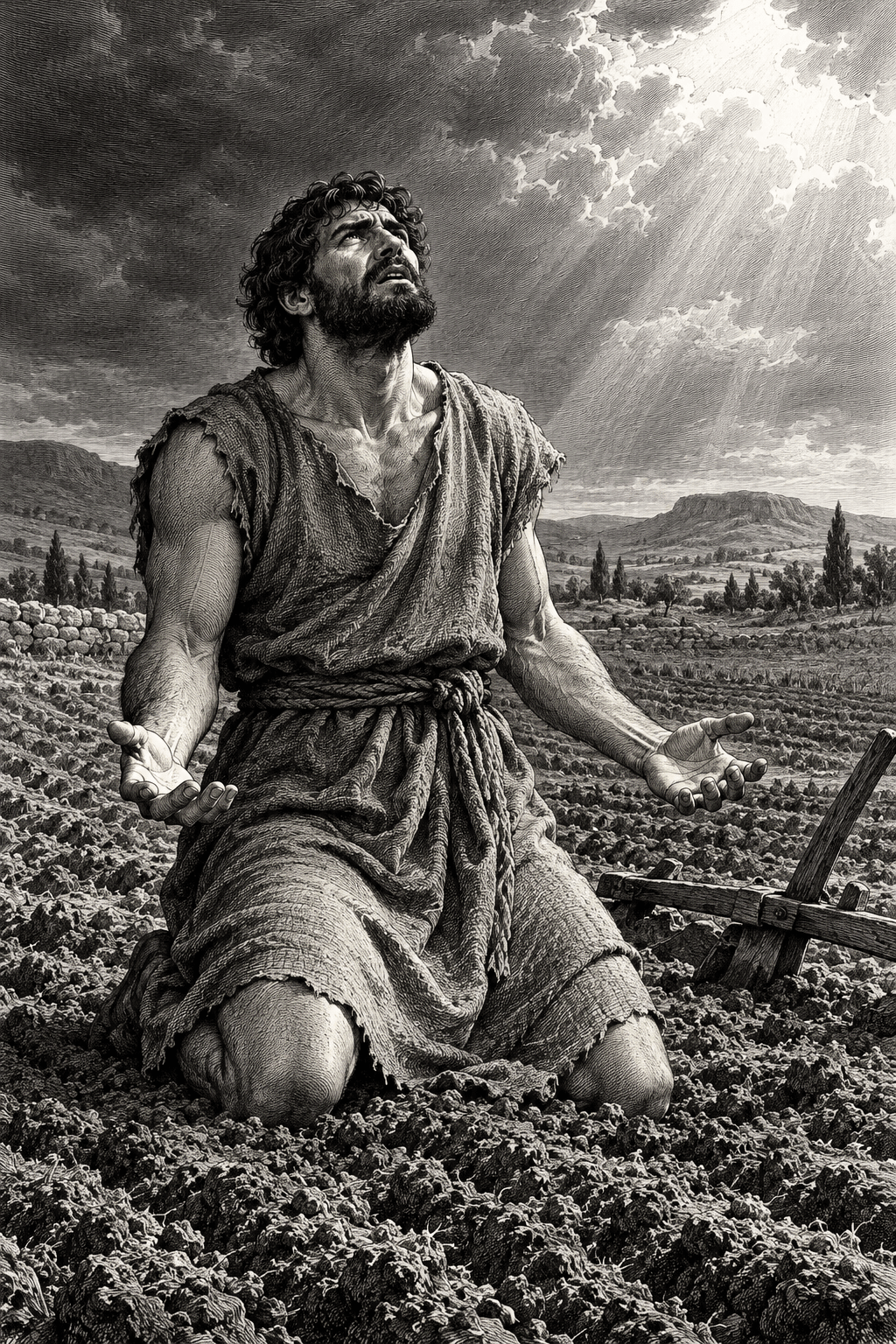
Cain thought that he had killed and found rest, but God came to question him so as to stir repentance in him (see verses 8–10 above). For He does not want to cover our sins with an outward wrapping while corruption creeps on in the depths; but as a spiritual physician He wants to uncover the wounds and expose them for the sake of healing. On the other hand, God wanted to assure Cain that He is the God of Abel, who does not forget him, even if his brother stretched out his hands against him to be rid of him. As Saint Didymus the Blind says, in the words of the Lord:
Do not think that your crime has escaped My eyes and My care, which does not slumber. [140]
And as Saint John Chrysostom says:
He got rid of him because he saw him beloved, expecting to remove him from the love; but what he did made him all the more established in the love, for God sought him, saying: Where is Abel thy brother? [141]
Cain hid his brother’s body, but he could not silence the voice of the soul crying out to God, which the Lord expressed by saying: “the voice of thy brother’s blood crieth unto me from the ground” (10); for blood points to the soul, being a sign of life. If the blood is shed, the soul remains crying out through the blood unjustly shed on the earth. This crying voice is the voice of every person who is wronged for the sake of the truth, so that he is counted a witness to the truth, a martyr, whose cries keep resounding above the limits of the earth (place) and of death (time). Of this voice Saint Ambrose says:
Blood has a loud voice that reaches from earth to heaven. [142]
So injustice or distress does not silence the soul nor bridle its tongue; on the contrary, it makes it all the more united with the living Word of God, the Crucified, so that it has a voice that death cannot overcome nor the grave confine. It is as though the secret of the power of the voice of blood unjustly shed is man’s union with the living Crucified One. And Saint Clement of Alexandria saw in Abel’s blood a symbol of the blood of Christ, whose atoning voice and work do not cease, for he says:
The blood could not have uttered a voice unless you saw it as belonging to the incarnate Word. For the ancient righteous man (Abel) was a type of the new Righteous One (the Lord Christ, the Word of God); and what the old blood intercedes for is accomplished through the position of the new blood. The blood, which is the Word, cries out to God, declaring that the Word suffers. [143]
If Cain destroyed Abel’s body with his body, so that his tongue was completely silenced, he could not bridle the tongue of his heart and his inner cries, to which God, who hears the hidden sighs, responds. As Saint John Chrysostom says:
Moses was suffering and prayed thus (in his heart) and was heard, for God said to him: “Wherefore criest thou unto me?” (Exodus 14:15), though he did not cry with his mouth; and Hannah too, whose voice was not heard, accomplished all she wanted, for her heart cried out (1 Samuel 1:13). And Abel not only prayed while silent, but even when he died his blood sent forth a cry clearer than the sound of a trumpet. [144]
Cain made light of his brother Abel’s life, and so he made light of God Himself in his conversation with Him; for every sin aimed at our brothers drives us to sin against God Himself. As Saint John Chrysostom says:
Let none of us despise another, for this is an evil work that teaches us to make light of God Himself. For in truth, whoever despises another despises God, who commanded us to show every care for others… Cain despised his brother, and immediately made light of God. [145]
If the disobedience of Adam and Eve bore a tangible discipline reminding humanity of the bitterness of disobedience, the first murder brought Cain a tangible material discipline revealing to him what had befallen his depths, for it was said to him: “When thou tillest the ground, it shall not henceforth yield unto thee her strength” (12). Because of his crime a kind of barrenness came upon the earth, to reveal man’s earth, that is, his body, which by sin had become barren, offering no fitting spiritual fruit. Saint Didymus the Blind comments on this divine discipline:
It sometimes happens that because of man’s sins the earth becomes barren and gives no fruit, as it is said: “Therefore shall the land mourn, and every one that dwelleth therein shall languish” (Hosea 4:3). The earth was given to bear fruit for those who keep their understanding uncorrupted… but the fruit diminishes at the Lord’s command (because of man’s corruption) so that people may change their state. [146]
If the earth points to the body, which loses its original work and becomes without spiritual fruit, the soul too loses its inner peace, for it was said to him: “a fugitive and a vagabond shalt thou be in the earth” (12). It is as though the soul that has submitted to the earthly body of dust finds it barren, and lives in it without rest or peace, but in a state of wandering and terror. This is what Holy Scripture affirmed by saying: “And Cain went out from the presence of the Lord, and dwelt in the land of Nod, on the east of Eden” (16). The soul goes out from the bosom of its Lord, the source of its peace, to dwell in “Nod,” which means “wandering” or “turmoil.” As Saint Didymus the Blind says:
“Nod” means “turmoil.” There he had to dwell who left quiet virtue and entered into turmoil. [147]
And Saint Jerome says:
The translation of “Nod” is “wandering.” Since Cain was banished from God’s presence, he naturally dwelt in Nod and became a wanderer. So the Jews, when they crucified God their Lord, wandered here and there and went seeking their bread. They were scattered in the world and did not remain in their land. They beg for spiritual riches, for they have no prophets; they have become without law, priests, or sacrifice; they have become beggars in the full sense of the word. [148]
The secret of the wandering is going out from the presence of the Lord (16), not a going out in place, but a going out from fellowship with Him and enjoyment of Him. As Saint Didymus the Blind says:
We do not understand that Cain went out far from the Lord in place; rather we say that every sinner is outside the Lord, in the same sense carried by the expression “enter before the Lord” when the Psalm says: “come before his presence with singing” (Psalm 100:2). When we enter His presence we leave behind everything outward, that is, sins and all tangible things, so that we may enjoy other things not of this world and share in the knowledge of God… God is not subject to place, even though a temple was set up for Him… Cain went out because he counted himself unworthy to behold the face of the Lord, that is, he no longer had the mind of the Lord. [149]
And Saint Basil the Great sees that the harshest punishment a person falls under is deprivation of the Lord’s presence:
The harshest kind of punishment imposed on those of good heart is estrangement from God. [150]
Cain realized the seriousness of the state he had reached, and confessed to the Lord (see verses 13–15 above).
It is clear from Cain’s confession that he felt remorse, not out of hatred of sin, but out of fear of earthly punishment. Yet the Lord opened the door of hope: He did not promise him that he would not be killed, but that whoever killed him would be punished very bitterly, as one on whom vengeance is taken sevenfold, and He gave him a mark so that whoever found him would not kill him. So the Lord began with Cain in love, that perhaps Cain would throw himself anew into God’s bosom in sincere repentance and return to Him.
Saint Basil the Great sees that Cain sinned and also deserved seven disciplines. [151] His sins were: his envy of his brother Abel; his lying to God; his deceiving Abel by drawing him into the field; what is most hideous, his killing his brother; his setting an evil example for humanity at the beginning of its history; and his sinning against his parents by killing their son. As for the seven disciplines: because of him the earth was cursed; the earth became his enemy, so that he lived on it as with his enemy; the earth would not give him its strength; he would live in groaning; he would be in terror; he would be driven out a wanderer; and he would be estranged from the face of the Lord.
As for the mark God gave Cain so that whoever found him would not kill him, perhaps it points to the sign of the cross, in which the sinner hides to find safety and peace through his reconciliation with God. This is the mark with which God’s children, who cannot bear abominations, are sealed, and which keeps them from destruction, as Ezekiel the prophet saw (Ezekiel 9:6). And Saint Augustine sees that it is the sign of the covenant given to the men of the Old Testament as a shadow of the cross, declared in their law and rites, for he says:
This mark belonged to the Jews, when they held fast to their law, were circumcised, kept the sabbaths, sacrificed the Passover, and ate unleavened bread. [152]
3. The Children of Cain
KJV · Verses 17–24
17 And Cain knew his wife; and she conceived, and bare Enoch: and he builded a city, and called the name of the city, after the name of his son, Enoch. 18 And unto Enoch was born Irad: and Irad begat Mehujael: and Mehujael begat Methusael: and Methusael begat Lamech. 19 And Lamech took unto him two wives: the name of the one was Adah, and the name of the other Zillah. 20 And Adah bare Jabal: he was the father of such as dwell in tents, and of such as have cattle. 21 And his brother's name was Jubal: he was the father of all such as handle the harp and organ. 22 And Zillah, she also bare Tubalcain, an instructer of every artificer in brass and iron: and the sister of Tubalcain was Naamah. 23 And Lamech said unto his wives, Adah and Zillah, Hear my voice; ye wives of Lamech, hearken unto my speech: for I have slain a man to my wounding, and a young man to my hurt. 24 If Cain shall be avenged sevenfold, truly Lamech seventy and sevenfold.
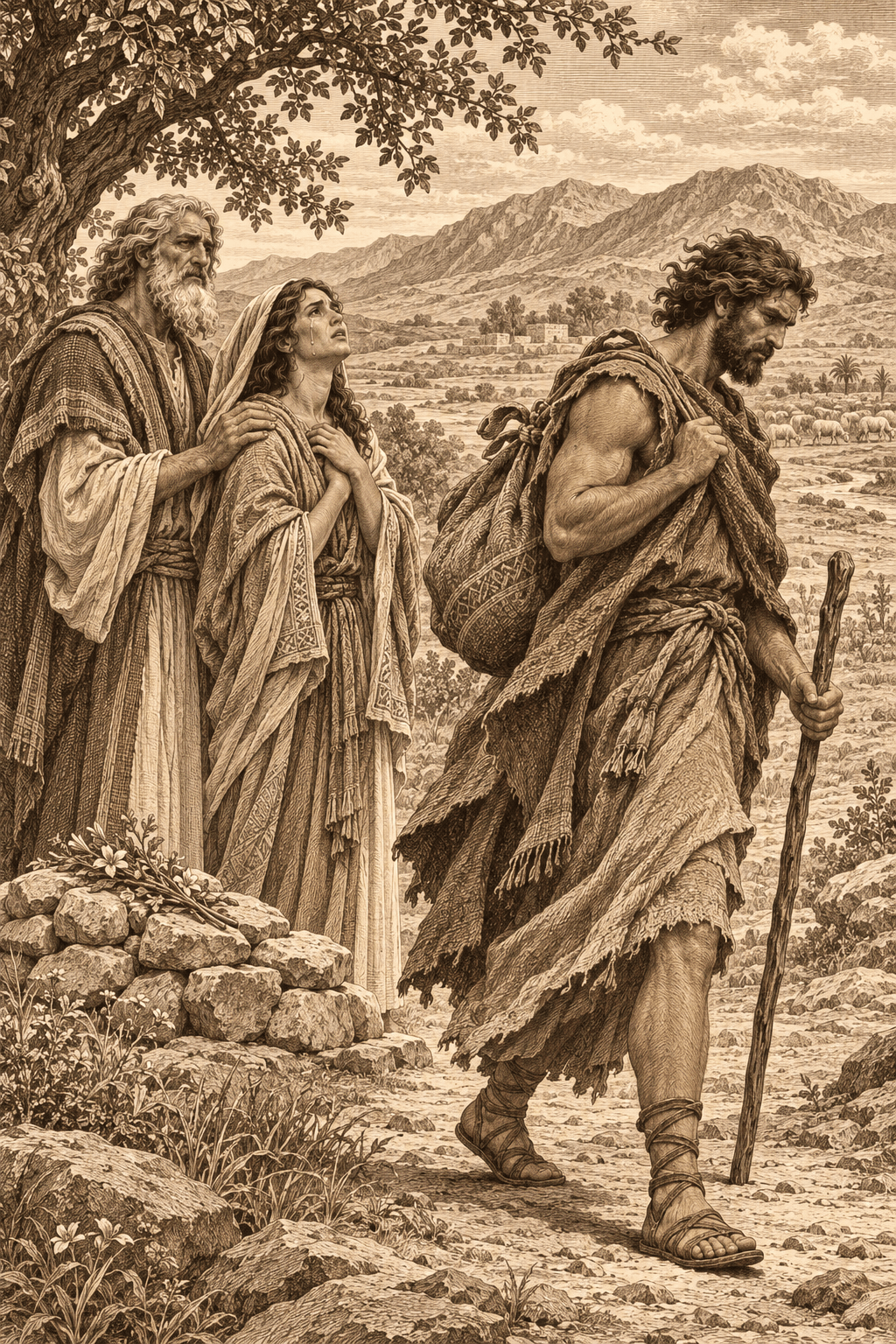
If God opened the door of hope before Cain, despite the hideousness of the evil he committed against God and men, instead of returning to Him in repentance to regain his peace, he built a city and called it by the name of his son, “Enoch” (17), so that his children would not live as wanderers like him. It is as though he repeated what his parents had done before him, when they sewed aprons of fig leaves for themselves (Genesis 3:7), covering their nakedness while the inner corruption remained without remedy.
This is the first city man built for himself, to shelter in it from God’s decrees and disciplines, or rather to shelter from the wandering he had brought on himself. So Saint Jerome says:
The great city that Cain built first and called by the name of his son is taken as a symbol of this world, which the devil built with vice, supported with crime, and filled with evil. [153]
And Saint Augustine says:
It is recorded that Cain built a city, but Abel, as a passer-by, built nothing; for the city of the saints is above, though it begets citizens for itself here below, that they may depart at the appointed time and reign, when they are gathered on the day of resurrection and the promised kingdom is given them, in which they will reign with their Prince, the King of all ages. Amen. [154]
If Cain begot “Enoch,” giving him an earthly city to protect him from wandering instead of the spiritual blessing, the Scripture records for us the line of Cain’s descendants until it reaches Lamech, presenting him to us as the husband of two wives, Adah and Zillah. Of the first he begot Jabal and Jubal, and of the second Tubal-cain and his sister Naamah. Saint Jerome sees that Lamech did not have one Eve, but was the first to marry two wives, a sign of the work of the heretics who divide the Church into churches turned aside from the faith. [155] In any case, if Cain presented the most hideous example of crime at the beginning of human history by unjustly killing his brother, the fruit of evil is heresy, which corrupts the Church of God and distorts the faith, and even drives to atheism. As Saint Augustine says: “Behind every atheism is a lust.”
Some see in Lamech’s life with these two wives a representation of pagan life, or distance from God. [156] For if “Adah” in Hebrew means “beauty” or “ornament,” and “Zillah” means “shadow,” the first points to the lust of the eyes and the second to the lust of the flesh. The first by her beauty or ornament seduces the eye from looking to heavenly things, and the second as a shadow draws the soul into slavery to the lusts of the body, which is but a shadow that vanishes; that is, she draws it to bodily, temporal, passing things.
In the Assyrian language “Adah” is taken from “adhatu,” meaning “darkness,” and “Zillah” derives from “zillatu,” meaning “the shadows of night”; as though Lamech chose in his wickedness to unite with darkness and the shadows of night through his evil life.
Before speaking of the saying Lamech uttered to his wives, let us mention the meanings of the names in this chapter:
A) Irad, son of Enoch: the word “Irad” derives from the Hebrew word “ir,” meaning “city,” perhaps because Cain was building the first city in the world, which he called by the name of his son Enoch. Some see that the word “ir” in Hebrew means “young ass” or “wary.”
B) Mehujael, son of Irad: his name means “smitten by God.”
C) Methusael, son of Mehujael: his name means “hero of God” or “man of God.”
D) Lamech: means “strong.”
Lamech uttered to his wives the first poem in Hebrew literature, called “the Song of the Sword of Lamech” (see verses 23–24 above).
Through this song we sense the spirit of boasting and self-assertion in self-defense, and confidence in man’s strength and violence. Some see that Lamech declares to his wives that he uses the sword invented by his son Tubal-cain, of whom it was said, “an instructer of every artificer in brass and iron” (22), using it in his self-defense; so he counts himself innocent if he kills a man, as long as it is not with intent to kill but in self-defense. If Cain, as the murderer of his brother, is avenged sevenfold, Lamech as one defending himself is avenged seventy and sevenfold.
There are many interpretations of this song. Some see that Lamech grew very old and his sight grew weak, and as his grandson was leading him, and he loved hunting, his grandson pointed out game to him; he shot an arrow, and it killed his ancestor Cain unintentionally. When the boy cried out announcing Cain’s death, Lamech struck the boy and killed him; so he said: “I have slain a man (Cain) to my wounding, and a young man to my hurt.” He realized that as a murderer he must be killed, but since he killed unintentionally, the Lord would avenge him seventy and sevenfold.
Some see that the number 77 reminds us of the genealogy of the Lord Christ as given in the Gospel of Luke (Luke 3:23–38); for sin is avenged, or justice is fulfilled, by the coming of the Savior, who pays the full price on the cross.
4. The Birth of Seth
KJV · Verses 25–26
25 And Adam knew his wife again; and she bare a son, and called his name Seth: For God, said she, hath appointed me another seed instead of Abel, whom Cain slew. 26 And to Seth, to him also there was born a son; and he called his name Enos: then began men to call upon the name of the Lord.
When Eve acquired “Cain,” she thought him a blessing for all generations, but his life was soon corrupted and he killed his righteous brother… So God did not leave Eve broken-hearted, but gave her a new beginning by bearing “Seth” in place of “Abel.” The meaning of “Seth” in Hebrew is “substitute” or “appointed,” as though God formed him in place of Abel and appointed him the head of a holy generation. And indeed Seth begot “Enos,” which means “man”; “then began men to call upon the name of the Lord” (26).
Notes and References
[131] Saint Ambrose, Cain and Abel 1:1 (Arabic translation).
[132] Saint Augustine, The City of God 15:1.
[133] Fr. Tadros Yacoub Malaty, The Book of Numbers, 1981.
[134] Saint Ambrose, Cain and Abel 1:2.
[135] Saint Ambrose, Cain and Abel 1:3.
[136] Saint Didymus the Blind, On Genesis 119–120.
[137] Saint Didymus the Blind, On Genesis 121.
[138] Saint Ambrose, Cain and Abel 1:7.
[139] Saint Didymus the Blind, On Genesis 121.
[140] Saint Didymus the Blind, On Genesis 129.
[141] Saint John Chrysostom, Homilies on Romans 8.
[142] Saint Ambrose, Letter 22:23.
[143] Saint Clement of Alexandria, The Instructor 1:6.
[144] Saint John Chrysostom, Homilies on Matthew 19:4.
[145] Saint John Chrysostom, Homilies on 2 Timothy 7.
[146] Saint Didymus the Blind, On Genesis 129.
[147] Saint Didymus the Blind, On Genesis 136.
[148] Saint Jerome, Homilies on the Psalms 35.
[149] Saint Didymus the Blind, On Genesis 135.
[150] Saint Basil the Great, Letter 260:4.
[151] Saint Basil the Great, Letter 260.
[152] Saint Augustine, On the Psalms 49.
[153] Saint Jerome, Letter 46:7.
[154] Saint Augustine, The City of God 15:1.
[155] Saint Jerome, Letter 123:2.
[156] Edersheim, The Bible History, vol. 1, p. 30.