
Divine inspiration closed the previous section by defining the lands the people had taken, whether under the leadership of Moses or of Joshua, showing the kings who were driven out or killed so that Joshua might occupy their places — a sign of the transformation of the devil’s kingdom, which he had usurped in our hearts, into the kingdom of the true Joshua. Now, as Joshua grew old, he began to divide the lands among the tribes, beginning with the division east of the Jordan among the two tribes and a half:
1. The old age of Joshua (1).
2. The land remaining to be possessed (1–6).
3. Division by lot (6–7).
4. The portion of the two tribes and a half (8–33).
1. The Old Age of Joshua
KJV · Verses 1
1 Now Joshua was old and stricken in years; and the Lord said unto him, Thou art old and stricken in years, and there remaineth yet very much land to be possessed.
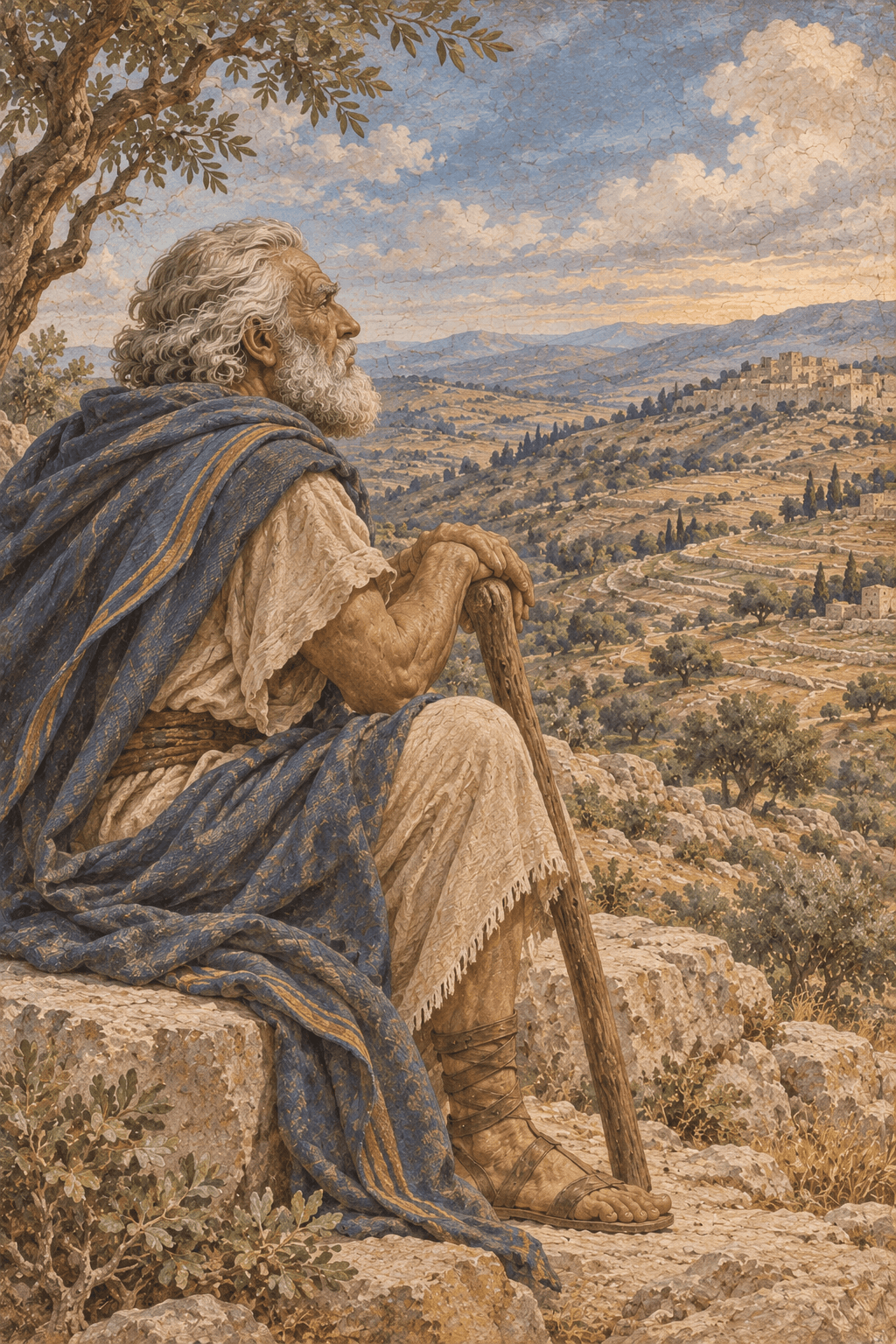
If Joshua is a symbol of Jesus Christ, why is it said of Joshua that he was old and stricken in years, though the Lord of glory Jesus never grew old? We can understand old age from two sides:
First: old age in the sense of advancing years, when a person enters a state of age, weakness and incapacity that ends in his death. This is the old age of incapacity, which did not touch the Lord of glory Jesus, for He ascended while still a mature man in the flesh; so that His Church, united to Him and bearing His attributes, carries in herself no spiritual old age or spiritual weakness. Like her Bridegroom she bears a maturity that does not grow old; her youth is renewed like the eagle’s.
In other words, the true Christian, though he grows old and weak in body, remains young and alive in spirit and heart, without weakness, in Christ Jesus who does not grow old.
Second: old age in the sense of wisdom … “the wisdom of the elders,” which is not tied to age but to maturity of mind and spirit. Adam lived long years on the earth, but because of his descent into sin he did not receive the title “old man,” nor was it said of him that he was “well stricken in age,” for he did not profit from his days but lost them. The first to enjoy this title were Abraham and Sarah his wife, for it was said:
“Now Abraham and Sarah were old and well stricken in age” (Genesis 18:11), when they hosted the Word of God and the two angels in their tent. Their life became a heaven in which God and His angels dwelt, and they became worthy to receive the promise of Isaac, a symbol of Christ Jesus. It is as if a person truly becomes old and well stricken in age when he carries the heavenly nature within him, hosting God to reign in him and opening himself to the heavenly ones as his beloved friends!
Here too, as Joshua begins to divide the land of the inheritance — as if, through the symbol, he offers the heavenly inheritance to the believers — it is said of him that he is old and stricken in years. In this Joshua is a symbol of Jesus Christ, not as an old man in incapacity, but as the Wisdom of God, in whom He grants us the eternal inheritance.
Origen has a beautiful comment on the phrase “old and stricken in years”:
“Here we find that it is the Holy Spirit who declares that Joshua is old and stricken in years … a phrase that cannot be applied to a sinner, for the sinner does not advance in days, since he does not do this: ‘forgetting those things which are behind, and reaching forth unto those things which are before’ (Philippians 3:13); therefore he is not fit for the kingdom of God (Luke 9:62). On the contrary, when we reach forward, striving toward perfection, we advance in days. [207]”
This title, given to Joshua the son of Nun by the Lord Himself, is a testimony of honor for him, a sign of his reaching forward, not only to enjoy the inheritance but to give the inheritance to others. He not only carries the heavenly nature, but offers it to his brethren and his children.
On the other hand, Joshua became advanced in days because, as a symbol of Jesus the Sun of Righteousness, in every action the sun shone on him and gave him a new, holy day full of glorious works. It is as if he acquired these spiritual days working in the Lord, so that they became his own, and so he is called advanced in days.
2. The Land Remaining to Be Possessed
KJV · Verses 2–6
2 This is the land that yet remaineth: all the borders of the Philistines, and all Geshuri, 3 From Sihor, which is before Egypt, even unto the borders of Ekron northward, which is counted to the Canaanite: five lords of the Philistines; the Gazathites, and the Ashdothites, the Eshkalonites, the Gittites, and the Ekronites; also the Avites: 4 From the south, all the land of the Canaanites, and Mearah that is beside the Sidonians unto Aphek, to the borders of the Amorites: 5 And the land of the Giblites, and all Lebanon, toward the sunrising, from Baalgad under mount Hermon unto the entering into Hamath. 6 All the inhabitants of the hill country from Lebanon unto Misrephothmaim, and all the Sidonians, them will I drive out from before the children of Israel: only divide thou it by lot unto the Israelites for an inheritance, as I have commanded thee.
The Lord says to Joshua: “There remaineth yet very much land to be possessed” [1].
How does Scripture say, “And the land rested from war” (Joshua 11:23), and then say, “There remaineth yet very much land to be possessed”? The land which Joshua trod with his feet he reigned over, driving out the adversaries, so that it rested from war. This is the community of believers who have accepted the entry of the Lord Christ into their spiritual and bodily life; He has forgiven all their sins and given them peace with the Father, and peace with one another, and peace within the person himself, between spirit and body, by sanctifying all!
This is the true rest that has come to every true believer in his relationship with God his Father and with his human brethren, and even in his relationship with his own body, his feelings and his inner sensations … He enjoys a transcendent rest in Christ Jesus. As for the declaration that there remains very much land to be possessed, this is natural, for much land had not yet been entered by Joshua … Even now there are still many unbelievers who have not enjoyed the Lord’s entering their lives to reign in them.
The Psalmist affirms that the Lord Christ must reign, saying: “All nations shall serve him” (Psalm 72:11), and also:
“He shall have dominion also from sea to sea, and from the river unto the ends of the earth. They that dwell in the wilderness shall bow before him” (Psalm 72:8–9).
We can also say that the Lord Christ — the true Joshua — when He was lifted up on the cross, entered Hades to reign over those who had died in hope, carrying them off to His Paradise. In this way we understand the phrase, “And the land rested from war.” Christ the Head conquered on behalf of all mankind by His cross. But this victory is the power given to the Church through the generations, so that by His victory she may conquer, and by His triumph she may crush Hades and carry every soul to Paradise … In this way we understand the second phrase: “There remaineth yet very much land to be possessed.”
The Lord reigned when He was in the flesh on earth, and He still reigns, standing in the midst of His Church through the generations, granting victory to the believers and opening the door of salvation to all generations.
3. Division by Lot
KJV · Verses 7
7 Now therefore divide this land for an inheritance unto the nine tribes, and the half tribe of Manasseh,
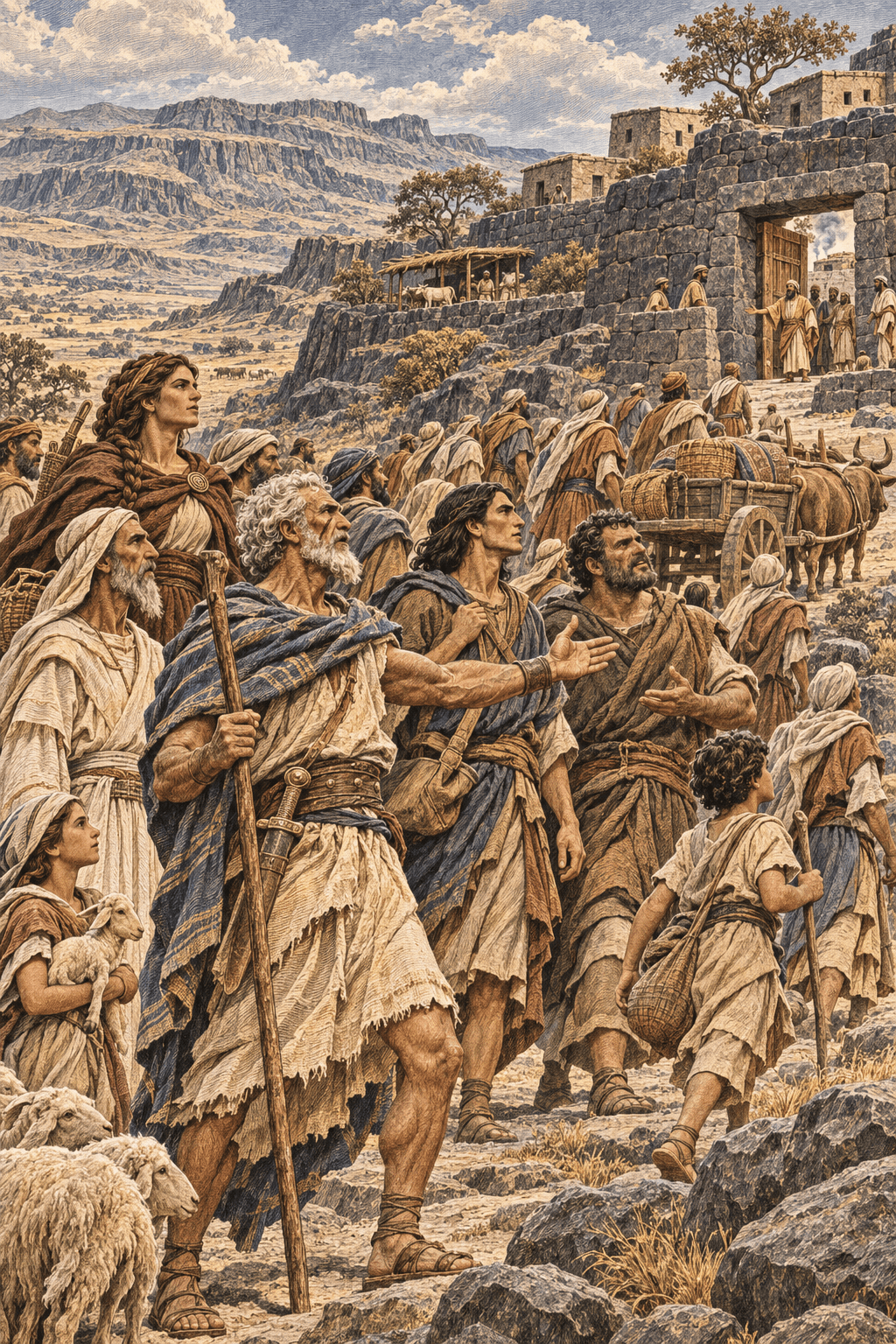
“Only divide thou it by lot unto the Israelites for an inheritance, as I have commanded thee” [6].
The lot was used in Holy Scripture in both the Old and New Testaments. It was not practiced as chance befalling a person in any way whatever, but after prayers lifted up to God, so that the human will might stop and wait for the divine will. Origen, [208] criticizes the men of his own age for not using it in the ordination of bishops, priests and deacons, offering evidence of its use from both Testaments.
First: in the Old Testament. It is said in the Book of Leviticus: “And Aaron shall cast lots upon the two goats; one lot for the Lord, and the other lot for the scapegoat. And Aaron shall bring the goat upon which the Lord’s lot fell, and offer him for a sin offering. But the goat, on which the lot fell to be the scapegoat, shall be presented alive before the Lord, to make an atonement with him, and to let him go for a scapegoat into the wilderness” (Leviticus 16:8–10).
Joshua used it in dividing the land which the Lord gave to His people. In the Book of Jonah, when the sailors felt utterly unable to act, they cried to their gods and finally cast lots, and learned that this confusion was because of Jonah (Jonah 1:7). And it is said in the Book of Proverbs:
“The lot causeth contentions to cease, and parteth between the mighty” (Proverbs 18:18), as if casting the lot among those who are spiritually strong reveals the truth and removes from among them every contention or difference of opinion.
Second: in the New Testament. When it was necessary to appoint someone as an apostle of the Lord in the place of Judas, “they appointed two, Joseph called Barsabas, who was surnamed Justus, and Matthias. And they prayed, and said, Thou, Lord, which knowest the hearts of all men, shew whether of these two thou hast chosen … And they gave forth their lots; and the lot fell upon Matthias; and he was numbered with the eleven apostles” (Acts 1:23–26).
Origen comments: “The apostles’ use of it shows that if we use it with absolute faith, together with recourse to prayer, it reveals to people the hidden will of God clearly.” [209] But some suppose that this happened before the descent of the Holy Spirit, who gives the Church the spirit of discernment and the perception of God’s will through prayer with a holy life, without the need for a lot, as happened in the choosing of the deacons (Acts 6:2–3). [210]
Perhaps God permitted the use of the lot in dividing the land so that personal factors would not interfere in the distribution, and no tribe would feel that what it received was by the favor of a man; rather, it was a gift from God Himself, God’s free gift, so that no one, great or small, could humiliate a tribe by claiming to have given it something of his own.
4. The Portion of the Two Tribes and a Half
KJV · Verses 8–33
8 With whom the Reubenites and the Gadites have received their inheritance, which Moses gave them, beyond Jordan eastward, even as Moses the servant of the Lord gave them; 9 From Aroer, that is upon the bank of the river Arnon, and the city that is in the midst of the river, and all the plain of Medeba unto Dibon; 10 And all the cities of Sihon king of the Amorites, which reigned in Heshbon, unto the border of the children of Ammon; 11 And Gilead, and the border of the Geshurites and Maachathites, and all mount Hermon, and all Bashan unto Salcah; 12 All the kingdom of Og in Bashan, which reigned in Ashtaroth and in Edrei, who remained of the remnant of the giants: for these did Moses smite, and cast them out. 13 Nevertheless the children of Israel expelled not the Geshurites, nor the Maachathites: but the Geshurites and the Maachathites dwell among the Israelites until this day. 14 Only unto the tribes of Levi he gave none inheritance; the sacrifices of the Lord God of Israel made by fire are their inheritance, as he said unto them. 15 And Moses gave unto the tribe of the children of Reuben inheritance according to their families. 16 And their coast was from Aroer, that is on the bank of the river Arnon, and the city that is in the midst of the river, and all the plain by Medeba; 17 Heshbon, and all her cities that are in the plain; Dibon, and Bamothbaal, and Bethbaalmeon, 18 And Jahaza, and Kedemoth, and Mephaath, 19 And Kirjathaim, and Sibmah, and Zarethshahar in the mount of the valley, 20 And Bethpeor, and Ashdothpisgah, and Bethjeshimoth, 21 And all the cities of the plain, and all the kingdom of Sihon king of the Amorites, which reigned in Heshbon, whom Moses smote with the princes of Midian, Evi, and Rekem, and Zur, and Hur, and Reba, which were dukes of Sihon, dwelling in the country. 22 Balaam also the son of Beor, the soothsayer, did the children of Israel slay with the sword among them that were slain by them. 23 And the border of the children of Reuben was Jordan, and the border thereof. This was the inheritance of the children of Reuben after their families, the cities and the villages thereof. 24 And Moses gave inheritance unto the tribe of Gad, even unto the children of Gad according to their families. 25 And their coast was Jazer, and all the cities of Gilead, and half the land of the children of Ammon, unto Aroer that is before Rabbah; 26 And from Heshbon unto Ramathmizpeh, and Betonim; and from Mahanaim unto the border of Debir; 27 And in the valley, Betharam, and Bethnimrah, and Succoth, and Zaphon, the rest of the kingdom of Sihon king of Heshbon, Jordan and his border, even unto the edge of the sea of Chinnereth on the other side Jordan eastward. 28 This is the inheritance of the children of Gad after their families, the cities, and their villages. 29 And Moses gave inheritance unto the half tribe of Manasseh: and this was the possession of the half tribe of the children of Manasseh by their families. 30 And their coast was from Mahanaim, all Bashan, all the kingdom of Og king of Bashan, and all the towns of Jair, which are in Bashan, threescore cities: 31 And half Gilead, and Ashtaroth, and Edrei, cities of the kingdom of Og in Bashan, were pertaining unto the children of Machir the son of Manasseh, even to the one half of the children of Machir by their families. 32 These are the countries which Moses did distribute for inheritance in the plains of Moab, on the other side Jordan, by Jericho, eastward. 33 But unto the tribe of Levi Moses gave not any inheritance: the Lord God of Israel was their inheritance, as he said unto them.
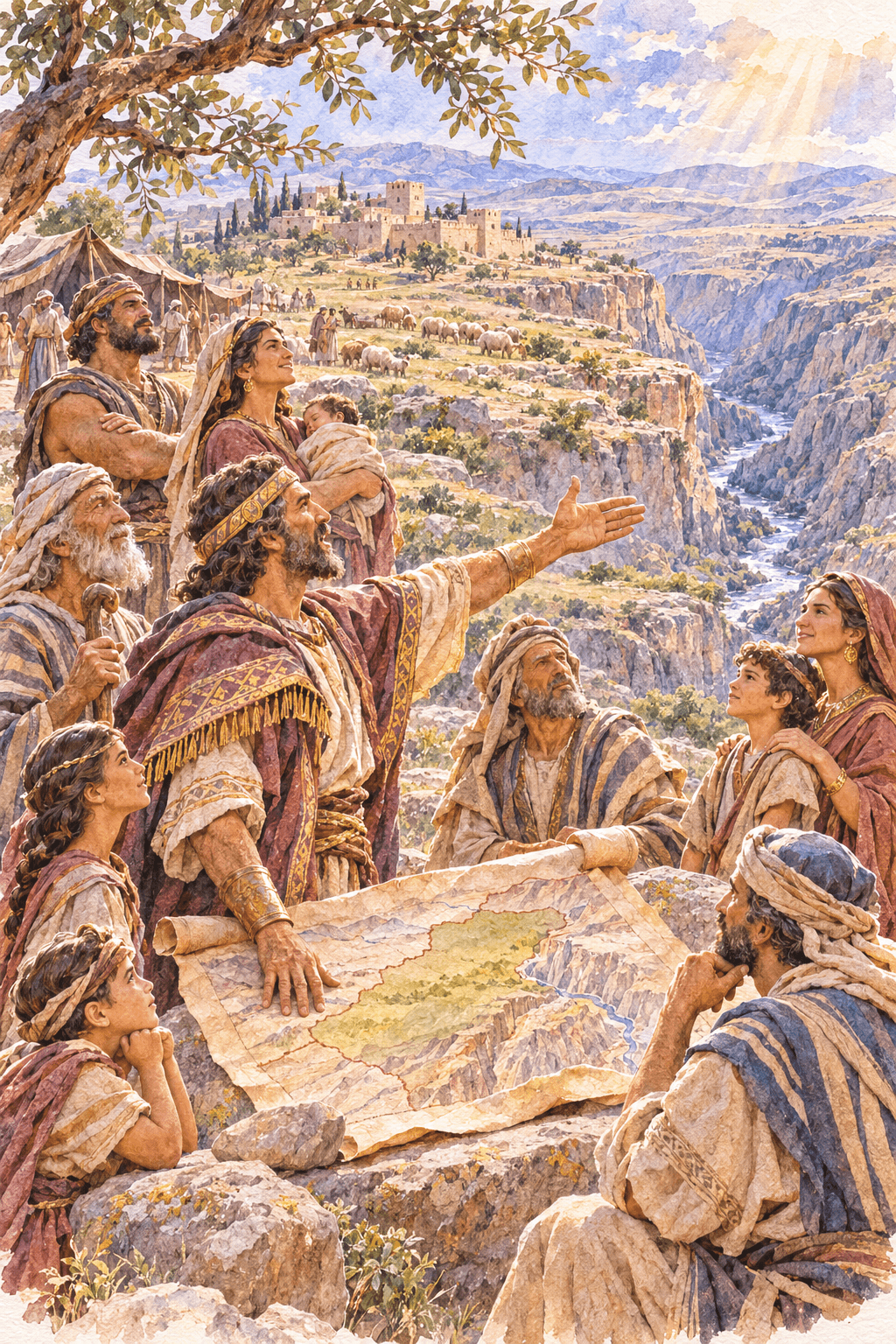
It was not possible for the two tribes and a half — who represent the men of the Old Testament — to inherit before us; they receive the inheritance from the hand of Joshua himself, as the Apostle Paul says: “And these all, having obtained a good report through faith, received not the promise: God having provided some better thing for us, that they without us should not be made perfect” (Hebrews 11:39–40).
Their inheritance was fixed in the days of Moses, but they crossed over to fight with the rest of the tribes, so that all might take possession together at the appointed time, when Joshua had grown old and the land had rested from war. In this — as Origen says — there is a pointer to the struggle of our departed loved ones with us through their prayer for us, so that we may all inherit together. [211]
Notes and References
[207] Origen, Homilies on Joshua 16:1.
[208] Origen, ibid. 23:2.
[209] Origen, ibid.
[210] Fr. Tadros Y. Malaty, Pastoral Love (Arabic), pp. 233–234.
[211] Origen, Homilies on Joshua 16:5.