
This book opened by revealing the principal truth in ministry: that God is the One who works in His servants (Joshua 1), to bring them with His people into His inheritance. Then came the story of the two spies and Rahab the harlot, affirming that a practical faith in God the Savior is the way to attain the divine inheritance and enjoy God’s promises. Now, as we stand on the bank of the Jordan, we discover what baptism makes possible in the crossing — what God’s saving work through baptism makes possible for the enjoyment of the inheritance. Origen says: “The events of the Jordan are a picture of the mystery that takes place in baptism.” [68]
1. Waiting three days (1–4).
2. Preparing to cross (5–6).
3. Joshua magnified in the Jordan (7–8).
4. The Ark in the Jordan (9–12).
5. The one heap (13–17).
1. Waiting Three Days
KJV · Verses 1–4
1 And Joshua rose early in the morning; and they removed from Shittim, and came to Jordan, he and all the children of Israel, and lodged there before they passed over. 2 And it came to pass after three days, that the officers went through the host; 3 And they commanded the people, saying, When ye see the ark of the covenant of the Lord your God, and the priests the Levites bearing it, then ye shall remove from your place, and go after it. 4 Yet there shall be a space between you and it, about two thousand cubits by measure: come not near unto it, that ye may know the way by which ye must go: for ye have not passed this way heretofore.
When the two spies had given their report of God’s work with them, the whole procession set out toward the Jordan: “And Joshua rose early in the morning; and they removed from Shittim, and came to Jordan, he and all the children of Israel, and lodged there before they passed over. And it came to pass after three days, that the officers went through the host …” [1–2].
The two spies gave Joshua a realistic report: all Jericho was in terror and fear, and Rahab had received them in her house and taken them up to the roof, so that they might go to the mountains and then come to him. This pointed to the word of preaching among the catechumens, who realize that through Jesus Christ the Savior all the strongholds of evil are torn down, the prince of darkness trembles, and salvation is accomplished for whoever embraces the mission of Jesus Christ and His Gospel … But this will not be fulfilled for them except by setting out to the river Jordan under the leadership of “the true Joshua” Himself!
Faith must be sealed with baptism, so that one may cross to the inheritance and enjoy God’s promises and His free gifts! The journey from Shittim to the Jordan under the leadership of Joshua is the commitment of the catechumens to cross into baptism.
They departed from Shittim, which means “acacia trees,” the place where Balaam tried to curse the people of Israel (Numbers 22–24), and where the people went astray after the daughters of Moab and Midian and Baal-peor (Numbers 25), in order to go through the Jordan into the land of promise. They departed from the curse, from error and from debauchery (Baal-peor) to the new, holy life of baptism. But this setting out required them to stand with Joshua for three days before crossing the Jordan.
Here we enter into the mystery of the three days, of which we have often spoken and will keep on speaking, as the mystery of the resurrection with Christ on the third day. There is no crossing of the Jordan and no enjoying of what baptism makes possible except through burial with the Lord for three days, in Him and with Him! The Apostle Paul says:
“Know ye not, that so many of us as were baptized into Jesus Christ were baptized into his death? Therefore we are buried with him by baptism into death: that like as Christ was raised up from the dead by the glory of the Father, even so we also should walk in newness of life” (Romans 6:3–4).
And Saint Ambrose says:
“Baptism is the cross. What took place for Christ in the crucifixion and burial, baptism works in us, though not in the same manner. Christ died in the flesh and was buried; but we die to sin and are buried … If you share with Him in death and burial, all the more will you share with Him in the resurrection and life. [69]”
The three days, as we saw in chapter one, [70] also point to the Holy Trinity. There is no crossing in the waters of baptism except after the declaration of our faith in the Holy Trinity, in which we receive sonship to the Father and membership in the body of the only-begotten Son, while the Holy Spirit establishes us in the Son. In other words, baptism is the enjoyment of the work of the Holy Trinity in our lives; without our faith in Him, baptism profits nothing!
After the three days had passed — that is, after receiving the power of Christ’s resurrection and declaring faith in the Holy Trinity — the officers, the captains of thousands, hundreds and tens, went through the camp and commanded the people (see verses 3–4 above).
Saint Augustine says:
“Jordan means ‘their descent.’ Descend, then, that you may be lifted up; and do not be lifted up, lest you fall. [71]”
If baptism is a descent for the sake of ascent, its way is strange to the sons of men who fell into pride, who do not wish to descend, and even if they wished, they could not. It is a new way, which had to be opened by the One who alone was able to humble Himself though He is the Great One: the incarnate Word of God. The crossing of the Ark of the covenant of the Lord, carried by the priests the Levites before the people, means that the Lord Christ Himself opened the way of baptism, going forward into it in His humility to lift us up to sonship to God. The Son became a servant, so that in the waters of baptism He might lift the servants up to sonship to God!
Had the Lord Christ not sanctified the waters of the Jordan, baptism would have been mere water without power. That is why Saint Ambrose says that it “bears the grace of Christ.” [72] In the Coptic rite the water is signed with the cross and the cross is immersed in it, declaring that the Crucified One — the true Ark of the covenant — has entered the Jordan and sanctified it.
The officers asked the people to keep a space of about two thousand cubits by measure between themselves and the Ark. The number 2 points to love, which makes the two — the lover and the beloved — one; for love came in the first and second commandments of the law. The Good Samaritan paid two pence to the inn out of his love for God and for his wounded brother, and the widow offered two mites as a sign of her love for God and for people.
The number 1000 points to the heavenly life. So the number 2000 points to love on the heavenly, spiritual level, whether love for God or for people. It is as if the one seeking baptism, in order to receive its blessings, must accept the new love in the waters of baptism. In this way the baptized enjoys the blessing of God dwelling in him, who dwells only in hearts enlarged by love. Saint Augustine says:
“If love is found, the fulfilling of the law is also found (Romans 13:10), where God dwells in you and you become a throne for Him. [73]”
If in the waters of baptism we become holy members of the body of Christ, we truly bear His attribute, which Saint John the Beloved expressed: “God is love” (1 John 4:8). And if baptism is a new birth, the Apostle affirms: “Every one that loveth is born of God, and knoweth God. He that loveth not knoweth not God” (1 John 4:7–8). It is as if whoever closes his heart to God and to people gains nothing from his birth in the waters of baptism; rather, it becomes a cause of judgment upon him … He received the possibility of love through the new birth, but did not practice it.
And if baptism is the mystery of the soul’s illumination, then without love man lives in darkness (1 John 2:9) … Thus the Jordan cannot be separated from the nature of heavenly love given to us by the Holy Spirit.
As for His saying, “Come not near unto it, that ye may know the way by which ye must go: for ye have not passed this way heretofore” [4], it points to the fact that this way is new for us; we have not experienced it before, and it would not have been possible to enjoy it or draw near to it had the Lord not entered first and opened it!
If Joshua’s crossing represents the crossing of Jesus Christ as our Savior — for the name Joshua means “Yahweh is salvation” — the crossing of the Ark points to Him as the Word of God, since it carries within it the two tablets of the law; and the crossing of the priests points to Him as the great High Priest. It is as if in the waters of baptism we meet our Savior Jesus, the Word of God, the Giver of life, the High Priest who intercedes for us before the Father through His precious blood. In them we abide in His holy body, to receive our salvation and enjoy His life in us, and through Him we gain boldness before the Father!
2. Preparing to Cross
KJV · Verses 5–6
5 And Joshua said unto the people, Sanctify yourselves: for to morrow the Lordwill do wonders among you. 6 And Joshua spake unto the priests, saying, Take up the ark of the covenant, and pass over before the people. And they took up the ark of the covenant, and went before the people.
“And Joshua said unto the people, Sanctify yourselves: for to morrow the Lord will do wonders among you” [5]. Joshua required them to sanctify themselves so that they might see God’s wonders in their midst. Truly these wonders are not the price of their sanctifying themselves; they are free gifts offered to whoever declares his longing for and faith in God’s work through his earnestness and readiness to receive God’s graces and gifts.
In our study of the rite of baptism we saw the preparations required of those seeking baptism so that they might be worthy to receive this sacrament. [74] Those seeking baptism in the early Church were bound to certain studies and to careful examination of their faith and conduct, as well as to fasting and prayer with vigils before baptism. Tertullian says:
“Those who are about to enter baptism ought to pray with constant prayers, fasts, bendings of the knee and vigils, together with the confession of all their past sins. [75]”
Saint Cyril of Jerusalem has a wonderful address to those seeking baptism:
“If the day of your wedding drew near, would you not leave everything and give yourselves wholly to preparing the feast? The day of the consecration of your souls to their heavenly Bridegroom has drawn near; will you not cease to busy yourselves with temporal things, so as to gain the spiritual? Let your mind be refined as by fire, with reverence! Let your souls be melted like metal, so that the dross may pass away and the pure metal remain … Pray with greater perseverance, that God may make you worthy of the heavenly and immortal mysteries. [76]”
3. Joshua Magnified in the Jordan
KJV · Verses 7–8
7 And the Lord said unto Joshua, This day will I begin to magnify thee in the sight of all Israel, that they may know that, as I was with Moses, so I will be with thee. 8 And thou shalt command the priests that bear the ark of the covenant, saying, When ye are come to the brink of the water of Jordan, ye shall stand still in Jordan.
It is fitting for man to magnify God through his worship, his inner conduct and his dealings with others; but here we find God Himself assuring Joshua: “This day will I begin to magnify thee” [7]. How does God magnify Joshua? Joshua’s greatness in the eyes of God and of the people was linked with the crossing of the river Jordan (Joshua 4:14). It is as if this were a symbolic picture of the beginning of the declaration of the greatness of our Lord Jesus through the Jordan. The points of comparison appear in the following:
First: He says to him, “That they may know that, as I was with Moses, so I will be with thee” [7]. This is what the crossing of the river Jordan declared, for it revealed God’s presence with Joshua. As for our Lord Jesus, His crossing of the Jordan, or His baptism, revealed His relationship with the Father as the only Son of God and the object of His good pleasure, for “the heavens were opened unto him … And lo a voice from heaven, saying, This is my beloved Son, in whom I am well pleased” (Matthew 3:16–17).
The feast of the Lord’s baptism has been called “the Feast of the Divine Epiphany.” Through it not only was the Holy Trinity manifested — the Son in the water, the Spirit descending upon Him, and the Father speaking of Him from heaven — but the work of the Holy Trinity in our lives was also clearly manifested. Through baptism the Holy Spirit grants us the new life that has become ours in Christ Jesus, and opens our inner insight to perceive our new position as children of the Father, enjoying His fatherhood and His good pleasure, because we are members of the body of His beloved Son.
Second: perhaps Joshua was also magnified through the priests carrying the Ark of the covenant and going before the people until all crossed the waters of the Jordan. This is the first time we find the holy Ark carried by the priests and taking a leading role for the people, who were bound to remain about two thousand cubits away [4]. This action brought out many aspects of the work of our true Joshua in the waters of baptism, of which we mention the following:
A) Our true Joshua was magnified, not by our carrying the Ark of the covenant, but by what He gave us in the new Jordan, where we have come to carry the Holy Trinity Himself. We ourselves have become God’s holy temple, receiving His Holy Spirit within us through the sacrament of the Holy Myron (chrismation). The kingdom of God has come to be within us (Luke 17:21); God dwells in us and reigns over us.
B) The priests’ carrying of the Ark points to God’s gift to man. The Ark represents the divine presence, and carrying it means man’s drawing near to God after a long period of enmity. Man used to look upon God as a consuming fire that could not be approached. But now that our Joshua has entered the Jordan, He has brought us not only to draw near to Him, but to be united with the Father in Him. In the holy waters the fiery Spirit works in us, not to burn our souls, but to destroy our old man and burn up the enmity, granting us a spiritual illumination through which we perceive our sonship to God and our union with Him.
Therefore Origen says: “Blessed are those who have come near! They have drawn near and dwell beside the fire that enlightens them and does not burn them.” [77] If in the divine Incarnation the divinity was united with the humanity, and we saw the Son of God come down to us and dwell in our midst, near to us, indeed as one of us, then in the Jordan He gave us to rise up to Him and draw near to Him, to carry His divine life within us, and He lifts us up to His heavens.
This is what glorifies our true Joshua: not our drawing near to carry the Ark with the priests of the Old Covenant, but our being lifted up to heaven and being with God, united with Him in His Son by His fiery Holy Spirit.
Saint Gregory, Bishop of Nyssa, speaks briefly of the work of the Jordan in our lives:
“The Jordan has been magnified, for it renews men and plants them in the Paradise of God. [78]”
Again Saint Gregory of Nyssa invites us to enjoy baptism, in which our Joshua is glorified through His work in our lives, saying:
“You have been wallowing in the mire for a long time; hasten to the Jordan, not at the call of John, but at the voice of Christ! In truth the river of grace runs everywhere. It does not rise in Palestine to disappear in the neighboring sea; it covers the whole world, enters Paradise, flows against the course of the four rivers that come down from there, and brings back into Paradise things far more precious than the other rivers bring. For those rivers bring sweet scents and cultivation of the earth and fruits, but this river brings men born of the Holy Spirit! Imitate Joshua the son of Nun: carry the Gospel as he carried the Ark! Leave the wilderness, that is, sin, and cross the Jordan. Hasten toward the life according to Christ, toward the land that bears the fruits of joy, in which streams of milk and honey flow. Overthrow Jericho, the old dwelling, and do not leave it fruitful. [79]”
We have already spoken in some detail of the power of baptism in our lives, which truly glorifies our Jesus who has carried us across this holy river. [80]
C) The people being bound to stay about two thousand cubits away from the Ark points to the believers of the Old Testament as a whole, who, though they enjoyed salvation, did so from afar, through symbols and prophecies, that is, through shadows and the likeness of heavenly things. The believers of the New Testament are symbolized by the priests carrying the Ark. In both our Joshua is glorified and magnified.
Third: Joshua was also magnified because, through his crossing of the Jordan, the priests appeared as leaders of the people by carrying the Ark, being the lampstand that carries the divine light to shine for all. Since the Ark contains the tablets of the covenant, it symbolizes the preaching of the divine word, without which no one can cross to the land of promise and enjoy the eternal inheritance. Origen says:
“It is the order of priests and Levites that stands near the Ark of the covenant of the Lord, in which the law is kept, for they must enlighten the people with the commandments of God, as the prophet says: ‘Thy word is a lamp unto my feet, and a light unto my path’ (Psalm 119:105). This light is kindled by the priests and Levites, among whom there are those who put the candle on a candlestick, and it giveth light unto all that are in the house (Matthew 5:15). [81]”
In the Jordan of the New Testament, the priests do not carry an Ark containing the law engraved on two stones; they carry “the word of God” engraved on their hearts by the Spirit (2 Corinthians 3:3), shining with its attributes in their inner life and outward conduct. They offer it not only by words of preaching, but by the Holy Spirit who brings the word into the hearts of the hearers. The Apostle Paul says: “For our gospel came not unto you in word only, but also in power, and in the Holy Ghost, and in much assurance; as ye know what manner of men we were among you for your sake” (1 Thessalonians 1:5).
Fourth: Joshua was also magnified by the crossing of the people under the leadership of the Ark. They could not have crossed had Joshua and the priests carrying the Ark not gone ahead and stood in the Jordan, for it was said to Joshua: “When ye are come to the brink of the water of Jordan, ye shall stand still in Jordan” [8]. This is a symbolic picture of the truth of salvation: we could not have enjoyed the new life, nor crossed the Jordan in power, had our life-giving Jesus not entered the Jordan Himself and stood in it, to carry us on His shoulder and set out with us to His kingdom.
Truly, the water of baptism without Christ becomes ordinary water, able to wash the body without sanctifying it, unable to enter the depths of the soul.
Joshua and the priests were bound to stand in the Jordan. What a symbolic picture of the greatness of our true Joshua, who entered with us into the waters of the Jordan, so that we see Him standing and we stand with Him and in Him! Truly He was buried in the water as in the tomb, but it was not possible for death to hold Him nor for the tomb to close upon Him; He stood up risen from the dead, granting us the risen life.
We are buried with Him by baptism into death (Romans 6:4), not to remain buried but to be risen with Him and in Him. This is the secret of the magnifying of the true Joshua, for in the waters of baptism the mystery of His cross, His burial and His resurrection is declared as one inseparable mystery!
Fifth: Joshua is magnified by receiving the leadership, a symbol of the true Joshua receiving the leadership of our souls at our crossing of the new Jordan, and after it as well. Saint Ambrose speaks of the Lord Himself performing the sacramental work during baptism, saying:
“Do not consider the merits of individuals … Believe that the Lord Jesus is present at the invocation of the priest, He who said, ‘For where two or three are gathered together in my name, there am I in the midst of them’ (Matthew 18:20). How much more, when the Church is present and His mysteries are present, does He grant us the declaration of His presence? [82]”
In more than one place Saint John Chrysostom asks us not to look at the priest during the sacramental service, but at the Lord Christ Himself, who works secretly in him. As for our Lord Jesus leading our souls after baptism, Origen says:
“Having crossed the river Jordan by means of the priests, you enter the land of promise, the land in which Joshua — after Moses — takes charge of you and becomes your guide on your new way. [83]”
4. The Ark in the Jordan
KJV · Verses 9–12
9 And Joshua said unto the children of Israel, Come hither, and hear the words of the Lord your God. 10 And Joshua said, Hereby ye shall know that the living God is among you, and that he will without fail drive out from before you the Canaanites, and the Hittites, and the Hivites, and the Perizzites, and the Girgashites, and the Amorites, and the Jebusites. 11 Behold, the ark of the covenant of the Lord of all the earth passeth over before you into Jordan. 12 Now therefore take you twelve men out of the tribes of Israel, out of every tribe a man.
Joshua says: “Hereby ye shall know that the living God is among you, and that he will without fail drive out from before you the Canaanites, and the Hittites, and the Hivites, and the Perizzites, and the Girgashites, and the Amorites, and the Jebusites. Behold, the ark of the covenant of the Lord of all the earth passeth over before you into Jordan” [10–11].
In this passage two principal and complementary lines in the liturgy of baptism appear clearly: the establishing of the kingdom of God by His appearing in the midst of His children and dwelling in them, and His driving out, or destroying, of the kingdom of the devil, symbolized by these pagan nations. We have spoken at length of these two lines in our study of baptism. [84]
It should be noted that the crossing of the river Jordan, while it brought out God’s dwelling among His people and His granting them victory over the kingdom of darkness, also reveals, on the other hand, God’s work with His children in subjecting nature for their sake. As long as we carry the Creator within us, creation is subject to us and works in obedience for our sake. Origen compares nature’s subjection to the believers for their good with its resistance to the wicked, saying:
“The wicked man feels hatred toward all creation, as is said of the Egyptians, who feel enmity toward the earth, the waters, the air and the sky. But for the righteous, even what seems harsh is turned into plains and gentle slopes. The righteous man crosses the Red Sea as one walking on dry land, while the Egyptian who wishes to cross it is swallowed up in it. For the righteous the water is a wall on his right hand and on his left (Exodus 14:22–29)! Let the righteous man go forward into the terrifying mazes of the wilderness, and he finds food for himself from heaven (Psalm 78:24). So too in the Jordan, the Ark of the covenant led God’s people; the priests and Levites stood still, and the waters, as if seized with astonishment, stood still before the mysteries of God in reverence, withdrew from their course and gathered on one side as a heap, to offer God’s people a way without danger (Joshua 3:15). Do not be astonished, O Christian, when we tell you what happened with the ancient people; for the word of God promises you — you who cross the river Jordan through the sacrament of baptism — far greater and loftier good things. It promises you a way and a passage through the air. Hear what Saint Paul says of the righteous: ‘We … shall be caught up together with them in the clouds, to meet the Lord in the air’ (1 Thessalonians 4:17). Indeed, it befits the righteous man to fear nothing, for all creation is at his service. Listen also to the promises God gives us by the prophet: ‘When thou walkest through the fire, thou shalt not be burned; neither shall the flame kindle upon thee. For I am the Lord thy God’ (Isaiah 43:2–3). Thus the righteous man is as one in his own chamber, at rest; and wherever he is, all creation shows itself subject to him (Genesis 1:26; Psalm 8:6) … So, when you remember these unheard-of signs of the greatness of God — the sea split in two for your sake, and the water of the river halted at its source — you turn and cry: ‘What ailed thee, O thou sea, that thou fleddest? thou Jordan, that thou wast driven back?’ And the word of God answers you: ‘Tremble, thou earth, at the presence of the Lord, at the presence of the God of Jacob; which turned the rock into a standing water, the flint into a fountain of waters’ (Psalm 114:5, 7–8). [85]”
Saint Augustine perceived this, and in his soliloquy with God he says:
“You have consecrated all Your creation to my service, so that I may be consecrated wholly to Your service.”
“You have put all things under the feet of man (Psalm 8), so that he may be devoted wholly to You. Therefore You have set no lord over him but Yourself; rather, You have made him lord over Your creation! [86]”
5. The One Heap
KJV · Verses 13–17
13 And it shall come to pass, as soon as the soles of the feet of the priests that bear the ark of the Lord, the Lord of all the earth, shall rest in the waters of Jordan, that the waters of Jordan shall be cut off from the waters that come down from above; and they shall stand upon an heap. 14 And it came to pass, when the people removed from their tents, to pass over Jordan, and the priests bearing the ark of the covenant before the people; 15 And as they that bare the ark were come unto Jordan, and the feet of the priests that bare the ark were dipped in the brim of the water, (for Jordan overfloweth all his banks all the time of harvest,) 16 That the waters which came down from above stood and rose up upon an heap very far from the city Adam, that is beside Zaretan: and those that came down toward the sea of the plain, even the salt sea, failed, and were cut off: and the people passed over right against Jericho. 17 And the priests that bare the ark of the covenant of the Lord stood firm on dry ground in the midst of Jordan, and all the Israelites passed over on dry ground, until all the people were passed clean over Jordan.
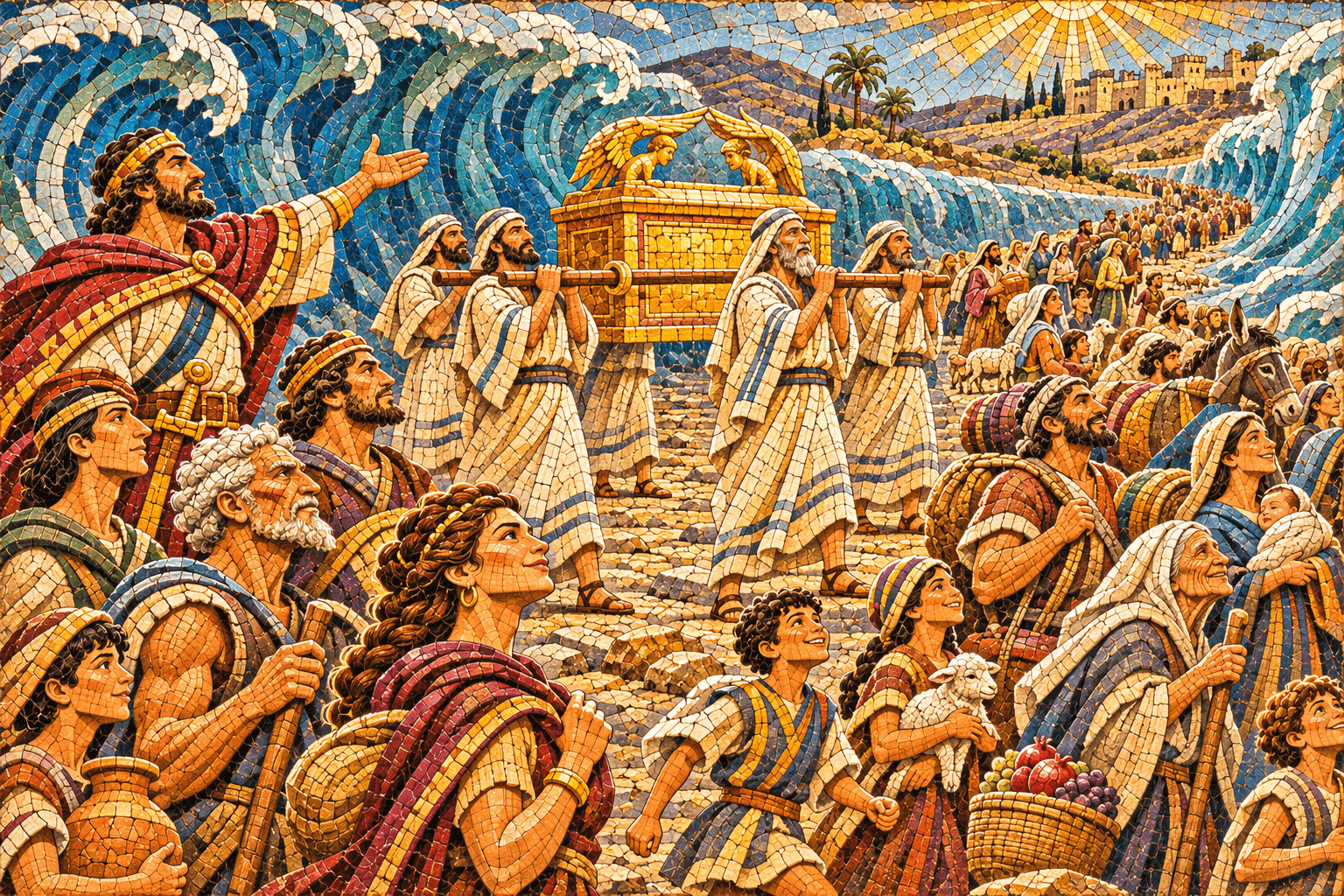
The crossing of the river Jordan under the leadership of Joshua was entirely different from the crossing of the Red Sea under the leadership of Moses the prophet. The latter was accomplished by the splitting of the sea and the crossing of the people, with the salt water on both sides as a wall for them. But here the waters “that come down from above … shall stand upon an heap” [13]; that is, the waters coming down from above remained at the source, halted on this right-hand side, while those flowing down into the salty Dead Sea ran off into it, and their place dried up.
So the water was sweet on one side, toward the source, and not two walls on both sides as in the crossing of the Red Sea. This did not happen by chance; it carried a symbol of the New Covenant, which we perceive by a brief comparison of the two crossings, explaining the symbolic aspects in all the details of the new crossing:
First: in our study of the Book of Exodus we spoke of the crossing of the Red Sea under the leadership of Moses the prophet as a symbol of baptism. What, then, is the difference between it and the crossing of the river Jordan under the leadership of Joshua the son of Nun? What I wish to make clear here is that the two crossings in reality represent two complementary aspects of the sacrament of baptism. The first points to putting off the old man, and the second to enjoying the gift of the new man.
In truth they are one integrated work: there is no enjoying the new man unless the old is put off, and the old cannot be put off unless we put on the new. So, though we compare the two crossings, in truth they are one extended crossing, in which the one seeking baptism puts off the old man — whom the law (Moses) exposed and laid bare, showing its fruit, eternal death — and puts on the new man, offered by divine grace through our true Joshua, as the Evangelist says:
“For the law was given by Moses, but grace and truth came by Jesus Christ” (John 1:17). The first represents the cross with Christ, and the second represents the resurrection with Him. That is why the first was accomplished by striking the sea with the rod (the cross), and the second by the standing of the priests carrying the Ark (the resurrection)!
Second: in the crossing of the Red Sea under Moses, the waters split in two and became walls on their right and on their left; but here the waters gathered at the source, while the rest flowed down into the Dead Sea, so that the way dried up before them. Origen sees in this a living picture of the work of baptism, which “made both one, and broke down the middle wall of partition; for the waters were heaped up on one side.” [87] Through Moses, or the law, humanity was split into Jews and Gentiles; but in Christ Jesus we have received through baptism the spirit of unity, not only between us and heaven, but among one another … for the Church has been gathered from all nations, all peoples and all tongues, and all have become members of the one body.
The way of the law is narrow; only one people can cross by it, and the waters hem it in like walls on the right and on the left. But the new way of Joshua is wide; the waters gather on one side, and the whole world can cross by it, open to all without racial distinction!
On the other hand, it was not without reason that the sweet water remained on one side, on their right as they crossed, while the water on the other side flowed down into the salty Dead Sea [16]. Origen says:
“If all who are baptized kept the sweetness of the divine Spirit they received, and not one of them returned to the bitterness of sin, it would certainly not have been written that part of the river is cast into the abyss of the salt sea. Therefore these words, it seems to me, point to a difference among the baptized … For there are some who receive holy baptism and then turn back and give themselves over to the cares of the world and the inclinations of the lusts, and drink again from the salty cup of lust. These are symbolized by the part of the water that flows into the sea and is lost in the salt waters. But the part that remains standing and keeps its sweetness may point to those who, without turning back, keep the gift they received from God. Naturally, those who are saved can be symbolized by one part, for there is also only one ‘bread of God … which cometh down from heaven, and giveth life unto the world’ (John 6:33), as there is ‘one Lord, one faith, one baptism’ (Ephesians 4:4–6) … [88]”
Third: the crossing under the leadership of Moses brings us into a way between two walls of salt water; but under the leadership of Joshua the water is sweet and the way wide … The first expresses the law, which brings us into bitterness and makes us like people hemmed in and in danger; the second expresses the sweet and rich grace of our Lord Jesus, which gives the soul joy as we cross this world.
Fourth: the first crossing was in turmoil, with the enemy behind and salt water on both sides; but the second crossing was in peace, with no enemy behind us and no salt water around us … It is the way that is “our true Jesus,” in whom we rest and do not fear the enemy, and the salt waters cannot come near us.
Fifth: after the first crossing, a barren wilderness awaited the people, through which they would walk forty years — though God did not abandon them in the wilderness but shepherded them Himself and cared for all their spiritual, physical and moral needs. But in the second crossing the believer sees the land of Canaan not far from him, and Jerusalem very near. In Christ Jesus our Lord we see the heavenly Jerusalem clearly by faith; His heavenly promises are not far off, for we enjoy their pledge.
And wonderfully, in the second crossing the water remains halted on high at the source … as if pointing to the believing soul rising upward to live in heavenly things and not sinking into the waters of the Dead Sea.
Sixth: Origen says:
“When Moses brought the people out of the land of Egypt, there was no order among the multitudes and no rite among the priests; so they crossed the water of the sea … But when my Lord Joshua leads the army, let us look: ‘The priests go before the people carrying the Ark of the covenant on their shoulders … in which the law and the holy table (the manna) are kept.’ [89]”
Seventh: in the first crossing all were silent, but in the new crossing the priests carried trumpets, a sign of triumph and victory.
Eighth: in the first crossing the people carried no memorial of the crossing; but in the new crossing they carried with them twelve stones, pointing to the holy Church found in the depths of the Jordan … that is, she came forth mystically through baptism.
Ninth: the crossing took place when the soles of the feet of the priests carrying the Ark of the Lord rested in the waters of the Jordan, pointing to the Lord Christ, the great High Priest, crushing Satan under His feet. Our crossing is the fruit of His crushing of the powers of darkness!
Tenth: the timing of the crossing of the river Jordan was precise. We know that the river opposite Jericho is about 150–180 feet deep, and the crossing took place during the flood, between April and May, when the water is doubled and the river wide and very swift — a sign of God’s work in baptism: it overflows, in a transcendent way!
Notes and References
[68] Origen, Homilies on Joshua 5:1.
[69] Ambrose, On the Sacraments (De Sacramentis) 51:1 [reference as given in the source].
[70] See the commentary on Joshua 1:11.
[71] Augustine, On the Psalms 42.
[72] Ambrose, On the Sacraments 51:1 [reference as given in the source].
[73] Augustine, On the Psalms 99.
[74] See Fr. Tadros Y. Malaty, The Holy Spirit between the New Birth and Continual Renewal (Arabic), 1981, pp. 139–151.
[75] Tertullian, On Baptism 20.
[76] Cyril of Jerusalem, Procatechesis 6, 16.
[77] Origen, Homilies on Joshua 4:3.
[78] Gregory of Nyssa, On the Baptism of Christ, PG 46:293D.
[79] Gregory of Nyssa, On Baptism, PG 46:420D–421A.
[80] See our book on the Holy Spirit.
[81] Origen, Homilies on Joshua 4:2.
[82] Ambrose, On the Mysteries 5.
[83] Origen, Homilies on Joshua 4:1.
[84] See our book on the Holy Spirit (the renunciation of Satan).
[85] Origen, Homilies on Joshua 4:1.
[86] Augustine, Soliloquies 19, 20.
[87] Origen, Homilies on Joshua 1:4.
[88] Origen, ibid. 4:1.
[89] Origen, ibid. 1:4.