
Since the river Jordan points to the sacrament of holy baptism in its positive aspect, Joshua chose twelve men from the people to carry twelve stones from the depths of the Jordan and set them up in Gilgal, declaring the rise of the holy Church through baptism.
1. The memorial stones (1–8).
2. The stones set up in the riverbed (9).
3. Hastening to cross (10–11).
4. The crossing of the armed men (12–13).
5. The people revere Joshua (14).
6. Going up to Gilgal (15–24).
1. The Memorial Stones
KJV · Verses 1–8
1 And it came to pass, when all the people were clean passed over Jordan, that the Lord spake unto Joshua, saying, 2 Take you twelve men out of the people, out of every tribe a man, 3 And command ye them, saying, Take you hence out of the midst of Jordan, out of the place where the priests' feet stood firm, twelve stones, and ye shall carry them over with you, and leave them in the lodging place, where ye shall lodge this night. 4 Then Joshua called the twelve men, whom he had prepared of the children of Israel, out of every tribe a man: 5 And Joshua said unto them, Pass over before the ark of the Lord your God into the midst of Jordan, and take you up every man of you a stone upon his shoulder, according unto the number of the tribes of the children of Israel: 6 That this may be a sign among you, that when your children ask their fathers in time to come, saying, What mean ye by these stones? 7 Then ye shall answer them, That the waters of Jordan were cut off before the ark of the covenant of the Lord; when it passed over Jordan, the waters of Jordan were cut off: and these stones shall be for a memorial unto the children of Israel for ever. 8 And the children of Israel did so as Joshua commanded, and took up twelve stones out of the midst of Jordan, as the Lord spake unto Joshua, according to the number of the tribes of the children of Israel, and carried them over with them unto the place where they lodged, and laid them down there.
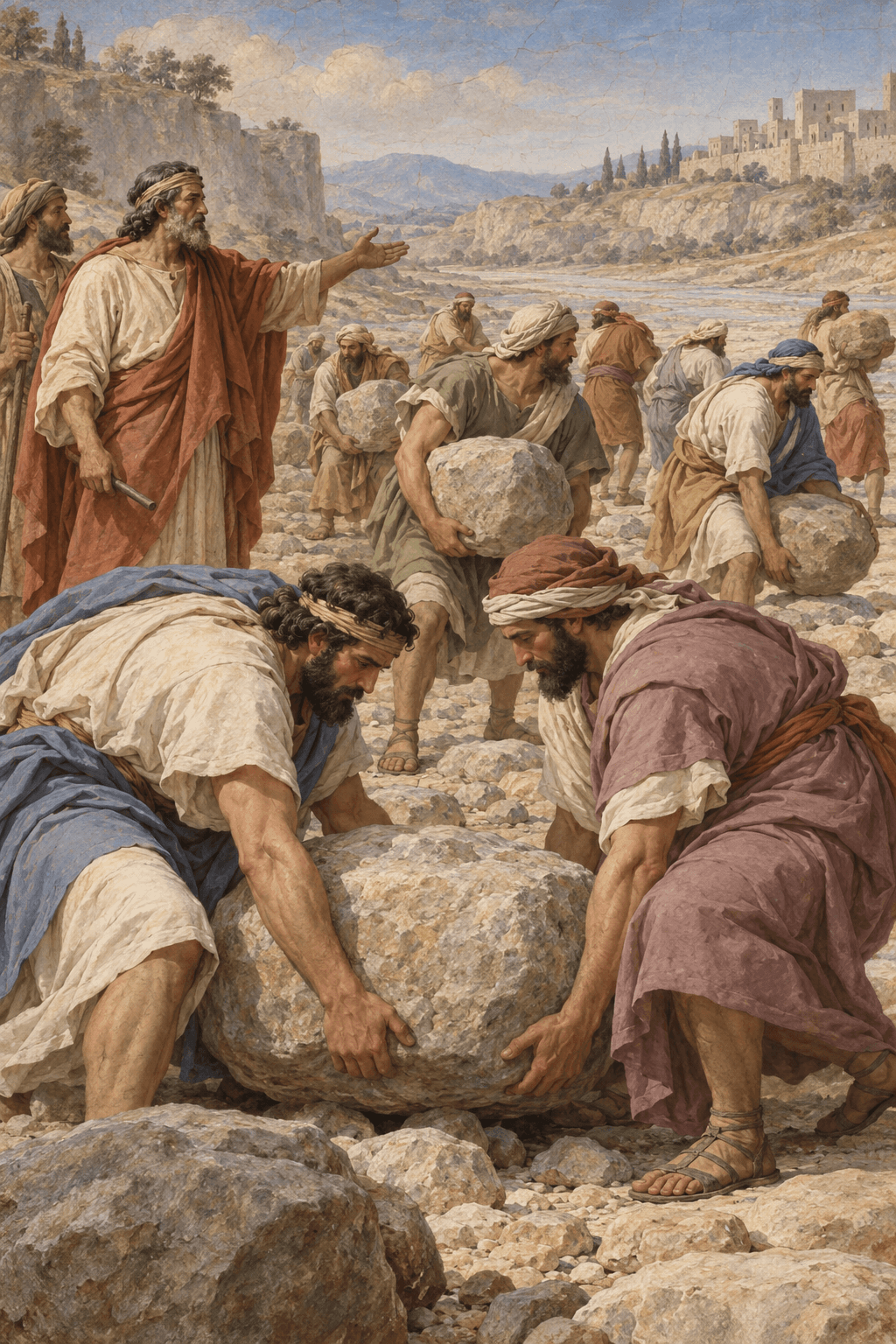
God commanded Joshua to choose twelve men from the people. By carrying twelve stones from the bed of the Jordan, from the place where the priests stood, they truly declare the rise of the Church as the hidden body of Christ, which came into being through the waters of baptism. As Saint Augustine says:
“The number 12 points to the holy Church, which is gathered from the four corners of the world (Mark 13:27) through baptism in the name of the Holy Trinity (4 × 3). [90]”
Or we can say that the Holy Trinity reigns over mankind in the east and west, the north and the south, so that the number 12 points to the kingdom of God over all mankind, that is, to the Church, which embraces members from all nations and peoples.
This Church was declared through this number in the Old Testament, where the number of tribes representing God’s people, or His kingdom on earth at that time, was twelve (Genesis 35:22). In the New Testament the Lord chose twelve disciples who shall judge the twelve tribes (Matthew 19:28). Even the heavenly Jerusalem — which in its essence means the kingdom of God in us forever, or, as our teacher Saint John calls it, “the tabernacle of God … with men” (Revelation 21:3) — has twelve gates (Revelation 21:12), three gates on each side.
At Elim the people found twelve wells of water (Exodus 15:27), pointing to the Church, for whom the Holy Spirit (the well of water) has become the secret of her life and comfort in the wilderness of this world. When Moses built an altar to the Lord, he set up twelve pillars (Exodus 24:4), revealing that the Church is living pillars in the heavenly temple of the Lord and a spiritual altar on which and in which the unique, eternal sacrifice of the cross is offered.
In the same thought Elijah the prophet built an altar of twelve stones when he offered the sacrifice (1 Kings 18:31). In the Jewish rite the high priest placed twelve precious stones on the breastplate he wore when he stood in the presence of God, as if he were Jesus Christ, the heavenly High Priest, who carries His Church on His heart and on His shoulders and presents her continually before the Father. Saint Irenaeus sees that the garments of the priests in the Old Testament bore twelve bells (Exodus 28:21, 34). [91] We know that the garment points to the body; it is as if Jesus Christ our Priest wears His Church as a white garment without spot, shining as the light (Matthew 17:2), moving with Him wherever He moves, sounding the bells of joy and exultation for His saints and of warning for those who neglect their salvation!
2. The Stones Set Up in the Riverbed
KJV · Verses 9
9 And Joshua set up twelve stones in the midst of Jordan, in the place where the feet of the priests which bare the ark of the covenant stood: and they are there unto this day.
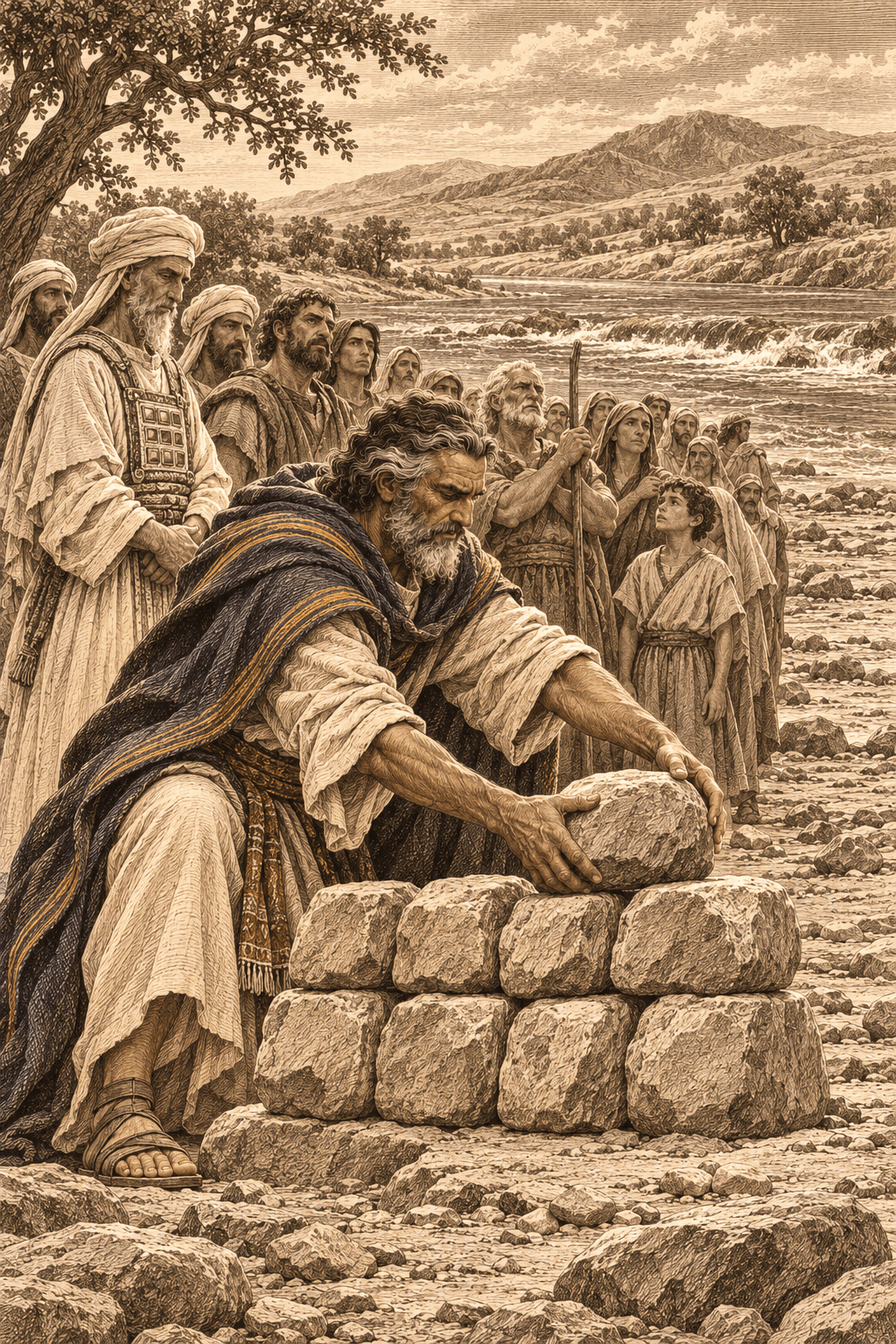
“And Joshua set up twelve stones in the midst of Jordan, in the place where the feet of the priests which bare the ark of the covenant stood” [9]. At the very time the men took twelve stones from the riverbed, they also brought twelve stones to the riverbed and set them up there. Bishop Caesarius says:
“The twelve stones they brought down into the riverbed are the fathers of the Old Testament, while the twelve stones they carried up out of the riverbed point to the disciples of Christ. [92]”
The stones carried down into the riverbed point to the Jews who were buried in the wilderness and disappeared, while the stones lifted from the riverbed point to the Gentiles, who went forth to the land of promise through baptism.
In fact we cannot separate the stones lifted on shoulders to Gilgal, to be built up there, from the stones set up in the bed of the Jordan. The first point to the Church as the body of Christ, which crossed the Jordan and bears the cross, death and burial every day, in order to rise also with her Head and experience with Him every day the new, risen life; while the other stones point to the continuing of the cross with Christ.
It is as if the true believer must rise with the Lord and experience every day sitting with Him in the heavenly places, to live with an angelic mind in a lofty, holy life; and at the same time stand on the bank of the Jordan, to see himself buried in its depths with his Savior, that he may experience the resurrection with Him.
Wonderfully, Holy Scripture tells us of the stones lifted to Gilgal, where the kingdom (the land of promise) is, before speaking of the stones set up in the midst of the Jordan, although burial precedes resurrection, suffering precedes rest, and humiliation precedes glory. But in spiritual reality there is no separation between the cross and the resurrection, between suffering with the Lord Christ and enjoying His rest, between bearing humiliation for His sake and receiving His glory.
The Lord hung on the cross while He is the Resurrection, before His resurrection took place; He entered into sufferings though His glories are eternal! And the Christian cannot accept burial, suffering and humiliation unless he perceives, by the Spirit of God, the resurrection of Christ, His rest and His glory! That is why the Apostle Paul says:
“That I may know him, and the power of his resurrection, and the fellowship of his sufferings, being made conformable unto his death; if by any means I might attain unto the resurrection of the dead” (Philippians 3:10–11). He cannot enter into the fellowship of His sufferings unless he knows the power of His resurrection; then he accepts death with joy in the hope of the great day of resurrection!
Would that our heart might walk about every day in Gilgal — the land of promise — to find a place for itself among the living stones, perceiving the power of the Lord working in it to lift it from glory to glory and bring it into the depths of heavenly things! Then it goes out to the bank of the Jordan, to realize that it cannot set out for the true Gilgal unless it is buried in the depths of the Jordan! It rejoices in the power of the resurrection, but not apart from the cross and burial with the Lord of glory Jesus!
Finally, Holy Scripture assures us that there is no enjoyment of these divine gifts except in Jesus Christ, of whom it is said: “Now that he ascended, what is it but that he also descended first into the lower parts of the earth? He that descended is the same also that ascended up far above all heavens, that he might fill all things” (Ephesians 4:9–10).
3. Hastening to Cross
KJV · Verses 10–11
10 For the priests which bare the ark stood in the midst of Jordan, until everything was finished that the Lord commanded Joshua to speak unto the people, according to all that Moses commanded Joshua: and the people hasted and passed over. 11 And it came to pass, when all the people were clean passed over, that the ark of the Lord passed over, and the priests, in the presence of the people.
“And the people hasted and passed over. And it came to pass, when all the people were clean passed over, that the ark of the Lord passed over” [10–11]. Origen gives us a living picture of what this swift crossing means. He says:
“It seems to me that the words ‘And the people hasted and passed over’ were not added by the Holy Spirit without need. Rather, it befits us who come to the baptism of salvation and receive the mysteries of the word of God not to walk slackly or carelessly, but to hasten in the work until we have passed over completely. To pass over ‘completely’ means to carry out all the commandments. Let us hasten to cross by fulfilling what is written: ‘Blessed are the poor in spirit’ (Matthew 5:3); for when we leave all pride and embrace the humility of Jesus, we are worthy of the promised blessedness. And when this commandment is fulfilled, let us not stop, but pass on to the rest of the commandments, such as ‘Blessed are they which do hunger and thirst after righteousness’ (Matthew 5:6), and ‘Blessed are they that mourn’ now in this world … ‘Blessed are the meek’ (Matthew 5:4–5), ‘Blessed are the peacemakers’ (Matthew 5:9). In this way we become worthy to hear that we are children of God (Matthew 5:9). And let us hasten to cross through the virtue of patience and the bearing of persecutions. By this active and fervent seeking to attain all perfection, whose goal is the victory of virtue, the Jordan is crossed swiftly … But when we have finished this crossing we have reached our goal, and then we must also be watchful and careful, lest through excessive negligence in our conduct we stumble: ‘But as for me, my feet were almost gone’ (Psalm 73:2). It is as if the prophet says that we must be no less zealous in keeping the virtues than we were in seeking them. [93]”
Let us then hasten to cross through a working faith, living as those who struggle to fulfill the divine commandments and to keep the gifts and virtues we have received from God. In ancient times, when Lot and his family lingered, the angels “laid hold upon his hand, and upon the hand of his wife, and upon the hand of his two daughters; the Lord being merciful unto him: and they brought him forth, and set him without the city. And it came to pass, when they had brought them forth abroad, that he said, Escape for thy life; look not behind thee, neither stay thou in all the plain; escape to the mountain, lest thou be consumed” (Genesis 19:16–17).
Lot, his wife and his two daughters did hasten and flee; but Lot’s wife could not keep the gift of salvation. After hastening, she turned back in her heart and became a pillar of salt!
Saint John Climacus warns us against lingering and not hastening in the crossing, especially at the beginning of our spiritual life. He says:
“Sluggishness at the very beginning of the spiritual battle is a sure sign of our coming death — a hateful and dangerous thing. A firm beginning certainly profits us, even if we grow slack afterwards. For the soul that was strong at the beginning, when it becomes negligent, remembers its former zeal, and this spurs it on to advance; and so it obtains wings. [94]”
Wonderfully, the priests carrying the Ark of the covenant did not come out of the riverbed until all the people had hastened across [10–11]. What true fatherhood! The good shepherd seeks not his own but that of others. Though he is the one who opens the way and prepares it for them, he remains, bearing the last place in the ranks, until he is reassured about all his children. The priests began the crossing and completed it, as if bearing the mark of their Master, who, though He is above all, took the last place in the ranks to embrace all mankind — He who is the beginning and the end, the first and the last (Revelation 22:13).
4. The Crossing of the Armed Men
KJV · Verses 12–13
12 And the children of Reuben, and the children of Gad, and half the tribe of Manasseh, passed over armed before the children of Israel, as Moses spake unto them: 13 About forty thousand prepared for war passed over before the Lord unto battle, to the plains of Jericho.
In our study of the Book of Numbers, these tribes asked Moses the prophet to leave them the land of Gilead, east of the Jordan, as an inheritance, and not to have a share west of the Jordan with the rest of the tribes. Moses agreed on condition that the men go down with their brethren (Numbers 32). Here divine inspiration affirms that about forty thousand of these tribes, prepared and armed for war, went out before the people and before the Lord for the work.
We observe in the text before us the following:
First: the number of those going out to the work, or to war, from these tribes was about forty thousand. If the number 4 points to the body, which is of the earth (“the four corners of the world”), the number 1000 points to the heavenly or spiritual life, as we mentioned in our previous study. It is as if these men went down to share with the community both physically and spiritually, sharing with them in temporal matters and in heavenly matters.
How easy it is to share with others physically by attending their joys or their occasions of sorrow! But with this physical sharing we must also share with them spiritually, with heart and mind. For example, when I share in someone’s celebration of his success, I am not content to attend or to give a present; what is greater is that I share with him in heart and spirit, longing for his spiritual success and his enjoyment of the divine gifts.
Let our fellowship with the other members be through the Head, Jesus Christ, who cares for us spiritually, physically, psychologically, socially and culturally … He wants us to succeed in every aspect of our lives.
Second: inspiration affirms that they passed over “before the children of Israel” and also “before the Lord.” It is not enough to work for the holy community, for its spiritual growth and its victory over the darkness of evil; our work must be inwardly for the sake of the Lord of this community. Many serve in the Church and do glorious works “before the children of Israel,” but they do not offer the work for God, nor do they appear “before the Lord” … they serve people, or serve their own dignity and self-glory, not God.
Third: Scripture describes them as “prepared for war.” Origen says:
“Who are these men whom Scripture presents as girded, or lightly equipped? I cannot offer anything of my own, but we learn it from the epistles of the Apostle: ‘having your loins girt about with truth’ (Ephesians 6:14). Do you see how Paul defines those who are girded as those who wear the girdle of truth? So it befits us that ‘truth’ be our girdle, if we are truly faithful to this mystery represented by this (spiritual) armor of war. If truth is the girdle of the soldiery of Christ, then every time we sin in speech and utter a lie, we have taken off the girdle of Christ’s soldiery. But if we really live in the truth, we are armed for the struggle. If we walk in lies, we are without weapons! Oh, that we might imitate these forty thousand girded for war, who passed over before the Lord, and be girded with the truth! Let us also not forget what Scripture says, ‘girded before the Lord’; for it is not enough to make the truth appear before people, since we can deceive people and appear truthful. We are not counted as girded with truth unless we keep it before the Lord — I do not mean the truth that people hear in our words, but that which God sees in the depths of our hearts. Let there be no guile on our lips and no deceit in our hearts, for the prophet rebukes those ‘which speak peace to their neighbours, but mischief is in their hearts’ (Psalm 28:3). [95]”
5. The People Revere Joshua
KJV · Verses 14
14 On that day the Lord magnified Joshua in the sight of all Israel; and they feared him, as they feared Moses, all the days of his life.
“And they feared him, as they feared Moses, all the days of his life” [14]. Origen says:
“Everyone under the law fears Moses; but when he sets out from the law to pass over to the Gospel, his worship changes and his fear changes, as the Apostle says: ‘For I through the law am dead to the law, that I might live unto God. I am crucified with Christ: nevertheless I live; yet not I, but Christ liveth in me’ (Galatians 2:19–20). [96]”
Those who live under the killing letter fear the law and tremble; but whoever lives in the freedom of the Spirit reveres our living Jesus with the fear of a son who is afraid of wounding his father’s feelings! We revere Him through the love that lifts us from the fear of slaves to the holy fear of sons. It was said of the Lord Christ Himself: “And shall make him of quick understanding in the fear of the Lord” (Isaiah 11:3).
6. Going Up to Gilgal
KJV · Verses 15–24
15 And the Lord spake unto Joshua, saying, 16 Command the priests that bear the ark of the testimony, that they come up out of Jordan. 17 Joshua therefore commanded the priests, saying, Come ye up out of Jordan. 18 And it came to pass, when the priests that bare the ark of the covenant of the Lord were come up out of the midst of Jordan, and the soles of the priests' feet were lifted up unto the dry land, that the waters of Jordan returned unto their place, and flowed over all his banks, as they did before. 19 And the people came up out of Jordan on the tenth day of the first month, and encamped in Gilgal, in the east border of Jericho. 20 And those twelve stones, which they took out of Jordan, did Joshua pitch in Gilgal. 21 And he spake unto the children of Israel, saying, When your children shall ask their fathers in time to come, saying, What mean these stones? 22 Then ye shall let your children know, saying, Israel came over this Jordan on dry land. 23 For the Lord your God dried up the waters of Jordan from before you, until ye were passed over, as the Lord your God did to the Red sea, which he dried up from before us, until we were gone over: 24 That all the people of the earth might know the hand of the Lord, that it is mighty: that ye might fear the Lord your God for ever.
The Lord told Joshua to command the priests carrying the Ark of the covenant to come up out of the Jordan, after he was assured that all the people had gone up before it. Then the waters of the Jordan returned to their place and flowed over all its banks. The people came up out of the Jordan to encamp in Gilgal on the tenth day of the first month. Here we observe the following:
First: the people went up from the Jordan into the land of promise on the very day on which each man took a lamb to offer as the Passover sacrifice (Exodus 12:3). It is as if the day on which they kept the mystery of the Passover is the very day on which their going up from the Jordan was fulfilled and their feet trod the land of promise; as if their going up to the inheritance were accomplished through the Passover, that is, the mystery of the cross. There is no victory and no inheritance for us outside the circle of the cross!
Moreover, the day on which the movement out of bondage began is the very day on which the movement into freedom began; as if the going out and the coming in represent one integrated work, with no time separating them. In the cross, as in baptism, I set out from the bondage of the true Pharaoh to enter the freedom of the glory of the children of God in the true Joshua. By the Holy Spirit I put off the old man with his evil deeds, which bound me all my days, and by the Holy Spirit I put on the new man with his holy nature in Christ Jesus, to complete the days of my sojourning free in the Lord!
Second: this going up into the land of the inheritance took place on the tenth of the first month. Since the first month points to the beginning of a new year, this going up points to entering into the new life through our enjoyment of the new inner man, so that we live with the mind of Christ (Philippians 2:5) and bear His attributes in us. The number 10 points to temporal perfection, and also to the Ten Commandments.
It is as if we enter the inheritance in its perfection when we complete our struggle on earth and declare, in Christ Jesus who fulfilled the commandments, that we are not breakers of the law … Truly we were once breakers of the law, but in Christ Jesus, who was made under the law (Galatians 4:4) for our sake, we have become not breakers of it. Through the new life (the first month) we rise from under the law to above the law, to live in the righteousness of God by His Holy Spirit!
Third: the first camp of the people after crossing the Jordan and entering Canaan was called Gilgal, that is, “rolling” or “circle.” This name came to declare the rolling away of the ancient reproach of bondage (Joshua 5:9). Though they had set out from Pharaoh’s bondage about forty years earlier, the reproach of bondage was not removed from them until their feet trod the land of Gilgal (in Canaan). It is as if the reproach of sin is not removed from us except by our entering “the circle of eternity” and enjoying the pledge of the eternal inheritance within us.
When God speaks of His works with His people, He speaks of freeing them from the land of bondage and bringing them “from Shittim unto Gilgal” (Micah 6:5), as if it were the last place where the people settled, although geographically it was the first place inside Canaan where they settled … By reaching Gilgal, God counted them as having enjoyed all Canaan. Gilgal has many memories that reveal God’s works with them in this new land, among them:
A) Gilgal was the center of Joshua’s operations. There he set up the twelve memorial stones (Joshua 4:19), and there the people were circumcised a second time (Joshua 5:8–9) … So when we cross to the heavenly life (the circle), our Jesus takes charge of our life and directs all our affairs until He completes our victory in Him.
B) Gilgal appears as a holy place even in the days of Samuel (1 Samuel 7:16). There Saul was made king (1 Samuel 10:8; 11:14; etc.), and there was most likely a sanctuary there. [97] So our heart becomes the true Gilgal, sanctified by the Spirit of God, who makes it a temple for Himself and makes us kings united with the King of kings, having spiritual authority over the powers of darkness (the demons) and all their works.
C) Gilgal was also the center of Saul’s military operations against the nations, especially Amalek … When the heart is sanctified, it becomes a spiritual military post against evil and sin, for God!
Finally, many events took place at Gilgal. The men of Judah went there to meet David when he returned from Gilead (2 Samuel 19:15) … Sadly, this place later became a center of pagan worship in the days of the kings who reigned after Jeroboam, and the prophets denounced and cursed it (Hosea 4:15; 9:15; 12:11; Amos 4:4; 5:5).
It may be the “house of Gilgal” mentioned after the captivity (Nehemiah 12:29). The site of Gilgal is not precisely known. Some think it is near Khirbet en-Nitla (Khirbet el-Athleh), beside Birket Jiljulieh, about three miles southeast of Ain es-Sultan; others suggest Khirbet el-Mefjir, about a mile and a quarter northeast of ancient Jericho (Ain es-Sultan). [98]
Notes and References
[90] Augustine, On the Psalms 87.
[91] Irenaeus, Against Heresies 1:18.
[92] Caesarius of Arles, Sermon 115:3, 4.
[93] Origen, Homilies on Joshua 5:1.
[94] John Climacus, The Ladder of Divine Ascent, Step 1:11.
[95] Origen, Homilies on Joshua 5:2.
[96] Origen, ibid. 5:4.
[97] McKenzie, p. 311.
[98] The New Westminster Dictionary of the Bible, p. 332.