
This chapter speaks of the altar of incense (1–10), the atonement silver (11–16), the laver (17–21), the anointing oil (22–33), and the holy incense (34–38).
1. The Altar of Incense
KJV · Verses 1–10
1 And thou shalt make an altar to burn incense upon: of shittim wood shalt thou make it. 2 A cubit shall be the length thereof, and a cubit the breadth thereof; foursquare shall it be: and two cubits shall be the height thereof: the horns thereof shall be of the same. 3 And thou shalt overlay it with pure gold, the top thereof, and the sides thereof round about, and the horns thereof; and thou shalt make unto it a crown of gold round about. 4 And two golden rings shalt thou make to it under the crown of it, by the two corners thereof, upon the two sides of it shalt thou make it; and they shall be for places for the staves to bear it withal. 5 And thou shalt make the staves of shittim wood, and overlay them with gold. 6 And thou shalt put it before the vail that is by the ark of the testimony, before the mercy seat that is over the testimony, where I will meet with thee. 7 And Aaron shall burn thereon sweet incense every morning: when he dresseth the lamps, he shall burn incense upon it. 8 And when Aaron lighteth the lamps at even, he shall burn incense upon it, a perpetual incense before the Lord throughout your generations. 9 Ye shall offer no strange incense thereon, nor burnt sacrifice, nor meat offering; neither shall ye pour drink offering thereon. 10 And Aaron shall make an atonement upon the horns of it once in a year with the blood of the sin offering of atonements: once in the year shall he make atonement upon it throughout your generations: it is most holy unto the Lord.
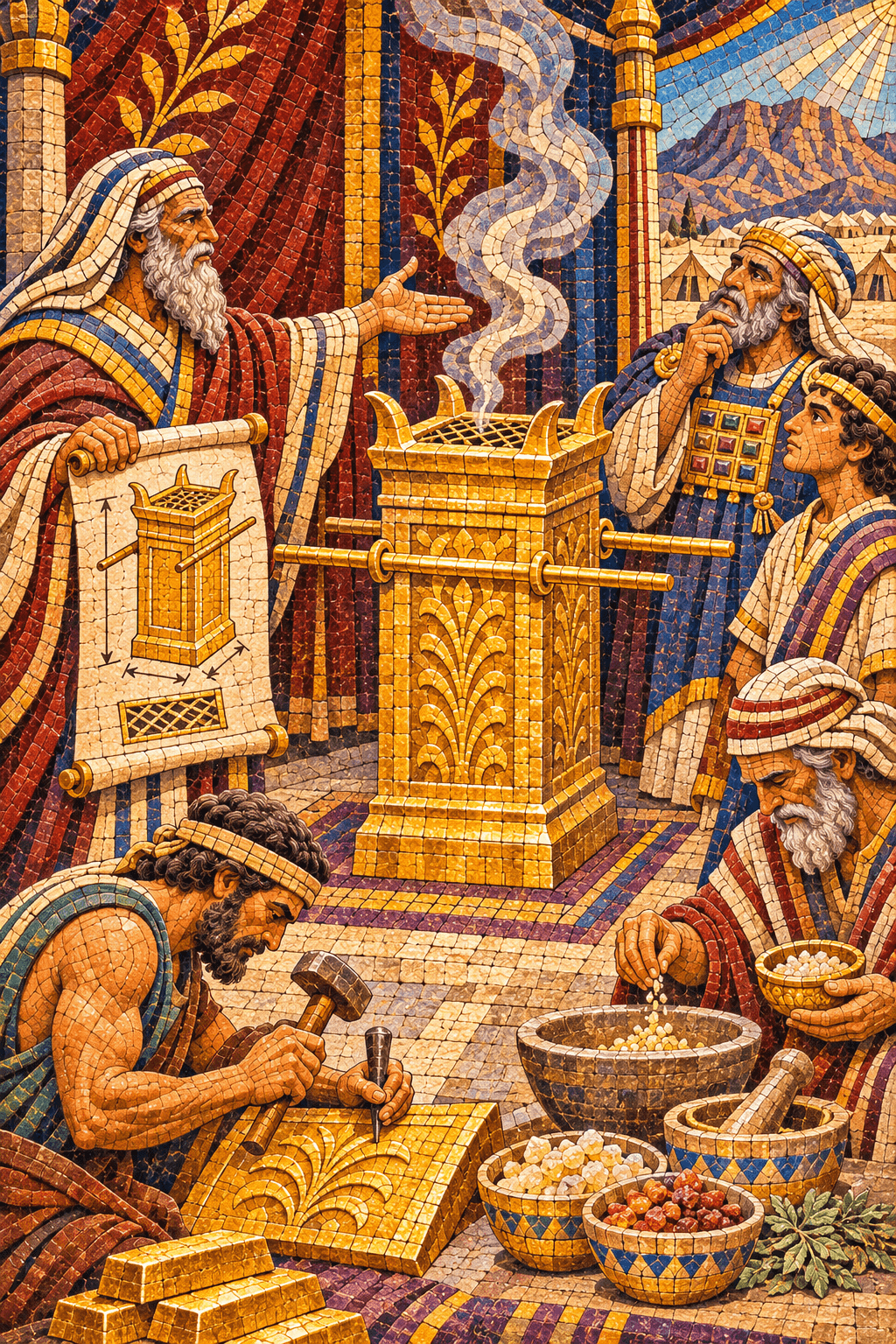
The speaking of the golden altar of incense came after the speaking of the bronze altar of burnt offering. The sinner meets in the court the bronze altar, to see his sin turned to ashes under the altar; then, through the great High Priest, the Lord Christ the Savior, he is able to enter the divine holy places. He enters into the heart of the holy place to see before him the ark of the covenant in the holy of holies, the table of shewbread on his right, and the lampstand on his left, offering his life on the golden altar as a sweet savour of incense, which the Father smells as a savour of delight and good pleasure in Christ Jesus. Through the bronze altar the debt was paid, so that we might enter into the righteousness of Christ in fellowship with Him, eat the bread of angels, be enlightened by the Holy Spirit, and see the divine glories above the cherubim…
The scene shook the depths of the soul of Origen, and he said:
Let each of us seek how he may build within himself a tabernacle for God! Let the soul have in the depths of the heart an altar of incense, so that she may say: “For we are unto God a sweet savour of Christ” (2 Corinthians 2:15). Let it also carry the ark of the covenant, where the two tables of the Law are, so that it meditates on the law of God day and night (Psalm 1:2). Let her very mind be an ark and a library that keeps the divine books, for the prophet says: Blessed is he who keeps the law of the Lord in his heart to do it. Let her carry in her heart the pot of manna, that is, the right and sweet understanding of the word of God; and let her have Aaron’s rod, that is, priestly teaching and the continual examination of godliness. And above all glory, let her carry the priestly adornment, for within her there is one who plays the part of the priest… who binds us to God; some call him the heart, some the sense of the mind, and others the thought.
Let there be within us the adornment of the garments, like the priest, and the precious stones; and let us put on an ephod of linen, falling to the feet and covering the whole body, pointing to the first virtue with which we must be adorned, which is chastity. Let us take the breastplate set with stones, which point to the brightness of works: “that they may see your good works, and glorify your Father which is in heaven” (Matthew 5:16)… [389]
He also speaks of the inner altar of incense, saying:
The soul that will not give sleep to her eyes until she finds out a place for the Lord, the God of Jacob (Psalm 132:4–5), acquires for herself a steadfast altar in the midst of her heart, so that she may be able to offer to God. [390]
Father Methodius sees in the golden altar a symbol of the company of pure virgins at the heart of the Church, bearing the sweet savour of Christ the Virgin, for he says:
We have received that the bloodless altar of God points to the company of the pure. Virginity appears as a great and good thing, for it must be kept undefiled and wholly pure, having no share in the defilement of the body, but standing in the presence of the testimony, gilded with wisdom, in the holy place, giving forth the sweet savour of divine love. [391]
2. The Atonement Silver
KJV · Verses 11–16
11 And the Lord spake unto Moses, saying, 12 When thou takest the sum of the children of Israel after their number, then shall they give every man a ransom for his soul unto the Lord, when thou numberest them; that there be no plague among them, when thou numberest them. 13 This they shall give, every one that passeth among them that are numbered, half a shekel after the shekel of the sanctuary: (a shekel is twenty gerahs:) an half shekel shall be the offering of the Lord. 14 Every one that passeth among them that are numbered, from twenty years old and above, shall give an offering unto the Lord. 15 The rich shall not give more, and the poor shall not give less than half a shekel, when they give an offering unto the Lord, to make an atonement for your souls. 16 And thou shalt take the atonement money of the children of Israel, and shalt appoint it for the service of the tabernacle of the congregation; that it may be a memorial unto the children of Israel before the Lord, to make an atonement for your souls.
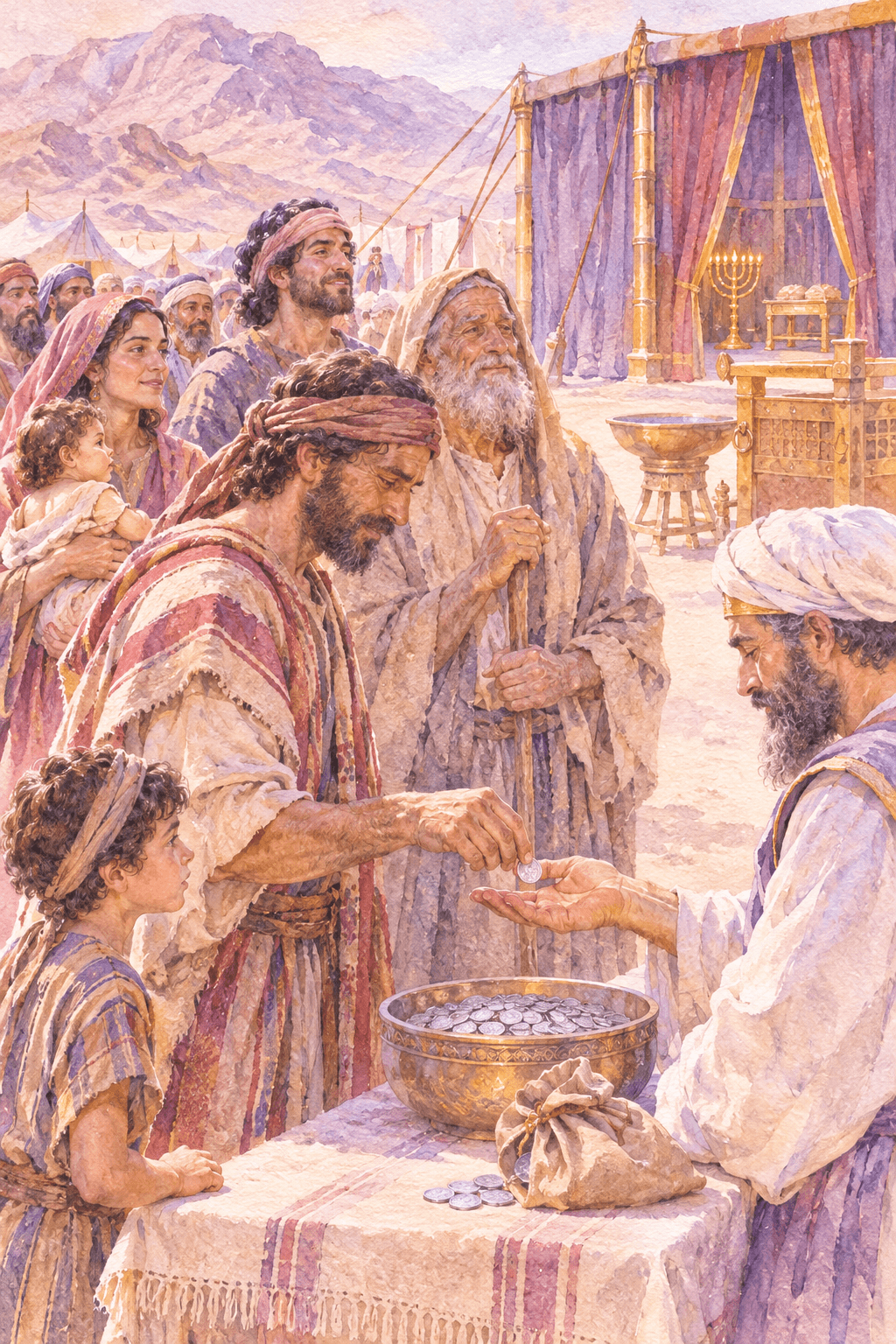
If the incense is the sacrifice of love which the priests offered within the holy place in the name of the whole community, the people were bound to offer a contribution of love toward the expenses of the tabernacle from all the men (twenty years old and above), without distinction between rich and poor: “The rich shall not give more, and the poor shall not give less than half a shekel” (15).
This points to the fact that, though the offering carries a communal spirit, it also carries a personal relationship between each believer and his God. The service of the tabernacle is the service of the whole community, without the believer losing his personality as a living member who has a direct relationship with God, while at the same time through his union with the community.
Note that the offering is symbolic (half a shekel), which all are able to give, so that the rich may not think that they have boldness with God’s servants at the expense of the boldness of the poor. Salvation is free for all, and every soul is equal before God and His servants.
3. The Laver
KJV · Verses 17–21
17 And the Lord spake unto Moses, saying, 18 Thou shalt also make a laver of brass, and his foot also of brass, to wash withal: and thou shalt put it between the tabernacle of the congregation and the altar, and thou shalt put water therein. 19 For Aaron and his sons shall wash their hands and their feet thereat: 20 When they go into the tabernacle of the congregation, they shall wash with water, that they die not; or when they come near to the altar to minister, to burn offering made by fire unto the Lord: 21 So they shall wash their hands and their feet, that they die not: and it shall be a statute for ever to them, even to him and to his seed throughout their generations.
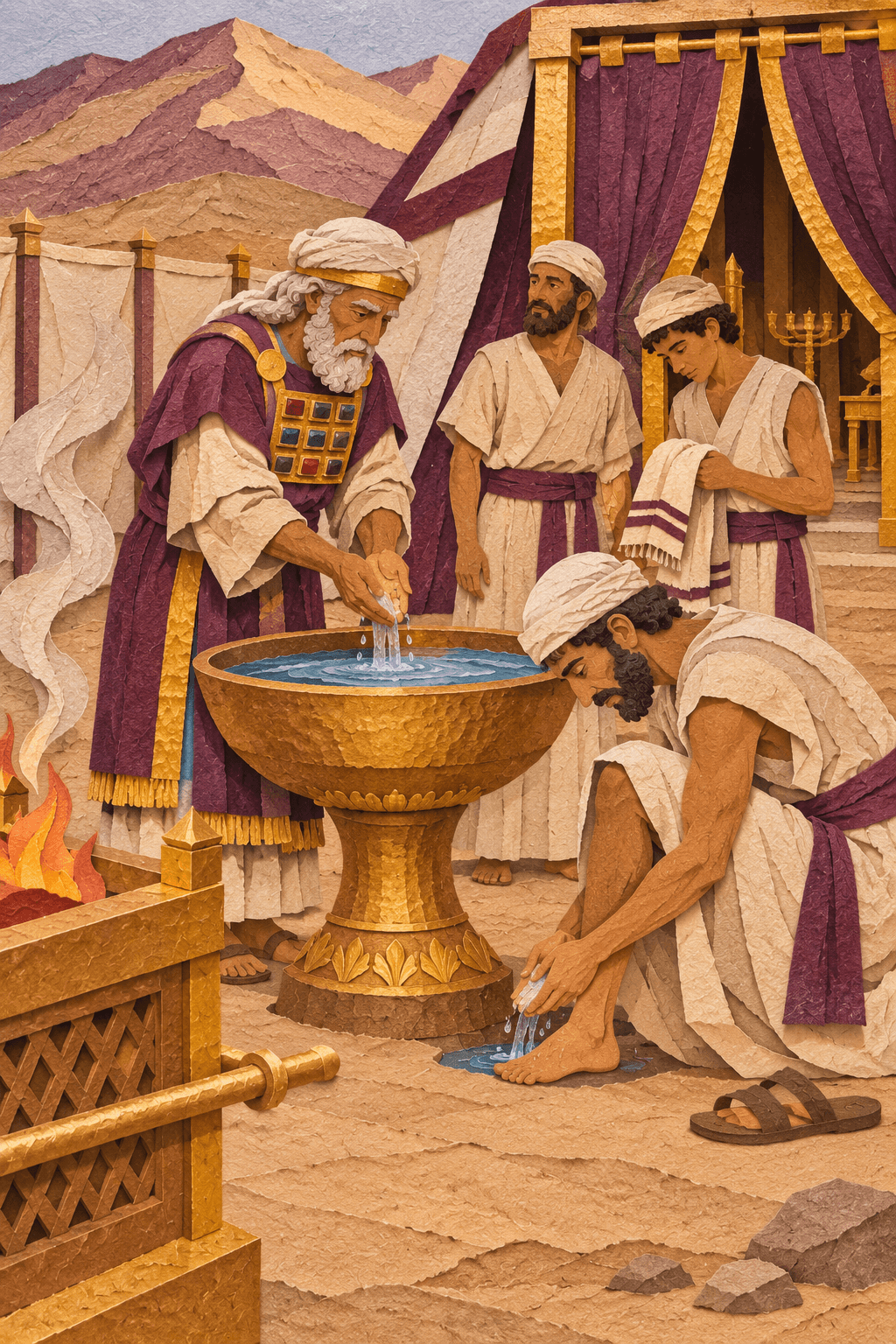
It is a round bronze vessel in the outer court, in which the priests washed their hands and feet before the service, or before entering the holy place. Its place is between the altar and the door of the tabernacle of meeting (18). It is as if it points to baptism: no one can enjoy the divine holy things, that is, enter the tabernacle of meeting and meet with God, unless he is first cleansed in the waters of baptism. Its being between the altar and the door of the tabernacle is because there is no cleansing by the waters of baptism except through the atoning sacrifice of Christ.
Saint Gregory of Nyssa says:
When anyone hears of the laver, let him understand that in which we are washed from shameful sins by the mystical waters. [392]
4. The Anointing Oil
KJV · Verses 22–33
22 Moreover the Lord spake unto Moses, saying, 23 Take thou also unto thee principal spices, of pure myrrh five hundred shekels, and of sweet cinnamon half so much, even two hundred and fifty shekels, and of sweet calamus two hundred and fifty shekels, 24 And of cassia five hundred shekels, after the shekel of the sanctuary, and of oil olive an hin: 25 And thou shalt make it an oil of holy ointment, an ointment compound after the art of the apothecary: it shall be an holy anointing oil. 26 And thou shalt anoint the tabernacle of the congregation therewith, and the ark of the testimony, 27 And the table and all his vessels, and the candlestick and his vessels, and the altar of incense, 28 And the altar of burnt offering with all his vessels, and the laver and his foot. 29 And thou shalt sanctify them, that they may be most holy: whatsoever toucheth them shall be holy. 30 And thou shalt anoint Aaron and his sons, and consecrate them, that they may minister unto me in the priest's office. 31 And thou shalt speak unto the children of Israel, saying, This shall be an holy anointing oil unto me throughout your generations. 32 Upon man's flesh shall it not be poured, neither shall ye make any other like it, after the composition of it: it is holy, and it shall be holy unto you. 33 Whosoever compoundeth any like it, or whosoever putteth any of it upon a stranger, shall even be cut off from his people.
The anointing oil holds a special place in God’s commandments to His people in the Old Covenant, for it points to the anointing of the Holy Spirit to perform works of leadership that carry aspects of the work of the Lord Christ Himself. Prophets, priests, and kings were anointed, things that came together in the person of the Lord Christ, who was called “the Christ” (the Anointed) because He was anointed from eternity for this work of salvation. The psalmist bore witness to Him, saying: “Thou hast loved righteousness, and hated iniquity; therefore God, even thy God, hath anointed thee with the oil of gladness above thy fellows” (Psalm 45:7; Hebrews 1:9)… We spoke of this anointing before in our commentary on the Song of Songs. [393]
This anointing also points to the general anointing given to Christians after baptism, which is called “the anointing of the Myron.” Saint Ambrose says:
Every believer is anointed a priest and a king, yet he does not become a real king or a real priest, but a spiritual king and a spiritual priest, offering to God spiritual sacrifices and offerings of thanksgiving and praise. [394]
Saint John Chrysostom says:
Those who were anointed in the Old Covenant were either priests, prophets, or kings. But we Christians, people of the New Covenant, must be anointed so that we may become kings, ruling over our lusts; priests, sacrificing our bodies and sanctifying them as a living sacrifice, holy, acceptable, our reasonable worship; and prophets, for our being shown very great and most important mysteries (concerning eternity). [395]
Saint Augustine says:
The name “Christ” comes from the anointing; so every Christian who receives the anointing shows not only that he has become a sharer in the kingdom, but also that he has become a fighter against Satan. [396]
5. The Holy Incense
KJV · Verses 34–38
34 And the Lord said unto Moses, Take unto thee sweet spices, stacte, and onycha, and galbanum; these sweet spices with pure frankincense: of each shall there be a like weight: 35 And thou shalt make it a perfume, a confection after the art of the apothecary, tempered together, pure and holy: 36 And thou shalt beat some of it very small, and put of it before the testimony in the tabernacle of the congregation, where I will meet with thee: it shall be unto you most holy. 37 And as for the perfume which thou shalt make, ye shall not make to yourselves according to the composition thereof: it shall be unto thee holy for the Lord. 38 Whosoever shall make like unto that, to smell thereto, shall even be cut off from his people.
As we said of the light (the golden lampstand), that it was not merely a means of lighting the tabernacle, but a rite of worship carrying a theological meaning concerning our relationship with God, so also the incense. Its purpose was not merely to produce a pleasant smell in the tabernacle; it carried a theological meaning touching our life in God. Therefore God fixed the kind of incense and its quantities, the time of burning it, and who should do this work. He forbade its use (in the same proportions) outside the tabernacle (37–38), or its burning by a strange hand!
In the Lord Christ’s conversation with His bride He said to her: “Who is this that cometh out of the wilderness like pillars of smoke, perfumed with myrrh and frankincense, with all powders of the merchant?” (Song of Solomon 3:6). It is as if the smoke of the bronze altar (the daily sacrifices) was joined with the daily incense rising from the golden altar; so the sacrificial work of Christ in our life is joined with our prayers, and God smells them as a savour of good pleasure.
In our study of the house of God from the liturgical and spiritual side, we dealt with incense and censing in the early Church, [397] and saw how the Jewish rite (Exodus 30:34–38) was joined with the Christian rite (Malachi 1:10–11) and with the heavenly rite (Revelation 8:3–4). The Church of Jerusalem accepted incense easily, for she knew it in the tabernacle of meeting and in the service of the temple, and knew it as an important rite in the chaburah meal. She saw in the prophecy of Malachi (Malachi 1:10–11) concerning the Church of the New Covenant that she offers the offering of incense from the rising of the sun to its going down, and she saw in the heavenly worship incense offered to God by the heavenly ones (Revelation 5:8; 8:4). But the churches of the Gentiles were at first afraid of it, lest the faithful of Gentile origin mix incense to God with incense to the idol. Yet soon we see in the early liturgies continual affirmations of offering the offering of incense to God.
Notes and References
[389] Origen, In Exod. hom. 9:4.
[390] Ibid.
[391] Methodius, Banquet of the Ten Virgins 5:6.
[392] Gregory of Nyssa, Life of Moses 2:185.
[393] Fr. Tadros Yacoub Malaty, The Song of Songs (Arabic, 5th ed., 1980), pp. 25–27.
[394] Fr. Tadros Yacoub Malaty, Divine Love (Arabic), p. 869.
[395] Divine Love, p. 870.
[396] Divine Love, p. 868.
[397] Fr. Tadros Yacoub Malaty, The Church, the House of God (Arabic, 1979), pp. 373–379.