
Abram showed his obedience to God by leaving Ur of the Chaldees and Haran and setting out toward Canaan. When the land could no longer accommodate his herdsmen and those of his kinsman, he gave his nephew the right to choose. Now that his nephew had fallen captive, Abram went out with his men to deliver him and his companions from the hand of Chedorlaomer. He refused every human reward, so that God might grant him something greater.
1. Lot and His Family Taken Captive
Genesis 14:1-12
1 And it came to pass in the days of Amraphel king of Shinar, Arioch king of Ellasar, Chedorlaomer king of Elam, and Tidal king of nations; 2 That these made war with Bera king of Sodom, and with Birsha king of Gomorrah, Shinab king of Admah, and Shemeber king of Zeboiim, and the king of Bela, which is Zoar. 3 All these were joined together in the vale of Siddim, which is the salt sea. 4 Twelve years they served Chedorlaomer, and in the thirteenth year they rebelled. 5 And in the fourteenth year came Chedorlaomer, and the kings that were with him, and smote the Rephaims in Ashteroth Karnaim, and the Zuzims in Ham, and the Emims in Shaveh Kiriathaim, 6 And the Horites in their mount Seir, unto Elparan, which is by the wilderness. 7 And they returned, and came to Enmishpat, which is Kadesh, and smote all the country of the Amalekites, and also the Amorites, that dwelt in Hazezontamar. 8 And there went out the king of Sodom, and the king of Gomorrah, and the king of Admah, and the king of Zeboiim, and the king of Bela (the same is Zoar;) and they joined battle with them in the vale of Siddim; 9 With Chedorlaomer the king of Elam, and with Tidal king of nations, and Amraphel king of Shinar, and Arioch king of Ellasar; four kings with five. 10 And the vale of Siddim was full of slimepits; and the kings of Sodom and Gomorrah fled, and fell there; and they that remained fled to the mountain. 11 And they took all the goods of Sodom and Gomorrah, and all their victuals, and went their way. 12 And they took Lot, Abram’s brother’s son, who dwelt in Sodom, and his goods, and departed.
Lot chose the region of Sodom, which at that time was subject to Chedorlaomer, king of Elam, and paid him tribute. We have already spoken about Elam.[251]
The name of its king, Chedorlaomer, means “servant of Laomer,” that is, the servant of one of the gods of Elam. He was known for his violence and might: he overran all the southern kingdoms, subjected all the lands of the Jordan valley to his authority, and extended his protection over the main road between Damascus and Egypt. These lands submitted to him. After twelve years, however, feeling their humiliation, five kings rebelled against him to avoid paying tribute: the kings of Sodom, Gomorrah, Admah, Zeboiim, and Bela (Zoar). Chedorlaomer therefore had to undertake a second campaign to discipline these rebellious kings. Three other kings allied themselves with him: the kings of Shinar, Ellasar, and Goiim. These four kings swept through the region. When the war centered near Sodom, the city was defeated, despite its natural defenses and the bitterness of its inhabitants’ spirits, because of the corruption that had destroyed it. The king was forced to flee, while Lot and his family fell captive and their possessions became spoil.
2. Abram Rescues Lot
Genesis 14:13-16
13 And there came one that had escaped, and told Abram the Hebrew; for he dwelt in the plain of Mamre the Amorite, brother of Eshcol, and brother of Aner: and these were confederate with Abram. 14 And when Abram heard that his brother was taken captive, he armed his trained servants, born in his own house, three hundred and eighteen, and pursued them unto Dan. 15 And he divided himself against them, he and his servants, by night, and smote them, and pursued them unto Hobah, which is on the left hand of Damascus. 16 And he brought back all the goods, and also brought again his brother Lot, and his goods, and the women also, and the people.
A man who had escaped told Abram the Hebrew that his nephew had been taken captive: “And when Abram heard that his brother was taken captive, he armed his trained servants, born in his own house, three hundred and eighteen, and pursued them unto Dan. And he divided himself against them, he and his servants, by night, and smote them, and pursued them unto Hobah, which is on the left hand of Damascus. And he brought back all the goods, and also brought again his brother Lot, and his goods, and the women also, and the people” (Genesis 14:14-16).
Lot sought his own interests and lost everything. Abram, however, had trained himself to seek the interests of others and could not bear to hear of the destruction of Lot and his family. His heart, aflame with love, could not rest while another suffered. He therefore rose quickly with 318 of his servants trained for battle, to defeat the one who had defeated five kings.
It is no wonder that Abram is called “the Hebrew” here. Since he lived as one passing through, a stranger, he was able, through this spirit of sojourning, to rescue Sodom and its king, and Lot and his family. Lot, on the other hand, had settled in Sodom and could not even save himself. How greatly the world needs people like Abram, who appears isolated and a stranger yet supports fallen souls through his holy life in the Lord, rather than people like Lot, whose thoughts are bound to the wicked.
Lot lived in a city that surrounded his thoughts with dust and earthly things. Abram lived by the “oaks of Mamre,” that is, the “oaks of vision,” awaiting the vision of God. This did not hold him back from serving others; on the contrary, it moved him all the more to labor for the salvation of all.
Saint Clement of Alexandria sees a purpose in Scripture’s mention of the number of servants who fought with Abraham, 318.[252] The Arabic text explains that the Greek numeral 300 begins with the letter iota, symbolizing the sign of Jesus Christ, and 18 with eta, pointing to the Savior’s name. Thus Abraham’s servants who fought alongside him represent those who have enjoyed the salvation of our Lord Jesus and have fled for refuge to His sign and His name. (For the Greek numeral clarification, see the translator’s note under reference 252.)
3. Meeting with Melchizedek
Genesis 14:17-20
17 And the king of Sodom went out to meet him after his return from the slaughter of Chedorlaomer, and of the kings that were with him, at the valley of Shaveh, which is the king’s dale. 18 And Melchizedek king of Salem brought forth bread and wine: and he was the priest of the most high God. 19 And he blessed him, and said, Blessed be Abram of the most high God, possessor of heaven and earth: 20 And blessed be the most high God, which hath delivered thine enemies into thy hand. And he gave him tithes of all.
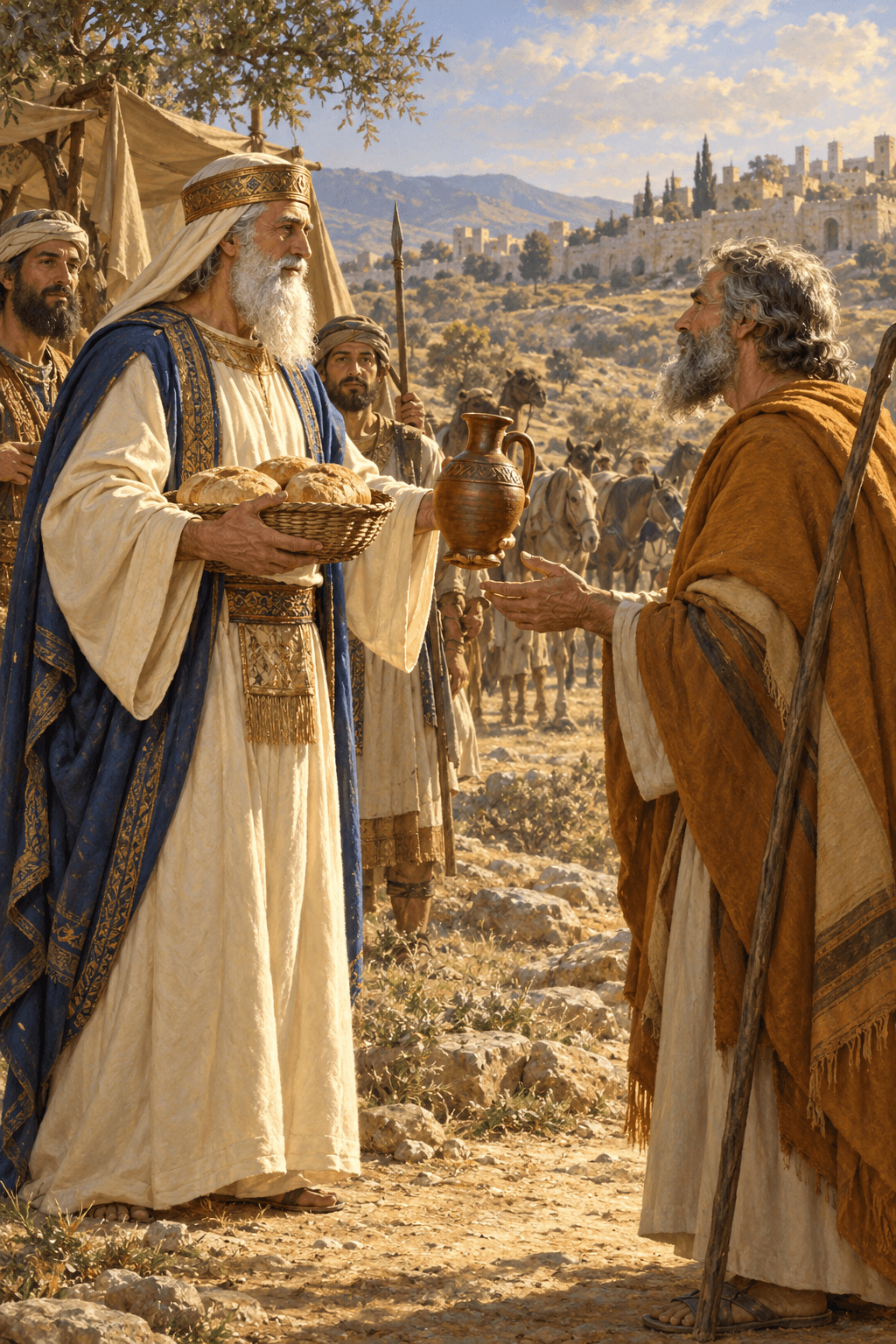
We have already discussed this meeting in our commentary on Hebrews 7. There we saw that the account of the meeting between Abraham the patriarch and Melchizedek, after Abraham’s victory over Chedorlaomer, presents a riddle to the Jews for which they find no explanation. How could Abraham the patriarch, who carried the Levitical priesthood in his loins, offer tithes to a stranger? Why did this king and priest appear in Holy Scripture and suddenly disappear, with no one knowing his father, his mother, or his ancestry? Why did he not offer a blood sacrifice, as was customary at that time? These are questions for which the Jews find no answer. The apostle, however, reveals their mystery by declaring that Melchizedek, as a type of the Lord Christ, surpassed Abraham, who carried the priesthood in his loins, namely the tribe of Levi. We may return to the commentary on Hebrews 7; here we shall be content with a few sayings of the Fathers.
“Who is more truly the priest of God Most High than our Lord Jesus Christ, who offered a sacrifice to God the Father, offering the very things that Melchizedek offered, bread and wine, that is, His Body and His Blood? As for Abraham, the blessing he received concerns his people.”
“This is our Melchizedek, who offered our holy sacrifice. He is the One who says, “Whoso eateth my flesh, and drinketh my blood” (John 6:54), giving us this mystery of His according to the order of Melchizedek.”
Saint Ambrose explained that Melchizedek was a holy man and a priest of God, prefiguring our Lord Jesus Christ, and was not an angel, as some Jews claimed.[255]
We may briefly compare the Lord Christ and Melchizedek as follows:
A. His Name
“Melchizedek” means “king of righteousness” (Hebrews 7:1-2).[*]
B. His Work
He is “king of Salem,” that is, king of peace (Hebrews 7:2).[**]
C. King and Priest
He was both king and priest at the same time. This was not the case among the Jews, since kings were from the tribe of Judah and the priesthood from the tribe of Levi. In Christ Jesus, however, both offices were fulfilled together.
D. His Offering
Melchizedek’s offering was unique in its kind, pointing to the sacrifice of the Lord Christ.
E. His Parentage and the Duration of His Reign
We know nothing of his father or mother, nor of the beginning or end of his reign. This points to the Lord Christ, who has no bodily father and no mother with regard to His divinity, who has no beginning of days and is eternal.
F. His Priestly Order
The Lord Christ came as a priest according to the order of Melchizedek, as though the Levitical priesthood had come to an end so that a new priesthood might arise.
G. Receiving Tithes from Abraham
Abraham, in whose loins was Levi, the receiver of tithes, himself offers tithes to Melchizedek, the type of the Lord Christ. What, then, must this type be? And how much greater must be the One whom he prefigures!
4. Abram Refuses a Human Reward
Genesis 14:21-24
21 And the king of Sodom said unto Abram, Give me the persons, and take the goods to thyself. 22 And Abram said to the king of Sodom, I have lift up mine hand unto the LORD, the most high God, the possessor of heaven and earth, 23 That I will not take from a thread even to a shoelatchet, and that I will not take any thing that is thine, lest thou shouldest say, I have made Abram rich: 24 Save only that which the young men have eaten, and the portion of the men which went with me, Aner, Eshcol, and Mamre; let them take their portion.
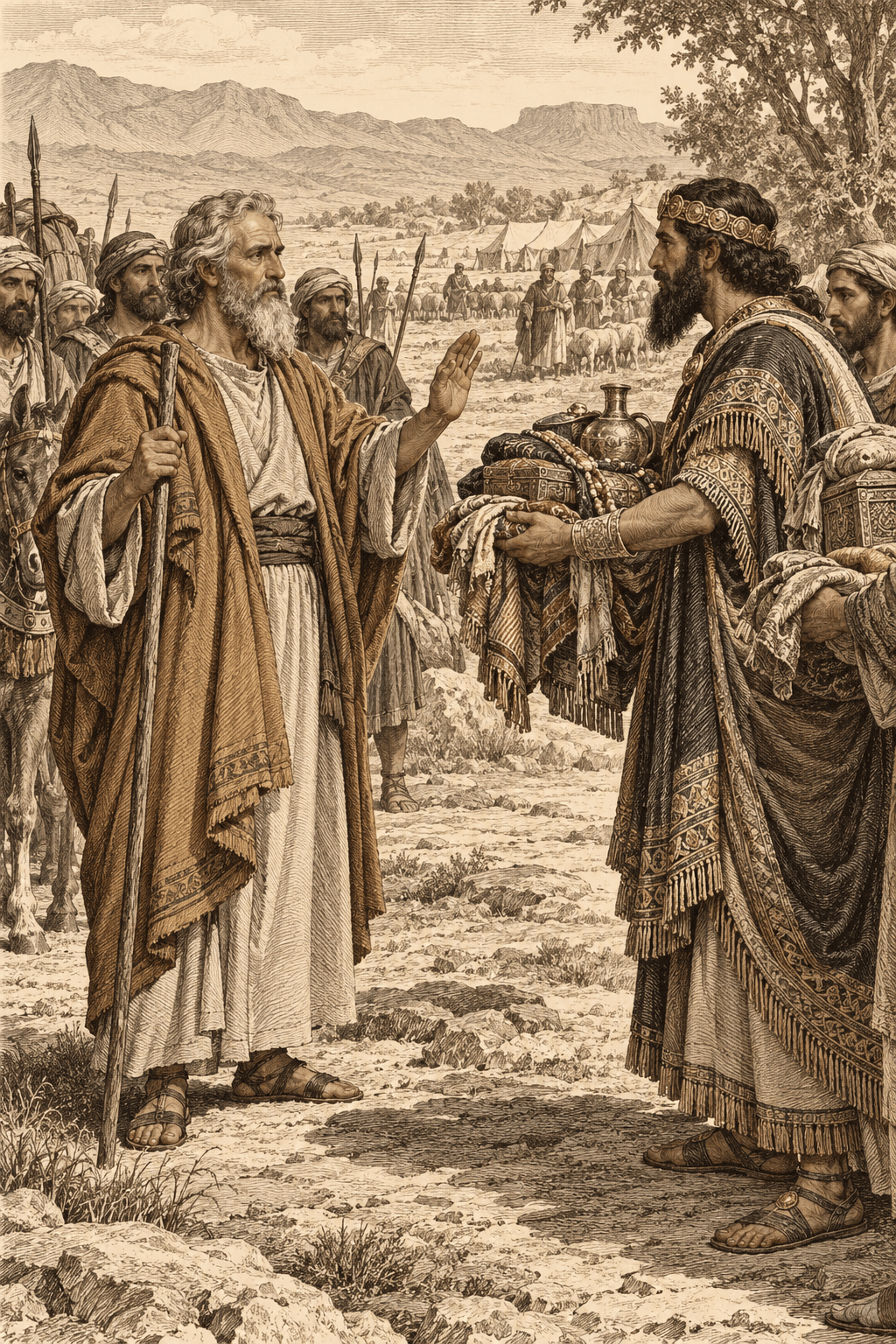
Abram was entitled to receive a reward for his labor. When the king of Sodom heard that Abram had rescued his people from Chedorlaomer, he came out of his hiding place to meet him (Genesis 14:17). He said to him, “Give me the persons, and take the goods to thyself.” Abram answered the king of Sodom, “I have lift up mine hand unto the LORD, the most high God, the possessor of heaven and earth, That I will not take from a thread even to a shoelatchet, and that I will not take any thing that is thine, lest thou shouldest say, I have made Abram rich: Save only that which the young men have eaten, and the portion of the men which went with me, Aner, Eshcol, and Mamre; let them take their portion” (Genesis 14:21-24).
Father Theonas says:
“Abraham surpassed the requirements of the Law that was given afterward. For after his victory over the four kings, he did not touch any of the spoils of Sodom, which were rightfully his as the victor, and which the king of Sodom himself, whom Abraham had rescued, offered to him.[256]”
Saint Ambrose says:
“He was faithful in war and humble in his victory, preferring to be enriched by the gifts of God rather than by the gifts of others.[257]”
In his nobility of spirit, Abraham refused a human reward for himself, awaiting the divine reward. Yet in doing so, he did not deprive his servants of their right to enjoy food from the king of Sodom, nor did he deprive his companions in the work of receiving their share. He refused to take anything for himself, but did not oblige others to refuse the reward. What a living image of spiritual and intellectual maturity!
Notes and References
[*] Clarification from the source website: the reference had been given as Romans 3:24, but Hebrews 7:1-2 is most probably the more accurate reference.
[**] Clarification from the source website: the reference had been given as John 16:32, but Hebrews 7:2 is most probably the more accurate reference.
[251] See the commentary on Genesis 10, “The Sons of Shem.”
[252] Stromata 6:11. Translator’s note: the Arabic source names iota for 300 and eta for 18. In Greek numerals, 300 is tau (Τ), associated with the cross, while 18 is iota-eta (ΙΗ), associated with the opening letters of the name Jesus. The source’s intended symbolism is retained above, and its numeral wording is identified explicitly. Compare Clement of Alexandria, Stromata, Book VI, chapter 11: https://www.newadvent.org/fathers/02106.htm
[253] Epistle 62:4.
[254] Homilies on the Psalms, homily 36.
[255] On the Christian Faith 3:88.
[256] Cassian, Conferences 21:4.
[257] On Belief in the Resurrection 2:96.