
God prepared every possibility of life for the human being, appointing him ruler over the earth and all its resources. He also granted him the greatest gift: human freedom, a sign of God’s esteem for the most perfect of His earthly creatures. Yet the human being soon fell of his own will under the deception of the enemy, the devil, disregarding God’s love for him.
1. The Deceitful Serpent
KJV · Verses 1–6
1 Now the serpent was more subtil than any beast of the field which the LORD God had made. And he said unto the woman, Yea, hath God said, Ye shall not eat of every tree of the garden? 2 And the woman said unto the serpent, We may eat of the fruit of the trees of the garden: 3 But of the fruit of the tree which is in the midst of the garden, God hath said, Ye shall not eat of it, neither shall ye touch it, lest ye die. 4 And the serpent said unto the woman, Ye shall not surely die: 5 For God doth know that in the day ye eat thereof, then your eyes shall be opened, and ye shall be as gods, knowing good and evil. 6 And when the woman saw that the tree was good for food, and that it was pleasant to the eyes, and a tree to be desired to make one wise, she took of the fruit thereof, and did eat, and gave also unto her husband with her; and he did eat.
Having given the human being everything, God established him in Paradise and granted him the commandment so that he might return love through obedience. Perhaps God had in mind still greater gifts to bestow upon him as a reward for his continuing obedience to the commandment. But the enemy of goodness envied the human being and wished to bring him down to death. He used the serpent to draw him into a destructive conversation.
Scripture says that the serpent was more cunning than all the animals God had made. It asked the woman whether God had truly forbidden them to eat from every tree in the garden. She replied that they could eat the garden’s fruit, except the fruit of the tree in its midst, of which she said God had commanded them neither to eat nor to touch, lest they die [1–3].
The enemy used God’s good creation as an instrument for destroying the human being. The fault lay not in the instrument but in the person who agreed to enter a futile conversation with the serpent. The woman even began to distort God’s words by claiming that He had forbidden them to touch the fruit, an exaggeration of the commandment. Therefore the apostle Paul asks us to avoid conversations that corrupt the mind and soul:
But foolish and unlearned questions avoid. (2 Timothy 2:23)
Saint John Chrysostom repeatedly emphasizes that Satan could neither creep into us nor overcome us unless we gave him an opportunity through negligence or through entering into a futile conversation with him. Among his words are these:
“Someone may say, “Did not Satan harm Adam, corrupting his being and depriving him of Paradise?” No; the cause lay in the negligence of the one who suffered harm, his lack of self-control, and his failure to struggle. Satan, who employed various powerful devices, could not bring Job into subjection. How, then, could he master Adam by a lesser means unless Adam had betrayed himself? [94]”
“It is carelessness and laziness, rather than the devil, that overthrow those who are not watchful. These are what allow the devil to carry evil to excess. [95]”
“I have not said these things to acquit Satan of blame, but to warn you against laziness. Satan wants us to blame him when we sin. In this way we plunge into every kind of evil and increase our punishment. We receive no forgiveness when we attribute the cause to him without offering repentance. [96]”
Concerning the futile conversation into which Eve entered with the serpent, Saint John Chrysostom says:
“She should have kept silent; she ought not to have exchanged words with it. Instead, in her folly she disclosed the Master’s command and thus gave Satan a great opportunity. Consider what an evil it is to deliver ourselves into the hands of our enemies and those who plot against us! This is why Christ says, “Give not that which is holy unto the dogs, neither cast ye your pearls before swine, lest they trample them under their feet, and turn again and rend you” (Matthew 7:6). This is what happened to Eve. She gave what was holy to dogs and swine; they trampled it underfoot, turned, and tore the woman. [97]”
Let us not fear Satan, for he cannot force his way into our hearts. Rather, let us be watchful over ourselves lest, by accepting his devices and deceptions, we allow him to creep into our depths, take control of our will, and rule our hearts, thoughts, and senses, bringing us under his bitter slavery.
In the conversation between Eve and the serpent, Satan offered humanity nothing but promises: they would not die; their eyes would be opened; they would be as gods, knowing good and evil [4–5]. It was a mere promise that they would become like God—an appeal to pride—and gain knowledge. He had done nothing for their benefit. Saint John Chrysostom says:
“Satan had shown no good deed, great or small. He merely enticed the woman with words and puffed her up with a vain hope; in this way he deceived her. Yet she regarded Satan as more trustworthy than God, although God had demonstrated His goodwill through His works. [98]”
“Since Satan could offer nothing in practice, he offered all the more promises in words. Such is the character of deceivers. [99]”
Eve could indeed have recognized the enemy’s deception, his opposition to God, and his resistance to God’s words. While God told Adam, “thou shalt surely die,” Satan said, “Ye shall not surely die.” Saint John Chrysostom asks:
“How else should a person recognize an enemy and adversary except through this answer contradicting God’s words? Eve ought immediately to have fled from the bait and drawn back from the net. [100]”
In other words, let us accept God as the guide of our lives and reject the devil as our deceiver and the destroyer of our souls. Saint Augustine says:
“God is our guide, and Satan is our destroyer. The guide gives His commandment; the destroyer proposes a deception. Shall we listen to the commandment or to the deception? [101]”
The Fathers of the Church speak of the devil’s deception of Adam and Eve. They discern in it three chief sins with which the enemy sought to destroy all humanity. He returned to attack the second Adam, the Lord Christ, with the same sins, supposing that he could catch Him in his snares. Father Serapion says:
“It was fitting that our Lord should be tempted by the same passions through which Adam was tempted when he bore God’s image before its corruption: gluttony, covetousness, and pride. These intertwined and multiplied after he transgressed the commandment and corrupted God’s image and likeness. Adam was tempted by gluttony when he took fruit from the forbidden tree; by covetousness when he was told, “your eyes shall be opened”; and by pride when it was said, “ye shall be as gods, knowing good and evil” (Genesis 3:5). Our Savior was also tempted by these three sins: by gluttony when Satan told Him, “command that these stones be made bread” (Matthew 4:3); by pride when he said, “If thou be the Son of God, cast thyself down” (Matthew 4:6); and by covetousness when he showed Him all the kingdoms of the world and their glory, saying, “All these things will I give thee, if thou wilt fall down and worship me” (Matthew 4:9). The Lord Himself gave us an example of how we may conquer, as He conquered when tempted. Both are called Adam: the one was first in destruction and death; the other was first in resurrection and life. Through the first, all humanity came under condemnation; through the second, humanity was set free. [102]”
Many Fathers concentrate on pride as the head of the sins. Through pride the devil and his hosts fell, and he offered humanity the same means of destruction. Saint Augustine says of our first parents, whom Satan deceived through pride:
“They listened to the deceiver’s voice, “ye shall be as gods,” and forsook God, who wished to make them gods through fellowship with Him, rather than through separation from Him. [103]”
“Through pride we fail to attain this immortality. If pride has wounded us, humility brings us healing. God came in humility to heal the human being of pride’s grave wound. [104]”
Thus the Fathers reveal the enemy’s deceit. Through the serpent he crept into Eve’s life, and she in turn drew her husband into the Fall: “she took of the fruit thereof, and did eat, and gave also unto her husband with her; and he did eat” [6]. Eve thereby lost her original mission as a helper (Genesis 2:18), becoming instead a snare to her husband and a cause of ruin to his life.
Saint Didymus the Blind understands the devil as working through the serpent that deceived the woman, who in turn drew her husband with her. In this spiritual interpretation, the enemy begins his warfare through desire, like a serpent creeping into us, to deceive the senses, represented by the woman. The senses then influence the mind, represented by the man, so that it loses its balance and wisdom and turns toward evil.
2. Their Eyes Were Opened
KJV · Verse 7
7 And the eyes of them both were opened, and they knew that they were naked; and they sewed fig leaves together, and made themselves aprons.
What does it mean that their eyes were opened and they saw their bodily nakedness? Through sin the human being recognized that he had entered a state of corruption, revealed in the sensations of the body and its uncontrolled desires. He entered into a new knowledge: the experience of evil, which mingled with his life and corrupted his body. He became aware of his body as now violent in evil and without restraint.
Saint Augustine says:
“They experienced a new movement in their bodies, which had become disobedient to them as a just recompense for their disobedience to God. The soul that rebels against God’s service, freely despising it, loses the mastery it previously possessed over the body. [105]”
“Their eyes were opened, not so that they might see—for they had seen before—but so that they might distinguish the good they had lost from the evil into which they had fallen. [106]”
“They knew that they were naked: stripped of the grace that had protected them from shame at their bodily nakedness, while the law of sin brought disorder to their minds. [107]”
Saint Ambrose says:
“You have come to know that you are naked because you have lost the garment of good faith. These are the leaves with which you seek to cover yourself. You rejected the fruit and wished to hide behind the leaves of the law, but you were deceived. [108]”
Seeing himself stripped of the fruit of divine grace working in the depths of the heart, the human being hides behind the letter of the law and outward forms without enjoying inward transformation. Saint Didymus the Blind sees the fig-leaf aprons, which cannot truly cover, as the flimsy excuses people make for their sins:
“Sometimes the sinner stitches together excuses for his sins. Do we not see this in many people? The angry person, for example, invents excuses to justify his anger and appear to be right, sometimes even using Scripture. This is the meaning of “they sewed fig leaves together”: neglecting the fruit, they made a kind of imperfect protection for themselves as aprons. We hear the angry person offer Elijah as an example, saying that he became angry and destroyed the captain of fifty (2 Kings 1:9–12). [109]”
3. God’s Care for Man
KJV · Verses 8–13
8 And they heard the voice of the LORD God walking in the garden in the cool of the day: and Adam and his wife hid themselves from the presence of the LORD God amongst the trees of the garden. 9 And the LORD God called unto Adam, and said unto him, Where art thou? 10 And he said, I heard thy voice in the garden, and I was afraid, because I was naked; and I hid myself. 11 And he said, Who told thee that thou wast naked? Hast thou eaten of the tree, whereof I commanded thee that thou shouldest not eat? 12 And the man said, The woman whom thou gavest to be with me, she gave me of the tree, and I did eat. 13 And the LORD God said unto the woman, What is this that thou hast done? And the woman said, The serpent beguiled me, and I did eat.
Although the human being answered God’s love with disobedience, God met even that disobedience with love, to draw his heart out of the sickness that had overtaken it and raise him from the death that reigned over him (Romans 5:14). The voice of God came walking in the garden to meet fallen humanity.
Scripture says, “they heard the voice of the LORD God walking in the garden in the cool of the day” [8]. They heard the Lord’s voice walking, although a voice does not walk. The “voice of the Lord” is His Word, the only-begotten Son, who took the initiative in love to seek the fallen human being and raise him up. He came at the blowing of the day’s breeze, for we meet Him through the Holy Spirit; in Hebrew the word for “spirit” and “wind” is the same. He came in the midst of the day so that we might know Him through His light. As the psalmist says:
In thy light shall we see light. (Psalm 36:9)
In other words, we do not hear the Lord’s voice walking within us unless He breathes His Holy Spirit upon His garden in our depths and illuminates it with His divine light, making us as though we stood in the midst of the day.
God did not wait for the human being to come and apologize for his sins. He approached first, lovingly drawing us to recognize and confess them. In the same spirit our Lord Jesus asks us to go to the brother who has sinned against us and speak with him, rather than waiting for him to come to us (Matthew 18:15). Saint John Chrysostom explains that the offender often holds back out of shame. We should therefore go to him first, privately, so that through love we may win him for ourselves while he also wins his own soul.
Thus the Word of God took the initiative in love. He called Adam and said, “Where art thou?” [9]. He was not ignorant of Adam’s location; He wished to enter into conversation with him, revealing that he had become unworthy of being a place of God’s knowledge, as though hidden from the divine light. Saint Augustine explains that the wicked person goes out, through his wickedness, from the sphere of God’s light and becomes as though outside His knowledge. This does not mean that God does not know him, but that He does not know him in the knowledge of friendship and communion. Thus He says to the foolish virgins:
Verily I say unto you, I know you not. (Matthew 25:12)
Saint Jerome says:
“We have heard that God does not know sinners; let us consider how He knows the righteous.”
How did the human being respond to this divine initiative?
First, “Adam and his wife hid themselves from the presence of the LORD God amongst the trees of the garden” [8]. This flight is the natural fruit of disobedience and separation from the Lord’s presence. Darkness cannot bear to behold the light. Adam says, “I heard thy voice in the garden, and I was afraid, because I was naked; and I hid myself” [10].
Saint Ambrose speaks of the sinner’s flight from the Lord:
“A guilty conscience is so burdened that it punishes itself without a judge. It wishes to cover itself, yet it stands naked before God. [110]”
Sin thus deprives the human being of inward peace and brings him into a state of terror.
Saint Didymus the Blind explains that Adam hid because, having sought knowledge through the experience of evil, he withdrew from the Lord’s face and from the pure knowledge of God. Origen understands the wicked as hiding from the Lord’s face, as it is written, “they have turned their back unto me, and not their face” (Jeremiah 2:27). The righteous, however, stand confidently before Him so that He may grant them a holy life (1 John 3:21), saying with the prophet Elisha, “As the LORD liveth, before whom I stand” (2 Kings 5:16).
After the Fall Adam hid and could not behold the Lord, because in his wickedness he had lost the inward image of God that drew him lovingly toward his Creator, the Lover of mankind. God now seemed to him terrifying, a judge of his sins. The fault lay in the human being, who had lost the purity of his nature and the illumination of his inward sight. Saint Didymus the Blind comments:
“Adam gives his nakedness as the reason for his fear. This nakedness arose from losing the virtue that covered him, for virtue is truly a divine garment. Therefore the apostle exhorts us, “put ye on the Lord Jesus” (Romans 13:14), and “Put on therefore… bowels of mercies” (Colossians 3:12): adorn yourselves with merciful conduct according to Christ. Or let us “put on the armour of light” (Romans 13:12), so that we may fight our spiritual enemies. [111]”
Second, when God met the human being through His loving initiative, despite the latter’s fear and flight, the human being did not deny his fault but justified it by blaming another. Adam said, “The woman whom thou gavest to be with me, she gave me of the tree, and I did eat” [12]. The woman said, “The serpent beguiled me, and I did eat” [13]. Adam blamed Eve, and even God who had given her to him; the woman blamed the serpent. Neither apologized for what had been done.
Saint Didymus the Blind comments on Adam’s answer:
“He should first have considered that he had received his wife from the Lord for his own good. He had not received her to give him lessons, but so that she might follow his example. [112]”
Concerning Eve’s answer, he says:
“Now she acknowledges that she was deceived. This is the condition of those who are deceived: they do not recognize evil until after committing it, because desire conceals their perception of the truth and takes knowledge away from them. [113]”
4. The Curse upon the Serpent
KJV · Verse 14
14 And the LORD God said unto the serpent, Because thou hast done this, thou art cursed above all cattle, and above every beast of the field; upon thy belly shalt thou go, and dust shalt thou eat all the days of thy life:
Because the serpent carried the devil’s deceptions to humanity, it received the curse that befalls every soul accepting the serpent’s characteristics and agreeing to become an instrument of the enemy of goodness and his enticements. The curse is, “upon thy belly shalt thou go, and dust shalt thou eat all the days of thy life.”
Whoever accepts becoming an instrument of the evil enemy becomes like the serpent, crawling on his belly and loving earthly things, with neither feet to lift him from the dust nor wings to carry him above temporal things. He loves to fill his belly with dust and crawls bodily so that his inward parts may be satisfied with what he desires.
From another perspective, whoever accepts the serpent’s counsel desires earthly things and himself becomes earth and dust: food for the serpent that crawls to devour him. But the person who has the wings of the Holy Spirit rises above the dust and journeys toward heaven itself. The serpent crawling on the ground cannot approach and devour him.
Saint Augustine says:
“The wicked cling to earthly things. Born of the earth, they think of the earth; and being earth, they become food for the serpent. [114]”
“When the enemy tramples my life, he makes it earth, and it becomes his food. [115]”
“Do you wish not to become food for the serpent? Do not be dust. You answer, “How can I avoid being dust?” By not savoring earthly things. [116]”
5. The Promise of Salvation
KJV · Verse 15
15 And I will put enmity between thee and the woman, and between thy seed and her seed; it shall bruise thy head, and thou shalt bruise his heel.
Having cursed the serpent that deceived humanity, so that we might reject it and refuse its characteristics within us, God offered the first promise of salvation: enmity between the serpent and the woman, between its seed and her seed; her seed would crush its head, and it would bruise His heel [15].
The serpent came to represent the devil himself, called “that old serpent” (Revelation 20:2). God placed enmity between the devil and the woman until Christ should come from the woman’s seed, without human seed, to crush the head of the serpent that had bruised humanity’s heel. Through His cross, Christ, born of a woman, crushed the serpent’s head. The apostle says:
And having spoiled principalities and powers, he made a shew of them openly, triumphing over them in it. (Colossians 2:15)
Yet the serpent bruises every person who descends from the higher life in the Lord to become a heel attached to the dust.
Saint Augustine sees the serpent’s head as pride, which casts human life downward and makes it a heel into which the serpent can inject its poison:
“The serpent watches for the heel of pride, when it sees you fall through pride and sink downward. Watch, then, for its head: pride, the head of all sins. [117]”
He also understands the serpent’s head as the beginning of sin within us through an evil thought. We must crush it at its beginning, before it brings us down to the heel and kills us. He says:
“What is his head? The beginning of an evil suggestion. When he begins to suggest evil thoughts, then you thrust him away before pleasure arises, and consent follows; and so shall you avoid his head, and he shall not grasp your heel. [118]”
6. The Discipline of Man
KJV · Verses 16–19
16 Unto the woman he said, I will greatly multiply thy sorrow and thy conception; in sorrow thou shalt bring forth children; and thy desire shall be to thy husband, and he shall rule over thee. 17 And unto Adam he said, Because thou hast hearkened unto the voice of thy wife, and hast eaten of the tree, of which I commanded thee, saying, Thou shalt not eat of it: cursed is the ground for thy sake; in sorrow shalt thou eat of it all the days of thy life; 18 Thorns also and thistles shall it bring forth to thee; and thou shalt eat the herb of the field; 19 In the sweat of thy face shalt thou eat bread, till thou return unto the ground; for out of it wast thou taken: for dust thou art, and unto dust shalt thou return.
After giving the promise of salvation, God announced His discipline of humanity. He opened the door of hope by declaring salvation before imposing the bitter discipline, so that the human being would not collapse beneath the weight of despair. He announced the woman’s discipline first, then the man’s.
First, the woman’s discipline: sorrow in conception and childbearing, desire toward her husband, and his rule over her [16]. Through God’s mercy the discipline under which Eve fell because of sin became a blessing when the Church, the new Eve, accepted bringing forth spiritual children for God through her sufferings. Saint Augustine says:
“The Church, Christ’s bride, conceives children and labors to bring them forth. As her figure, Eve was called the mother of all living [20]. A member of this laboring Church says, “My little children, of whom I travail in birth again until Christ be formed in you” (Galatians 4:19). The Church does not labor in vain or bring forth in vain. At the resurrection of the dead she finds the holy seed: the righteous who now stumble amid sufferings throughout the world. [119]”
What the Church, the new Eve, endures in conceiving spiritual children and bringing them forth in the Lord is also endured by every soul as a church, conceiving the fruit of the Spirit to bring forth children who gladden God’s heart. Saint Didymus the Blind says:
“While in the world, the Church brings forth children through pain, for virtue requires sorrow, and repentance produces “repentance to salvation not to be repented of” (2 Corinthians 7:10). “Strait is the gate, and narrow is the way, which leadeth unto life” (Matthew 7:14), whereas “wide is the gate, and broad is the way, that leadeth to destruction, and many there be which go in thereat.” Tears, however, are praiseworthy. [120]”
As painful childbearing became a blessing when the new Eve accepted the labor of bringing forth children in the Lord, so the other discipline, “thy desire shall be to thy husband, and he shall rule over thee,” also became a spiritual blessing. The incarnate Word of God approached the new Eve as her Husband, ruling over her through self-giving love. She longs for Him as the secret of her life, enjoying His characteristics within her so that she may enter His eternal glory with Him.
Second, the man’s discipline: the ground was cursed for his sake. In sorrow he would eat from it, amid thorns and thistles; by the sweat of his face he would eat bread until returning to the ground, for he was dust and to dust would return [17–19].
God created the earth for humanity and blessed it for humanity’s sake, so that it might bear blessings. When the human being disobeyed the Lord, the earth fell under the curse, producing thorns and thistles corresponding to his disobedience and inward thought. What happened literally to the earth was fulfilled symbolically in the body. Through our disobedience to God it lost its balance and sanctification, producing thorns and thistles that corrupt and destroy the soul.
Our earth thus remained without spiritual fruit until Saint Mary came. The Holy Spirit sanctified her as she accepted the divine promise, and she brought forth for us the first fruit who gladdens the Father’s heart and rejoices our lives. Saint Jerome says:
“This earth has yielded its increase. What it lost in the Garden of Eden it found in the Son. [121]”
Through the incarnation of the Word of God, our earth could produce fruit instead of thorns and thistles. The Lord Himself bore these thorns upon His brow in place of our earth, restoring its joy.
The earth bore the curse because of our sins. Life became difficult and harsh for humanity after the Fall: “In the sweat of thy face shalt thou eat bread.”
Finally, when the human being desires earth and dust instead of heaven, he hears, “for dust thou art, and unto dust shalt thou return.” He becomes food for the serpent, to which it was said, “dust shalt thou eat all the days of thy life” [14]. Therefore the heavenly Word of God came to remove our earthly nature and grant us heavenly characteristics. Saint Jerome says:
“As the sinner is told, “You are dust, and to dust you shall return,” so the saint is told, “You are heaven, and to heaven you shall return.” [122]”
7. The Garments of Skin
KJV · Verses 20–21
20 And Adam called his wife’s name Eve; because she was the mother of all living. 21 Unto Adam also and to his wife did the LORD God make coats of skins, and clothed them.
Although Adam and Eve had fallen under discipline, they are our first parents. In Adam we find the father of all humanity, and in Eve the mother of all. Yet through this parenthood sin passed to us, and we fell with them under the same discipline. Then the second Adam came, granting true life to believers. His wife, the new Eve, became the true mother of all living. Saint Didymus the Blind says:
“The Church is the mother of believers, and Christ is their Father, in whom all fatherhood in heaven and on earth has its source (Ephesians 3:15). [123]”
Saint Jerome says:
“As there is one Eve, the mother of all living, so there is one Church, the mother of all Christians. [124]”
Now, as our first parents came under divine discipline, God showed His love before expelling them from the garden. He made garments of skin and clothed them [21], replacing the fig leaves they had sewn into aprons. These garments may reveal that God made known to the first human being the importance of sacrifice as a symbol of the sacrifice of salvation, as though He entrusted Adam and Eve with the rite of the blood sacrifice.
These garments of skin, which do not wither like leaves, symbolize the sacrificed Lord Christ, whom we put on as the covering of our sins and the One who removes the shame of our old nature.
Saint Ambrose sees the garments of skin as an indication of the labors of repentance:
“God clothed them in garments of skin, not of silk. [125]”
8. The Expulsion of Man
KJV · Verses 22–24
22 And the LORD God said, Behold, the man is become as one of us, to know good and evil: and now, lest he put forth his hand, and take also of the tree of life, and eat, and live for ever: 23 Therefore the LORD God sent him forth from the garden of Eden, to till the ground from whence he was taken. 24 So he drove out the man; and he placed at the east of the garden of Eden Cherubims, and a flaming sword which turned every way, to keep the way of the tree of life.
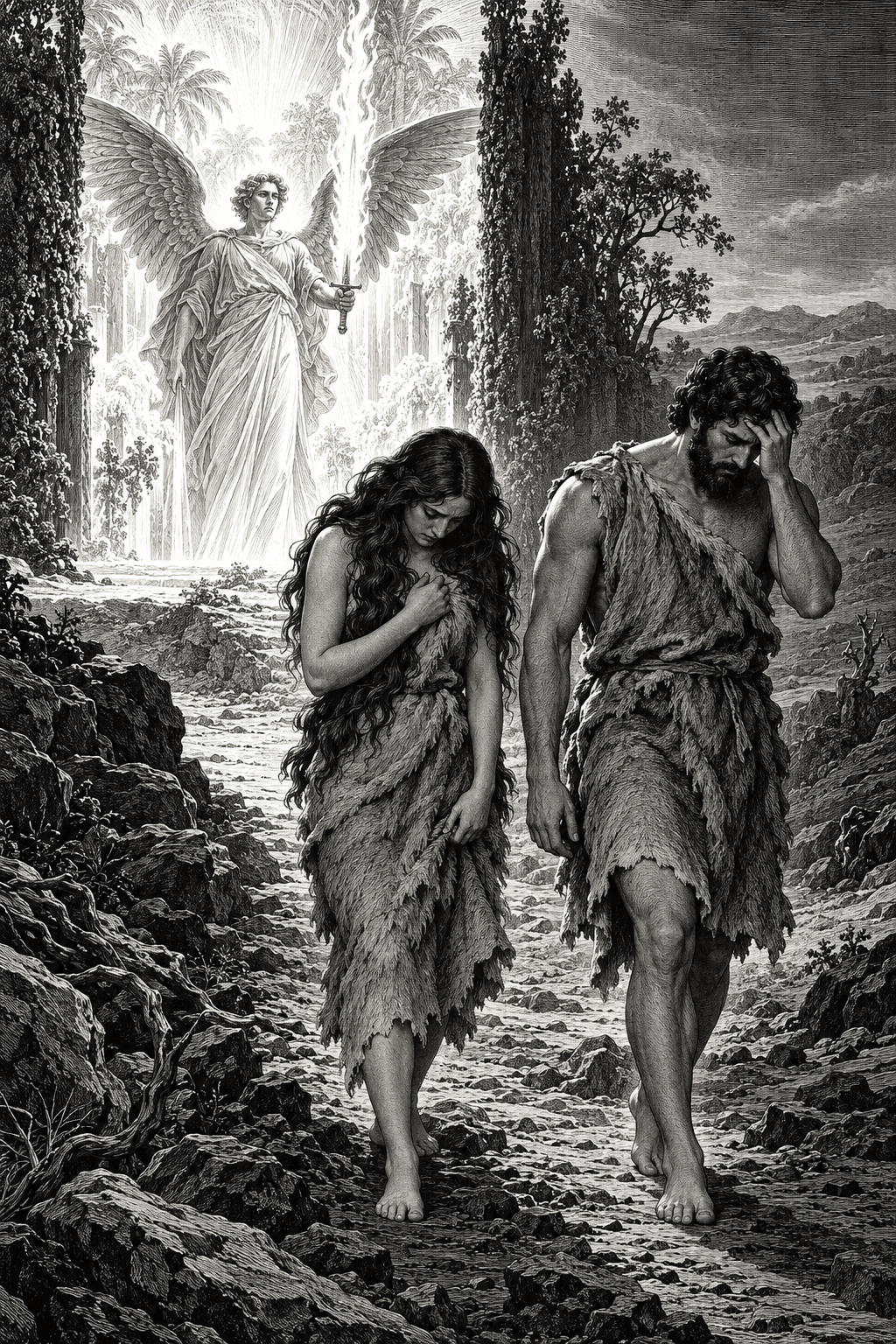
God made a garment of skin and clothed the human being, revealing His surpassing care through the sacrifice of the cross. His true covering is the Lord Jesus Himself, the Giver of life, who hides and shelters him within Himself. Why, then, did God expel him from Paradise?
First, although God expelled us from Paradise, in truth we expelled ourselves. Through disobedience our corrupted nature became unsuited to holy life in Paradise and suited instead to the earth that produces thorns and thistles. Saint John Chrysostom says:
“God gave us Paradise, an act of His compassionate providence. We showed ourselves unworthy of the gift, a consequence of our own negligence. He withdrew the gift from those who had become unworthy of it, and this came from His goodness. [126]”
Second, in expelling humanity from Paradise God did not intend to deprive the human being of the work of His hands, but to prepare him for a greater Paradise and an eternal life without end. Saint Theophilus of Antioch says:
“Although the expulsion was a punishment, it carried goodness on God’s part. He wished to punish sin, correct the human being, and restore him after renewing him. [127]”
Saint Ambrose says:
“Death was given as a remedy, for it sets a limit to evils. [128]”
Saint John Chrysostom expresses the same thought:
“Consider what Cain’s condition would have been had he remained in Paradise as a shedder of blood! Paradise was given to the human being. When he showed himself unworthy, God expelled him, so that by remaining outside and through humiliation he might become better, showing repentance, disciplining himself more, and becoming fit to return. When he had done this and become better, God restored him, saying, “To day shalt thou be with me in paradise” (Luke 23:43). Do you see how both the gift of Paradise and our expulsion from it reveal His great and tender care? Had the human being not suffered expulsion, he could not have become fit for it again. [129]”
The Lord guarded against the human being eating from the tree of life while corrupt in nature and thus remaining in evil forever. Scripture says, “Behold, the man is become as one of us, to know good and evil,” followed by the warning that he might take from the tree of life, eat, and live forever [22].
The speaker here appears to be the Holy Trinity, saying “as one of us” with regard to knowledge of good and evil. Yet the human being obtained this knowledge through the deadly experience of evil. Father Chaeremon comments:
“We cannot suppose that the human being previously had no knowledge of good at all; otherwise he would have been an irrational creature like the beasts. Such a statement is entirely foreign to the faith of the catholic Church. Moreover, Solomon the wise says, “God hath made man upright” (Ecclesiastes 7:29), meaning that he continually enjoyed the knowledge of good alone. “But they have sought out many inventions”: they acquired, as it is said, the knowledge of good and evil. After the Fall Adam gained a knowledge of evil that he had not possessed before, but he did not lose his knowledge of the good he had known. [130]”
Finally, when God expelled humanity from Paradise, He stationed a cherub to guard it, until the One who sits upon the cherubim Himself came, bearing us in His pierced side to bring us into His heavenly Paradise.
Notes and References
The numbering below follows the supplied Arabic source. Quotations from the Fathers are translated from the Arabic as cited by Father Tadros, except the English wording of note 118 retained in the supplied PDF. Abbreviated references are retained where the source does not identify an edition.
[94] Who Can Harm You?, 1965, p. 12.
[95] Does Satan Have Authority over You?, article 2, “Why Was Satan Not Removed from the World?”
[96] Ibid., article 2.
[97] Ibid., article 3.
[98] Ibid., article 3.
[99] Saint John Chrysostom, Homily 8 on 2 Timothy.
[100] Does Satan Have Authority over You?, article 3.
[101] Saint Augustine, On Psalm 71.
[102] John Cassian, Conferences 5:6; words of Father Serapion.
[103] Saint Augustine, The City of God 22:30.
[104] Saint Augustine, On Psalm 36.
[105] Saint Augustine, The City of God 13:13.
[106] Ibid., 14:17.
[107] Ibid.
[108] Saint Ambrose, Letter 20:7.
[109] Saint Didymus the Blind, On Genesis 85.
[110] Saint Ambrose, Concerning Repentance 2:103.
[111] Saint Didymus the Blind, On Genesis 92.
[112] Ibid., 93.
[113] Ibid., 95.
[114] Saint Augustine, On Psalm 62.
[115] Saint Augustine, On Psalm 7.
[116] Saint Augustine, On Psalm 104.
[117] Saint Augustine, On Psalm 37.
[118] Saint Augustine, On Psalm 49. The supplied PDF adds an English rendering clarifying that rejecting an evil suggestion at its beginning prevents the serpent from seizing the heel; that English wording is used above.
[119] Saint Augustine, On Psalm 127.
[120] Saint Didymus the Blind, On Genesis 102.
[121] Saint Jerome, Homily 6 on the Psalms.
[122] Saint Jerome, Homily 46 on the Psalms.
[123] Saint Didymus the Blind, On Genesis 106.
[124] Saint Jerome, Letter 123:12.
[125] Saint Ambrose, Concerning Repentance 2:11 (99).
[126] Does Satan Have Authority over You?, 1972, p. 19.
[127] Saint Theophilus of Antioch, To Autolycus 2:26.
[128] Saint Ambrose, On Belief in the Resurrection 2:38.
[129] Does Satan Have Authority over You?, 1972, pp. 19, 22–23.
[130] John Cassian, Conferences 13:12; words of Father Chaeremon.