
Although God had intervened to renew the world through the waters of the flood, instead of responding with love and resting upon God’s breast, humanity relied upon itself. People wished to erect a tower of their own making in which to shelter from God’s decisions concerning them. This tower seems to represent contemporary philosophies, especially existentialism, which see God as stifling humanity and depriving it of freedom, as though God’s glory depended upon humanity’s humiliation and His power came at the expense of human dignity. They therefore supposed that there was no escape from this God except by deifying the self and fleeing from Him in order to enjoy complete freedom.
1. The Tower of Babel
Genesis 11:1-9
1 And the whole earth was of one language, and of one speech. 2 And it came to pass, as they journeyed from the east, that they found a plain in the land of Shinar; and they dwelt there. 3 And they said one to another, Go to, let us make brick, and burn them throughly. And they had brick for stone, and slime had they for morter. 4 And they said, Go to, let us build us a city and a tower, whose top may reach unto heaven; and let us make us a name, lest we be scattered abroad upon the face of the whole earth. 5 And the LORD came down to see the city and the tower, which the children of men builded. 6 And the LORD said, Behold, the people is one, and they have all one language; and this they begin to do: and now nothing will be restrained from them, which they have imagined to do. 7 Go to, let us go down, and there confound their language, that they may not understand one another’s speech. 8 So the LORD scattered them abroad from thence upon the face of all the earth: and they left off to build the city. 9 Therefore is the name of it called Babel; because the LORD did there confound the language of all the earth: and from thence did the LORD scatter them abroad upon the face of all the earth.
“And the whole earth was of one language, and of one speech” [1].
Having spoken in the preceding chapter about Noah’s descendants and the emergence of nations and peoples, each nation with its own tongue, the author now explains how the whole earth once had one tongue and one language, and how the confusion of tongues subsequently occurred, so that each people came to have its own speech and language.
It was natural for people to speak one language. Some scholars have supposed that this language was Hebrew, arguing that the earliest names, such as Adam, Eve, and Eden, are Hebrew. Others have maintained that the world’s first language was Chaldean (Syriac), reasoning that all the Eastern languages derive from one source and that Hebrew is merely a branch of this language, especially since the earliest patriarchs lived in the region of the Tigris and Euphrates, the homeland of the Chaldeans. In any event, it is difficult to identify the world’s first language. What we do know is that the entire world spoke one language. [221]
We do not know how humanity began to speak a human language. We do know, however, that the first human being spoke the language of love, which knows no division. Adam and Eve understood one another in a spirit of love and unity through humility of spirit, and each person was a helper to the other. Through the language of love, the first human being knew how to address God, His angels, and all the heavenly beings, and to hear their heavenly voices. Indeed, through the language of love, humanity lived in harmony even with the creation that has no speech, so that all together expressed thanksgiving and praise to God. But when humanity fell into disobedience, it lost the language of love and unity. The human person became divided even against himself: his body came to speak a language different from that of his spirit, and he entered into a bitter inner conflict. He could no longer speak to God with joy and gladness, share in the heavenly beings’ liturgies, or live in harmony even with the creation that has no speech. Humanity lost its one tongue and its one inward language, even though for a time people continued to speak one language with their physical tongues!
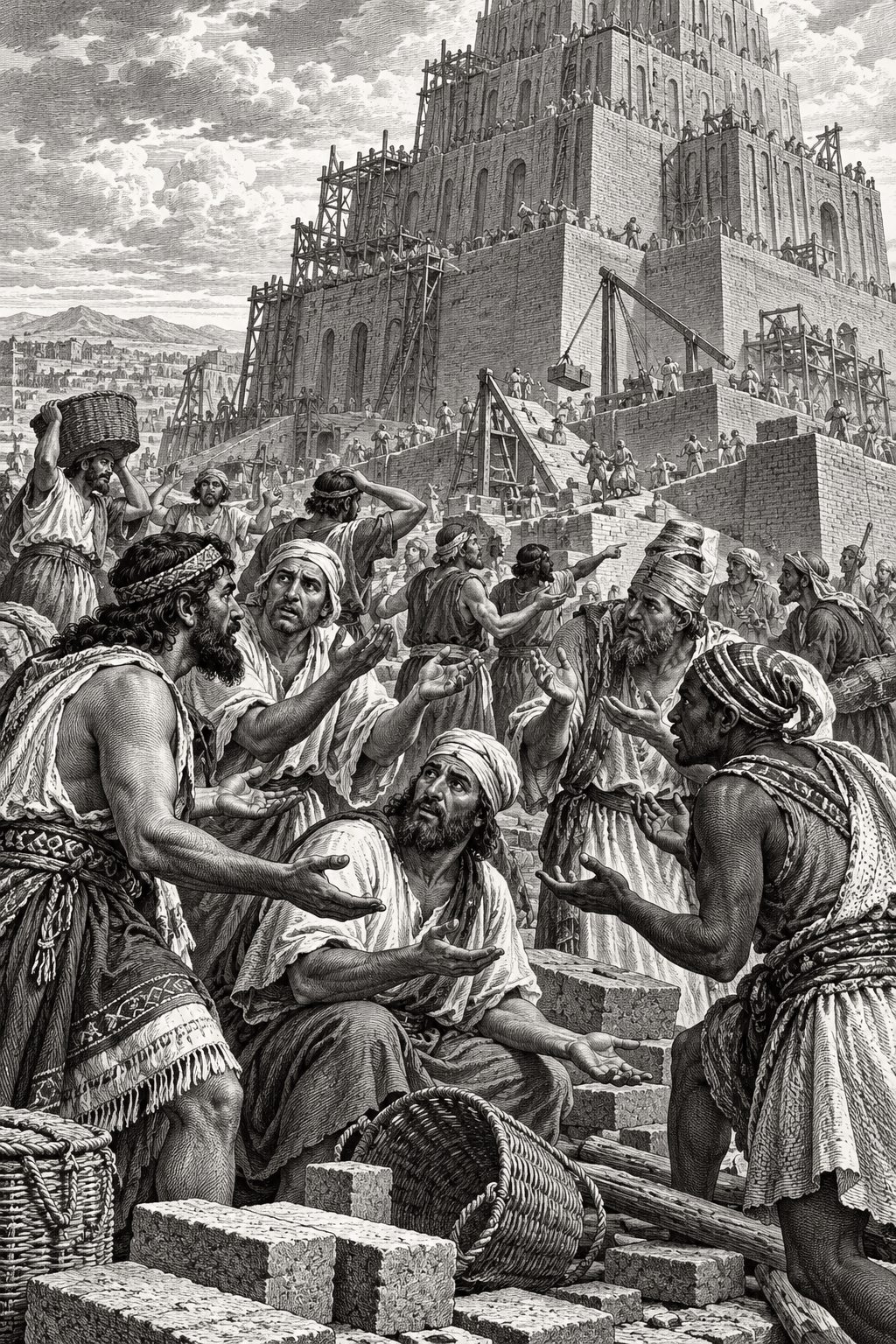
For this reason, the unity of outward language had to collapse after the unity of inward language had collapsed. What happened following the attempt to build the Tower of Babel was, as it were, a natural outcome and a revelation of humanity’s inner depths: humanity had lost its one tongue and one language. In other words, the confusion of tongues came to expose the confusion within. Whenever people became troubled by this confusion, they were to look inward first, seeking unity in the language of heart and spirit before seeking unity in the language of the outward tongue.
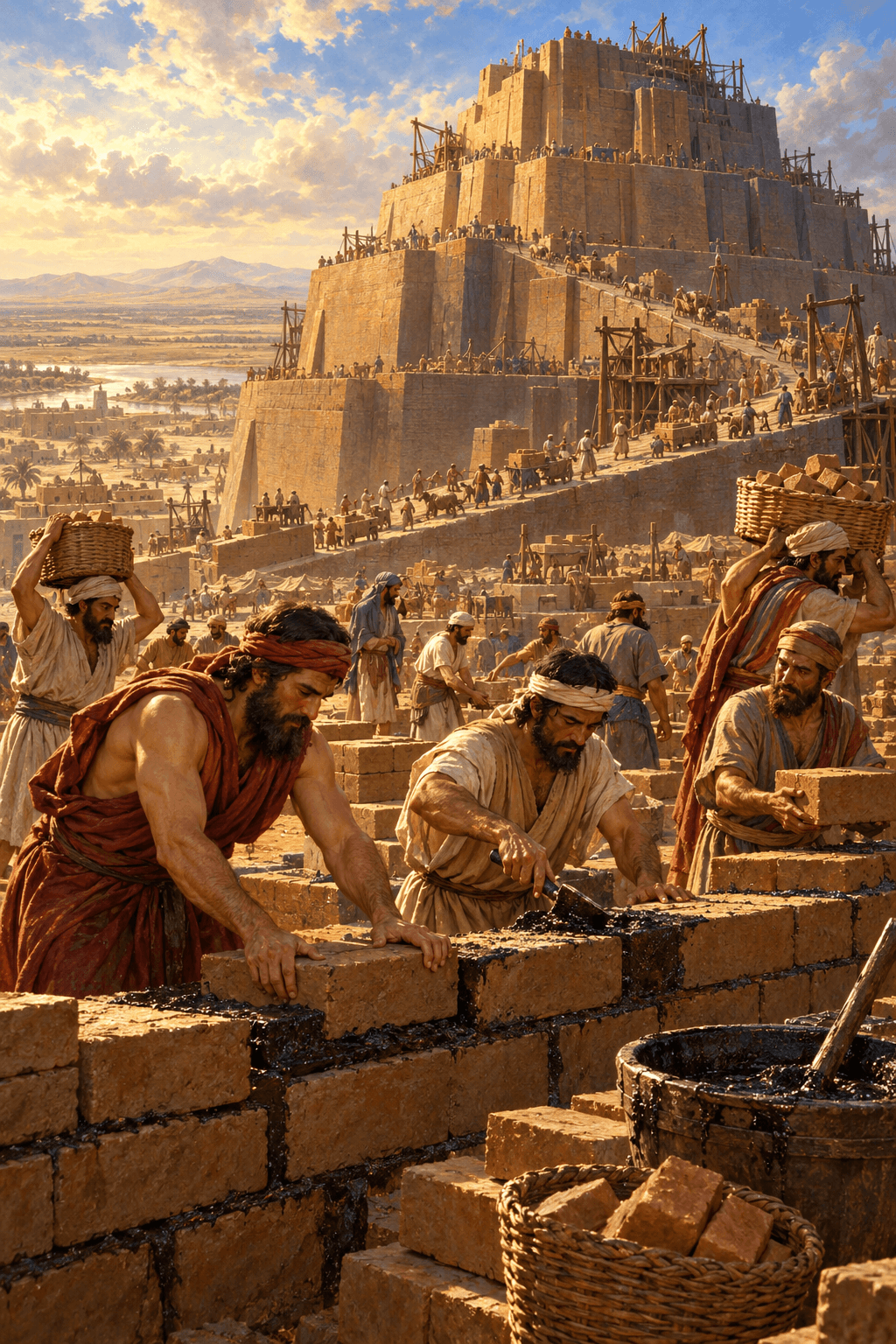
“And it came to pass, as they journeyed from the east, that they found a plain in the land of Shinar; and they dwelt there. And they said one to another, Go to, let us make brick, and burn them throughly. And they had brick for stone, and slime had they for morter. And they said, Go to, let us build us a city and a tower, whose top may reach unto heaven; and let us make us a name, lest we be scattered abroad upon the face of the whole earth” [2-4].
After the flood, when the ark had come to rest on Mount Ararat, they journeyed eastward to the plain of Shinar, the plain of the Tigris and Euphrates, southeast of the mountain. On the plain they found a climate suitable for making red bricks, firing them after drying them in the sun, as is still done in Egypt. The slime they used was a kind of mineral bitumen, called pitch when it solidifies, which is abundant in the Euphrates region.
Their human plan was to establish a city and a high tower so that, if another flood came, they would find refuge from God’s severe chastisements. As was said of the Canaanite cities, they were “great and walled up to heaven” (Deuteronomy 1:28). The evil did not lie in establishing the city itself or in wanting to build a lofty tower, but in the purpose of their undertaking: “let us make us a name, lest we be scattered abroad upon the face of the whole earth.” It was as though they did not trust God’s covenant with their father Noah and considered Him unfaithful to His promises. Moreover, instead of thinking this way, they ought to have returned to God in love, finding in Him their heavenly city and a true stronghold. Through Him they would receive a name, not only upon the face of the earth but even in heaven!
In wishing to build an earthly city to protect them from God’s wrath, they rejected the heavenly city, whose very essence is to cast oneself into the embrace of the heavenly Father. Saint Augustine considers Nimrod the founder of this city, which was called Babel (Genesis 10:9-10). He says:
““Babel” means confusion or disorder. It belonged to Nimrod the giant, its founder, as was indicated earlier. When Scripture spoke of him, it said that the beginning of his kingdom was Babel (Genesis 10:10). Babel held authority over the other cities as the capital or royal seat, although it had not yet reached the dimensions planned for it by the pride and wickedness of its founder. The plan was for its buildings to rise to heaven, whether this meant one tower higher than the other buildings or all the towers being built in this way, just as we speak in the singular of “the soldier” while meaning the whole army. But what did these presumptuous, self-exalting people intend? How did they suppose that they could raise a work against God by building it above all the mountains and the clouds spread through the air? What spiritual or material exaltation can harm God? The true, safe way to heaven is built through humility, which lifts the heart to the Lord, not against Him, as was said of this giant: “He was a mighty hunter before the LORD” (Genesis 10:9). Some have misunderstood this expression because of the ambiguity of the Greek word, which was translated “before the Lord” rather than “against the Lord,” although it can bear both meanings. In the Psalm it is used in the sense of “before”: “let us kneel before the LORD our maker” (Psalm 95:6); and in Job in the sense of “against”: “That thou turnest thy spirit against God” (Job 15:13). Here, therefore, the hunter is understood as being “against the Lord.” What does “hunter” mean but a deceiver, an adversary, and a destroyer of the earth’s animals? He and his people erected this tower against the Lord, expressing their wicked pride. God justly punished their wickedness, even though their plan had not succeeded. But what was the nature of the punishment that overtook them? Since the tongue was the instrument of dominion, punishment fell upon it, so that the person who would not understand God as He gave His commandments should himself become unintelligible when giving orders. [222]”
Through pride, humanity lost its universal unity. As Saint Augustine says:
“Through the proud, tongues were divided; through the humble apostles, tongues were united. [223]”
Through pride, humanity also lost its inward unity. In its pride it failed to understand God’s language, which is full of love. The result was that the body did not understand the language of the spirit, and the spirit came to have a language opposed to that of the body. As the Apostle Paul says concerning the person who is outside the sphere of the Holy Spirit, the Giver of unity: “For the flesh lusteth against the Spirit, and the Spirit against the flesh: and these are contrary the one to the other: so that ye cannot do the things that ye would” (Galatians 5:17).
Concerning Scripture’s words, “And the LORD came down to see the city and the tower, which the children of men builded” [5], Saint Augustine comments that those who built were children of men:
“They were not children of God; rather, this community lived in a human manner, and we call it an “earthly city.” [224]”
As for the words “the LORD came down to see,” these are not to be understood literally:
“God is wholly present everywhere and does not move from one place to another. He is said to come down when He does something unusual on earth, as though His presence thereby becomes perceptible. Likewise, “to see” does not mean that He learns something new, since it is impossible for God to be ignorant of anything. Rather, He is said to see and to know in the sense that He causes something to be seen and known. [225]”
As we have said before, in His love God speaks to us in our human language so that we may understand His purposes and mysteries as far as we can bear. He condescends and communicates with us in the language we can comprehend.
Saint Augustine also understands God’s descent as taking place through the descent of the angels to us, since they are His dwelling place and fellow workers with God (1 Corinthians 3:9). [226]
2. The Descendants of Shem
Genesis 11:10-26
10 These are the generations of Shem: Shem was an hundred years old, and begat Arphaxad two years after the flood: 11 And Shem lived after he begat Arphaxad five hundred years, and begat sons and daughters. 12 And Arphaxad lived five and thirty years, and begat Salah: 13 And Arphaxad lived after he begat Salah four hundred and three years, and begat sons and daughters. 14 And Salah lived thirty years, and begat Eber: 15 And Salah lived after he begat Eber four hundred and three years, and begat sons and daughters. 16 And Eber lived four and thirty years, and begat Peleg: 17 And Eber lived after he begat Peleg four hundred and thirty years, and begat sons and daughters. 18 And Peleg lived thirty years, and begat Reu: 19 And Peleg lived after he begat Reu two hundred and nine years, and begat sons and daughters. 20 And Reu lived two and thirty years, and begat Serug: 21 And Reu lived after he begat Serug two hundred and seven years, and begat sons and daughters. 22 And Serug lived thirty years, and begat Nahor: 23 And Serug lived after he begat Nahor two hundred years, and begat sons and daughters. 24 And Nahor lived nine and twenty years, and begat Terah: 25 And Nahor lived after he begat Terah an hundred and nineteen years, and begat sons and daughters. 26 And Terah lived seventy years, and begat Abram, Nahor, and Haran.
Saint Augustine explains why Shem’s descendants are listed immediately after the account of the flood and the establishment of Babel. Just as from Ham’s descendants came the one who established Babel, a symbol of the earthly city, so from Shem’s descendants came the one who would establish the city of God. He says:
“It was necessary to preserve the succession of generations descending from Shem in order to reveal the city of God after the flood, just as the generations descending from Shem before the flood had already been presented. Now that Scripture has revealed the earthly city, Babel, that is, confusion or disorder, it returns to the patriarch Shem to summarize the generations descending from him to Abraham, specifying each father’s age when he begot the son named in the succession and the total years of his life. [227]”
Saint Augustine holds that the whole world spoke one language, which was later called Hebrew, and that in the days of Peleg the earth was divided (Genesis 10:25), so that other languages appeared alongside Hebrew. The line connecting Shem with Abraham continued to speak Hebrew, while the other branches turned to other languages. These are the people of whom it is said, “and begat sons and daughters” [17, 19, 21, 23, 25]. Each father thus begot a son who received the inheritance, the hope in God’s promise, and the language, while the remaining sons and daughters walked in another spirit and spoke a language different from their father’s. [228]
3. Abram and Lot
Genesis 11:27-32
27 Now these are the generations of Terah: Terah begat Abram, Nahor, and Haran; and Haran begat Lot. 28 And Haran died before his father Terah in the land of his nativity, in Ur of the Chaldees. 29 And Abram and Nahor took them wives: the name of Abram’s wife was Sarai; and the name of Nahor’s wife, Milcah, the daughter of Haran, the father of Milcah, and the father of Iscah. 30 But Sarai was barren; she had no child. 31 And Terah took Abram his son, and Lot the son of Haran his son’s son, and Sarai his daughter in law, his son Abram’s wife; and they went forth with them from Ur of the Chaldees, to go into the land of Canaan; and they came unto Haran, and dwelt there. 32 And the days of Terah were two hundred and five years: and Terah died in Haran.
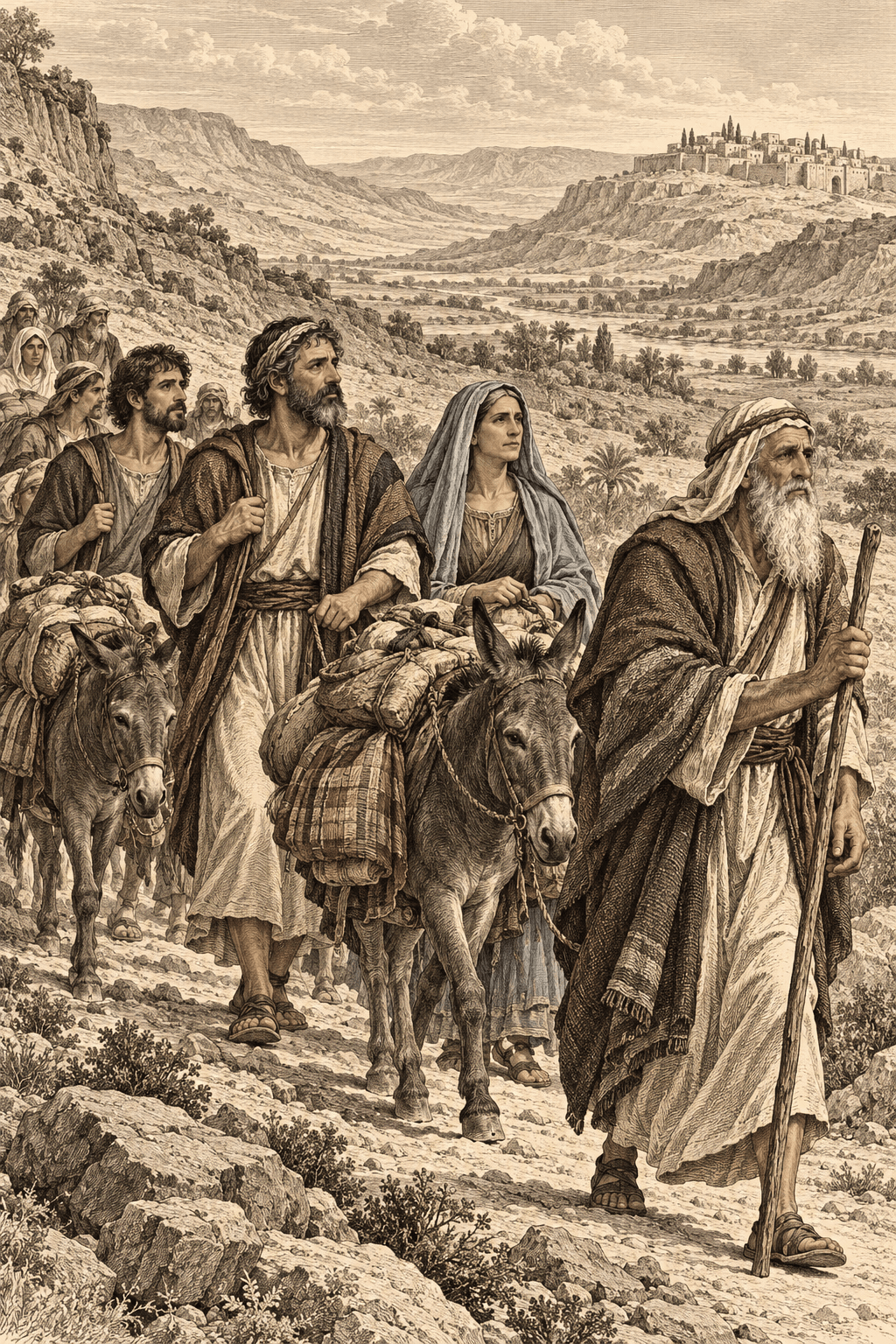
After tracing Shem’s descendants, the account reaches Abraham and his nephew Lot, who lived in Ur of the Chaldees. With Abraham’s appearance, the father of the patriarchs emerges to receive a promise and a covenant from God: through his offspring the nations would be blessed. The following chapters speak of this.
Abraham appeared in Ur of the Chaldees, and it seems that his family also worshiped foreign gods. In the whole world there was no one worshiping the living God except Abraham, for it is said: “Your fathers dwelt on the other side of the flood in old time, even Terah, the father of Abraham, and the father of Nachor: and they served other gods. And I took your father Abraham from the other side of the flood, and led him throughout all the land of Canaan, and multiplied his seed, and gave him Isaac” (Joshua 24:2-3).
As for the migration of Abraham, Sarah, and Lot with Nahor to Haran [31], we shall leave its discussion to the following chapter, God willing.
Notes and References
[221] Archdeacon Naguib Girgis, The Book of Genesis, 1973, pp. 181-182.
[222] City of God 16:4.
[223] On Psalm 55.
[224] City of God 16:5.
[225] Ibid.
[226] Ibid.
[227] Ibid. 16:10.
[228] Ibid. 16:11.