
RUTH IN THE FIELD OF BOAZ
Having come to Bethlehem in the company of Naomi, Ruth entered into the field of Boaz, to glean the fallen heads of grain; as though she represents the congregation of the Gentiles who entered into faith and received the membership of the church (Bethlehem), even though spiritually attached to the law (Naomi) ……….. Yet she did not come slothful, but entered into the field of the Lord Christ (the true Boaz), at the end of time, to glean what the fathers and the prophets have previous labored in.
1. Boaz, a mighty man of valor 1
2. Ruth in Boaz’ field 2 ‐ 7
3. A friendly conversation in the field 8 ‐ 16
4. Ruth in Naomi’s house 17 – 23
1. BOAZ, A MIGHTY MAN OF VALOR:
“There was a relative of Naomi’s husband a man of great wealth (A mighty man of valor) of the family of Elimelech. His name was Boaz” (1)
As Ruth came to Bethlehem, a man called ‘Boaz’ appeared as her relative. It is as though a believer who enters into the membership of the church (Bethlehem), to find the Lord Himself as his relative; for in Him he gets sonship of the heavenly Father through the water of baptism. According to St. Jacob Al‐Serougi:[Baptism is the womb that gives birth daily to beloved children, and sanctifies them to become brothers of the only‐begotten Son ………. Come, O you far off, and become near; for the house of God is open before all who come to it].
He is called ‘Boaz’ meaning (one of great wealth and power), or (Jehovah is wealth or power). In Christ Jesus we perceive that God is our wealth and power, we carry Him in us to lift us from the humility of the pit, up to the power and the glory of the heavenly life.
He is also called “a mighty man of valor”, which means, not only mighty in war, but one of authority and awe. The Lord Christ is “A Mighty Man of Valor”, not in the sense of acting violently and cruelly against men; but to grant the frail soul a support in Him; to lift her up above affliction and suffering, and to grant her the life of conquest. According to the apostle Paul: “Now, thanks be to God who always leads us in triumph in Christ, and through us diffuses the fragrance of His knowledge in every place” (2 Corinthians 2: 14). And according to the scholar Origen: [As long as the Savior is the righteousness, the truth, and the holiness ……. And He is the endurance as well; it is not possible for anyone to become righteous or a saint without Him; and no one can endure labors without Him].
2. RUTH IN BOAZ’ FIELD:
“So Ruth the Moabite said to Naomi, ‘Please let me go to the field, and glean heads of grain after him, in whose sight I may find favor. And she said to her, ‘Go, my daughter’” (2)
According to the statute, the heads of grain fallen after the reapers, should be left to the stranger and the poor (Deuteronomy 24: 19‐22; Leviticus 19: 9, 10; 23: 22). Ruth a young woman of foreign race asked her mother‐in‐law to allow her to do such a work. She was always ready to do any work, and not to get any rest doing it, as testified by the reapers to Boaz, saying: “She continued to work from morning until now, she rarely rested in the house” (7).. She came early in the morning, and neither rest nor slothfulness had a place in her.
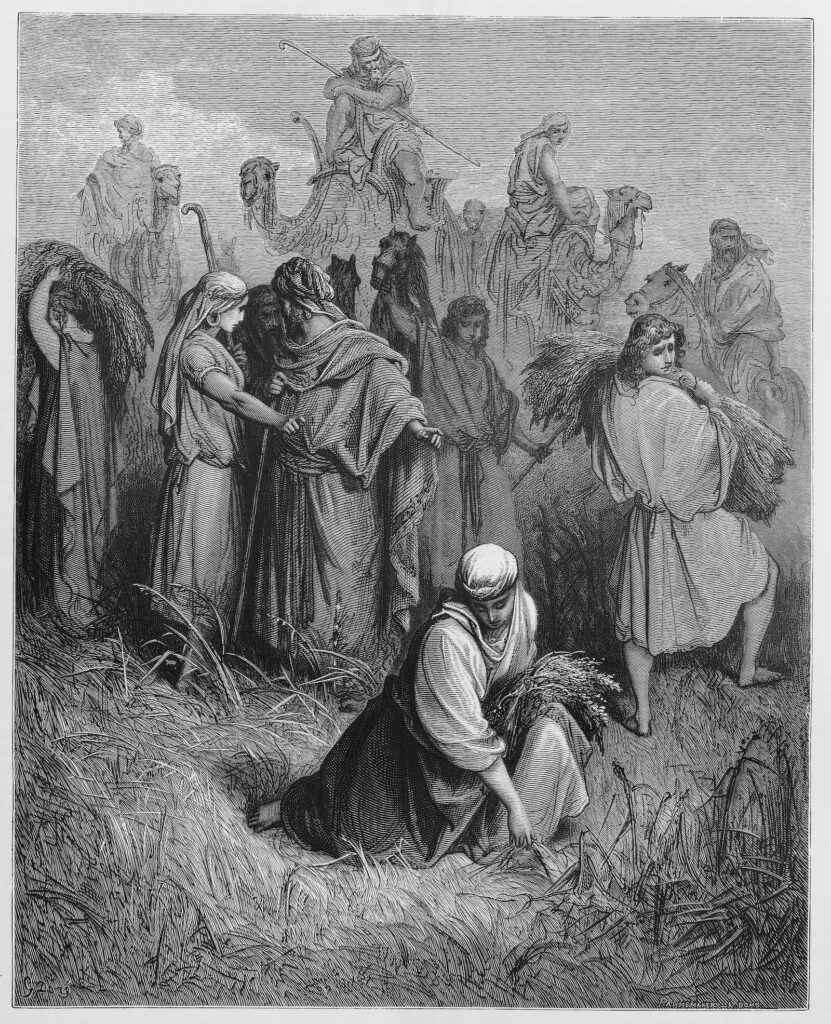
Ruth represented the congregation of the Gentiles, who spiritually received the law (Naomi); yet, at the same time, while those of the law (Naomi) stayed at home, doing nothing, they set forth to the field of the true Boaz after the reapers, to gather every fallen head of grain to the account of Christ. Even though she did not plow the land, nor sowed the seeds, yet she came to reap the harvest, in which the early fathers and the prophets labored in the old; according to the Words of the Lord to His disciples: “I sent you to reap that for which you have not labored; others have labored, and you have entered into their labors” (John 4: 38).
Ruth was not a spoiled woman, but a striving one who has forsaken the easy life in Moab among her family and her gods; and came to work hard in Boaz’ field in Bethlehem, the land of Judah, from morning until evening without rest ……. Came to gather from the harvest in which others labored to sow before her.
Through her strife, she was worthy of Boaz inquiring about her identity from the reapers, saying: “Whose young woman is this?” (5). He did not say: “Who is this young woman?”, but said: “Whose young woman is this?”. For, in the East, it was the custom for every girl or woman to belong to a certain man, as a wife, daughter, or a maidservant. Not knowing whose this woman was, the reapers said: “It is the young Moabite woman who came back with Naomi from the country of Moab” (6) . This is the case of the church of the Gentiles that has forsaken her old father, and came to Judah without a man ………. , of foreign race, and in need of a groom to embrace her and to refer her to himself.
Ruth lived together with Naomi, as though spiritually with the law; yet without a man, anticipating Christ Jesus as her Groom, listening to the divine saying: “Listen, O daughter; consider and incline your ear; forget your own people also, and your father’s house. So the king will desire your beauty; Because He is Your Lord, worship Him” (Psalm 45: 10, 11). She rejected her whole past, her past experience, and her past belonging to the devil, to receive the heavenly Groom. As according to St. Augustine: [The Gentiles came from their father the devil denying their son-hood to him]; ……….. and also according to him:[Your God is your King; and your King is your Groom as well]. You are betrothed to your King, your God, to Him you are married, and by Him you are adorned, saved, and healed. Everything you have of what make Him glad, are His].
3. A FRIENDLY CONVERSATION IN THE FIELD:
Having set forth to Boaz’ field, as though to the ecclesiastical work, she became worthy, not only to inquire about by the owner of the field, but to enter into a true friendly conversation with him. In his field amid the true spiritual strife, we encounter by faith, the Lord, to hear Him say to us: “You will listen, my daughter, will you not? Do not go to glean in another field, nor go from here, but stay close to my young women” (8)
He calls the soul, that belonged before to a foreign race (my daughter), asking her not to leave his field, and not to go from there, but to be always in the circle of his love to receive the kisses of his mouth (Song 1: 2), and to give her whole life to him. The sign of his company is “to stay close to his young women”; namely to have fellowship with his saints, to enjoy their spiritual experience, to follow their lead, and to have with them a bond of love. He says to her: “If you do not know, O fairest among women, Follow in the footsteps of the flock” (Song 1: 8).
Asking her to stay close to his young women who follow the reapers to tie the sheaves ,namely to change her status from a needy stranger to a worker in the field, like a daughter of the owner, or one of his relatives; he says to her: “Let your eyes be on the field which they reap, and go after them. Have I not commanded the young men not to touch you? And when you are thirsty go to the vessels and drink from what the young men have drawn” (9)
He seeks from her to let her eyes be on the field, as though her own; and commanded his young men not to touch her; and perceiving that, with her strife and labor, she would be in need water to drink, he asked her to go to the vessel and drink from what the young men have drawn.
What is this vessel that bears water to the thirsty during their strife, but the living church, which has in her midst the Lord Jesus Christ, the Fountain of living water, who says: “If anyone thirsts, let him come to Me and drink” (John 7: 37); “The water that I shall give him, will become in him a fountain of water springing up into everlasting life”. The Lord Christ pours His Holy Spirit on the world through His church, to satisfy every soul that receives Him, and to grant her the everlasting life.
Before such overflowing love, having presented to her the life‐giving water, “Ruth fell on her face; bowed down to the ground, and said to him: ’Why have I found favor in your eyes, that you should take notice of me, since I am a foreigner?’” (10). ………….. The gift of the Holy Spirit poured by the Lord Christ through His church, grants the spirit of humility to the human soul, to bow down to the ground, in appreciation of His favor, and as a sign of her thanksgiving which she feels she does not deserve..
Ruth’s admission with humility that, being a foreigner, she is not worthy of such generosity, increased her beauty in Boaz’ eyes. He answered her: “It has been fully reported to me, all you have done for your mother‐in‐law since the death of your husband, and how you have left your father and your mother and the land of your birth, and have come to a people whom you did not know before” (11).
Having shown humility before him, he acknowledges her love, and how she left her former father, namely the devil, her former mother, namely the evil life, in which she was raised; and the land of her birth, namely her love for the world, and got spiritually attached to Naomi, namely to the law, and came to a people she did not know before, namely to the fellowship of the heavenlies who were foreign to her; but now, having borne the heavenly nature, she entered into their fellowship.
Boaz ended his talk to her by saying: “The Lord repay your work, and a full reward be given you by the Lord God of Israel, under whose wings you have come for refuge” (12). ………….. Having left her land, her people, and her father’s household, and come to have refuge in the living God, to let Him be her Father, riches, and everything for her; she became worthy of enjoying a full reward. She bore the practical faith of Abraham, he who left Haran and set forth, led by the divine care toward Canaan, to hear the divine voice, saying: “Do not be afraid, Abram, I am your shield, your reward is exceedingly great” (Genesis 15: 1). What is this exceedingly great reward for Abram, or the full reward for Ruth, but the enjoyment of the true Boaz, to have Him a Groom of their soul, to get united with Him, and attached to His heavenly church forever.
Before that great gift, Ruth was so crushed in her depth, to say humbly to Boaz: “Let me find favor in your sight my Lord, for you have comforted me, and have spoken kindly to your maidservant, though I am not like one of your maidservants” (12). ……… As our Boaz embraces us a bride united to Him, and members in His holy body; it is befitting of us to present our whole life as a sacrifice of thanksgiving, perceiving how He comforted our hearts, and lifted us, who are unworthy to be counted as his wage laborers or servants.
As a sign of His union with her, God sought from her to partake of His heavenly food and His eternal drink, to sit together with His angels (the reapers), to get satisfied and keep some back. ……… Boaz said to her: “At meal time, come here and eat of the bread, and dip your piece of bread in the vinegar; so she sat beside the reapers, and he passed parched grain to her, and she ate and was satisfied, and kept some back” (14). ……… What is that meal time but the great Thursday of the covenant, in which the church came, not to eat bread from His hands, but His Holy Body; and not to dip her piece of bread in vinegar, but to enjoy His precious blood. By that she sat, not beside earthly reapers but beside the angels, reapers of heaven who anticipate the ultimate day of harvest, to come together with the Great Judge on the clouds to reap the holy souls to the account of His kingdom, for all to live as one heavenly church, to praise the Redeemer forever.
This heavenly bread which we enjoy, supports us to work in His vineyard, so as not to fail along the way. He grants us His holy body and blood to enjoy His life in us, working in His harvest. Boaz commands His young men: “Let her glean, even among the sheaves, and do not reproach her. Also let grain from the bundles fall purposely for her, leave it that she may glean, and do not rebuke her” (15, 16).
In short, we may say that the friendly conversation that took place between Boaz and Ruth revealed the exalted love of the Lord Christ for His bride, whom He called His daughter, asked her to stay in His field, as though her own, and to stay close to His young women, as though her sisters; to eat His holy body and to drink His precious blood; He granted her Himself as a full wage to bring gladness to her heart. In turn, she paid this exalted love, back with humility, and feeling unworthiness of those divine graces.
4. RUTH IN NAOMI’S HOUSE:
“So she gleaned in the field until evening, and beat out what she had gleaned, and it was about an ephah of barley. Then she took it up and went into the city, and her mother‐in‐law saw what she had gleaned. So she brought out and gave to her what she had kept back after she had been satisfied” (16, 17).
After a long day of work from morning until evening, without giving rest to her body, Ruth gathered an abundance of fallen sheaves, beat them with a rod to separate the grains from the straw, then set forth to the city to give to her mother‐in‐law about an ephah of barley, to cover their need for five days. But, above all, it has been a happy day in which she encountered Boaz, and enjoyed his friendly talk and gentle deeds.
It is a living portrait of the striving soul all the days of her sojourn, not giving rest to the body; but what truly gives her joy is her encounter in the midst of work, with her Groom, getting to know Him, and listening to His words, and receiving His divine graces. ……..Here, at the end of the day, it is befitting of her to beat what she strived to glean with the rod of the cross to separate the good grains from the worthless straw that is fit to burn with fire; then to set forth with her spiritual harvest to her inner heart, as though to the city, to present to Naomi, namely to the commandment or the divine statute, to sit together to give an accounts of her long day; and to glorify God working in her.
What brought gladness to the heart of Naomi, was not the ephah of barley brought back by Ruth at the end of the day after being satisfied, as much as what she noticed on her face of signs of joy and gladness of heart; which Naomi perceived as blessing she has got; hence she said to her: “Where have you gleaned today? And where did you work? Blessed be the one who took notice of you” (19). Seeing on Ruth no signs of intense exhaustion, nor of grumbling or complaint, but a spirit of joy, Naomi said to her: “Blessed be he of the Lord, who has not forsaken His kindness to the living and the dead’, ‘This man is a relation of ours, one of our close relatives’” (20)
Who is Boaz in whom the blessing of the Lord is proclaimed to the living and to the dead. Who is counted as a relation of ours, our closest relatives, but the Person of the Lord Christ, in whom all were blessed, the dead set forth from hell to paradise; and the living come to be filled with hope in Him. He who bonded with us, and bore our nature, as our firstborn Brother; came forward as our closest second Relative, after the Law, our first closest relative grew old, and came to be unable to satisfy us.
Naomi’s advice (the law) to Ruth confirms that of Boaz, which was to stay close to his young women; As though the law we have spiritually received, confirms what the Lord Christ presents to us, to stay close to His saints, and to live together with them as one church, holy in Him.
The Holy Book says: “So she stayed close to the young women of Boaz to glean until the end of the barley harvest and wheat harvest, and she dwelt with her mother‐in‐law” (23).
It is befitting of us, therefore to dwell together with the spiritual law, in which we enjoy the Lord Christ, not through the deadly letter and the dry text, but through the living spirit; and, in our strife on earth, to stay close to the young women of Boaz, namely to the wise virgins in the unity of the practical faith, the unity of the spirit and work, until the end of the harvest of the old covenant (the barley); and even until the end of the harvest of the new covenant (the wheat), for all of us to encounter the true Boaz on the clouds as the Groom of the catholic (the collective) church.